


145,99 €
Mehr erfahren.
- Herausgeber: John Wiley & Sons
- Kategorie: Fachliteratur
- Sprache: Englisch
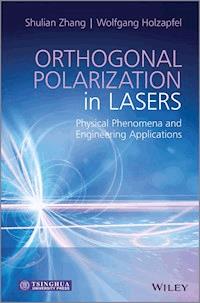
Lasers generally emit radiation, which is either simply linearly polarized or unpolarized and stochastically polarized. Contrary to these common lasers, all orthogonally polarized lasers simultaneously emit radiation in two linear polarization states, both exactly orthogonally oriented to each other. Due to this orthogonality, both polarized components in the beam are independent of each other to a high degree and the studies presented in this book make clear that this feature can give a strong advantage in certain laser applications, for instance in high-precision measurements. Orthogonal Polarization in Lasers: Physical Phenomena and Engineering Applications summarizes the basics and advanced research results of orthogonally polarized lasers, birefringence laser cavities, and their applications. The authors include a number of figures, experimental designs, and measurement curves to enable the reader to not only learn the basic principles and technologies but also to understand many applications in modern engineering and to start their own R&D projects. The book covers polarization effects, which are of fundamental importance across various disciplines of science and technology. * Includes a number of figures, experimental designs, and measurement curves to help readers learn the basic principles and start their own R&D projects. * Discusses many types of relevant lasers (helium/neon lasers, ND:YAG lasers, semiconductor lasers, laser diodes). * Written by multiply-published authors in the subject area. * Contains material useful for metrology applications. This book is intended for use by researchers, postgraduates, and engineers working in laser science, optics, and measurement and testing, while senior undergraduate students working in optical and laser science can use the book for advanced understanding in their field.
Sie lesen das E-Book in den Legimi-Apps auf:
Seitenzahl: 830
Veröffentlichungsjahr: 2013
Ähnliche



















Contents
Cover
Title Page
Copyright Page
Dedication
Foreword
Foreword
Preface
Introduction
Part One: Fundamentals of Lasers and Beam Polarizations
Chapter 1: Rigorous Introduction to Lasers and Beam Polarizations [1-7]
1.1 The Basic Amplifier/Cavity Configuration
1.2 Optical Waves of a Laser
1.3 Cavity Closed-Loop and Laser Threshold
1.4 Survey of Techniques for Generating and Converting Laser Polarization States
References
Chapter 2: Basic Physical Effects Inside Lasers [1-10]
2.1 Interaction between Light and Particles
2.2 Line Shape Function and the Line Broadening Mechanism
2.3 Gain Coefficient of Light in an Active Medium
2.4 Saturation of Gain in the Laser Active Medium
2.5 Threshold Condition, Gain for Stationary Operation, and Lasing Bandwidth
2.6 Optical Cavities and Laser Modes
2.7 Laser Mode Competition
2.8 Mode Push/Pull and Locking Effects
2.9 Power Tuning Properties of Lasers
References
Chapter 3: Specific Laser Technologies Applicable for Orthogonally Polarized Beam Generation
3.1 Background
3.2 He–Ne lasers [1, 2]
3.3 Carbon Dioxide (CO2) Laser and Its Polarization States [1, 2]
3.4 Optically Pumped Nd: YAG Lasers (1.06 μm) [1–11]
3.5 Semiconductor Lasers [10–13]
3.6 Fiber Lasers [15–24]
3.7 Conclusions on Relevant Orthogonally Polarized Laser Technologies
References
Part Two: Generation of Orthogonal Laser Polarizations
Chapter 4: Zeeman Dual-Frequency Lasers and Multifrequency Ring Lasers – Orthogonally Polarized Lasers in Tradition
4.1 Introduction
4.2 Zeeman Dual-Frequency Lasers [1, 2]
4.3 Multifrequency Ring Laser [4–11]
References
Chapter 5: Matrix Theory of Anisotropic Laser Cavities – A Further Approach to Orthogonally Polarized Dual-Frequency Lasers [1–10]
5.1 Background
5.2 Polarization-Dependent Properties of Optical Materials
5.3 Introduction to the Jones Formalism
5.4 Mathematical Description of Polarized Light by the Jones Vectors
5.5 Transfer Matrixes of Retarders, Rotators, and Polarizers
5.6 Serial Connections of Anisotropic Elements and the Jones Theorem
5.7 Connection of Different Retardations within the Same Anisotropic Element [5, 6]
5.8 Calculation of Eigenpolarizations and Eigenfrequencies of Passive Anisotropic Cavities [4–10]
5.9 Conclusions
References
Chapter 6: Orthogonal Polarization and Frequency Splitting in Birefringent Laser Cavities
6.1 Laser Frequency Splitting Due to Intracavity Birefringence [1–6]
6.2 Laser Frequency Splitting Caused by Intracavity Quartz Crystals [2, 4, 7–12]
6.3 Laser Frequency Splitting Caused by Intracavity Electro-optic Crystals [8, 22–24]
6.4 Induced Stress Birefringence and Laser Frequency Splitting [20, 25, 26]
6.5 Frequency Splitting in Semiconductor Lasers
6.6 Frequency Splitting in Fiber Lasers
6.7 Observation and Readout of Frequency Splitting
6.8 Final Remark on Methods Used to Obtain Small and Also Larger Frequency Differences
References
Chapter 7: Design of Orthogonally Polarized Lasers
7.1 Background
7.2 Quartz Birefringence He–Ne Laser [4–9]
7.3 Stress-Induced Birefringence He–Ne Laser [10–15]
7.4 Equidistant Frequency Split Ultrashort He–Ne Laser [16]
7.5 Zeeman Birefringence Dual-Frequency He–Ne Laser [15, 17–23]
7.6 He–Ne Laser with Two Intracavity Birefringence Elements [18]
7.7 Orthogonally Polarized Lasers with a Superposition Layer Birefringence Film [24, 25]
7.8 Laser Diode Pumped Birefringent Nd:YAG Laser with Tunable Frequency Difference [27, 28]
7.9 Orthogonally Polarized Lasers with Electrically Controllable Frequency Differences [30]
References
Part Three: Nonlinear Behavior of Orthogonally Polarized Lasers
Chapter 8: Competition and Flipping Phenomena in Orthogonally Polarized Lasers
8.1 Intensity Tuning, Mode Competition, and Frequency Difference Tuning in Dual-Frequency Lasers
8.2 Properties of Intensity Tuning and Frequency Difference Tuning in Birefringent Zeeman Lasers [8, 14, 15]
8.3 Polarization Properties Caused by Optical Activity of an Intracavity Quartz Crystal [16–20]
8.4 Effect of Optical Activity in the Frequency Difference [21]
8.5 Polarization Flipping and Optical Hysteresis in Birefringent Lasers [22–25]
References
Chapter 9: Optical Feedback Effects in Orthogonally Polarized Lasers
9.1 General Concept of Laser Feedback
9.2 Optical Feedback for Birefringent He–Ne Lasers
9.3 Optical Feedback of Birefringence Zeeman Lasers
9.4 Optical Feedback with an Orthogonally Polarized External Cavity
9.5 Narrow Feedback Fringes of Birefringent Dual-Frequency Lasers
9.6 Optical Feedback of a Microchip Nd:YAG Laser with Birefringence
9.7 Conclusions on the Feedback in Orthogonally Polarized Lasers
References
Chapter 10: Semi-classical Theory of Orthogonally Polarized Lasers
10.1 Modeling of Orthogonally Polarized Lasers
10.2 Theoretical Analysis of Orthogonally Polarized Lasers [7, 8]
10.3 Analysis of Optical Feedback Phenomena in Birefringent Lasers [12, 13]
References
Part Four: Applications of Orthogonally Polarized Lasers
Chapter 11: Introduction and Background of Applications
11.1 Survey of the Application Potential
11.2 What Is the Particularity of OPDF Laser Measurements?
References
Chapter 12: Measurements of Optical Anisotropies by Orthogonally Polarized Lasers
12.1 Phase Retardation Measurement of Wave Plates by Laser Frequency Splitting [5–12]
12.2 Phase Retardation Measurements of Optical Components Based on Laser Feedback and Polarization Flipping [23–26]
12.3 Intracavity Transmission Ellipsometry for Optically Anisotropic Components
References
Chapter 13: Displacement Measurement by Orthogonally Polarized Lasers
13.1 Background and Basic Considerations
13.2 Zeeman OPDF Laser Interferometer
13.3 Displacement Measurement Based on Cavity Tuning of Orthogonal Polarized Lasers – OPMC Displacement Transducers
13.4 Displacement Measurement Based on Feedback of Orthogonally Polarized Lasers [31–34]
13.5 Displacement Measurement Based on Feedback of the BZ-Laser
13.6 Displacement Measurement Based on Orthogonally Polarized Feedback of Nd:YAG Lasers [18, 35–38]
13.7 Microchip Nd:YAG Laser Interferometers with Quasi-Common-Path Feedback [39–46]
References
Chapter 14: Force and Pressure Measurement by Means of Photoelastic Nd:YAG Lasers
14.1 Principle and Experimental Setup of Force and Pressure Measurement [2–16]
14.2 Force Measurement: Experimental Results [2, 3, 9, 10, 12–16, 26]
14.3 Pressure Measurement: Experimental Results [17, 18]
14.4 Advanced Studies in Force to Frequency Conversion [2, 8, 19–26]
14.5 Prospects of Laser-Based Force Measurements [19–26]
References
Chapter 15: Measurements via Translation/ Rotation of Intracavity Quartz Crystals
15.1 Displacement Measurement by Means of an Intracavity Quartz Crystal Wedge [1, 2]
15.2 Measurement of Earth's Gravity by Means of an Intracavity Quartz Crystal Wedge [3]
15.3 Vibration Measurement by Means of an Intracavity Quartz Crystal Wedge [4]
15.4 Measuring Rotation Angles by Means of an Intracavity Quartz Crystal Plate [5, 6]
References
Chapter 16: Combined Magnetometer/Rate Gyro Transducers by Four-Frequency Ring Lasers [1–5]
16.1 Principle of the Frequency Splitting Ring Laser Weak Magnetic Field Transducer [4, 5]
16.2 Experimental Arrangement
16.3 Experimental Results and Discussions
16.4 Conclusions
References
Chapter 17: Further Applications of Orthogonally Polarized Lasers
17.1 Tunable Signal Generation
17.2 Polarized Lasers in Material Processing
References
Chapter 18: Conclusions of Part Four
18.1 Phase Retardation Measurement Applications
18.2 Displacement Sensing Applications
18.3 Force, Pressure, and Acceleration Measurement Applications
Index
This edition first published 2013 © 2013 Tsinghua University Press. All rights reserved.
Published by John Wiley & Sons Singapore Pte Ltd, 1 Fusionopolis Walk, #07-01 Solaris South Tower, Singapore 138628, under exclusive license by Tsinghua University Press in all media throughout the world excluding Mainland China and excluding Simplified and Traditional Chinese languages.
For details of our global editorial offices, for customer services and for information about how to apply for permission to reuse the copyright material in this book please see our website at www.wiley.com.
All Rights Reserved. No part of this publication may be reproduced, stored in a retrieval system or transmitted, in any form or by any means, electronic, mechanical, photocopying, recording, scanning, or otherwise, except as expressly permitted by law, without either the prior written permission of the Publisher, or authorization through payment of the appropriate photocopy fee to the Copyright Clearance Center. Requests for permission should be addressed to the Publisher, John Wiley & Sons Singapore Pte Ltd, 1 Fusionopolis Walk, #07-01 Solaris South Tower, Singapore 138628, tel: 65-66438000, fax: 65-66438008, email: [email protected].
Wiley also publishes its books in a variety of electronic formats. Some content that appears in print may not be available in electronic books.
Designations used by companies to distinguish their products are often claimed as trademarks. All brand names and product names used in this book are trade names, service marks, trademarks or registered trademarks of their respective owners. The Publisher is not associated with any product or vendor mentioned in this book. This publication is designed to provide accurate and authoritative information in regard to the subject matter covered. It is sold on the understanding that the Publisher is not engaged in rendering professional services. If professional advice or other expert assistance is required, the services of a competent professional should be sought.
Limit of Liability/Disclaimer of Warranty: While the publisher and author have used their best efforts in preparing this book, they make no representations or warranties with respect to the accuracy or completeness of the contents of this book and specifically disclaim any implied warranties of merchantability or fitness for a particular purpose. It is sold on the understanding that the publisher is not engaged in rendering professional services and neither the publisher nor the author shall be liable for damages arising herefrom. If professional advice or other expert assistance is required, the services of a competent professional should be sought.
Library of Congress Cataloging-in-Publication Data
Zhang, Shulian. Orthogonal polarization in lasers: physical phenomena and engineering applications / Shulian Zhang, Tsinghua University, Wolfgang Holzapfel. pages cm Includes bibliographical references and index. ISBN 978-1-118-34649-5 (cloth) 1. Lasers. 2. Polarization (Light) I. Holzapfel, W. (Wolfgang) II. Title. QC688.Z53 2013 621.36′6–dc232013014717
To Shuyun (S.Z.)
To Gudi (W.H.)
Foreword
by Zhou Bingkun
With good grace I have followed the request to contribute a foreword for this monograph written by a Chinese–German author team. One author of this monograph, namely Shulian Zhang, has worked first as a young university lecturer with me since 1970. I know his academic career well and I am familiar with the content in this monograph. I am therefore glad to write a foreword for this book.
Professor Zhang had discussed with me his basic idea of orthogonal polarization in the early beginning of his research. His initial aim was to break through the bottleneck of Zeeman dual-frequency lasers, which outputted a less than 3 MHz frequency difference. The Zeeman dual-frequency laser has been applied as a unique light source of interferometers for several decades, which has pushed manufacturing industry greatly, including IC equipment, machine tools, automobiles, etc. The upper limit of the frequency difference less than 3 MHz comes from the physical principle of Zeeman lasers and limits the measurement speed of interferometers to 1 m/s, which limits the production efficiency of IC equipment and machine tools. How can the frequency difference in a laser be enlarged? The idea to put a quartz crystal into the standing-wave laser cavity to gain a frequency difference larger than 40 MHz had succeeded in Zhang's laboratory. That is the birefringence dual-frequency laser. In this laser the quartz crystal plate is used as the element of splitting one mode frequency into two frequencies and tuning their frequency difference. This was the beginning when Professor Zhang started to study systematically the laser frequency splitting and orthogonal polarization in lasers at Tsinghua University.
Zhang's research in the following years yielded not only development of novel birefringence Zeeman lasers with zero to hundreds of MHz frequency splitting but his team has also discovered dozens of laser phenomena and invented several kinds of instruments, which are reported in many peer-reviewed papers. At the same time a number of researchers worldwide have turned to the investigation of orthogonal polarization in lasers, broadened the laser academic space, and built a new researching domain. Meanwhile, this domain has become a new part of laser fundamentals.
Professor W. Holzapfel, the distinguished co-author of this book, is well known in the scientific community for his significant contributions in measurement science and applied optics. His research team at Kassel University, Germany, have also studied systematically orthogonal polarization phenomena in He–Ne lasers and Nd:YAG lasers since the middle of the 1980s. Research was focused on precise force to frequency conversion by photoelastic lasers. The team demonstrated first of all the enormous force measurement capability of photoelastic Nd:YAG lasers. Furthermore, the team verified very precise force measurements by photoelastic laser crystals in the time/frequency domain. Holzapfel demonstrated successfully that orthogonally polarized lasers perform extreme broadband vibration detection over many decades.
Besides healthy scientific competition the same interest joins the Chinese and German team together to cooperate successfully for a long time since 1995. Chinese and German scientists share research ideas, results, and together have also written this book. The contents of this book are from a large number of articles and patents published by researchers in France, Germany, USA, UK, Japan, Switzerland, etc., many from S. Zhang and W. Holzapfel. I think some of the reported inventions and findings would be typical samples in laser technology, and bring extensive influence on laser education to students. The monograph has much fresh content, deep theory, and experiments. The laser is often used only as the light source in many traditional laser applications, but here, in this book, the laser itself becomes the sensor, which can be used in the measurement of many physical quantities, such as optical phase retardation inside optical elements, force and pressure, displacement, vibration, angle and magnetic field, etc.
I believe the publication of this book will bring more attention to laser polarization and orthogonally polarized laser. Its theoretical analysis and experimental phenomena can deepen the understanding of general laser theory and accelerate applications of orthogonal polarization, especially in precision measurement. The book will benefit undergraduate students and graduate students significantly and help scientists and engineers to solve their problems. The publication of this monograph is an important and pleasing event for both fields of laser technology and precision measurement.
Zhou Bingkun
Professor of Tsinghua University
Academician of Chinese Academy of Sciences
President of the Optical Society of China
Beijing, July 2012
Foreword
by Konrad Herrmann
This monograph is to my knowledge the first English book covering the topic “orthogonal laser polarization”. It deals with specific physical phenomena that may appear in lasers, like
The observable polarization-dependent phenomena in lasers are really abundant and can appear in different technologies, for instance in Nd:YAG microchip lasers and semiconductor and He–Ne lasers. It is well known for practicing optical engineers that any nonbirefringent material can lose its optical isotropy and can have birefringence, which is often observed in optical components like lenses, prisms, optical fibers, and laser rods, as well as in reflective films and antireflective films on cavity mirrors or windows. This is due to unwanted stresses induced by the component housing and also by residual stresses caused by the fabrication process, for instance due to heat treating. Usually, polarization-dependent phenomena in optical systems and components are mostly evaluated as parasitic and should be eliminated as far as possible.
Contrary to these mainstream evaluations the authors of the book demonstrate that there is a surprising high potential in engineering and application of orthogonally polarized lasers. This conclusion is based on ample experimental data, which they gained with different test equipments and arrangements. The experimental results are explained by application of the Jones matrix theory and Lamb's theory. There is no doubt that polarization-dependent phenomena in lasers can be utilized for very precise, high-resolution measurement and sensing.
A large number of application examples are introduced in the monograph, including optical phase retardation measurement of optical elements, pressure and force sensing, and furthermore measurement of displacement, vibration, angle, and magnetic field, etc. The polarization-dependent laser sensors have some unique advantages due to new principles. For example, laser internal measurements of wave plate phase retardation has vanishing systematic errors, and can be performed with the highest accuracy. The laser force transducer allows combined measurements of static and high frequency dynamic forces up to high frequencies by a single microchip Nd:YAG laser. The measured forces cover the range from well below 10−7 N up to more than 10 N, that is at least nine decades of the input force. The microchip Nd:YAG laser feedback interferometer is a fully noncontact interferometer and can measure the displacement of machinery parts and liquid surfaces with 1 nm resolution.
In the context of this book the authors have collected the worldwide achievements of scientists and engineers in past decades. Also by this accumulation of knowledge, which is outside the current main streams of optical measurements, this book has proven its academic worth.
The book will stimulate scientists and engineers in research and development. To the researcher it provides a state of the art to manifold polarization effects in lasers and offers new ways in high precision measurement. Practicing engineers get valuable hints for the design and application of novel laser-based sensing instruments and optical components. The book takes a certain center position between a handbook and textbook, and can therefore also be of benefit to upper level undergraduate and postgraduate students, significantly in advanced courses dealing with optics, lasers, and measurement.
May this book find a wide acceptance between researchers, practitioners, and students of laser measurements!
Dr. Konrad Herrmann
Physikalisch-Technische Bundesanstalt (PTB)
Braunschweig, FRG
July 2012
Preface
This book deals with polarization phenomena in lasers and in particular with lasers emitting radiation in two linear polarizations states, both exactly orthogonally oriented to each other. Although lasers with these special features have been commercially available for some years (for instance internal mirrored He–Ne laser tubes, diode pumped Nd:YAG micro lasers), and numerous scientific papers report related experiments and applications, there is no summarizing book presentation in the scientific literature at present. Laser users in engineering and science are also commonly not aware of the potential advantages of orthogonally polarized lasers. In this book we will try to explain how these uncommon lasers can generate orthogonal polarizations, what their special features and advantages are, and how practicing scientists and engineers can successfully use orthogonally polarized lasers in design and applications. The state of research in this promising technique is discussed in detail. Although not written in the form of a college textbook due to its comprehensive treatment of the subject, the monograph will be useful to students. It might be used successfully in university/college courses on advanced laser technology, measurement, and optical sensing technologies and can serve as a reference book in thesis generation and research.
Contrary to orthogonally polarized lasers, the common lasers emit radiation in uncontrollable polarization states or are single linearly polarized due to utilizing special polarization elements. In many laser applications in which the power of the beam has magnitudes of primary interest polarization control must not be performed.
On the other hand, managing/controlling the polarization state of light sources has long been the tradition in optical science and engineering, for instance in polarimetry and ellipsometry. Polarization control must be performed in excess in modern optical communication systems as well as in other high-speed data transmission systems because these are generally polarization-sensitive systems and it is vital to control polarization of the applied laser diodes to obtain low bit-error rates. To get a light beam in a defined polarization state, discrete optical elements or integrated structures, polarizers, rotators, wave plates (retarders), Brewster plates, and apertures are applied. In this state of the art of laser polarization control the total beam intensity is mostly the favored magnitude of primary interest. However, scientists and engineers often need today more advanced techniques, which must allow very precise control of oscillating laser modes, that is of their individual polarization state and frequency, as well as control of the total number and power of oscillating modes. These advanced techniques are basic for applications of orthogonally polarized phenomena in lasers and we will discuss them in detail in this book.
We point out firstly that orthogonally polarized phenomena in lasers result from optical anisotropy effects in materials including optical activity and birefringence. Optical activity is inherent in several materials, such as quartz crystals, and are also used in Faraday cells. Some other crystalline materials often stressed in classic textbooks, such as calcite, quartz crystals, KD*P, and KTP, are known to have natural birefringence. Moreover, any applied material called not birefringent (i.e. optical isotropic materials) can have birefringence, such as observed in optical components like lenses, prisms, optical fibers, and laser rods made, for instance, of neodymium-doped yttrium–aluminum–garnet crystals (Nd:YAG) and neodymium-doped glasses (Nd:Glas). The same is true even for carefully manufactured laser reflective films and antireflective films on cavity mirrors or windows. This “induced” birefringence may be caused by remaining internal stresses resulting from the fabrication process or by outer mechanical stress sources. For instance, induced birefringence can very easily be introduced in lasers as long as your fingers gently pinch the laser mirrors. Hence you change the polarization state of the laser as well as inducing laser frequency splitting, which means that each mode frequency is split into two orthogonally polarized frequencies and the frequency difference changes by the force of your fingers applied to the mirror. We will explain in detail these effects in later chapters.
We will further make clear in this book that these orthogonally polarized phenomena in lasers should not be classified hastily as unwanted laser disturbances and parasitic phenomena but, based on these polarization effects very useful and precise measurements of unknown “laser input magnitudes” (measurands) can be carried out. Via specific converter effects (optical feedback, photoelasticity in the laser cavity, etc.) and an appropriate input device the measurand generates typical responses in the laser output beam. The dominant response effect is again the above-mentioned frequency splitting of excited modes, which is often accompanied by polarization state changes. These output responses can be easily detected by state-of-the-art electronics if the laser frequency and mode polarization are under control. Due to their unique intrinsic properties orthogonally polarized lasers can often be applied as virtually compensated measurement instruments, which yield high resolution and digitally pleasant frequency outputs. In some cases, by orthogonally polarized effects in lasers the measurand (for instance force, acceleration) can be detected directly as a vector magnitude, which means that its magnitude and its planar pointing direction are measured simultaneously. These features open up new ways in measurement.
Hence, worldwide, some systematic experiments, mathematical modeling, and testing of potential applications dealing with laser polarization and induced splitting of polarized modes have been carried out in the last few years. Scientists from China, France, Germany, the United States, Britain, Japan, Switzerland and other countries have published numerous papers and patents. We, the authors, hope that our monograph reflects much of the global activities in this field but we feel that we cannot be sure that there will be total completeness in our approach. We apologize therefore to any of our colleges whose publications may not be adequately cited and represented in this monograph. Furthermore, we are also aware that there may remain some bugs and imperfections in our presentation although we have tried constantly to avoid these. Hence, we are always open for any hints and critical comments from our readers.
Both authors of this book have performed long time cooperation in research and lecturing since 1995. This cooperation took place not only due to several guest professorships and research visits of Shulian Zhang to the University of Kassel and of Wolfgang Holzapfel to Tsinghua University, Beijing, but also due to permanent exchange of members, ideas, and experiences between both research teams over the past years. At first Shulian Zhang got the idea and yielded a first draft of a basic monograph dealing with orthogonal polarization effects in lasers. Later Wolfgang Holzapfel followed his friendly invitation to write this book together. By this close cooperation both authors would like to express their mutual valuation. Furthermore, both authors would like to give their respect here to the many coworkers and students who have contributed directly and indirectly to the book.
S. Zhang thanks professors, graduates, and undergraduate students in his own team at the Key State Lab of Precision Measurement Technology and Instruments at Tsinghua University for their great efforts. The team continuously studied orthogonal polarization effects in lasers over many years; that is when older students graduated and moved ahead, younger ones joined the team and continued the research. All team members did their best in cooperation, in acquiring basic material for the book manuscript, and last but not least in translation from Chinese to English. The professors who participated in these permanent studies are: Guofan Jin, Yan Li, Yanmei Han, Kelan Li, Jihua Guo, and Minxian Wu. The postdoctoral or doctoral or master's degree students are (in sequence of graduation date): Junjiang Zhang, Dating Zhou, Xiangdong Hu, Sun Yang, Yanmei Han, Yuye Jin, Mingxing Jiao, Yi Zhang, Jia Li, Wenkai He, Zhibing Deng, Yan Xiao, Juncheng Xu, Yingchun Ding, Ming Ren, Jie Fu, Lu Li, Hui Guo, Fang Xie, Chunning Huang, Jinghua Liu, Aihua Zhang, Wenhua Du, Xiaobin Zong, Xinjian Yang, Yingchao Cui, Ligang Fei, Gang Liu, Zhiguang Xu, Ming Liu, Mingming Wang, Xiaoyan Liu, Xinjun Wan, Yong Xu, Xiang Cheng, Li Zhang, Jinyun Ding, Yidong Tan, Lufei Zhou, Duo Li, Wei Mao, Weixin Liu, Liu Cui, Haohao Li, Yanxiong Niu, Matthias Dilger, Chaohui Hu, Zhou Ren, Cheng Ren, Yinan Zhang, Zhengqi Zhao, Chunxin Xu, Peng Zhang, Shoushen Zhu, Zhaoli Zeng, Song Zhang, Weiping Wang, Shijie Zhao, Jiang Li, Haisha Niu, Yongqin Zhang, Shaohui Zhang, Ling Xu, Hao Chen, and Xiaoli Li. Yuye Jin also wrote the first draft of Chapter 2, checked formulas of the first draft, and did translation work.
The following Chinese organizations have supported more than 30 projects during these studies and are gratefully acknowledged: the National Natural Science Foundation of China, the Ministry of Education, the Ministry of Science and Technology, the Beijing Natural Science Foundation, the Cao Guangbiao Foundation, the Beijing Education Committee, and Tsinghua University.
W. Holzapfel would like to thank, for excellent cooperation and for convincing scientific contributions to the research topic, his following team members: Dr.-Ing. Uwe Riss, Dr.-Ing. Walter Settgast, Dr.-Ing. habil. Ulrich Neuschaefer-Rube, Dr.-Ing. Stephan Neuschaeffer-Rube, Dr.-Ing. Chun Ye, Dr.-Ing. Manfred Kobusch, Dr.-Ing. Lijian Hou, and Dr.-Ing. Nejat Mahdavi, and furthermore for valuable assistance: Dr.-Ing. Werner Baetz, Dr.-Ing. Jan Braasch, and Dr.-Ing. Michael Hoelscher. Also the team members Dipl.-Phys. Martin Finneman, Dipl.-Phys. Wolfgang Luxem, Dipl. Phys. U. Ruedinger, Ing. grad. Horst Paul, and Dipl.-Ing. Martin Suske yielded valuable contributions to the research topic.
He also thanks for financial support the German Federal Ministry of Research and Education (former Research and Technology) and The German Research Community (Deutsche Forschungsgemeinschaft DFG), as well as the following companies: Bodenseewerk Geraetetechnik (Ueberlingen), Sartorius (Goettingen), and Honeywell (Maintal).
We also thank Professor Zhou Bingkun and Dr. Konrad Herrmann, academician members, who have written forewords for this monograph as well as Professor Gerd Jaeger, Technical University Ilmenau, FRG. Throughout our study they have often provided support to the research teams.
Shulian Zhang
Wolfgang Holzapfel
Introduction
Light beam polarization is a basic characteristic of laser radiation. This book deals with lasers emitting simultaneously two linear polarization states, both exactly orthogonally oriented to each other and consequently split in beam frequency. Although lasers with this special feature are commercial available since years and numerous scientific papers report related experiments and applications, there is no summarizing book at present. The specific advantages of orthogonally polarized lasers are not commonly aware for potential users in engineering and science.
In this monograph we explain how lasers can generate orthogonal polarizations, what their special features and advantages are and how scientists and engineers can successfully use orthogonal polarization and frequency splitting in lasers. There are 4 parts incorporating 18 chapters overall. Part I includes 3 chapters, which introduce fundamentals of lasers and beam polarizations including basic physical effects inside lasers, lasers applicable for polarization controlled beam generation, and laser polarization black box theory. Part II comprises 3 chapters, which introduce special orthogonal polarized lasers: Zeeman dual-frequency lasers, multi-frequency ring lasers, birefringence dual-frequency lasers, and matrix theory of anisotropic laser cavities. Part III contains 3 chapters discussing physical behavior of orthogonal polarization in lasers, physical phenomena revealed by cavity tuning, optical feedback effects and semi-classical theory in orthogonally polarized lasers. Part IV including 9 chapters is dealing with novel applications of orthogonal polarization in lasers, for instance high resolution displacement sensing, precise force and pressure measurements with broad dynamic range, vehicle rotational sensing and combined magnetometer/rate-gyro sensing by four-frequency ring lasers and last but not least precise measurement of phase retardation and other optical anisotropies in optical samples and systems.
This monograph offers systematic material for scientists and engineers, as well as professors, universities graduate and undergraduate students.
Part One
Fundamentals of Lasers and Beam Polarizations
The first part of the book (Chapters 1 to 3) covers “Fundamentals”. For readers not very familiar with physics and the technology of lasers and optics (but with some basic knowledge) we present in Chapters 1 and 2 short introductions to these topics. These facts are also of general interest in all the following chapters. For those already familiar with the basic material of these two chapters (and potentially also that of the third chapter) may skip these chapters. From another point of view readers can learn the laser basic knowledge through this part, which the authors tried to write in the way easy to read.
In Chapter 1 we explain the basic structure of common laser systems by using elementary black box units (amplifiers, mirrors, optical cavities, all assumed to be optically isotropic here!) and we discuss simple connections between these isotropic boxes, such as series and feedback circuitry. Here we introduce basic parameters of laser systems like gain and the amplification factor, the standing wave condition, and the self-consistent condition of laser oscillation and we describe the electrical field and its polarization states in case the system acts as steady state oscillator after threshold. Furthermore, we give a first overview on basic optical elements, which can modify the polarization state and how different polarization states can be generated principally by using these elements in combination with laser radiation.
Chapter 2 introduces some fundamental physics and technology of lasers with more focus on atomic details. We deal here with basic interactions between light and particles, the atomic line broadening mechanism, gain saturation in homogeneously and inhomogeneously broadened laser materials, laser mode competition, etc. Our readers will need basic understanding of this material, because physical effects described here for common lasers are also provide basic knowledge in understanding orthogonally polarized phenomena in lasers.
In Chapter 3 we focus on those laser technologies that are of special interest in a monograph dealing with orthogonal polarization in lasers. The technologies described here are not only the most favored in the generation of orthogonally polarized laser modes, but some of these lasers also have the potential to oscillate in a very stable manner in different frequency split modes and are the focus of our interest.
Lesen Sie weiter in der vollständigen Ausgabe!
Lesen Sie weiter in der vollständigen Ausgabe!
Lesen Sie weiter in der vollständigen Ausgabe!
Lesen Sie weiter in der vollständigen Ausgabe!
Lesen Sie weiter in der vollständigen Ausgabe!
Lesen Sie weiter in der vollständigen Ausgabe!
Lesen Sie weiter in der vollständigen Ausgabe!
Lesen Sie weiter in der vollständigen Ausgabe!
Lesen Sie weiter in der vollständigen Ausgabe!
Lesen Sie weiter in der vollständigen Ausgabe!
Lesen Sie weiter in der vollständigen Ausgabe!
Lesen Sie weiter in der vollständigen Ausgabe!
Lesen Sie weiter in der vollständigen Ausgabe!
Lesen Sie weiter in der vollständigen Ausgabe!
Lesen Sie weiter in der vollständigen Ausgabe!
Lesen Sie weiter in der vollständigen Ausgabe!
Lesen Sie weiter in der vollständigen Ausgabe!
Lesen Sie weiter in der vollständigen Ausgabe!
Lesen Sie weiter in der vollständigen Ausgabe!
Lesen Sie weiter in der vollständigen Ausgabe!
Lesen Sie weiter in der vollständigen Ausgabe!




