


9,99 €
Mehr erfahren.
- Herausgeber: 50Minutes.com
- Kategorie: Sachliteratur, Reportagen, Biografien
- Serie: Art & Literature
- Sprache: Englisch
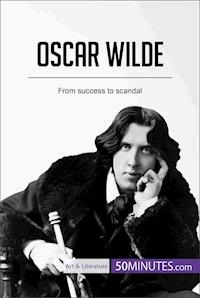
Keen to learn but short on time? Find out everything you need to know about the life and work of Oscar Wilde in just 50 minutes with this straightforward and engaging guide!
Oscar Wilde was one of the best-known writers of the 19th century, with works such as
The Picture of Dorian Gray widely recognised as classics. This self-proclaimed “Professor of Aesthetics” became famous in fashionable London society thanks to his brilliant conversational skills and insightful opinions on art and literature, and found success across a range of genres, including literary criticism, plays and short stories. However, Victorian society was deeply conservative and intolerant in matters of sexuality, and Wilde was imprisoned in 1895 for his relationships with men. He died poor and forgotten three years after his release, but his image has since been restored and he is now celebrated as a key figure of modern literature.
In this book, you will learn about:
• Wilde’s most famous works, including
The Picture of Dorian Gray and
The Importance of Being Earnest
• The literary movements and earlier writers who influenced his work and ideas
• His personal life, including his relationships with men, which led to him being cast out of fashionable society
ABOUT 50MINUTES.COM | Art & Literature
The Art & Literature series from the 50Minutes collection aims to introduce readers to the figures and movements that have shaped our culture over the centuries. Our guides are written by experts in their field and each feature a full biography, an introduction to the relevant social, political and historical context, and a thorough discussion and analysis of the key works of each artist, writer or movement, making them the ideal starting point for busy readers looking for a quick way to broaden their cultural horizons.
Das E-Book können Sie in Legimi-Apps oder einer beliebigen App lesen, die das folgende Format unterstützen:
Seitenzahl: 37
Veröffentlichungsjahr: 2018
Ähnliche












Oscar Wilde
Name: Oscar Fingal O’Flahertie Wills Wilde.Born: 16 October 1854 in Dublin.Died: 30 November 1900 in Paris.Context: Victorian London, when dandies and aesthetes flocked to the city’s salons and dominated avant-garde art and literature.Notable works:Lord Arthur Savile’s Crime (1887), short storyThe Canterville Ghost (1887), short storyThe Picture of Dorian Gray (1891), novelSalomé (1894), playAn Ideal Husband (1895), playThe Importance of Being Earnest (1895), playDe Profundis (1897), letterThe Ballad of Reading Gaol (1898), poemFew literary figures have captured the public’s imagination as much as the Irish author Oscar Wilde. In the upper-class salons of Victorian England in the late 19th century, this impeccably dressed dandy and self-proclaimed “Professor of Aesthetics” drew the eyes of everyone around him and dispensed incisive aphorisms on art, morality and beauty. However, this fame-hungry socialite and dazzling conversationalist was less vain than is commonly thought: behind his apparent shallowness, he was a true philosopher and, above all, a brilliant writer.
He was a multifaceted figure and tried his hand at a variety of genres: as an aesthete and a firm believer in art for art’s sake, he had an excellent grasp of the artistic production of his time and proved an insightful critic; as a dandy, he was a demanding poet who sought out the beauty in everything around him; as a storyteller, he gave his fertile, curious imagination free rein in several short stories and a novel; and as a witty conversationalist he excelled as a playwright. Whether he was writing articles, poems, essays, short stories, novels or plays, his intelligence and sophistication shine through on every page. Wilde was many things, but he was never boring: his writing is suffused with humour and erudition, and in spite of its light touch and apparent shallowness and frivolity, it deals with profound and universal themes. What is more, his writing is provocative, and this continues to captivate readers today.
Although he was admired by some during his lifetime, he was also harshly criticised by others, who deemed his work immoral. As a gay man, he was ostracised by his narrow-minded contemporaries, before being sentenced to two years in prison and living out the rest of his days in poverty and obscurity.
Context
The mighty British Empire
Wilde was born in Ireland, which had been ruled by the British since the 16th century and became part of the United Kingdom with the Act of Union in 1800. However, at the end of the 19th century, independence movements in the country, which campaigned for Home Rule for Ireland, were growing in strength. In spite of their efforts, the country did not gain its independence until 1921.
In Wilde’s time, the British Empire was at its height. The two outstanding political figures of this period were the prime ministers William Gladstone (1809-1898) and Benjamin Disraeli (1804-1881), but the most emblematic personality was undoubtedly Queen Victoria (1819-1901), who ruled from 1837 to 1901 and gave her name to the Victorian era. During her reign, Britain’s military and commercial power allowed it to maintain an empire stretching around the world and notably encompassing the Indian subcontinent, Canada, much of Africa and Australia. The country’s economy was in such good shape that it weathered the Long Depression (1873-1896), a global economic crisis, and even emerged from it with positive growth. It was then able to impose its practices of free trade at a time when the rest of the Western countries had adopted protectionist policies. Industrialisation and technological progress played a major role in the country’s economic growth and expanding influence.
British society
During this period, Britain, and London in particular, started to become the country we know today. Its landscapes and the lifestyle of its inhabitants were transformed by the development of the steamship and the railways, while many of London’s most famous landmarks, including Big Ben (1859), the underground (1863), the Royal Albert Hall (1871) and Tower Bridge (1897) were built during this period of rapid urbanisation. At the same time, London’s population grew rapidly, and the British capital became not only the world’s most populous city, but also the most modern, thanks to recent developments in electricity, telephone, automobiles and cinema.




