


Erhalten Sie Zugang zu diesem und mehr als 300000 Büchern ab EUR 5,99 monatlich.
- Herausgeber: Nick Hern Books
- Kategorie: Geisteswissenschaft
- Sprache: Englisch
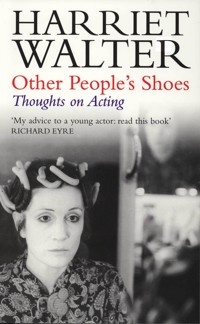
Harriet Walter's wonderfully practical - and personal - introduction to acting. 'Acting is what I do with who I am', writes Harriet Walter. And in this book she takes us step by step through the processes involved in performance. Each step of the way is illuminated with brilliantly precise examples from her own career. So we are introduced to the Workshop, the Rehearsal, and the Roots and Pathways into a role. Then follows the main meat of the book: six Keys to the Development and Exploration of character. The closing section deals with Performance on stage and screen. Every insight, every suggestion is firmly rooted in the author's own experience. Harriet Walter's book is full of unparalleled insights into the everyday working life of an actor, and into quite how much hard work is needed before they can convincingly put themselves in other people's shoes. 'My advice to a young actor: read this book' Richard Eyre
Sie lesen das E-Book in den Legimi-Apps auf:
Seitenzahl: 460
Veröffentlichungsjahr: 2014
Das E-Book (TTS) können Sie hören im Abo „Legimi Premium” in Legimi-Apps auf:
Ähnliche



















Other People’s Shoes
Thoughts on Acting
HARRIET WALTER
NICK HERN BOOKS
London
www.nickhernbooks.co.uk
Contents
Dedication
Acknowledgements
Prologue
PART ONE
: Why Do It?
1
‘One’s Real Life is the Life One Does Not Lead’
2
A Bit of My Own Story
3
Changing the World
PART TWO
: Preparations and Rehearsals
4
Early Days
5
Joint Stock and the Workshop
6
Rehearsal-Room Diplomacy
7
Roots and Pathways
PART THREE
: Character and Context
8
Horses for Courses
9
The Physical Key
10
The Psychological Key
11
The Language Key
12
The Personality Key
13
The Biographical Key
14
The Functional Key
PART FOUR
: Performance
15
Keeping It Alive
16
Acting on Film
As If It Matters: By Way of an Epilogue
About the Author
Copyright Information
For my family
(they know who they are)
Acknowledgements
The publisher gratefully acknowledges permission to quote from the following: The Persecution and Assassination of Marat as Performed by the Inmates of the Asylum of Charenton under the Direction of the Marquis de Sade by Peter Weiss, published by Marion Boyars Publishers of London and New York, English version by Geoffrey Skelton, verse adaptation by Adrian Mitchell, 1965; Cloud Nine by Caryl Churchill, published by Pluto Press Ltd and Joint Stock Theatre Group, 1979, reissued by Nick Hern Books, 1989, copyright Caryl Churchill; Old Times by Harold Pinter, published by Faber and Faber, 1971; Hedda Gabler by Henrik Ibsen, adaptation by Helen Cooper (Judy Daish Associates Ltd), 1996 (produced for the Chichester Theatre); La Musica by Marguerite Duras, this translation copyright Calder Publications Ltd, translated by Barbara Bray, 1962; The Seagull by Anton Chekhov, translated by Thomas Kilroy, by permission of the translator and the Gallery Press, Loughcrew, Oldcastle, County Meath, Ireland, published 1993; The Castle and The Bite of the Night by Howard Barker (Judy Daish Associates Ltd), published by Calder Publications Ltd, 1985 and 1988; The Jail Diary of Albie Sachs by David Edgar, first published by Rex Collings Ltd, 1982, reissued by Methuen Publishing Ltd, 1997, copyright David Edgar.
The author would like to thank Faith Evans, Kate Jones, Antonia Till, Lesley Levene, Geraldine Cooke, Cathy Courtney, Nick Hern, Jane Maud, Caroline Downing, Nick de Somogyi, Matt Applewhite and Alex Peake-Tomkinson.
Prologue
Books by actors are usually presumed to fall into one of two categories: autobiography or instruction manual for theatre practitioners. This book is neither. My life story would make dull reading, and others have written brilliant craft books which I wouldn’t presume to supplant. What prompted me to write this were the numerous questions I and other actors are so frequently asked by members of the public who are curious about what we do and how we do it. These questions vary from the gossipy to the profound and I felt that they deserved more thorough elucidation than the usual sounds bytes in celebrity profiles.
Answering some of these questions in a book set me a test which I began to relish and although I set out to write for the audience, I increasingly felt that I was writing as much for myself and my fellow actors, trying to pin down this elusive craft/art in as practical a way as possible. Many actors I have met are grateful to be reminded of the purpose which first fuelled their career choice, being as they are bombarded by media pressure to subscribe to misleading criteria for success; star quality, theatre dynasty connections, a traumatic childhood, a newsworthy romantic partner. When this media fog clears we can get down to the real business of acting, which in some sense is only a study of human motivation, behaviour and interaction.
Besides exploring the job of acting, this books touches on some of the challenges of being an actor. Actors, second only to politicians, are the most interviewed and talked about people in the world, and yet misconceptions still abound. Most societies throughout history have had a schizophrenic attitude towards the acting profession. We have been thought of as priest and as parasites, idols to be emulated and selfobsessed misfits to be scorned. In many parts of the world actors have been the focus of political dissent and have spearheaded revolutions. In this country the media likes to keep actors in their place – the gossip columns. If we stray into more serious territory we risk being called pretentious. If we back a political party we are at best set-dressing, at worst seeking publicity. Despite this climate I meet people all the time who, unless they are merely being polite or are better actors than I will ever be, express a great interest in, and appreciation of, our work.
Many actors have been invited to write about acting and have refused, protesting that it is impossible. (To my mind Simon Callow’s wonderfully lucid book Being An Actor proves them wrong.) A few of my colleagues seem slightly threatened by my attempt, as though I were intending to give away trade secrets or destroy their mystique. I couldn’t do that if I tried. There will always be an element of acting which is inexplicable and which we do not understand ourselves.
Instinct and inspiration are indefinable but, when an actor builds a performance, there are many things at work besides those more mysterious ingredients. Emotional recall, clinical study, intellectual choice, personal taste all play a large part in the process, and these I have tried to anatomise. I have also attempted to point up the connections between acting and any other human endeavour and to demonstrate how drama is part of life, not an esoteric extra on the side. To do this I draw mostly on my own career for examples since mine is the only career I have the right to pry into. In that sense alone this is an autobiography. Whether I like it or not, I shall expose more of myself in and between the lines of this book than I have ever done on stage. In writing about acting I inevitably say much about myself, because acting is what I do with who I am.
HARRIET WALTER
Part One
WHY DO IT?
1
‘One’s Real Life Is the Life One Does Not Lead’
[ OSCAR WILDE ]
They say we only have one life, but some people make a career out of resisting that idea. Everyone starts with a blank page, but all too soon the biographical data creep up on us: where and when we were born, to whom, in what order and of what gender, who taught us, who loved us and who did not. The facts crowd in and shape our options. Actors, bigamists and conmen are some of those who keep grabbing for a fresh sheet of paper on which to reinvent their lives.
Actors are parasites. We function through other people’s inventions and borrow other people’s lives. Protected by the camouflage of character, we can express our truest selves and yet avoid detection. We are moving targets. We are reflections, but which is more ‘real’ – the light or the reflected light?
A Memory
I am about five years old. I am wafting Isadora-like round the drawing room of our London home to Chopin’s Nocturnes on the gramophone. I wallow in the melancholy as only the young and basically hopeful can bear to do. The hugeness of my yearnings threatens to burst my little seams. My aspirations are as deep as the music, as high as the sky. And yet I cannot name them.
Now I am eleven. I have been taken to Covent Garden to watch Rudolf Nureyev dance. As he spins and leaps he takes me with him. The Nameless Aspiration is within groping distance. I want to dance like him? No. I want to be him? No, not exactly. I want to be the music? That’s getting nearer but still not right. I would just have to carry on groping.
Meanwhile, there was childhood to get through.
An Early Lesson
In reality I was an unexceptional child, the younger and weedier of two girls being brought up in uneventful comfort in London in the 1950s. I juggled those irreconcilable opposites that go with the job of growing up. I was both massively important and totally insignificant at the same time. I was shy but desperate to shatter my shell and be heard.
I was surprised to hear my mother and sister say very recently that they remember me as being very funny as a child. According to my own memory, my sister was unbeatably hilarious (to this day no one can make me laugh like she can) and deserved the limelight every time.
At my first school, I was the one who ducked under the desk when they were looking for volunteers to be in the play. I suspect this had more to do with cowardice and pride than modesty. Already acting was too important for me to be seen doing it badly.
However, in the safety of my own home I do recall the sweaty exhilaration of being given my head in the ‘entertainments’ which my sister and I would knock up from time to time. One evening, my act in front of the grown-ups seemed to be going pretty well when suddenly, by some adult yardstick which totally bewildered me, I must have tipped over a limit.
‘Now you’re just showing off. . .’ said by a friend of the family. Jam on the brakes. Screech to a halt. Then an interminable huff. I had been a star for a few minutes, now all of a sudden I was a worm. There never seemed to be anything in between.
We have all been there. But why can I still feel the sting of that slap in the face? In a way it was my first acting lesson, delivered in a teacher’s voice, stern and witheringly gentle. Learning through shame, is that the deal? Fair enough. Swallow hard.
The thing was to learn to anticipate that point of going ‘over the top’ and temper the act myself.
Playing
Acting is an instinctive human ability. Children say, ‘Let’s pretend,’ and, hey presto, it is true. As children we close our eyes and we can be anyone, anywhere. We test ourselves in safety and enter crises under our own control. We collaborate, initiate and compromise with others in creating parallel worlds. Play is a rehearsal for the real world, in which grown-up people conduct serious business, and spend their leisure time watching others doing what they have forgotten how to do.
Many actors only pretend to grow up. The child in them goes underground, but is always accessible. At school I continued wanting to invent dramatic games long after my best friends had started sneering at them. Outwardly I succumbed to convention, and it was not until I was a ‘grown-up’ at drama school that I was allowed to play again. By then, paradoxically, it was called ‘work’.
Meeting Demons
In my year at drama school there were two mountaineers. They were good amateur rock-climbers and could have made that their life instead of acting. They were torn between their two ambitions. In those early days I could not see a link, but now I think I can. In both activities there is an element of facing one’s demons, of testing oneself.
Some people feel safer avoiding their fears, while others prefer to meet them and beat them. For this reason, one often finds pilots who started with a fear of heights, doctors who are hypochondriacs and actors who are terrified of people.
How Can Actors Be Shy?
‘You get up there in front of all those people!’ they say. ‘Yes, but as somebody else,’ we reply. For ‘shy’ we should perhaps read ‘self-conscious’. After all, self-consciousness is a prerequisite of the profession. We have to be conscious of our every move on stage, where a fist too tightly clenched or a quivering lip can give the whole game away.
For ‘shy’ also read ‘fear of being judged’, ‘fear of not living up to our own standards of perfection’, ‘fear of being pinned down’, ‘fear of being misunderstood’, even perhaps ‘fear of being understood’.
Actors are of course not alone in feeling discontented with themselves (and I am certainly not suggesting that all actors do), but we have a particular way of dealing with that discontent. We can pretend to be someone else for a short while, and be paid and professionally licensed to do so. People who believe themselves to be deep-down horrid can become the nation’s favourite cuddly comic. People who fear they are spineless can play kings and heroes. Angst-ridden introverts can project themselves on to outrageous out-spoken alter-egos. This resourceful compensation for our inadequacies keeps many an actor off the streets, out of prison and away from the psychiatrist’s couch.
Containing Monsters
It is not just the people watching us whom we fear, it is human interaction itself – the unpredictability of other people, and perhaps the monsters in ourselves. All these fears can be contained and controlled in a drama, as they cannot be in life. In a drama we know what our opposite number will say next and we are ready with a fluent answer.
In the real world, if we give rein to our passions the consequences can ripple down the rest of our lives, so we suppress them, and can grow to fear them as unvisited caged animals throbbing at the back of our brains. But in a drama these monsters can be temporarily let out. Aggression, Vulgarity and Vulnerability can rampage round the stage. We have learned how to use them there and we know that the consequences will finish at curtain-down.
Compared to the dangers of real life, the stage can be the safest place on earth.
The Nosy Parker
Like most actors, I am an awkward mix of shy and nosy. I have an almost insatiable curiosity about what makes people tick, but a paralysing combination of pride and tact prevents me from downright asking. I am thrown back on gumshoe techniques such as eavesdropping on buses, listening in on crossed lines (rare jewels) and just occasionally trailing someone in the street. These methods, though fun, are frustratingly limited if you want to remain unobtrusive, not to mention legal. Once, when I was much younger, I slipped into someone’s house while they were helping their husband load the car. Heart racing, I found a cupboard under the stairs and crouched there waiting . . . For what? There was no spy-hole or chink in the door, so I couldn’t watch the woman, and, except for one unrevealing phone call to her doctor, I never heard her speak. Then the problem was to leave without detection. ‘Please go upstairs!’ I willed her, as the inevitable desire to pee came upon me. Eventually she did just that, and I sneaked out of the fruitless house.
Lacking the boldness to blatantly intrude on someone’s life, I was forced to be nosy closer to home. Like one of those nineteenth-century doctors who experimented with new drugs on themselves, I put myself through various trials: ‘What must it be like to . . .?’
And, no, I didn’t do drugs, but I did spend one winter night on a park bench just to see what it was like. The trouble was that I could not re-create the conditions of someone forced to spend the night on a park bench not just for a night, but for unknowable numbers of nights to come.
Why Not Me?
We are all familiar with the protestation ‘Why me?’, but that equally begs the question ‘Why not me?’ When I was young, I could never grasp why I was in this husk and not that. Why was I me and not you or she or that dog over there? I am sure everyone (perhaps even the dog) asks these ontological questions at various phases in their life, but maybe with some people the phases last longer.
I have never experienced a sense of reincarnation, but I do occasionally have giddying flashes of what could be called parallel or multi-incarnations. These are almost impossible to describe, since they last only a millisecond. My most recent flash happened on a November night in London, as I was trudging in the rain past a bus-stop queue. Suddenly the glare of daylight . . . heat and flying bullets . . . a dusty headscarf tied across my nose and mouth to keep out the smell of a street battle. I don’t know where the vision came from, but at the time it felt as vivid as the icy pins of rain that tickled my face.
I do not put these flashes down to anything mystical. I think it is more to do with news coverage; the fact that every day on television, on the news or in documentaries, events and people on the other side of the world are beamed into our living rooms. That flood victim could be me, that mental patient, that freedom fighter, that lottery winner. Late at night our time, we can see live footage from tomorrow morning in Australia. We have even seen a moon’s-eye view of the Earth, for heaven’s sake. Jane Austen’s folk never had to handle all that.
2
A Bit of My Own Story
Another Memory
Night-time. I’m in the back of our Hillman Husky, looking out of the small rear window. We are swirling round what is probably Leicester Square – anyway, I remember bright lights. I contort myself so that I am looking upside-down at the stars. ‘I’m going to be an actress,’ I say. I am ten years old and have just seen The Parent Trap starring Hayley Mills. Not only was the heroine blonde and pretty, but she was twins! The twins had been parted as babies when their parents split up. One had been brought up by her mother as a long-haired little lady, the other, who had known only her father, was a short-haired tomboy, and lucky Hayley Mills got to play both.
The twins meet for the first time aged thirteen and befriend one another after a hostile start. Together they plot to reunite their parents and succeed. Hayley Mills was small and young, but she was watched and listened to by millions. According to my admittedly faulty memory, my ambition was conceived and proclaimed out loud that day.
Healing the Family
My parents split up when I was thirteen years old. Unlike Hayley Mills in The Parent Trap, I put up little or no resistance. When my father first told me that he and my mother were ‘parting’ (I remember that word), he said, ‘I’m sure I can rely on you to take it like a chap.’ To begin with it was easy to obey. I was numb. I remember looking at myself in the bathroom mirror and thinking, ‘Why aren’t I crying?’
There was inevitably a delayed reaction. I started behaving oddly at boarding school, with the result that I was taken away. My father having left by now, my mother bore the brunt of my outpourings. She gave me total licence, but I did not know where to stop. I could not stem my tears. Uncertain what to do, my mother sent me to a doctor, who diagnosed a minor nervous breakdown and prescribed tranquillisers and no school for at least six months. All this infuriated my father (who rarely took a pill in his life) and drove a further wedge between my parents.
Within the year I was happily ensconced in a new boarding school where no one knew me, and I could grab that clean page and reinvent myself. No longer was I ‘slightly mad’ (a description I overheard at some grand party), but the faintly mysterious offspring of a rather glamorous divorce. I buried any unfinished business with my parents and sank my teeth into work, friendship and the school play . . .
It was not until much later that I began to see how much the divorce had influenced my character and the course of my life.
Quite recently, a chance observation on the part of a relative stranger happened to ring true: ‘You are healing your family through your work.’ I can just hear my family saying, ‘We don’t need healing, thank you very much!’ but as I understand it the remark was more to do with the rifts and contradictions that had remained within me as a result of the divorce than a literal mending of a marriage. I have no wish to indulge in a public therapy session, but I am almost clinically interested in the routes the mind takes in order to fill gaps and repair damage, so I will try to explain the gist.
I grew up with an impression of two mutually exclusive tribes, my father’s family and my mother’s family, each attached to a package of opposing adjectives. The former loomed in my imagination as remote, tough-minded and eccentric, the latter as warm, volatile and gossipy. My father’s clan was through and through English, my mother’s of Italian descent.
Maybe I got this exaggerated picture from my maternal grandmother’s habit of defining people in terms of opposites. My father was cautious, frugal and self-contained, whereas my mother was trusting, generous and needy. My father’s style was minimalist, my mother’s eclectic, and so on.
There was also an assumption that because I looked like my mother and my sister looked like my father we had inherited the character packages of their respective clans and therefore must be opposites: ‘You take after your mother’s side of the family, your sister takes after your father’s.’ The years would reveal how inaccurate these generalisations were, but at the time they seemed to be carved in ancestral stone.
When my parents’ marriage started to founder (politely and privately and definitely pas devant les enfants), it seemed to me as though my sister and I were being split into warring camps, and when my father finally left, I felt so twinned with my mother that I too became the rejected wife. In my adolescent confusion, I linked my budding femininity with being unacceptable. If I could pull back from the brink of woman-hood, I might regain my father’s approval.
I dusted down my tomboy act from an earlier phase, reckoning that I could just about hack it for the length of our now rare meetings. I knew my father was uncomfortable with real closeness, so I protected him from my need for it and stuck to the safe territory of jokes. I slipped up once, when he was seeing me off to school. When I hugged him that bit too vehemently on the platform, he stiffened and gently pushed me away. ‘Now you’re not going to get soppy, are you?’ It was not unkindly meant, he was merely wishing on me some of the armour-plating that had got him through life since he was sent away to school aged seven.
I continued sifting through my character, trying to eliminate ‘mother’ features for my father’s benefit, and trying to disguise the attempt for my mother’s benefit. My selfimposed task of being all things to all people was proving difficult. In my father’s sphere I felt inauthentic, in my mother’s a traitor. All my disguises were wearing thin and I felt see-through.
Not so at my new school, where I continued to fashion my personality (it never occurred to me that I already had one for free). I started to capitalise on my versatility, being one thing to one person, another to another. For this please-all strategy to work, the more incontinent aspects of my nature had to be sent into exile and were allowed to return only much later, when they could safely be called artistic temperament.
Through the process of acting, over the years I have confronted and embraced the various ‘contradictions’ in my nature, and laid them bare in front of my family. I have been victim and leader, neurotic and clown, and in playing out these extremes have settled on my true mien. I have quietened those ancestral voices and united the tribes. I have matured from boy parts via Shakespeare’s androgynes to the full-bodied Duchess of Malfi, and belatedly become an adult who is relatively happy in her skin.
A Detour
In my late twenties I wanted to give blood but was told I was underweight. I was referred to a GP, who pronounced the magic word ‘anorexia’. This is not the time or the place to go into details. but suffice to say mine was a fairly mild case and I came through the worst of it with the help of some rather toe-curling little ‘chats’ with the GP.
After a few of these sessions, I began to suspect that the GP was fixated on the theory that gender-confusion was at the heart of my problem. He had been digging over and over the rather unyielding ground of my relationship with my father, and his eyes almost did somersaults when I told him of the numerous boys I had played on stage. From then on I had my work cut out trying to get him off the Closeted Lesbian track. (Not that I didn’t give it due consideration, and not that I would have been ashamed to admit it if it were true. I was just as sure as anyone ever is that it wasn’t.)
One year on, I was rehearsing Caryl Churchill’s Cloud Nine at the Royal Court, when one of the actors injured themselves. The doctor was called and promptly turned up. And which doctor did that just happen to be? You guessed it. And what was I playing? Edward: a sailor-suited Edwardian boy who likes to play with dolls, does naughty things in the woods with Uncle Harry and whom Caryl specifies must be played by a woman. As the GP bathed me in his knowing gaze, I tried desperately to demonstrate how my now more feminine figure was straining at the confines of my sailor-suit. Oh, how I batted my lashes and flirted with the guys, but I felt I was over-acting, protesting too much. ‘How are you, Harriet?’ asked the GP in his best bedside voice. ‘Fine,’ I squawked. I even sounded as though my voice was breaking.
And Many Years Later. . .
As I approached the age my parents were when they split up, I became more curious about their lives. When my mother was ten, her own parents divorced. When I asked her why, she replied that she never really knew. ‘One simply didn’t ask.’
My parents’ generation are reluctant to talk about themselves, they see it as a weakness or self-indulgence, but my persistent questions seemed to arouse a similar curiosity in them. Not long before he died, my father and I were sitting in a restaurant when he suddenly asked me, ‘Do you know why your mother and I divorced?’ My jaw dropped with astonishment. I waited to hear the answer to what all of us (my mother included) had not dared to ask at the time. The waiter came over. ‘More wine, sir?’ Go away, go away pleeease, I beamed out. Left alone again, I nudged my father on. ‘So . . . why did you divorce?’ (Toes curling under the table.) ‘What? Oh, I’m not sure. I was thinking you might tell me.’
The School Play
I cannot for the life of me remember the title, but there was bound to have been a vicar and a postmistress in it, and there were definitely some french windows, a standard lamp and a sofa set at a jaunty diagonal in the French’s edition diagram. I played Cowslip, the farm girl, and my first scene went something like this:
Enter Cowslip, the farm girl, carrying a basket of eggs.
SOMEONE: Good evening, Cowslip. What have you got there?
COWSLIP: Baa-sket.
SOMEONE: Yes, I can see that, but what’s in it?
COWSLIP: Eggs.
SOMEONE (becoming impatient): What sort of eggs?
COWSLIP: Yourn.
(I remember that ‘yourn’!)
Apart from those few lines, all I recall is a feeling. Several analogies come to mind: teasing a baited fish on the end of a line, tugging a kite string, catching a wave. I lobbed each line into the arena like a pebble into a pond, waiting for the ripples of laughter to nearly but not quite die before chucking in the next. I had discovered timing. My instincts were probably as pure and uncluttered then as they have ever been since. I sat back like a passenger and let them take over the wheel.
I was cheered as I went into supper that night and the headmistress called me ‘a natural actress’. I was a heroine for at least a day and had clinched my identity. I know, the performance lives only in my memory, and it probably wasn’t that great, but the point is I had the sensation for the first time that I didn’t just long to act, I might actually be able to do it.
My school acting career culminated in a performance of Le Malade Imaginaire in French (now I am showing off), as we were doing it for A-level. I played Argan, the eponymous hypochondriac, and as Maurice Chevalier was the only old Frenchman I could think of I basically did him. My mother claims to have seen through my gruff-voiced ‘hon hon hon’s and Gallic shrugs to the budding actress beneath. According to her, she came to the play wondering whether I had anything of ‘what it takes’ and left relieved to think that I had.
How can one really tell, though? Even with fully fledged professionals, one can be unsure how good or bad someone is. Kids can show a natural aptitude which they lose in later life, and besides there is more to acting than putting on accents and funny walks, and more to succeeding in the acting profession than being good at acting.
I am incredibly grateful to both my parents that, with so little to go on, they took my ambition seriously. They neither pushed me nor put me off, although they quite sensibly impressed upon me the tough and insecure nature of the game. They knew something of the profession through my mother’s brother, Christopher Lee, whose own career, though relatively blessed, has never been anxiety-free. To a certain extent my uncle had already absorbed any shockwaves that might have been caused by having an actor in the family, so I had one less battle to fight.
A Funny Way of Showing It
In their heyday, my parents shared a sense of humour and were both exceptionally good-looking and fun. They had more style than money and a wide, cosmopolitan circle of friends. What they also shared was a well-concealed but deep lack of self-confidence. Both had a dominant parent who had given them a sense of failure. They had dealt with these things in opposite ways, which determined their style as parents. My mother lavished her children with praise to make up for what she had lacked. My father’s style was not to impose, which I misread as indifference.
Then, on my thirtieth birthday, he showed me a letter he had received from his father. It was dated 1968, the year I left school and the year before my grandfather died. The gist of the letter was that I had a good brain and should go to university to study languages or law. I quote: ‘She could obtain an interesting and well-paid post in some organisation like UNO.’ He ends the letter by writing, ‘All girls want to be actresses at some time or another. If you allow yourself to be diverted into the pursuit of this will-o’-the-wisp you will land yourself in endless trouble.’
Although my grandfather was ninety-four when he wrote this and the last of the old Victorians, it is interesting that he was not against a girl having a career. ‘In these precarious times it is absolutely necessary for girls to be in a position to earn some money both before and after marriage.’ But then, as the letter is typed and my grandfather’s signature looks like the trail of a drunken ant, my father may have been right in thinking that my step-grandmother was breathing heavily in his ear.
The touching point about the letter is that my father paid it no attention and kept it for me to read until I was already well on the road.
A Joke
Q: How do you get an elephant out of the theatre?
A: You can’t. It’s in their blood.
3
Changing the World
‘To change the world you must first change yourself.
You must become the change you want to see in the world.’
[REG BIRCH, ABORIGINAL ELDER]
My parents’ cool-headedness was severely challenged when I turned down a place at Oxford, preferring to get straight on to drama school, at a point when no drama school would have me. Gentle reasoning was brought to bear, but I was not to be sidetracked. In the end I got the best of both worlds by spending a year acting in Cambridge. I had been short-listed by LAMDA (the London Academy of Music and Dramatic Art), and told basically to go away for a year and learn a bit of life. A male undergraduate friend of mine suggested I come to Cambridge, where the college drama societies were always short of actresses. In the days before mixed colleges, there were about four men to each woman at the university, and those women were too busy working twice as hard as their brothers in order to ‘deserve’ their privileged place.
‘There, but for the grace of whatever, go I,’ I mused, as I cycled past Newnham on my way to some rehearsal room. I had made the right choice. Life in a women’s college seemed too like boarding school all over again. I went home each night to a freezing bedsit, high on my new-found independence and my certainty that I was on the road to Where I am Meant to Be.
Until that year in Cambridge, I had seldom seen a play and I certainly had no sense of politics. By the time I left, I had felt the power of theatre, I wanted to change the world and I had glimpsed a possible connection between the two.
A South African Adventure
One day I was tipped off that one of the college drama societies was planning a three-month tour to South Africa. They were to do Shakespeare’s All’s Well that Ends Well and Peter Weiss’s Marat/Sade. I had just seen Peter Brook’s film of the latter and been knocked sideways by it, so I rushed to audition.
I got the parts of Charlotte Corday in Marat/Sade and the Widow in All’s Well that Ends Well, and with two and a half months to go before the start date I had plenty of time to bask in carefree anticipation.
Or so I had hoped. In fact the National Union of Students launched a nationwide campaign to stop the tour. There were letters of protest in every major newspaper, accusatory insults flew through the air and I had a crash course in why. I had never really noticed the word ‘apartheid’; I always switched off in Current Affairs lessons at school. Nor had I paid much attention in Geography; to me South Africa was just the bit at the bottom of Africa.
Many people withdrew from the tour, and I thought of it but was persuaded not to by the director of Marat/Sade. He explained to me that the drama tour was to be a cover for a small film unit making a documentary about the evils of apartheid. It was hoped that, if successful, the film would not only spread the story but also make some money for the exiled South African opposition. Obviously none of this could be made public knowledge at this stage.
I was taken along as a discreet observer to a meeting of representatives from these opposition groups with the film crew. I felt very meek and out of my depth, but left convinced that I should weather the NUS storm, keep my mouth shut and go.
Nothing could have prepared me for the surrealism of South Africa. From the moment I touched down at the airport to the day I straggled back to London three months later (and one stone lighter), there was no let-up in the onslaught on my moral and physical senses. It was as though someone had taken hold of my brain and was wrenching its bits apart, shifting them around like on a Rubik’s cube.
In my guise as undercover sound-recordist, I attended the trial of a newspaper editor accused of bias in his exposé of prison conditions for blacks, I witnessed a mass arrest and, sneaking behind the set-dressing of the show-case miners’ living quarters, I saw the rat-infested human zoo that was the reality. There was, I confess, an element of the spy thriller about all this, but the thrill soon wore off. I started to have nightmares, and one night I was woken up by a policeman sitting on my bed. (Luckily he turned out to be looking for someone else, not for the reels of film footage which I kept in the bottom of my suitcase until a safe moment arose to send them on to London.)
Secrecy was of the utmost importance, and for the other members of the crew the stakes were extremely high. One of them was on a wanted list for previous activities in then Rhodesia and had a passport with a false name. Another, a hirsute thirty-year-old, was hard pushed to pass himself off as a Cambridge undergraduate (even when called upon to act as a background lunatic in Marat/Sade).
Such was their well-founded paranoia that I was only just tolerated as an occasional addition to the team, and we operated entirely without the knowledge of the rest of the Cambridge group. After all, it could not be taken for granted that they were all ‘on our side’. The tour had been facilitated in the first place through one member whose parents had friends in high (and obviously white) places.
However, by the six-week mark, when we had travelled half-way round the country, played in tin shacks in the townships and made black African friends, our varied political shades were forced into line. We had made a promise to Peter Weiss that we would play Marat/Sade only to mixed or black audiences. The big night came when we were to perform at Fort Hare, the most important of the very few black universities in the country.
The Fort, as it was dubbed by the students and locals, was in those days a mockery of a university. An entirely white staff imposed their views on students who were not allowed to leave the premises, hold meetings, talk to the press, visit other universities or receive visitors without the Rector’s permission. As we passed through the main gate, a sign read: ‘No unauthorised person may enter the college grounds. By Order.’ This, together with the sound of a wailing siren signalling the end of a lecture period, combined to give me the impression I was entering a prison camp.
Having started to set up shop in the theatre, we inquired how the show was selling, only to find that over sixty per cent of the tickets had already been sold to the white staff and population of the town. The black students had known about the performance for just twenty-four hours, whereas the whites had been preparing for it and booking their tickets for the last month. Feeling rightly affronted, the students were refusing to come. The whole purpose of our visit had been sabotaged and turned into a white PR campaign: Cambridge University (and by implication the British establishment) endorses apartheid. I could already hear the NUS back home crying, ‘We told you so.’
Even the most dithery fence-sitters among us were galvanised into action. There was a multiracial religious seminary up the hill which we used as neutral ground for a meeting with representatives of the African students. It emerged that the students were on strike in protest at the expulsion of some of their leaders. These young men had earned the right to study where many of the continent’s most prominent statesmen had trained (including Mandela himself), but now, due to their political activities, they had been thrown back to scratch a living in the Bantustans, the arid areas allotted by the state as African ‘homelands’.
It took time for us to prove our sympathy and our prior ignorance of the situation. We vehemently denied any association with the university staff or their propaganda. We suggested that the students turn up at the theatre that night, when we would oust the whites and make way for those we had originally intended as our audience. Brave talk. I think the students knew better.
Half an hour before the show there was still no sign of the students. Meanwhile, the whites in their furs and jewels were tripping in. Suddenly there was a stirring outside our make-up tent. A large crowd of students had assembled in the dark and anyone who was ready in costume was sent out to talk to them.
I will never forget it. Each cast member stood alone, encircled by a group of forty or so students. We spoke in simple terms as we knew that one in three of them was an informer (a role it was hard to refuse when the government was paying your fees). ‘If you want to see the show, we will tell that audience to go away and we will let you in instead. If you don’t want to see the show, we will not perform at all and we will leave.’ A silent sea of unreadable faces. ‘We understand it is difficult for you to answer as individuals, but as a group you could take a step forward if you want us to perform.’ A long pause. Not a shoe shuffled. ‘We understand from this that you do not want us to perform, so we will leave.’
Hardly had we turned to go when the Dean of the university leapt to a microphone in the auditorium and announced, ‘Due to the intimidatory tactics of certain ringleaders among the students, our Cambridge friends are being forced to abandon the show. We are ashamed and sorry . . .’ At that moment our tour leader, who if anything had been the most right-wing of us all, grabbed the mike and gave our side of the story. He was rewarded by a smack on the jaw from a well-swung handbag.
From then on our little group became more and more embattled. The Dean’s side of the story was headline news in the next day’s papers. We struggled to redress the balance, but made only a small column on page ten several days later.
Back in England, the Observer gave us a half-page to tell our version of the story and, thanks to some underground network, many of the Fort Hare students read it. I received several letters from them thanking me (mine was the name on the article) for telling it like it was. I was embarrassed by their gratitude. They risked so much more in writing to me than I ever did in fronting the article.
Apart from this feedback, it was hard to quantify the effect of our visit on the people we met, and even harder to assess their response to the plays, but when we played Marat/Sade in Soweto and such places, and sang:
Why do they have the Gold
Why do they have the Power
Why Why Why Why
Why do they have friends at the top
Why do they have the Jobs at the top?
We’ve got nothing
Always had nothing
Nothing but Holes and millions of them.
Living in holes, dying in holes
Holes in our bellies, and holes in our clothes . . .
the political resonance rang round the tin-roofed hall. We had no follow-up survey with which to check it out, but nine hundred African people standing up at the end of the show and singing ‘Nkosi Sikelele Afrika’ is something to behold, and is good enough for me.
New Allegiances
The documentary film achieved what it set out to do. It raised money through sales all over the world and was shown on television and in the cinema. I returned from South Africa a tentative marxist – I only mumbled the label, and even write it here with a small ‘m’. I had extrapolated from the extremes of apartheid the far subtler mechanisms of oppression nearer home. I may just have swapped one pair of blinkers for another, but at least I was being shown a different view of the world.
I sought political educators in pubs and in books, but I lacked the intellectual rigour to take up any cut-and-dried stance. Politics was not in my blood. Come the revolution, I would never be able to trust my gut instincts as my working-class friends could. One friend I particularly envied. To her it was so simple: all toffs were bastards and communism was a Totally Good Thing.
I decided that only first-hand experience could determine or shift my political point of view, so I grabbed any opportunity to taste other people’s lives. I joined picket lines at dawn and slept on floors with striking dock workers, but, as with my park-bench interlude, these could only ever be a taste.
At drama school, where I formed my first close friendships with people from different backgrounds, it was at least two terms before I confessed to my own. In England more than in any other country, as soon as we open our mouths a whole set of assumptions are made about us based on the way we sound. I wanted to make friends first and then be judged if necessary, not the other way around. So with my slippery accent I kept them guessing, and I never invited anyone home.
But this dishonesty soon began to pall. Drama school was supposed to be a place of trust and honesty, and my own fear of judgement was making me cheat. I remember one group improvisation where we had to go back to our schooldays. The task was to recall and re-create as accurately as possible how we interacted with our peers at different stages in our development. Our teacher would set the scene: for example, ‘It’s morning break, the playground, and you’re five years old.’ He would let the improvisation run for a while, as we fought, played or clung to the outer edge sucking our thumbs, then he would snap his fingers and announce, let’s say, ‘School bus outing. You’re in the fourth form,’ or ‘Exams are over. You’re in the canteen.’
Not having experienced life in a state school, I was bound to slip up and give myself away. What were the playground crazes? How old was one in the fourth form? What did one eat at school dinners? I opted to hide behind a very mousy persona and not join in the games. It was a lie, and I resented my own cowardice that prevented me from playing honestly like the others.
In another group session we were invited to tell something of our life story. One girl described how her parents had not spoken to each other directly for several years. Hers was a large family and the atmosphere at meals was unbearable, with her mother saying to one of the kids, ‘Tell your dad to pass the gravy,’ or the father saying, ‘You can tell your mother I’m off out.’
‘Why don’t they get divorced?’ I asked after we had recovered a bit. ‘Divorced?!’ The girl almost choked with disbelief at my stupidity. ‘Most people can’t afford to divorce.’ She looked at me with new eyes for a flash, but our friendship survived, as bit by bit I came clean.
Although there was some cowardice involved in my masquerade, there were other good reasons for it. Throughout the 1960s working-class playwrights and actors had flourished, and in the early 1970s theirs was the most challenging and interesting work. Scenes from these new plays were put on by the students at LAMDA and I wanted to be in them. If I couldn’t venture beyond the facts of my up-bringing at drama school, where could I?
As it was, I played rough parts, mad parts, old and young parts, which was just how I wanted it. It was not until our final year that one or two members of staff tried to box me into a ‘classy’ mould. One of them, an actor/ playwright with working-class origins, had written an autobiographical play about his marriage to a posh Kensington girl. He cast me as his wife, and this was the first posh girl I had had to play. I could not get a handle on her, and had little interest in doing so. I remember the writer cornering me one day in order to tackle my resistance. ‘But she’s a Kensington girl, you can do that standing on your head.’ Now, standing on my head I wouldn’t have minded!
It is not that there is anything intrinsically wrong with posh parts, just that in this case the character’s poshness was her only function. Besides, like my fellow students, I was interested in the exotic. We were all trying to transcend our autobiographical data, and in a sense LAMDA was the intersection of our respective journeys.
Not for All Markets
If I had conformed to the posh-girl type, I might have had a speedier start in the mainstream of the profession. As it is, I do not regret one inch of the circuitous route I actually took. When I came out of LAMDA, my light was still quite well hidden under the bushel, and although this was not a conscious tactic, it helped narrow down any job offers to those that would suit me best. On the whole, if your message is hard to read, you can trust that those who ‘get’ you will be good for you, and that those who do not will not.
Plunging In
One of the few people to read my message when I auditioned for various drama schools was Frank Whitten. He was Vice-Principal of LAMDA, and the teacher who has had the most lasting influence on me. He took us for improvisation classes and would never explain the purpose of an improvisation or acting game before we got up to do it. He was confident that the ‘meaning’ would reveal itself retrospectively. We were to leave behind reason and intellect, like socks and shoes at the edge of the swimming pool, plunge in and play. The more uncritically we took part, the more certainly the point of the lesson would get through, and because it was experienced first-hand, it would stay in the memory far longer than any lecture or verbal exposition. Through Frank’s skilfully devised improvisations I experienced a sample of every acting principle or problem that would come up in my professional life and I constantly refer back to him.
My Circuitous Route
In my final year at LAMDA there was a philosophical split among the staff. There were those who believed that drama school should give students a taste of the ideal work model, which would remain as something to strive for in the outside world; and there were those others who took the view that ideals were all very fine, but there was no room for them in the Real Commercial World and students had better get used to that now. For me, the latter had nothing to offer but the legacy of their own disappointment. I knew who would get my vote.
The group I favoured left LAMDA and formed a company of their own, Common Stock Theatre, where they continued their pursuit of the ideal working model. Meanwhile, we students gritted our teeth and submitted to the final year’s polish-up (for that was all it was).
On our last day at LAMDA, we rushed out of the school, caught the tube to St James’s Park and, in an excited gaggle, signed on at the Chadwick Street dole office. Being an out-of-work actor was a definite promotion from being a drama student.
That was a Friday and on the Monday I got a phone call. Someone had dropped out of Common Stock, would I like to join? In those days, you couldn’t work without an Equity card, and you couldn’t get an Equity card until you were offered a job. Each repertory company could give away one or two places a year to an apprentice actor or acting ASM. If you won a place, you would get provisional Equity membership and then have to clock up forty-two weeks’ work in order to earn your full card.
Common Stock was a newly formed fringe company which hadn’t the means to pay Equity wages or dish out Equity cards, so I explained to them that I would love to join, with the proviso that if I was offered a ‘proper job’ I would have to leave them. I felt very guilty about this, but their swift agreement made me see that anyone else would have done the same.
One does not leave drama school with a diploma saying ‘Now I Can Act’, just a basic alphabet of acting and a smattering of the vocabulary. Although I was longing to be a real actress, I wanted to go on learning (and still do). Among my favourite classes at LAMDA were Jane Gibson’s mask work and Frank Whitten’s improvisations; I also loved Chattie Salaman for setting such high standards and giving me such a hard time. All three were founder members of Common Stock and continued to teach me there.
My social/political education was also continuing. Common Stock was a community theatre, which meant that it drew its material from and played it back to certain targeted groups, on their own territory rather than in a theatre building. The company was run democratically, which is to say that all decisions were shared, but people with particular aptitudes (e.g. book-keeping, set-building, directing) would specialise in those areas.
Writers were part of the cooperative, but they developed the plays in cahoots with the target group (kids under twelve, teenagers, single parents, OAPs, whatever). Thus it was that my first professional role as a squirrel who gets baked in a pot and my second as a horrid Sweetshop Lady who is magically turned into a sweet and stuck in one of her own jars (Big Prop) were conceived by a gang of under-tens from Whitechapel.
We performed all over London, from housing estates to sandpits, under the M40 and on disused railways. We visited a famously rough youth club, where a favourite pastime of the kids was to throw darts at human targets, and managed to distract them from their sport with a play devised with the help of kids from another youth club on the other side of town.
I was doing what I loved best, and in a good social cause, but eventually (several ignored letters and some failed auditions later) the lure of the Equity card summoned me away. I had read in a trade paper about a small young company based at the Duke’s Playhouse in Lancaster. Their blurb emphasised their community work and work in schools, but they also played a more regular repertoire of Shakespeare, Pinter and panto. It was this variety that attracted me, so I wrote to them, detailing my ‘career’ so far. The attraction was mutual. I joined in time for the panto, served my forty-two weeks to get my card and stayed on for at least forty more.




