


18,99 €
Mehr erfahren.
- Herausgeber: John Wiley & Sons
- Kategorie: Fachliteratur
- Sprache: Englisch
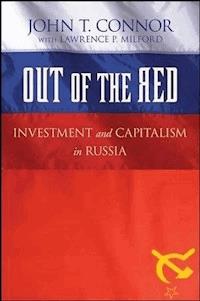
Over the last fifteen years, Russia has become a larger part of the global economy—and in the years ahead, it will continue to grow in prominence. If you want to improve your investment endeavors in this market, you must first understand how it operates. With Out of the Red as your guide, you’ll become familiar with all the opportunities this country has to offer and learn how to make the most informed investing decision within this emerging arena.
Sie lesen das E-Book in den Legimi-Apps auf:
Seitenzahl: 282
Veröffentlichungsjahr: 2011
Ähnliche



















Contents
Foreword
Preface
Part One: Free Markets and Democracy Arrive in Russia
Chapter 1: Today’s Russia
Russia’s Transformation into a Free Market Economy
Learning the Hard Lessons of Capitalism: The 1998 Crisis
The Putin Era
The Challenges of Democracy
Summary
Chapter 2: Investing in Russia: Risk/Reward
Risks of Investing in Russia
Rule of Law
Regulatory Atmosphere
Viktor Zubkov
Rewards
Summary
Part Two: Russia as a Rising Economic Power
Chapter 3: An Overview of Business in Russia
Russia as an Emerging Free Market
Russia: Not Just Oil and Gas
Emerging Industries
Summary
Chapter 4: Metals and Mining
Steel
Aluminum
Mining
Chapter 5: Oil and Natural Gas
Oil Industry
Natural Gas
Chapter 6: Information and Communication as a Business
Cellular Telecom
Wireline Telecom
Media
Chapter 7: The Rising Russian Consumer
Retail
Real Estate
Banking
Transportation
Auto Industry
Chapter 8: Electricity and Infrastructure
Russia’s Energos
Infrastructure
Chapter 9: Ukraine and Kazakhstan
Ukraine
Kazakhstan
Part Three: The Future of Investing in Russia
Chapter 10: Discovering the Real Russia
Think Tanks: The Hateful Crowd
Other Think Tanks
Recent U.S. Stance
Areas of Tension
Summary
Chapter 11: What’s in Store for Russia and Its Investors?
Who Will Lead?
Predictions for the Future
Summary
About the Authors
Index
Copyright © 2008 by John T. Connor and Lawrence P. Milford. All rights reserved.
Published by John Wiley & Sons, Inc., Hoboken, New Jersey.
Published simultaneously in Canada.
No part of this publication may be reproduced, stored in a retrieval system, or transmitted in any form or by any means, electronic, mechanical, photocopying, recording, scanning, or otherwise, except as permitted under Section 107 or 108 of the 1976 United States Copyright Act, without either the prior written permission of the Publisher, or authorization through payment of the appropriate per-copy fee to the Copyright Clearance Center, Inc., 222 Rosewood Drive, Danvers, MA 01923, (978) 750-8400, fax (978) 750-4470, or on the Web at www.copyright.com. Requests to the Publisher for permission should be addressed to the Permissions Department, John Wiley & Sons, Inc., 111 River Street, Hoboken, NJ 07030, (201) 748-6011, fax (201) 748-6008, or online at http://www.wiley.com/go/permissions.
Limit of Liability/Disclaimer of Warranty: While the publisher and author have used their best efforts in preparing this book, they make no representations or warranties with respect to the accuracy or completeness of the contents of this book and specifically disclaim any implied warranties of merchantability or fitness for a particular purpose. No warranty may be created or extended by sales representatives or written sales materials. The advice and strategies contained herein may not be suitable for your situation. You should consult with a professional where appropriate. Neither the publisher nor author shall be liable for any loss of profit or any other commercial damages, including but not limited to special, incidental, consequential, or other damages.
For general information on our other products and services or for technical support, please contact our Customer Care Department within the United States at (800) 762-2974, outside the United States at (317) 572-3993 or fax (317) 572-4002.
Wiley also publishes its books in a variety of electronic formats. Some content that appears in print may not be available in electronic books. For more information about Wiley products, visit our Web site at www.wiley.com.
Library of Congress Cataloging-in-Publication Data:
Connor, John T., 1941-
Out of the red : investment and capitalism in Russia / John T. Connor ; with
Lawrence P. Milford.
p. cm.
Includes bibliographical references and index.
ISBN 978-0-470-26978-7 (cloth)
1. Investments—Russia (Federation) 2. Capitalism—Russia (Federation) 3. Russia (Federation)—Economic policy. I. Milford, Lawrence P., 1975- II. Title.
HG5580.2.A3C66 2008
330.947—dc22
2007047648
The book is dedicated to Arkady Volsky, who embodied the best in the transition from the old regime to the new. The Founder of the Union of Industrialists and Entrepreneurs, Russia’s leading business lobby, he was, earlier, a young Soviet factory manager who became economic advisor to the leader of the USSR. Arkady was smart, honest, patriotic, hard working, effective, and dedicated to excellence in Russian business policy and practice.
Foreword
Russia’s transition from a component of the Soviet empire to independence and from a planned economy to a market system with the majority of productive assets under private ownership is one of the most remarkable transformations of the last hundred years. The new Russia possesses the potential for the most promising investment opportunities of the twenty-first century.
That potential, of course, is not yet a full reality. Russia’s stock market has been subject to wide fluctuations, although its currency is now fully convertible and the market for it stable. And the runaway inflation of the early 1990s (largely the product of the monetary imbalances created in the last years of the Soviet period) has given way to steadily declining inflation, down to manageable levels. The more serious problems and uncertainties that Russia faced in the 1990s, such as lower prices for oil, its major export, a persistent budgetary deficit, fears of currency instability, and a lackluster effort to complete its reform process, have given way to a high price for oil, continuing reform, and solid monetary and fiscal management. In fact, Russia, which continues to enjoy large trade and budgetary surpluses, has proven to be one of the world’s most conservative fiscal and monetary regimes.
Tax collection has increased dramatically after Russia’s tax reform was implemented, including a low 13 percent flat personal income tax rate. Investment in the stock market has broadened and deepened as more companies go public and as domestic pension funds and other investors join foreign investors. Russians are still finding their way to and in a capitalist market system, and individuals are not yet accustomed to building retirement funds in equity assets. This, however, is a worldwide trend, most noticeable in the United States, and it therefore seems likely (though by no means assured) that Russians will also join the parade. If Russian productivity begins to grow and financial markets become more stable, their attraction for Russians and foreigners alike will grow.
John Connor has been active in Russia for 30 years. Unlike most financial specialists who took an interest in Russia only after independence, Connor understands the Soviet system and period as well, which provides historical depth to his judgments. His involvement since 1993 has been particularly intense: In that year he founded an insurance company in Russia and has been an active participant in the Russian stock market since 1996.
For those considering investments in Russian securities, John Connor’s book is a godsend. I know of no other work that describes so well the companies offering securities to investors in the Russian stock market. Both readable and concise, it provides just the sort of information potential investors need to have.
Jack F. Matlock Jr.
Former U.S. ambassador to the USSR
Special assistant for national security to President Ronald Reagan
Preface
At the end of the nineteenth century, Russia sported the world’s fastest-growing economy; business was flourishing. Then came the Red Revolution, and “business” disappeared. Looking at that nation’s “financial statements,” Stalin and the Soviet era leadership added substantial assets to the balance sheet—through forced industrialization. The Soviet Union’s income statement, by contrast, was characterized by inputs exceeding outputs. In short, Enterprise Soviet Russia operated at a loss (or in the red, some may say).
With the disintegration of the Eastern European Soviet empire in the early 1990s and the subsequent dismemberment of the Soviet Union itself, Russia was back and business reappeared. A modern constitution was adopted, patterned on that of France, and democratic institutions were created. From Boris Yeltsin leading the rise of Russian democracy to Vladimir Putin leading the rise of the Russian economy, the transformation of the Soviet Union into modern Russia has created a wealth of opportunities for business.
Americans continue to be fascinated with what is going on in Russia. After nearly a half century of living through the Cold War, watching the former bastion of communism emerge as a democratic nation is a story that resonates in the West. This book looks at Russia’s fast-growing and highly profitable business economy, and what it means for global markets.
Part One sets the stage for the investor or more general business/economics reader to understand Russia in terms of traditional risk/reward analytical categories, including recent historic developments informing these judgments.
When approaching the subject of business in Russia, it is hard not to address up front the overwhelming concern that the average reader evinces about crime and corruption and the rule of law in Russia, so Chapter 2 provides some further background.
Part Two discusses how conditions were ripe for business to flourish in the 1990s and focuses on the new businesses in Russia’s free market economy that have grown up over the last 15 years, as well as on the so-called oligarchs who are the first generation of owner-operators. Some businesses were built from the privatized bits and pieces of former Soviet ministries and some are purely private start-ups like the cell phone companies. Chapters 4 through 8 discuss the leading companies in the main sectors of the Russian economy today. Chapter 9 briefly steps away from the discussion of Russia to look at the countries of Ukraine and Kazakhstan and at a few companies there.
Part Three challenges the reader to move beyond the traditional misconceptions about modern-day Russia and look toward its future. Chapter 10, titled “Discovering the Real Russia,” highlights the evident negativity among U.S. elites toward many of these recent developments in Russia. Chapter 11 looks forward briefly toward possible future developments in Russia.
Earlier writings for the Third Millennium Russia Fund (TMRFX) focused more on the mechanics of investing in the Russian stock market, which are by now well understood. In fact, Russia has become mainstreamed, as most global financial firms are well represented in Moscow. So this book is an attempt to put investing in Russia in the broader context of the companies that have grown up, their leaders, and the macroeconomic and political developments that form the present-day environment for doing business in Russia.
The Third Millennium Russia Fund can be viewed on a daily basis at Yahoo! Finance and other Internet sites and at www.tmrussia.com. The Third Millennium Russia Fund is a series of The World Funds and can be reached at 1-800-527-9525. The Fund covers all the countries of the Commonwealth of Independent States (CIS). Now that Russia has entered a dramatic domestic growth phase, we hope its stock market will continue to outperform world stock markets, but past results are never an indicator of future performance.
The contents of this book pertaining to markets and specific companies come mainly from the research conducted by Third Millennium Russia Fund. This research has been aided by the research departments of various brokerage firms that cover Russia and the Commonwealth of Independent States (CIS). We would like to especially thank UBS for its extensive research resources for the region.
Part One
FREE MARKETS AND DEMOCRACY ARRIVE IN RUSSIA
Chapter 1
Today’s Russia
The Russians have endured generally abysmal leadership for long periods of time. In the nineteenth century, Tsar Alexander II freed the serfs, but Josef Stalin in effect again enslaved the population in the second quarter of the twentieth century. As a result, the Russians are long-suffering and more than a little cynical about their leaders. If you want to hear something unfavorable about Russia and its leaders, you do not have to go to Washington, D.C. Just ask a Russian and you will hear it at length. You do not have to read an American journalist; just pick up a Russian newspaper.
Russia has a tremendous number of daily newspapers, and readership continues to be among the highest in the world. The expression and range of opinions in the Russian media are very great. If it is favorable coverage you need for your business or political purposes, just buy it, it’s for sale. Broadcast media? That’s another story as it is under the Kremlin’s thumb.
Rebuilding Russia is now the challenge. For the past 15 years, the country has been depleting its Soviet-era legacy infrastructure: the roads, factories, proven oil reserves, and so forth. Now the era of inadequate new investment is over and a period of domestic growth and expansion has been launched, a la post–World War II Japan and the United States. Public–private partnerships, including toll roads, a new Priority National Projects program, and company-funded capital expenditures (capex) are all in prospect.
Lesen Sie weiter in der vollständigen Ausgabe!
Lesen Sie weiter in der vollständigen Ausgabe!
Lesen Sie weiter in der vollständigen Ausgabe!
Lesen Sie weiter in der vollständigen Ausgabe!
Lesen Sie weiter in der vollständigen Ausgabe!
Lesen Sie weiter in der vollständigen Ausgabe!
Lesen Sie weiter in der vollständigen Ausgabe!
Lesen Sie weiter in der vollständigen Ausgabe!
Lesen Sie weiter in der vollständigen Ausgabe!
Lesen Sie weiter in der vollständigen Ausgabe!
Lesen Sie weiter in der vollständigen Ausgabe!
Lesen Sie weiter in der vollständigen Ausgabe!
Lesen Sie weiter in der vollständigen Ausgabe!
Lesen Sie weiter in der vollständigen Ausgabe!




