


14,99 €
Mehr erfahren.
- Herausgeber: John Wiley & Sons
- Kategorie: Fachliteratur
- Sprache: Englisch
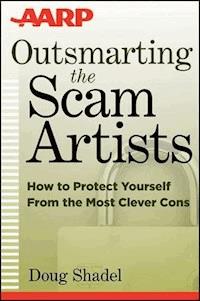
A practical guide to avoiding the most common scams, from a fraud-fighting expert U.S. consumers lose billions of dollars each year to scam artists--and the next victim could be you. While anyone can be targeted, many victims are older. In AARP's Outsmarting the Scam Artists, renowned fraud-fighter Doug Shadel offers practical advice for consumers who want to protect their money as well as the financial assets of their parents and families. Despite the rise of scams, many people are embarrassed to admit they've been victimized. The author helps break the cycle of shame by including accounts from the people who've been scammed as well as tips from a surprising source: convicted con artists who reveal how they've defrauded people like you. * Get practical tips to combat all kinds of scams, from simple lottery tickets to non-existent oil and gas deals and religious ponzi schemes * Learn how to protect yourself by securing your mailbox and fraud-proofing your trash * Get inside the head of sophisticated scam artists to discover how you can become the type of individual they avoid Scammers are everywhere. But with Outsmarting the Scam Artists in hand, you can protect yourself and your money.
Sie lesen das E-Book in den Legimi-Apps auf:
Seitenzahl: 291
Veröffentlichungsjahr: 2012
Ähnliche



















Contents
Acknowledgments
Preface
Part I: The Scam Artists’ Playbook
Chapter 1: Inside the Con Artist’s Mind
No Conscience
Creating a Persona
Conclusion
Chapter 2: Ether
What Con Artists Say about Ether
Case Study: The Effects of Ether on a Smart Investor
Tilling the Soil of Victimization
What Social Science Teaches Us about Ether
How the Thinking and Feeling Brains Work Together
Emotional Hijacking Equals Ether
The Hot-Cold Empathy Gap
Chapter 3: The Stages of Fraud
Stage One—The Front
Stage Two—The Drive
Stage Three—The Close
Stage Four—The Load
Conclusion
Part II: Con Artists in Action
Chapter 4: Exploiting Ego
The Front
The Drive
The Close
The Load
Conclusion
Tips for Avoiding Oil and Gas
Chapter 5: Exploiting Faith
The Front
The Drive
The Close
Conclusion
Tips for Avoiding Ponzi Schemes
Chapter 6: Exploiting Fear
The Front
The Drive
The Close
Tips for Avoiding Gold Coin Fraud
Chapter 7: Exploiting Boredom
The Front
The Drive
The Close
The Load
Tips for Avoiding Movie Scams
Chapter 8: Exploiting the American Dream
Most Business Opportunity Frauds Are Alike
The Front
The Drive
The Close
The Load
Conclusion
Tips for Avoiding Business-Opportunity Fraud
Chapter 9: Exploiting Hope
Alice—Age 75
Doris—Age 83
Myrtle—Age 79
Tips for Avoiding Lottery Fraud
Chapter 10: Exploiting Credit
The Interview: Inside the Mind of an Identity Thief
Tips for Avoiding Identity Theft
Part III: How to Fight Fraud
Chapter 11: Who Are the Victims?
The Fraud-Vulnerability Quiz
How to Score Your Quiz
What Factors Make Us Vulnerable?
Summary of Risk Factors
Specific Profiles
Conclusion
Chapter 12: Become a Fraud Fighter
Protecting Yourself from Fraud
Protecting Friends and Family from Fraud
Coping with Being a Victim
Conclusion
Chapter 13: Fraud Prevention That Works
Psychological Barriers to Preventing Fraud
Cultural and Practical Barriers to Fraud Prevention
Prevention that Works
The Fraud Fighter Call Centers
Conclusion
Call To Action: Join the Fraud Fighters
Appendix A
Appendix B
About the Author
Index
Copyright © 2012 by AARP. All rights reserved. AARP is a registered trademark.
Published by John Wiley & Sons, Inc., Hoboken, New Jersey.
Published simultaneously in Canada.
No part of this publication may be reproduced, stored in a retrieval system, or transmitted in any form or by any means, electronic, mechanical, photocopying, recording, scanning, or otherwise, except as permitted under Section 107 or 108 of the 1976 United States Copyright Act, without either the prior written permission of the Publisher, or authorization through payment of the appropriate per-copy fee to the Copyright Clearance Center, Inc., 222 Rosewood Drive, Danvers, MA 01923, (978) 750-8400, fax (978) 646-8600, or on the Web at www.copyright.com. Requests to the Publisher for permission should be addressed to the Permissions Department, John Wiley & Sons, Inc., 111 River Street, Hoboken, NJ 07030, (201) 748-6011, fax (201) 748-6008, or online at www.wiley.com/go/permissions.
Limit of Liability/Disclaimer of Warranty: While the publisher and author have used their best efforts in preparing this book, they make no representations or warranties with respect to the accuracy or completeness of the contents of this book and specifically disclaim any implied warranties of merchantability or fitness for a particular purpose. No warranty may be created or extended by sales representatives or written sales materials. The advice and strategies contained herein may not be suitable for your situation. You should consult with a professional where appropriate. Neither the publisher nor author shall be liable for any loss of profit or any other commercial damages, including but not limited to special, incidental, consequential, or other damages.
For general information on our other products and services or for technical support, please contact our Customer Care Department within the United States at (800) 762-2974, outside the United States at (317) 572-3993, or fax (317) 572-4002.
Wiley also publishes its books in a variety of electronic formats. Some content that appears in print may not be available in electronic books. For more information about Wiley products, visit our web site at www.wiley.com.
This and other AARP books are available at AARP’s online bookstore, aarp.org/bookstore.
Library of Congress Cataloging-in-Publication Data:
Shadel, Doug, 1957–
Outsmarting the scam artists : how to protect yourself from the most clever cons / Doug Shadel.
p. cm.
Includes bibliographical references and index.
ISBN 978-1-118-17364-0 (pbk.); 978-1-118-22702-2 (ebk); 978-1-118-24007-6 (ebk); 978-1-118-26467-6 (ebk)
1. Fraud–Prevention. 2. Swindlers and swindling. I. Title.
HV6691.S42 2012
613.6—dc23
2011050802
This book is dedicated to the hundreds of public servants and volunteers who have devoted their lives to fighting fraud in all its forms.
Acknowledgments
I would like to thank the following individuals for their contributions, directly or indirectly, to this book: Scott Adkins; Emily Allen; Lona Choi-Allum; John Barnett; Crystal Tolbert Bell; Dan Bolick; Joe Borg; Alan Buie; Elliot Burg; Bruce Carlson; Kathi Brown; Laura Carstensen; Pat Cashman; Rachelle Cummins; Martha Deevy; Shari Delaney; Jimmy Edwards; Rob Ence; Jason Erskine; John Gannon; Lois Greisman; Chuck Harwood; Bill Hessle; Kathryn Holguin; Sally Hurme; Christine Kieffer; Melodye Kleinman; Dan Lord; Erin Leahy; Jodi Lipson; Ellyn Lindsey; Shoshana Lucich; Jean Mathisen; Greg Marchildon; Ingrid McDonald; Rob McKenna; Amy Nofziger; Nanna Notthoff; Karla Pak; Anthony Pratkanis; Jennifer Sauer; Susanne Schiebe; Lori Schock; Mike Schuster; Emily, Nick, and Renee Shadel; Bridget Small; Chris Raaum; John Risjman; Terri Thome; Doug Walsh; Gerri Walsh; Cheryl Weber; and Lee White.
PREFACE
The Big Myth about Fraud
Anyone who has spent time giving talks in the community about how to avoid fraud encounters a common reaction: “This is all well and good for other people, but I’m too smart to ever fall for one of these scams.”
People who make such comments haven’t met Dave Benson, a highly successful businessman who retired in 2002 with a nest egg of more than $2 million dollars. Two years later, he had lost nearly $650,000 of it to an oil and gas scam out of Dallas, Texas.
They also haven’t met Steve Johnson, a 20-year veteran stock-broker who got to age 58 and saw that his 401(k) was not sufficient to pay for his retirement, so he started investing in high-risk investments like rare stamps, stock options, and oil and gas units. He eventually lost $75,000.
And then there was Allen Jennings, a college professor at the University of California with a PhD in organic chemistry who lost $800,000 to a series of movie scam investments operating out of Hollywood, California.
The list goes on. Research conducted by AARP and the Financial Industry Regulatory Authority (FINRA) Foundation found that investment fraud victims had more education, earned more, and were more financially literate than the general population. Many victim lists look like a who’s who of American business.
So why are so many people in denial about their own susceptibility to this crime? Part of it is human nature. Health psychologists long ago identified something known as “the illusion of invulnerability.” This is the human tendency to under estimate one’s own chance of getting a serious illness and it is a major barrier to changing one’s behavior. For if a person thinks, as apparently many do, that “other people get cancer, but I won’t,” they will never take any steps to avoid it. The same illusion holds true for becoming a fraud victim. If you don’t think you will be taken, you won’t take steps to avoid it.
One goal of this volume is to convince the reader that anyone, no matter how intelligent or successful, can be taken given the right circumstances and the right con man. You will see numerous examples in these pages of extraordinarily sharp business people who fell prey to the sophisticated psychological tactics con men employ.
The New Frontier: Emotion and Persuasion
New research has uncovered the two primary tools con artists employ to defraud victims: heightened emotions and persuasion. With regard to emotions, the con artist’s first order of business is to get the victim into a heightened emotional state known as “ether.” The con artists all believe that heightened emotions make it easier to push the target into a poor decision because they are less able to access the thinking part of the brain and raise objections based on logic and reason. Social scientists have known for years that not only do we make poor decisions when we are in a heightened emotional state, but we are also notoriously poor at realizing how much influence such emotions have on our decisions. This suggests that fraud prevention efforts should include information about the impact of emotion on decision-making.
Another key tool employed by con artists is persuasion. Researchers have discovered that while new scams arise everyday, the underlying persuasion tactics employed in those scams remain fairly constant. They have also discovered that fraud victims are less able than the general public to spot persuasion tactics used by con men. Thus, an emerging new strategy in the fight against fraud is to teach people the persuasion tactics used in all scams. And as we describe in Chapter 13, there is growing evidence that such prevention tactics are effective.
Targeting Vulnerable Populations
An estimated 10 to 15 percent of the U.S. population falls for one kind of scam or another each year.1 While theoretically anyone can be victimized, researchers have discovered that there are certain demographic, psychological, and behavioral characteristics that make some people more susceptible to fraud than others. This suggests that prevention messages can be targeted to particular vulnerable populations instead of having to reach everyone. For example, a 2011 study by the AARP Foundation found that the average fraud victim was 69 years old. Other studies of known victims have found the average victim age to range between 55 and 65 years old.2 We discuss this new profiling research and how it is being applied in the field in Chapters 11 and 13.
Another important prevention tool, outlined in Chapter 3, is understanding the stages that con men take their victims through in a typical scam. This is simply another way for investors to be able to see a bad guy coming from a distance.
One final point about this book: The sources used to describe how fraud works are equal measures of social science research, law enforcement case files, victim profiles, and interviews with con artists. The insights from former con artists provide an unprecedented glimpse inside the mind of these swindlers. The 12 master cons quoted herein have collectively stolen hundreds of millions of dollars from American investors and consumers. Most of these cons insisted on hiding their identity, so we have given them each a pseudonym (see “Meet the Cons”).
What are they saying? In reviewing hundreds of pages of interview transcripts with con artists over the years, the insights they have provided are remarkably consistent. You might say that the “findings” from these interviews have been replicated over and over. There is very little disagreement among cons about the basic tactics they employ.
This volume reveals nothing less than the scam artist’s playbook, a detailed inventory of the strategies and tactics cons employ to defraud consumers. Our hope is that by understanding how these strategies and tactics work, we can begin to chip away at this pernicious social problem.
Meet the Cons
Rick Barnes—Barnes spent more than 15 years perpetrating one mail fraud scheme after another until his arrest and conviction in 2008. Specialty: Lottery and prize fraud.
Pete Chambers—Chambers was arrested in the mid-1990s as part of a massive sweep of fraudulent telemarketing rooms by the federal government. He served several years in federal prison for his crimes. Specialty: Free prize/lottery scams.
Jimmy Edwards—Edwards worked in more than 30 fraudulent boiler rooms mostly in south Florida between 1996 until his arrest in 2004. He was convicted of fraud and served 37 months in prison. Specialty: Business opportunity scams.
Mike Harris—Harris worked in oil-and-gas boiler rooms in Texas and Oklahoma for seven years in the 2000s. He was never charged with fraud but was named in lawsuits where victims sued firms in which he worked. Specialty: Oil and gas scams.
Chuck Jones—Jones worked in charity-fraud boiler rooms for several years before being arrested in 1995 along with 200 others in an FBI sweep of telemarketing rooms nationwide. Specialty: Charity scams.
Ed Joseph—Joseph worked for more than 20 years as an owner and operator of fraudulent boiler rooms across the country. Specialty: Gold coins/investments.
Ron Mann—Mann was co-founder and lead preacher of Globadine Ministries, the largest religious-based Ponzi scheme in U.S. history. Globadine took in more than $450 million in 10 years. Specialty: Ponzi schemes.
Sara Needleman—Needleman spent a decade as a meth addict and identity thief until her arrest and conviction in 2003. Her mother told her to tell AARP how she did it. Specialty: Identity theft.
Jeremy Shipman—Shipman worked in multiple fraudulent boiler rooms over the years before being convicted in 2009. He is currently serving a 33-month sentence in federal prison. Specialty: Gold coins/investment scams.
Freddy Smith—As far as we know, Smith has never been charged with a crime. He has trained hundreds of con men over the years on the craft of swindling people over the phone and has served as an informant for several law enforcement agencies. Specialty: Investments/gold coin scams.
Bill Sullivan—Sullivan owned and operated several fraudulent boiler rooms that raised money for low-cost Hollywood movies. He took in more than $20 million from 800 investors before being indicted by the U.S. Justice Department. Sullivan is currently serving a three-year jail sentence. Specialty: Movie investment scams.
Johnny Weber—Weber was a top closer of oil-and-gas deals in Texas. He was arrested after a firm he started took in $14 million in 18 months. Weber is currently serving a 10-year prison term. Specialty: Oil-and-gas investments.
Notes
1. K. Anderson, Consumer fraud in the United States: The second FTC survey (Washington DC: Federal Trade Commission, 2007).
2. K. Pak and D. Shadel National Victim Profiling Study (Washington DC: AARP Foundation, 2011).
PART I
THE SCAM ARTISTS’ PLAYBOOK
CHAPTER 1
Inside the Con Artist’s Mind
Pay phone/internet rtes
$150,000/yr possible
Call 1-800-888-8888
Have you ever seen an ad like this and wondered what they were offering? This ad appeared in the Baltimore Sun and in newspapers around the country in October 1999. It is known in the scam boiler room world as a “blind ad” because it is hard to tell from reading it what they are selling. Regardless of what is being sold, the “$150,000/yr possible” claim generates thousands of phone calls and in this case, all the calls were going to a south Florida business called All American Pay Phones (not its real name).
Lesen Sie weiter in der vollständigen Ausgabe!
Lesen Sie weiter in der vollständigen Ausgabe!
Lesen Sie weiter in der vollständigen Ausgabe!
Lesen Sie weiter in der vollständigen Ausgabe!
Lesen Sie weiter in der vollständigen Ausgabe!
Lesen Sie weiter in der vollständigen Ausgabe!
Lesen Sie weiter in der vollständigen Ausgabe!
Lesen Sie weiter in der vollständigen Ausgabe!
Lesen Sie weiter in der vollständigen Ausgabe!
Lesen Sie weiter in der vollständigen Ausgabe!
Lesen Sie weiter in der vollständigen Ausgabe!
Lesen Sie weiter in der vollständigen Ausgabe!
Lesen Sie weiter in der vollständigen Ausgabe!
Lesen Sie weiter in der vollständigen Ausgabe!
Lesen Sie weiter in der vollständigen Ausgabe!
Lesen Sie weiter in der vollständigen Ausgabe!
Lesen Sie weiter in der vollständigen Ausgabe!
Lesen Sie weiter in der vollständigen Ausgabe!




