


Erhalten Sie Zugang zu diesem und mehr als 300000 Büchern ab EUR 5,99 monatlich.
- Herausgeber: The Lilliput Press
- Kategorie: Geisteswissenschaft
- Sprache: Englisch
This first book-length study of the fiction of John McGahern traces his development as an artist by providing a detailed reading of each of his five novels and three collection of stories.
Sie lesen das E-Book in den Legimi-Apps auf:
Seitenzahl: 543
Veröffentlichungsjahr: 1993
Das E-Book (TTS) können Sie hören im Abo „Legimi Premium” in Legimi-Apps auf:
Ähnliche




















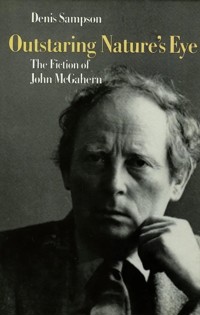
John McGahern. Courtesy of Madeline Green.
Outstaring Nature’s Eye
The Fiction of John McGahern
Denis Sampson
The Lilliput Press Dublin
For Gay
I knew myself too well. There was more caution than any love or charity in my habitual going home. It was unattractive and it had been learned in the bitter school of my ungiving father. I would fall into no guilt, and I was already fast outwearing him. For a time, it seemed, I could outstare the one eye of nature.
JOHN MCGAHERN, “Gold Watch”
We must not make a false faith by hiding from our thoughts the causes of doubt, for faith is the highest achievement of the human intellect, the only gift man can make to God, and therefore it must be offered in sincerity. Neither must we create, by hiding ugliness, a false beauty as our offering to the world. He only can create the greatest imaginable beauty who has endured all imaginable pangs, for only when we have seen and foreseen what we dread shall we be rewarded by that dazzling, unforeseen, wing-footed wanderer…. He is of all things not impossible the most difficult, for that only which comes easily can never be a portion of our being…. I shall find the dark grow luminous, the void fruitful when I understand I have nothing.
W. B. YEATS, Per Amica Silentia Lunae
In art the question: how? is more important than the question: what? If all that you repudiate appears as an image—note: as an image—in the writer’s mind, what right have you to suspect his intentions…. No man of real talent ever serves aims other than his own and he finds satisfaction in himself alone; the life that surrounds him provides him with the contents of his works; he is its concentrated reflection; but he is as incapable of writing a panegyric as a lampoon.
IVAN TURGENEV, “Introduction” to Collected Edition of Novels, 1880
The common end of all narrative, nay, of all, Poems is to convert a series into a Whole: to make those events, which in real or imagined History move on in a strait Line, assume to our Understandings a circular motion—the snake with it’s Tail in it’s Mouth.
S. T. COLERIDGE, Letter to Joseph Cottle, 7 March 1815
Contents
Title Page
Dedication
Epigraph
Preface
Acknowledgments
List of Abbreviations
Introduction: The Identity of the Artist
1. The Barracks: Suffering, Memory, and Vision
2. The Dark: Choice and Chance
3. Nightlines: Repetition of a Life in the Shape of a Story
4. The Leavetaking: Memory Becoming Imagination
5. The Pornographer: The Writing on the Wall
6. Getting Through: Imperfection in a Mirror of Perfection
7. High Ground: The Natural Process of Living
8. Amongst Women: The Troubles and the Living Stream
Conclusion
Appendix: Biographical Outline
Works Cited
Index
Copyright
Preface
John McGahern’s fiction has had a large and loyal audience for thirty years, yet the critical reputation of Ireland’s most important contemporary novelist remains enigmatic. The Barracks (1963) and The Dark (1965) won him a position as the most significant writer of prose in the generation after Beckett; indeed, many reviewers of the latter novel spoke of his work as on a par with the early Joyce. This comparison recurred also in reviews of later novels and stories, although his development as a writer through the seventies and eighties has evidently puzzled many, and the overall unity and direction of his oeuvre remain undefined. Comments on his work in histories of Irish literature are routinely laudatory, but interpretation is cursory and vague, and for many years his literary reputation was stuck fast in the mold of the Irish writer whose gestures of independence are punished by censorship and expulsion from his teaching position. But McGahern avoided the public role in which he was cast by the political issues surrounding the publication of The Dark, and for fifteen years he quietly nurtured his talent without promoting or defending his art. The respect of his peers has grown with the years. Academic articles on his work are few in number, however, and apart from a handful that examine the art of a particular novel or story, the bulk of general commentary has followed a thematic and repetitive approach and gives the distinct impression that the secret of McGahern’s art has eluded his readers. The popular and critical success of Amongst Women in 1990 won him a wider international audience, yet although his work has been loved, hated, and honored, his novels and stories have not received the careful reading they deserve from critics and scholars.
The readings that follow are an attempt to get close to the vital energy of McGahern’s art of fiction. His work is an organic whole, as in the case of any writer, but McGahern’s is a special case. He has not ranged out far in search of exotic material, but what may appear to be an obsessive interest in a small, largely rural, world is not in itself reason to think his work minor or merely of local concern. In most of McGahern’s fiction the true adventure consists in the engagement of the imagination with the everyday; he is, in short, a poet who happens to write in the medium of realistic prose. He has chosen to share with the reader the play of light and dark over an intimately observed local landscape, but, more tellingly, he shares the drama within the perceiving subject and between consciousness and place. One of the most remarkable features of these eight volumes of contemporary fiction is that they circle and converge on one another, and the reader is invited to contemplate the process of making within the context of an evolving life. Each new fiction casts light on earlier stories and novels, and, as McGahern has suggested in talking about Yeats, these successive “stanzas” are linked by “refrains” in the manner of a ballad.
Like other regional writers, he has made it his aim to go deeper and deeper into the soil of personal experience so that it is distilled by poetic perception until it assumes mythic patterns. If this brackets him with Thomas Hardy in the minds of some readers, the organic integrity of his work also has a more modern and contemporary quality because, like Proust or Yeats or Joyce, he includes the story of the evolution of the observer, the artist searching for his vision and for the renewal of his vision. Some readers are drawn into his work because it appears to be confessional in a frank and contemporary way, but insofar as the story of the young man growing up in the Irish countryside is autobiographical, it is so because the origin of the artistic vision and the stories of its renewal are dramatized through that material. The realistic mode thus becomes the site of a myth; place and personal experience are fused in a symbolic style to bear witness to a poetic vision of the human facts of suffering and mutability. As “Gold Watch” dramatizes it, the bereft individual comes face to face with the cyclops eye of Nature and must call on the resources of imagination to outwit, temporarily, the ultimate biological fate.
While many comparisons might be made with Irish writers of his generation and earlier in the areas of social and psychological insights, I have set myself another task. I have tried to follow McGahern’s own sense of the literary traditions to which he feels an affinity and the critical discourse in which he articulates his own sense of the creative process and of the literary medium. Some of the prominent figures are, predictably, Irish—Yeats, Joyce, Beckett—but McGahern reads them in their European literary contexts and ranges widely over many centuries of European writing for the foundations of his art and for his understanding of his role as artist. While it is tempting to trace his dialogue with philosophical and literary traditions, his fictional medium is created out of the examples and insights of Flaubert and Chekhov, Joyce and Proust. These are the main names that will recur in the following pages, but it will be seen that McGahern’s encounters with modernism simply gave him the intellectual discipline and context to pursue the search for his own style.
My method is straightforward and perhaps too pedestrian for some readers, but McGahern’s curious status has required me to address myself to different audiences. The bulk of the book is made up of individual chapters devoted to a single novel or collection of stories. My reading of each novel is an attempt to map those areas where technique and material most clearly reflect the vital presence of a personal vision; while I establish the coherence of each separate work, I also try to define each work’s part in an evolving whole. McGahern’s comment that Dubliners may be read as a novel has led me to view each collection of stories as an integrated work, although I have singled out certain key stories in each volume for extended study. McGahern’s development during each decade may be observed by situating each volume in relation to the novels. My hope is that these extensive discussions will inspire other readers to recognize the complexity of his art of fiction and to explore further where I have left off.
An introductory chapter draws on interviews, reviews, and other statements by McGahern to provide the necessary ambience of the writer writing. Almost all of this material comes from the eighties when he became a more public figure, and so I have had to sketch the path by which the boy from the Roscommon-Leitrim countryside became the mature artist he was, already, when The Barracks was published in 1963. From that point on, the going didn’t get easier for, following the banning of The Dark in 1965, he became, more determinedly than before, a writer who spoke only through his books: a new one has appeared at roughly five-year intervals ever since. His identity as an artist is, then, in his art, and although it may strike some critics as old-fashioned to say so (and McGahern’s wry story “Oldfashioned” has much to say that is pertinent about fashions and reputations), it may be because there is so little else to go on that his art has not become known to a much wider international audience.
Readers may question the appropriateness of my title for it will quickly become evident that I slide from “staring” to “seeing” in my attempt to describe McGahern’s narrative style. It is the poetic vision, the “gold watch” of fiction itself, which redeems that mundane material of self and family and place and which has already been stared at, perhaps too analytically. “Gold Watch,” that key story in McGahern’s oeuvre from which I have taken my title, may be seen as the essence of his technique: on the level of realism, it presents a character who is a skeptical rationalist to the point of anguish and absurdity, while on the symbolic or poetic level, the character’s experience is placed in a web of resonances and archetypal patterns that redeem the bitterness and the poignancy of the irresolvable conflict between father and son, transforming them so that they “seemed fixed like a leaf in a rock.” The fusion of frailty and hardness in such an image of the framing of particular moments in art; the prose that registers the triumphs and the absurdity of the person in time; the proximity of vision and blindness, of form and flux—all are suggested by “Gold Watch,” which epitomizes the heartfelt need and the felicity of McGahern’s artistic endeavor.
Acknowledgments
I was fortunate to meet John McGahern in early 1979, and a conversation I taped on that occasion, now partially printed in the CanadianJournal of Irish Studies 17, no. 1 (July 1991), has been the inspiration for my thinking over many years. My greatest debt is to John and Madeline McGahern for renewing that inspiration through conversation and correspondence, although I must note that I alone am responsible for these interpretations of his fiction, and nothing I have written here has been seen by the artist.
My debts to a handful of critics, notably, Michael Foley, Roger Garfitt, Thomas Kilroy, and Paul Devine, will be evident. Although J. C. C. Mays has not written about John McGahern’s work, I am conscious of a lasting debt to this exemplary teacher and scholar-critic, for many years a lecturer at University College, Dublin. George O’Brien’s enthusiasm for the project and his comments on earlier drafts have been invaluable in maintaining my energy during the writing. I would also like to thank John Wilson Foster for his early reading of the manuscript and for his comments on it; his support of the project was also crucial at that stage. I thank David McGonagle of The Catholic University of America Press for his interest in my proposal from the beginning and all those at the Press for the courtesy of their communications with me. In addition I offer thanks to Philip Holthaus, meticulous copy editor, whose thoughtful scrutiny of my sentences led to many improvements in clarity and style.
My first effort to articulate what I believed was significant in McGahern’s art was a brief essay on The Leavetaking in the CanadianJournal of Irish Studies 2, no. 2 (December 1976), and I would like to acknowledge the sustaining interest and encouragement of its editors, Andrew Parkin, Brian John, and Ronald Marken. In particular, parts of the discussion of McGahern and Proust included here appeared first in an article in the Canadian Journal of Irish Studies 17, no. 1 (July 1991) and my Checklist of writings by and about McGahern to which I refer readers appeared in the same issue. Quotations from John McGahern’s work are included by kind permission of the author and of Faber and Faber Limited.
The encouragement of my Irish and Canadian families has been a lifeline which cannot be acknowledged in this medium. From stuffing newspaper clippings in letters to indulging my solitary activities as reader and writer, different individuals have supported me in many ways, no one more than the person to whom I dedicate this book.
Abbreviations
John McGahern’s novels and volumes of stories are cited in the text as follows:
Note: In the cases of the last four books, the numbering of pages in paperback editions published by Faber and Faber corresponds to the numbering of pages in hardbound editions.
Introduction
The Identity of the Artist
Unlike many contemporary writers, John McGahern abstained for almost twenty years from influencing the critical reception of his work except through the medium of the fiction itself.1 In fact, it appears that becoming a cause célèbre in 1965 impelled him to adopt his own version of “silence, exile and cunning.” The publicity surrounding the banning of The Dark in Ireland and his dismissal from the teaching position he had occupied for ten years endangered his ability to write, he has reported,2 and so he withdrew from the hazards of public categorization or castigation to define the direction of his artistic development. He left Ireland at that time, and when he returned to live in the West of Ireland, settling eventually in the countryside of his childhood, he rejected the public role of social or literary commentator. When he began to give interviews fifteen years after The Dark, he appeared bemused by the fads and fashions of literary reputations and by the ironies of moral and political self-righteousness. Yet indirection conveys its own truth; the satirical strand of his work has grown to accommodate not only a wide-ranging preoccupation with religious, political, social, and sexual dogmatism, but also a concern with tribal forms of repression, and with literary stereotyping.
John Updike’s review of The Pornographer in the New Yorker was given the title “An Old-Fashioned Novel.” McGahern appears to have planned an oblique rejoinder: he wrote a story called “Oldfashioned” and wanted to have his next book called after it.3 In that story, a comic vignette of his own career, a country boy grows up to become a successful academic who “also made a series of documentary films about the darker aspects of Irish life. As they were controversial, they won him a sort of fame: some thought they were serious, well made, and compulsive viewing, bringing things to light that were in bad need of light; but others maintained that they were humourless, morbid, and restricted to a narrow view that was more revealing of private obsessions than any truths about life or Irish life in general” (HG 55). Thus McGahern plays with the whole issue of reputation, cunningly incorporating it into his work so that he can evade those broader categories that would deny his work its distinctiveness and its authenticity.
McGahern’s refusal in the sixties and seventies to comment on his own work, or to become a public figure, allowed him the deeper freedom to define himself as an independent artist. He has seemed willing to wait for his readers to discover the paths he has opened up for his own development. He may seem “oldfashioned,” then, in insisting that it is the work of art that is valuable, and his own life merely a distraction from it. And yet, when his oeuvre is looked at as a whole, it becomes evident that among the pleasures he offers—and this accounts for his popular success in Ireland—are meditations on the currents of familial and communal life, on the domestic history of the revolutionary decades of Catholic Ireland in the midcentury, on the burden of being a woman or a man in such a society. This is the material of McGahern’s art, for he is a deeply engaged observer of Irish society. It is the immediacy of his images of local life, in the country or in the city, that allows his fiction to be read as realism, but it exists also as a symbolic art in which the concrete image becomes a locus of meaning in an indeterminate world. “I think all good writing is local,” he has said, “in the sense of place, and I think nearly all bad writing is ‘national.’”4 In saying this, he is not only guarding his own freedom as an artist to set the terms of his participation in literary and political controversy but is insisting on the concreteness of the artistic image and the dangers posed to it by “bad writing,” or, as he will later dramatize it, by pornography.
In this, he is reflecting one of the lessons of his master, Joyce, or, rather, of Flaubert, expressed in the conversation of Stephen Dedalus: “The feelings excited by improper art are desire or loathing…. The arts which excite them, pornographical or didactic, are therefore improper arts. The esthetic emotion … is therefore static. The mind is arrested and raised above desire or loathing.”5 The equally celebrated terms in which Yeats stated a comparable goal, to become neither “rhetorician” nor “sentimentalist,” are another touchstone for McGahern’s determination to create his own “vision of reality.”6 Only a careful study of the art of his fiction will clarify the central importance to him of art itself as a way of knowing, and will direct the reader back with appropriate attention to the deeply felt psychological and social resonances of his work.
John McGahern has associated his wish to become a writer with his discovery in school that not only were places he knew in the Sligo-Leitrim-Roscommon region real physical places but also they existed in the musical and memorable poems of W. B. Yeats:
I think there is a peculiar moment in everybody’s growing up when there is that language change from being marvellous stories, like movies, and marvellous songs, which words always are for me, so that you suddenly realize that these things are about your own life … when [writing literature] becomes a moral activity. I suppose if it did happen with anybody it was with Yeats, because we used to go to the sea in Sligo. I suppose Yeats gives me more pleasure than any other writer, and more constant pleasure: to actually see the names like Knocknarea and Queen Maeve’s Grave, and “I stood among a crowd at Drumahair, His heart hung all upon a silken dress”—to actually know that those placenames were places that I knew like Boyle or Carrick on Shannon.7
This statement suggests that an intimate connection between place and style, the symbolic force of concrete images, was central to McGahern’s identity as a writer from the beginning. Yeats’s poems of longing and dreams in which the persona is anchored to the place-names appealed to the young McGahern because the pleasure of the language itself was given a moral dimension. If the experience of the teacher-mother in The Leavetaking recalls this discovery of Yeats’s poetry, then her association of poetry with memory and with “the infusion of the poetical personality into the words” (L 38) conveys McGahern’s own sense of “the essential mystery and magic” that literature finds in ordinariness.8 The value of “marvellous stories” or songs or movies as pleasurable diversion is now transformed; literature as a vocation is discovered, and a personal vision or truth is attached to specific effects of language. The local and ordinary world, the experience of a young country boy, became through the magic of Yeats’s verse the potential material of art.
These discoveries by the young McGahern seem to be echoed in two other childhood experiences he has recalled: the death of his mother when he was ten years old and his discovery of books. His early years were spent with his mother, a teacher; after her death he went to live with his father in the police barracks at Cootehall. McGahern has commented on this move: “[I]t was my first experience of the world as a lost world and the actual daily world as not quite real.”9 The phrase “the lost world” hints at the central importance that Proust will have later in his artistic life, and indicates the significance of memory as a means of restoring reality to the world. These literary and metaphysical resonances of that experience came later, but the boy seems to have made his own discovery that “time and the world are ever in flight” and that “words alone are certain good.” In “The Solitary Reader,” he tells how he “had great good luck when I was ten or eleven. I was given the run of a library. I believe it changed my life and without it I would never have become a writer.”10 McGahern’s essay re-creates the circumstances of his boyhood visits to a Protestant house in the neighborhood of Cootehall where he read indiscriminately, but the older McGahern associates those days with an experience of Proustian intensity: “There are no days more full in childhood than those days that were not lived at all, the days lost in a favourite book…. Nowadays, only when I am writing am I able to find again that complete absorption when all sense of time is lost.”11 Reading and writing conquer time not simply by recovering the pure concentration of childhood but by restoring a sense of authentic reality to the self.
Yet that intense pleasure changes, he goes on to say, and becomes more akin to what he spoke of in relation to Yeats, although he associates it here with a later phase of his youth when he went to live in Dublin and with a more deliberate search for particular works of literature. This search becomes a more personal quest for faith or truth: “[W]e begin to come on certain books that act like mirrors. What they reflect is something dangerously close to our own life and the society in which we live. A new painful excitement enters the way we read…. The quality of the writing becomes more important than the quality of the material out of which the pattern or story is shaped.”12 McGahern describes the great excitement of discovering European classics in literature, in the theater, and in the cinema, but he has already associated his interest not with “an indolence or drug” but with “our growing consciousness, consciousness that we will not live forever and that all human life is in essentially the same fix.”13 While “The Solitary Reader” describes the ambience in which McGahern grew into a literary life in Dublin, it is also a kind of manifesto that claims for literature that personal reality experienced by the “solitary reader,” without which “the word is spiritually dead.”14 This sensitivity to the pleasure and to the spiritual reality or truth in poetic language, which the mature McGahern has articulated as a critical norm, is affirmed most accurately in his own novels and stories.
His discovery of the meaning and value of literature appears to be continuous with these childhood experiences. Therefore it is scarcely surprising that his fiction is rooted in the childhood place. What may be surprising, however, is that the place and the experiences associated with it in his realistic fiction appear not to be moments of positive illumination, at least not overtly so. In the sixties when his first two novels were published McGahern became known as a realist, a naturalist, even, who wrote of characters who were victims of the most squalid and repressive aspects of Irish rural life. In The Barracks, he depicted the death by cancer of a middle-aged woman and then, in The Dark, he presented the claustrophobic world of an abused adolescent boy. The visceral account of violence and isolation and suffering upset some readers, but others recognized that “scrupulous meanness” and the presence of Joyce in other ways were a guarantee that it was “the quality of the writing” rather than “the quality of the material” that deserved attention.
McGahern did not become a poet or a man of letters in the manner of Yeats; instead, he became a prose writer in the footsteps of Joyce. While Dubliners was undoubtedly an early stylistic model, in ways that a later essay on the book suggests, and A Portrait of the Artist as aYoung Man was a model for the psychological observation of a young Catholic male, that novel and Ulysses can be seen as reference points for the working out of an aesthetic theory for fiction. The figures of Joyce and Yeats actually combine in the formation of McGahern’s identity as an artist. Joyce’s Dublin is where McGahern lived as a young man, and its features as a local place are definitively evoked and transformed in many of his stories, in The Leavetaking, and in ThePornographer. McGahern found in both writers a decisive emphasis on personal experience of a local place as an anchor for an art of symbolic transformation through style, and so, when McGahern began to write, he wrote with their authority of the places in which his imagination was rooted.
John McGahern grew up in the countryside outside Carrick on Shannon, in Leitrim to the east of the town and in Roscommon to the west, and the place-names of that region and the river Shannon itself provide a tangible location for much of his fiction. He was born a decade after the War of Independence and the Civil War had ended, and the violence of that period and the heroic role won by participants were a living history. They lived on in his childhood because his father and other family members had been actively involved, and his father’s subsequent career as a police sergeant maintained an intimate and disillusioned connection with the large-scale political and social movements that animated the newly independent state. These were also the decades when insular nationalism and conservative Catholicism were shaping the new society, the decades when liberals and writers like Sean O’Faolain voiced their opposition to censorship and to what McGahern has referred to as the competing bigotries in both parts of the divided island of Ireland.15 The bleak, male-dominated world of the barracks, and later of a small farm, during these decades is a representative situation in McGahern’s fictions. Over and over he returns to these settings to present abrasive father-son conflicts, and to offer the terrifying anatomy of frustration, disillusionment, and repression characteristic of a boy growing up in the shadow of a man whose life story, as it is revealed in Amongst Women, appears to be an allegory of Irish society itself in this century. This world of the father, of imprisonment in the darkness of violence and tyranny, of ignorance and insensitivity, of the destruction of dreams of renewal and heroism, represents a grim and heartfelt truth about many currents in Irish life, but they are not the only features of that place and time that engage his interest.
The world of childhood he captures in the fiction is an intimately personal one in which ordinary life appears to remain largely untouched by political changes.16 The country life of farmers and villagers is less a social world than it is a world of physical labor, often in unhospitable climatic conditions and always changing according to seasonal changes. The rituals of planting and reaping, of haymaking and potato-picking, and the dependence on rain and sun represent an elemental way of life. Social intercourse in this world is banal and awkward when it is not abrasive. Communal rituals such as sporting events or dances or weddings are rarely alluded to, and conversation is little more than the sharing of clichéd gossip, it too a routine that excludes personal feeling. The isolation of the dying Elizabeth is, in effect, no greater than the isolation of her husband, Sergeant Reegan, the isolation of the adolescent Mahoney no greater than that of his father, or of any of the characters in Nightlines.
Yet one communal ritual was critically important to the young McGahern in this place. The ceremonies of the Catholic church were central to his imaginative development; on numerous occasions he has associated poetry with those ceremonies. The countryside he describes is not the West of Ireland that Yeats had discovered as a child and had returned to as a mature artist; in contrast to Yeats, who believed that a pre-Christian spirituality permeated the folk life of the people, McGahern presents the social life of the people as impoverished, prosaic, and bleak. In his view, the Church provided the people with what Yeats believed it denied them: “The folk tradition had died except for the music. Some sense of the myths lingered on, but as a whisper. The sense of mystery, of luxury, of beauty or terror, all came from the Church, in its rituals and ceremonies.”17 He insists that the influence of the Church was positive: “I have nothing but praise for the Catholic Church. When I was growing up, it provided the only notion of poetry, of truth. It dealt with space and time, it had ceremonies, it had something more than earth itself.”18 This remark echoes a favorite quotation from Proust, which he has used on a few occasions to explain his attitude towards the place of the Church in everyday life: “The Church should be there if for nothing else for the spire that lifts men’s eyes from the avaricious earth.”19 While the power of the institutional church, of which he was himself a victim when he was fired from his job, is satirized in his work, rituals and ceremonies and the individual priests who appear in his fiction are represented with imaginative sympathy and compassion.
Although John McGahern describes himself as an unbeliever, and has said that his childhood participation in the Church was grounded more on fear than on belief, he is a religious writer in the largest sense because he associates art with a metaphysical quest, with the recovery of traces of mystery and a sense of the sanctity of the person. His fiction is preoccupied with the place of Catholicism in the lives of his characters—especially in the first three volumes, The Barracks, TheDark, and Nightlines—and with the place of faith in the movements of consciousness. His young men are frequently faced with the choice of becoming a priest, and all his characters are touched by the metaphysical and psychological emptiness that follows on the loss of faith. Scenes or chapters are sometimes structured by rituals, such as prayer, Confession, or the Mass; Amongst Women takes its title from the Hail Mary in the nightly rosary that Moran uses to reestablish his authority in the family. The aspect of religion that most interests him, however, is the inscrutable and instinctive need for a vision or a faith which, for him, is analogous to the need for poetry.20 The Catholic church was a mediating institution between the individual and the community, on the one hand, and between personal consciousness and the numinous, on the other. That sense of the mystery, the sanctity of person and place, has remained with McGahern, but the sense of life extending on beyond his community, repeating what he could observe close up as human nature itself, may have derived also from the sense of the universal that was embodied in the Latin of the One, Holy, Catholic and Apostolic Church in its preconciliar days.
The continuity of culture in a small country place gives to the behavior and customs of people a rootedness that seems to lift a veil from what is instinctive and to give to consciousness itself a timeless quality; this is another element of that place which McGahern seizes on and translates into fiction. Writing of the countryman, he has said that his spirit knows in an instinctive way: “Son esprit est ancestral aussi, de sorte qu’il voit sa vie comme une légende sur le même plan qu’Achille et que Hector: ‘Je chante tout ce qui fut perdu et tout ce qui fut gagné. Je chante à nouveau les combats.’”21 The “combats,” the rows, that McGahern observes in the familial and the local community have been the stuff of legends and epics, and his primary effort as a writer has been to see the forms of a universal struggle in the lives of ordinary people. The central and archetypal struggles in his fiction are the timeless ones between the generations, between father and son, and between mother and son. Whether the farmer-sergeant Reegan in The Barracks, Mahoney in The Dark, or Moran in Amongst Women and in many stories, the father in McGahern’s work assumes a mythic stature, his anguished inability to maintain control over his changing world expressed in an almost purely instinctive bitterness; his violence against his son is directed less at the efforts of the young man to make his own decisions than at the cruel fate of fathers who are unable to adapt to the loss of their power. He is the Lear of Oakport, the Cronos of Cootehall. The figure of the suffering mother overshadows the young man who, over and over, it seems, must accommodate himself to loss, to her death, to his own loneliness; Oedipus and Hamlet are not far offstage as the young man attempts to replace that childhood intimacy with an adult love. Struggles within the family on the small farm in the Shannon valley, within the prison of the barracks, are seen in the terms of human nature itself and are a microcosm of the world beyond.
The work is local, then, through the quality of intimacy with a knowable place which emerges in the accuracy of eye and ear, with its feeling for the lie of a hill, the light on lake water, the turns of phrase which are an unselfconscious poetry. While McGahern has set stories and parts of novels outside this region, and his evocation of the Dublin of, say, the nineteen fifties, is just as concrete, particular, and vivid, the Leitrim-Roscommon world he has invented is the anchor of his imagination, to which he always returns, because, as he has said, it is real. “One inherits one’s place, just as one inherits one’s accent, one’s language. What’s interesting after that is that one belongs to humankind.”22The reality of place is concretely represented in place-names and in the geography, history, and social customs that adhere to them; McGahern has spoken of his affection for Beckett’s work but sets himself apart from it because “you never meet place-names in Beckett’s books.”23 He goes on to explain his dissatisfaction with Beckett by referring to the concrete status of the representational image in art: “Francis Bacon, the painter, was against abstract art because it was actually going towards the aesthetic and was a sort of ornamentation finally. Leaving the image in, you make it difficult. I feel that about the place-names.” The status of the local image is associated here with being true to one’s character and at the same time true to the responsibility of art to be something more than ornamentation; McGahern’s anchor in the local reflects a conscious decision of the artist, for it is intimately associated with the moral commitment and the aesthetic principles of his art.
This local texture of McGahern’s fiction, in voice and in the concretely referential detail, assumes a symbolic status that is at the heart of his vision. In this reliance on a metaphysics of local images, his fiction parallels the poetry of Seamus Heaney and the plays of Brian Friel. Independently, all of these contemporary writers seem to be drawn to a mystical sense of reality associated with the local voice, typically in place-names; Faith Healer and Translations have introduced an international audience to this seductive and untranslatable sense of the numinous, and Heaney has made music and a mythology from the ways in which consonants and vowels from Gaelic, Scottish, and English have been grafted over centuries onto the townlands of Derry. There is a tradition of Irish writing in earlier generations and in earlier centuries in the Gaelic language, dinnseanachas, in which this minute attention to the local place and its indigenous culture takes on a sacred aura, but it is the literary uses of this heightened observation of the ordinary that is important here. As Patrick Kavanagh puts it, “the God of Imagination waking / In a Mucker bog,” or, in another way in “Epic,” “Till Homer’s ghost came whispering to my mind / He said: I made the Iliad from such a local row.”24 McGahern’s sense of the numinous is constant, although distinctly personal, but his sense of the primary reality of the concrete place and the “local row” allows him to write contemporary fiction as if Homer’s ghost had, indeed, spoken to him. The direction of McGahern’s work may have seemed unclear in the seventies as he turned to write portraits of the artist, in TheLeavetaking and The Pornographer, working in explicitly experimental styles that blend past and present, rural and urban elements. The return to Ardcarne and Oakport in High Ground and Amongst Women leaves no doubt, however, that the recurring preoccupation of McGahern’s fiction is the writing of a contemporary epic.
If McGahern became an artist through an affinity with Yeats, the foundations of his medium of prose fiction were laid by reference to two figures in particular, Joyce and Proust, although both of them have an ancestor, Flaubert, and a descendant, Beckett, who also played major parts in defining his medium. Allusions in novels and stories to these writers and others, explicit and implicit, will be considered in later chapters, for he shares with his reader his own sense of working within literary and philosophical traditions. The idea of tradition itself as an anchor for the individual talent is a part of McGahern’s classical sense of his art. I will leave aside for now the wider question of tradition and the confluence of particular traditions, and instead examine his dialogues with Proust and Joyce to explain McGahern’s thinking about the “gestation” of art and about the medium of prose fiction.
A brief essay, “The Image: Prologue to a Reading,” distills his view of the creative impulse, the evolution of the work, and its metaphysical status. Written in 1968 and revised a number of times since, it rests on the authority of Proust, most of all, and provides clues to a particular way of understanding McGahern’s earlier work and to the evolution of his later career. “Style is not at all a prettification as certain people think,” Proust writes, “it is not even a matter of technique, it is—like colour with painters—a quality of vision, the revelation of the private universe that each one of us can see and which others cannot see.”25 This sentence is clearly echoed in “The Image,” which continues, after identifying image and rhythm as the key elements of style: “The vision, that still and private universe which each of us possess but which others cannot see, is brought to life in rhythm.”26 McGahern accepts the idea that the creative impulse and the vision come from the moi profond that inhabits the social self or selves but has an ontological status. The uniquely individual rhythm of a writer’s style, which links his images and thereby creates the vision of the work of art, comes in an instinctive way. As Proust wrote about Chateaubriand, in an essay McGahern singles out, “One feels that beneath his sentences there lies another reality, which shows through from beneath it and whose physiognomy is made apparent, beneath the several clauses of the sentence, by their lineaments which correspond to it.”27 In “The Image” McGahern affirms his belief in this instinctive impulse to create, to translate that other reality hidden in the psyche into the images and rhythms that alone can suggest its uniqueness. Many years later, he still held to this metaphorical sense of the writing process: “The image is the basis of all writing. The writer’s business is to pull the image that moves us out of the darkness.”28 There are other verbal parallels with “The Image” in Proust’s essays, which McGahern has said are his favorite critical writing,29 but since many of those sketches and theoretical statements were incorporated in A la Recherche du temps perdu, it is not surprising to find that the celebrated early scene, prompted by the madeleine dipped in tea, lies behind “The Image” and behind McGahern’s own fiction.
The approach to the process of artistic creation in McGahern’s “Prologue” resembles Proust’s in the “Overture” in Swann’s Way. “By rhythm,” McGahern writes, “I think of the dynamic quality of the vision, its instinctive, its individual movements; and this struggles towards the single image, the image on which our whole life took its most complete expression once, in a kind of grave, grave of the images of dead passions and their days…. Image after image flows involuntary now, and still we are not at peace … straining towards the one image that will never come, the lost image.”30 It is perhaps a coincidence that Proust’s thoughts on the rhythm of George Sand’s prose, “beneath the everyday incidents, the commonplace thoughts and hackneyed words, I could hear, or overhear, an intonation, a rhythmic utterance fine and strange,” are followed by a statement of his partiality to “the Celtic belief that the souls of those whom we have lost are held captive in some inferior being, in an animal, in a plant, in some inanimate object, and so effectively lost to us until the day … we have delivered them: they have overcome death and return to share our life.”31 It is striking, however, that the souls of the dead resemble the past experiences of the self, McGahern’s “dead passions and their days,” which only involuntary memory can release from darkness, and which secretly resonate in our consciousness at unexpected moments: “Undoubtedly what is thus palpitating in the depths of my being must be the image, the visual memory which, being linked to that taste, has tried to follow it into my conscious mind…. Will it ultimately reach the clear surface of my consciousness, this memory, this old, dead moment which the magnetism of an identical moment has travelled so far to importune, to disturb, to raise up out of the very depths of my being?”32 Proust leaves us in no doubt that conscious efforts will be ineffective: “So it is with our past. It is a labour in vain to attempt to recapture it: all the efforts of intellect must prove futile.”33 This assertion of Proust, that only involuntary recall can recover the “soul” of our past experience, explains why he attaches to the reality of private images a spiritual essence that cannot be said to adhere to intellectual ideas or historical events.
Although McGahern seems skeptical about the chances of recovering the “lost image,” an artist’s compulsion drives him to continue the quest indefinitely, “rejecting, altering, shaping” the work of art, as if religious salvation and immortality depended on achieving perfection. Proust also associates “the object of my quest, the truth,” with religious and aesthetic ends, but even more with psychological ends: “This new sensation having had on me the effect which love has of filling me with a precious essence; or rather this essence was not in me, it was myself. I had ceased now to feel mediocre, accidental, mortal.”34 Here, in the opening section of his novel, Proust speaks of the revitalization of the self, the attainment of a sense of psychological and metaphysical reality, which at the end of the novel will be associated with the achievement of immortality through the distillation of personality in a literary style. McGahern’s “Prologue” states that artistic creation and religious faith are analogous: “It is here, in this search for the single image, that the long and complicated journey of art betrays the simple religious nature of its activity.”35 Proust makes explicit in the very title of his novel, In Search of Lost Time, that his work is a search, a quest for “resurrection” through art; the gestation of McGahern’s more modest oeuvre is anchored in that same quest.
While a casual reference in The Leavetaking to Proust’s statement on the spiritual insignificance of friendship alerts us to the presence of Proustian ideas in that novel, a more significant comment by the narrator and central character suggests his affinity with Marcel: “Loss and the joy of restoration, sweet balm of healing: already that shape must have been on all the faces bent over their books in this the classroom of the day. What a little room it would be without memory of the dead and dead days, each day without memory a baby carriage in the shape of a coffin wheeled from the avenue of morning into night” (L 45). In this novel of one day, Patrick Moran recaptures the death of his mother, and of his grandmother also, much as Marcel does in The Guermantes Wayand, involuntarily, in “The Heart’s Intermittances,” in Cities of the Plain. Like Marcel, he also tries to find faith in a beloved, so that the shadow cast by the suffering and death of a grandmother/mother may not forever distort the growth of the individual. In The Leavetaking, as in the other novels, and in a perfect Proustian exercise, “The Wine Breath,” McGahern makes suffering and death the primary reality that his central character must face, which empties of significance social bonds and aspirations and places on the character the burden of discovering that aspect of his life which is of spiritual value. In The Pornographer the alienated narrator is transformed through intimacy with his aunt’s dying and commits himself to the recovery of love with Nurse Brady. In The Barracks, Elizabeth Reegan faces the fact of mortality, and she becomes a surrogate artist for whom memory is centrally important: “Elizabeth was as much a way of looking as a character in her own right.”36 That quest for an authentic “way of looking” is a quest for the spiritual essence of selfhood, and for McGahern as for Proust, it is rooted in memory and in the symbol-making capacity of the self seen most clearly in art.
That comment on Elizabeth Reegan in The Barracks is a significant key to understanding the status of the narrator in all of McGahern’s fiction. The Proustian drama of the “I” begins in that first novel, for in important ways Elizabeth is an artist-narrator of her own life, even though the novel is written in the third person. In The Dark, the representation of consciousness in Proust’s novel has a bearing on the use of the shifting point of view, an aspect of the novel’s technique that has been misunderstood by critics.37 Here the different subjects—the adolescent boy’s experiences, represented intimately through first-person narration; the comments of the narrator on his experiences, in those chapters that are told in third person; and the inner debate where the boy is represented as intellectually aware and addresses himself as “you,” in effect a second-person point of view—form a composite portrait of the state of becoming; the drama of the formation of identity is explored from different angles because, as Proust wrote, “on ne se réalise que successivement,” and, as is evident in The Barracks, McGahern’s sense of identity is fluid and inconclusive. The succession of selves, “intermittance,” in the first two novels, becomes, as McGahern hinted in his comment on the character of Elizabeth, a drama of a way of seeing which links all of the stories and novels, and which is founded on the development of the central consciousness. The shifts of generation within the same family, so that Willie, the twelve-year-old boy in the first novel, is explicitly linked to the adolescent boy in The Dark, who in turn becomes Patrick Moran in The Leavetaking, are important because the reality they reflect on is surprisingly similar, but it is seen from the different vantage points of the maturing consciousness. The connections, in this sense, go all the way from the family situation in The Barracks to that in Amongst Women, and many stories are similarly integrated through explicit details such as names of characters, places, and recurring events into McGahern’s A la Recherche. Marcel circles over his own earlier experiences, over old places and his associations with them, and over the significant events and relationships that have reinforced his identity as an artist. He is the prototype for McGahern’s central consciousness, forever searching for the uniquely personal “way of seeing,” whether as a character or as a narrator.
Once this idea of a central consciousness, constantly in a state of change and in search of the “lost image,” is accepted as a contribution to McGahern’s conception of his whole oeuvre, the similarity to Beckett’s Trilogy also becomes evident. This comparison seems to be hinted at in McGahern’s choice of M-names, Mahoneys and Morans echoing Murphy and Molloy and Malone, and in the unnamed or unnameable characters, such as the pornographer. McGahern’s reading of Beckett’s Proust is especially relevant, for there he found the central emphasis on habit and on spiritual identity highlighted in a way that almost describes McGahern’s intention in The Barracks: “Life is habit. Or rather life is a succession of habits, since the individual is a succession of individuals…. Habit is then the generic term for the countless treaties concluded between the countless subjects that constitute the individual and their countless correlative objects. The periods of transition that separate consecutive adaptations … represent the perilous zones in the life of the individual, dangerous, precarious, painful, mysterious and fertile, when for a moment the boredom of living is replaced by the suffering of being.”38 Beckett’s remark later in his exposition of Proust’s ideas, “Suffering—that opens a window on the real and is the main condition of the artistic experience,” certainly has an echo in the central scene of The Barracks when Elizabeth recalls her dead lover Halliday.
But Beckett’s view of Proust leaves out much that interested McGahern in Proust’s novel. For one thing, McGahern’s oscillation between suffering and boredom, between habit and spiritual intuition, is certainly more anchored than Beckett’s in the social world of customs and conventions and in the material world of recognizable objects and landscapes. McGahern’s remark that “you do not find place-names in Beckett’s books” highlights Proust’s fascination with names and place-names. It is not only that names and place-names are the subject of meditative essays at various points within the novel, but that the accretions of detail, impression, and association give distinctive identities to places that are as spiritually real as many of the characters in the novel. Proust writes about this process at length, and it appears that for Marcel, the place of his childhood, Combray, and all his memories of family life associated with it, is the key to the circling of his consciousness and to the novel:
Is there an authority that ties us to our childhood more than to any other period? On this point the novel is clear: faith makes the difference. As children, we believe in the world around us as we never shall again. The Narrator states the case in the closing pages of Combray: “But I regard the Meseglise and the Guermantes ways primarily as the deepest layer of my mental soil, as firm ground on which I can still stand. It is because I used to believe in things and in beings while I walked along these two paths that the things and the beings they made known to me are the only ones that I still take seriously, the only ones that bring me joy.”39
In spite of Proust’s extraordinarily elaborate tracing of the movements of Marcel’s consciousness, this concreteness and specificity of the phenomenal world is focused especially on place, on Combray and its surrounding landscapes.
McGahern’s work is anchored in the countryside of Ardcarne and Oakport, intimately known and recalled in its sensual textures as well as in its associations, and the drama of the changing self, the central consciousness of the work taken as a whole, is bounded by its links to that knowable place. As Amongst Women demonstrated, the goal towards which all the fiction is moving is the more and more complete realization of the place itself.
In spite of this Proustian sense of the integrity of all of McGahern’s work, of the underlying unity of person, place, and memory, his study of Joyce’s method in Dubliners and his reflection on the aesthetic theories of Stephen Dedalus in A Portrait of the Artist as a Young Man ensured that the dominant style of his prose and the structure of his fictions did not overtly reflect Proust’s manner. Stephen’s discourse on aesthetic matters includes a number of statements that reverberate behind McGahern’s words in “The Image” and in his fiction. They are the celebrated ones, but their importance for McGahern should not be ignored. While the matter of style and personality is definitive, the formal conception of the artwork is the element of which Stephen speaks the most. Speaking of structure, for example, he uses terms which I believe were useful for McGahern: “The first phase of apprehension is a bounding line drawn about the object to be apprehended. An aesthetic image is presented to us either in space or in time…. Then, said Stephen, you pass from point to point, led by its formal lines; you apprehend it as balanced part against part within its limits; you feel the rhythm of its structure.”40 In my discussion of The Dark I will demonstrate that McGahern’s conception of “the rhythm of its structure” derives from the structure of A Portrait itself, and the interdependence of image, rhythm, and structure will be very evident in The Leavetaking, perhaps McGahern’s most Joycean novel. McGahern’s sense of the “formal lines” of fiction owes little to traditional English notions of the well-made plot, of chronology, or of character development. Beginning with the basic unit of the “image,” his fictions grow through modernist patterns of symbolism and rhythm to represent the drama of consciousness. Stephen goes on to propose a progression from lyric, to epic, to dramatic forms, concluding, for this time, with the culminating Flaubertian notion of impersonality: “The esthetic image in the dramatic form is life purified in and reprojected from the human imagination.”41 In McGahern’s statement, he speaks of “a world of the imagination, over which we can reign, and to reign is to purely reflect on our situation.” There is a crucial shift here from “life purified in” to “purely reflect on,” which has far-reaching implications for diverging assessments of the status of the artist and of his art, but the formal precision of the “esthetic image” McGahern accepted.
The scrupulous objectivity of observation on which the realistic texture of their fiction is founded is not an end in itself, however, but a quest for the layers of order beneath the random experiences of ordinary life. Such material as the frustration and domestic violence depicted in “Counterparts,” the claustrophobic bewilderment of the boy in “The Sisters” in the face of death and the priesthood, the banal and hilarious reverberations of dialogue in “Grace”—all reappear in MeGahern’s fiction as occasions for precise investigation at deeper levels. Early in his career, that texture, as reflected in Joycean stories like “Lavin,” “Wheels,” or “The Recruiting Officer,” or in the dialogue of the guards in The Barracks, comes close to echoing the “paralysis” that “scrupulous meanness” was designed to embody. More generally, when his deepest engagement with Joyce lay behind him, McGahern wrote with appreciation of the Joycean “method” of Dubliners, essentially a technique of objectifying the world of Dublin by fusing narrative voice with a set of epiphanies.42 This method of making the artist invisible, of making the narrative a still life or, in Joyce’s terms, moving towards the epic and the dramatic genres, became important to McGahern in other ways in the eighties, but in the work of the sixties and seventies, the concentration on the image, the epiphany, has a distinctly Joycean authority.
The poetic vision, the seeing into the meaning of the moment, makes the artist not only a scrupulous realist, with a talent for scientific accuracy in observation and for hearing or finding the mot juste, but also a seer, a priest-prophet whose business is to discover the mysterious laws behind the “ineluctable modality of the visible.”43 McGahern’s fiction makes clear the central importance of the “sordid actuality” of what is visible and of what is audible, of the texture of country life and city life, and of the telling detail. Like Joyce, he uses bathos and irony for his epiphanies, and his vision of the underlying laws is often bleak, but—after some experiments in Nightlines in a style that approximates Joyce’s “scrupulous meanness” and the “paralysis” of the earlier stories in Dubliners—McGahern seems to have found the mysterious rhythms of “The Dead” and the “classical temper” of Ulysses more congenial. The unexpected and grotesque comedy that often lights up the surface texture of McGahern’s prose should not be overlooked as a pleasure of the work and as a technique that assigns an objective reality to the text itself.44
Such modernist principles or terms are not uniquely Joycean, but the authority of an Irish forerunner who was committed to objectifying his autobiographical material appears to have had a shaping influence on McGahern’s conception of the nature of modern fiction. While the epiphany and the stasis of the aesthetic object provided him with models, another formal aspect of Joyce’s work that interested him is the dynamic relationship between the image and time. Richard Ellmann’s summary of the early Joyce’s ideas strikes a note that is very close to McGahern’s concern with vision and change: “The past has no ‘iron memorial aspect,’ but implies ‘a fluid succession of presents.’ What we are to look for is not a fixed character but an ‘individuating rhythm,’ not ‘an identificative paper but rather the curve of an emotion.’ This conception of personality as river rather than statue is premonitory of Joyce’s later view of consciousness.”45




