


32,99 €
Mehr erfahren.
- Herausgeber: John Wiley & Sons
- Kategorie: Geisteswissenschaft
- Sprache: Englisch
PACIFIC ELDORADO
PACIFIC ELDORADO A HISTORY OF GREATER CALIFORNIA
California‘s rich and complex history has long been shaped by its relationship with the vast ocean along its western shores. Pacific Eldorado: A History of Greater California presents the first comprehensive text to explore the entire sweep of California‘s past in relationship to the maritime world of the Pacific Basin. Noted historian Thomas J. Osborne dispels the commonly held notion of pre-Gold Rush California as a remote and isolated backwater. He traces the evolution of America‘s most populous state from the time of prehistoric Asian seafarers and sixteenth-century Spanish explorers through to its emergence in the modern world as a region whose unmatched resources and global influence have rendered it a veritable super state — a Greater California whose history has far exceeded its geographical boundaries. Interspersed throughout the text are “Pacific Profiles,” brief chronicles of notable figures who have made an impact on the state‘s history. At once scholarly and accessible, Pacific Eldorado offers a strikingly original interpretation of the origins and evolution of an extraordinary American state.
Sie lesen das E-Book in den Legimi-Apps auf:
Seitenzahl: 977
Veröffentlichungsjahr: 2013
Ähnliche




















Table of Contents
Cover
Title page
Copyright page
Dedication
Illustrations
Foreword
Preface
Acknowledgments
1 Beginnings: From Fire and Ice to Indian Homeland
Landforms
Climates
Plants and Animals
First Peoples and Their New Homeland
Tribal and Linguistic Groupings
Material Culture
Religion and Social Practices
The Chumash: Pacific Coast Mariners and Traders
Other Possible Early Voyagers to California
SUMMARY
2 Spain’s Greater California Coast
A Name, a Dream, a Land
Cabrillo’s Coastal Reconnaissance
Globalization Begins: The Manila Galleon Trade
Drake, Nova Albion, and Cermeño
The Spanish Pacific, Vizcaíno, and Monterey
Colonizing California: Missions, Indians, and the Sea
Ranchos, Presidios, and Pueblos
Gender and Sexuality in a Frontier Society
The Transpacific Fur Trade
Hippolyte de Bouchard’s Pirate Raids
SUMMARY
3 A Globally Connected Mexican Province
Mexico’s Misrule of California
Secularization of the Missions
Hides, Tallow, and Rancho Society
Fur Trappers
Early Settlers and Overland Emigrants
“Thar She Blows:” New England Whalers
The Charles Wilkes Pacific Expedition
SUMMARY
4 War and Gold: America’s West Coast Eldorado
California and the Pacific Squadron
Jumping the Gun at Monterey
Polk, the Pacific, and the Outbreak of War
California and the Mexican War
Gold, Ships, and Wagon Trains
The World Rushed In
Life in the Diggings
The Gold Rush’s International Economic Impacts
SUMMARY
5 National Crisis, Statehood, and Social Change
A Constitution, a Legislature, a State
Land Disputes and Independence Movements
Vigilance Committees and Untamed Politicians
Pacific Filibusterers
California, the Pacific, and the Civil War
Ocean Crossings: The Chinese on Sea and Land
Californios and Other Spanish-Speakers
Indians: A People under Siege
African Americans: Up from Bondage
SUMMARY
6 Pacific-Bound Rails, Hard Times, and Chinese Exclusion
A Transcontinental Railroad, California, and Pacific Commerce
Theodore Judah, the Big Four, and the Pacific Railroad Act of 1862
Chinese Laborers and the Push Eastward
The Southern Pacific Railroad and the American West
Transpacific Steamers
Depression and the Anti-Chinese Movement
The Constitution of 1879
Halting Chinese Immigration
SUMMARY
7 Eldorado’s Economic and Cultural Growth
Water, Land, and Rural Development
Commercial Agriculture
Black and White Gold
Interurban Railways and Southern California’s Rise
California’s Maritime Economy
California and the Spanish–American–Cuban–Filipino War
A Cosmopolitan Culture
SUMMARY
8 Anti-Railroad Politics, Municipal Graft, and Labor Struggles
The Battle of Mussel Slough
An Angry Widow Sues: The Colton Letters
Pacific Gateway: Locating a Harbor in Los Angeles
Debt Dodging Denounced
The Southern Pacific Political Machine
The “Queen City of the Pacific:” Boss Ruef’s San Francisco
Foiled Reform: The 1906 San Francisco Earthquake and Graft Trials
Maritime and Factory Labor
Field Work and the Wheatland Riot
SUMMARY
9 Governor Hiram Johnson and Pacific-Oriented Progressivism
The Beginnings of Reform
An “Aggressive Advocate” and the 1910 Election
Regulating the Economy
Democratizing Politics, Subsidizing Education
Women’s Suffrage and Public Morals
Water: Cities in a State of Thirst
San Francisco, Transpacific Racial Tensions, and Angel Island
African Americans, Hispanics and Filipinos, Sikhs, and Indians
Maritime Trade and the Panama Pacific Exposition
The Twilight of Progressivism
SUMMARY
10 Good Times and Bad in a Pacific Rim Super State
Mass Entertainment: Hollywood Movies, Pacific Fun Zones, and the Olympics
Extending California’s Water Infrastructure
Agribusiness and Banking
The 1920s Oil Boom
Maritime Enterprises
Transportation: Automobiles and Airplanes
Conservatism Restored
Religious Awakenings and Developments
Freedom-Minded and Other Women
The Great Depression: Strikes and Panaceas
Cultural Expression of a High Order
SUMMARY
11 America’s Pacific Bulwark: World War II and Its Aftermath
Military Installations: Forts, Naval Bases, and Airfields
The Wages of War: Shipyards, Aircraft Plants, and Universities
Opportunities and Prejudice: Women and Minorities
Japanese Imprisonment
The Postwar Military-Industrial Complex and International Relations
Population Growth, Housing, and Discrimination
Green Gold: Agribusiness and Labor
Governor Earl Warren: Progressive Republican
Richard Nixon and the Anti-Communist Crusade
SUMMARY
12 Liberalism at High Tide
Prosperity, Suburbanization, and Consumerism
Entertainment Media, Sports, and Amusement Parks
The San Francisco Renaissance and the Arts
Politics: Goodwin Knight, Pat Brown, and Reforming Government Operations
Enhancing the Super State: Water, Transit, and Universities
Students in Dissent, Campuses in Revolt
Minorities and Women
Coastal Counterculture in the 1960s
SUMMARY
13 “Gold Coast” Conservatism and the Politics of Limits
From Ultra-Right-Wingers to Mainstream Suburban Warriors
Ronald Reagan: The “Cowboy” Governor
Governor Jerry Brown: The Zen of Politics and Frugality
Crime and Racial Tensions
Business and Labor
Protecting the Environment and Supplying Energy
Governor George Deukmejian’s Right Turn
Voter Resentment, Term Limits, and Wedge Politics
Governor Pete Wilson and a Roller-Coaster Economy
Architecture and Fine Arts, Sports, and Entertainment
SUMMARY
14 The Ongoing Pacific Shift
Immigration, Diversity, and the Politics of Multiculturalism
Governor Gray Davis: An Able Moderate under Fire
The “Governator:” Arnold Schwarzenegger
Infrastructure Matters: Schools, Transportation, Health Care, and Prisons
The High-Stakes Gubernatorial Election of 2010
An Economic and Political Colossus
Major Environmental and Energy Challenges
The Pacific, the U.S Military, and California
Still the Pacific Eldorado
SUMMARY
Appendix: Governors of California, 1768–2012
The Spanish Period in Alta California (1767–1821)
The Mexican Period in Alta California (1821–1846)
American Military Governors (1846–1849)
The American Period (1849–2012) and Party Affiliation
Index
This edition first published 2013
© 2013 Thomas J. Osborne
Blackwell Publishing was acquired by John Wiley & Sons in February 2007. Blackwell’s publishing program has been merged with Wiley’s global Scientific, Technical, and Medical business to form Wiley-Blackwell.
Registered Office
John Wiley & Sons Ltd, The Atrium, Southern Gate, Chichester, West Sussex, PO19 8SQ, UK
Editorial Offices
350 Main Street, Malden, MA 02148-5020, USA
9600 Garsington Road, Oxford, OX4 2DQ, UK
The Atrium, Southern Gate, Chichester, West Sussex, PO19 8SQ, UK
For details of our global editorial offices, for customer services, and for information about how to apply for permission to reuse the copyright material in this book please see our website at www.wiley.com/wiley-blackwell.
The right of Thomas J. Osborne to be identified as the author of this work has been asserted in accordance with the UK Copyright, Designs and Patents Act 1988.
All rights reserved. No part of this publication may be reproduced, stored in a retrieval system, or transmitted, in any form or by any means, electronic, mechanical, photocopying, recording or otherwise, except as permitted by the UK Copyright, Designs and Patents Act 1988, without the prior permission of the publisher.
Wiley also publishes its books in a variety of electronic formats. Some content that appears in print may not be available in electronic books.
Designations used by companies to distinguish their products are often claimed as trademarks. All brand names and product names used in this book are trade names, service marks, trademarks or registered trademarks of their respective owners. The publisher is not associated with any product or vendor mentioned in this book. This publication is designed to provide accurate and authoritative information in regard to the subject matter covered. It is sold on the understanding that the publisher is not engaged in rendering professional services. If professional advice or other expert assistance is required, the services of a competent professional should be sought.
Library of Congress Cataloging-in-Publication Data
Osborne, Thomas J., 1942–
Pacific Eldorado : a history of greater California / Thomas J. Osborne.
pages cm
Includes bibliographical references and index.
ISBN 978-1-4051-9454-9 (hardback) – ISBN 978-1-4051-9453-2 (paperback) 1. California–History. 2. California–History, Naval. 3. California–Commerce–Pacific Area. 4. Pacific Area–Commerce–California. 5. California–Relations–Pacific Area. 6. Pacific Area–Relations–California. I. Title.
F861.O63 2013
979.4–dc23
2012031787
A catalogue record for this book is available from the British Library.
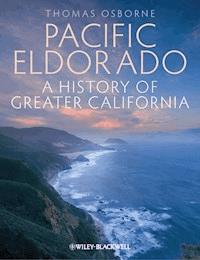
Cover image: The Big Sur coastline and Point Sur Lighthouse, California, USA. Photo © Don Smith / Getty Images.
Cover design by Simon Levy
For Ginger, Brooks, Todd, and my students at Santa Ana College – all Californians whose lives have been shaped and enriched by living in this veritable Pacific Eldorado
Illustrations
Foreword
Janet Fireman
(Editor, California History)
California was America’s dearest object of desire in the mid-nineteenth century, when Manifest Destiny fueled the nation’s expansionism. In the 1840s the United States engaged in a desperate quest to acquire California from Mexico, without knowing how very fabulous, how rich, how beautiful, and how loaded with potential the object of its desire actually was. That unknown capacity exceeded all expectations as time passed; that greatest gift of the nineteenth century, as some have said, is a gift that keeps on giving. California is full of surprises, and is famous for imagination and reinvention. One of those surprises is a new system of construing California’s history, as the following pages illuminate. Pacific Eldorado:A History of Greater California tracks the customary chronology, probing the depths and heights of economic, political, and cultural events; but it also introduces a crystal clear yet completely new lens through which to view the region’s past.
Ironically, the inspiration for Pacific Eldorado is as old as the sea. In fact, it is this grand body of water, the Pacific Ocean, the largest and deepest on earth, which once extended over surface that is now California land. The chapters herein describe how the state’s location came to be where and what it is: Even California, and 47 percent of Californians, started somewhere else and traveled to their current spot on the earth’s surface. That creation story of geological migration and accretion established a place over time and became a space like no other, favored by nature and supplied with plentiful resources that people hunted, extracted, nurtured, harvested, pumped, processed, sold, bought, and consumed. The fruit of these natural advantages – most famously gold – defined the state with a come-hither allure, offering prospects grasped, snatched, or secured by Californians from pre-statehood times onward. Capitalizing on the sea, its natural border, and crossing the Pacific and making it a part of their reality, Native Californians, Spaniards, Californios, and Mexicans, as well as peoples from across the Pacific in several directions, had already set the Pacific Eldorado project in motion by the time the United States took over in 1848.
A liaison of location and history furnishes the framework. From its geological assembly millions of years ago to its initial peopling by the first immigrants perhaps 20,000 years ago, through explorations and colonization by Spain, Mexico, and the United States in the past nearly 500 years to the present, California’s promise has been broader, deeper, and grander than its borders. Beginning with nature, topography, and natural resources and ending with facts and figures expressing California’s economic, political, financial, and cultural power and impact in the Pacific world and beyond, Pacific Eldorado draws a through-line from that distant beginning to our time. All this comes with risks and contests: these pages summarize our present concerns and forecast the future demographic and environmental challenges to the state for retaining its remarkable status. We and those coming up – the population is estimated to reach 50 million by 2025 – must be mindful of our drinking water, air quality, climate change, the marine ecosystem, and clean energy.
What does Pacific Eldorado deliver to the reader that is unavailable elsewhere? The answer lies in California itself: recognized world-round as special, appealing for its scenic variety, entertainment and recreational attractions, climate and resources, and bountiful possibilities. All this we take for granted. That California faces the Pacific Ocean is appreciated, but even though the long coastline is lionized, the essential truths of relationships between California’s location and what Californians have made of that have been ignored. Thomas Osborne brings a new contribution to current discourse about California and its past to reveal a grand tapestry of connections and a multi-hemispheric pattern of interaction with the Pacific world. From the original position California occupied in the American ideal – a foothold on the distant shore – he proffers a parade of Pacific ventures available to the nation because of California’s location, its profusion of natural resources, and the cornucopia of human capital, innovation, and imagination that the diversity of Californians have put into operation.
Reading Pacific Eldorado stimulates an understanding of the logical pairing of globalization with California. Our minds also focus on the inescapable: the wide Pacific and our entire world are narrowing through digital communication. Even so, the opportunities in our information age are simultaneously expanding the world. Analysis of the Pacific Eldorado concept is yet to be undertaken in the historical literature, but this new reckoning surely will spark broadened consideration of California’s links to the Pacific world. Those powerful trans-oceanic links, as this cutting-edge text shows, may best explain why the Golden State was so coveted in the mid-nineteenth century and remains even more so today.
Preface
“The flashing and golden pageant of California,
The sudden and gorgeous drama, the sunny and ample lands, …
Ships coming in from the whole round world, and going out to the whole world,
To India and China and Australia and the thousand island paradises of the Pacific …”
Walt Whitman, “Song of the Redwood-Tree” (1874)
Whitman’s enchanting “Song of the Redwood-Tree” has had a strong basis in the historical record. While this poem omits the gritty details of how “crimps” (owners of boardinghouses for sailors) strong-armed prospective crewmen into sea duty in San Francisco waterfront saloons, it still captures the alluring relationship California has had with the Pacific world for the past 500 years and more. Providing a comprehensive account of that past, Pacific Eldorado simultaneously illuminates the historical stepping stones to the state’s twenty-first century prominence in the Pacific Basin and globally. In doing so, it aspires to be among those on the cutting edge of internationalizing state and local history and giving the state’s long-time Pacific connections their due.
In other words, Pacific Eldorado narrates the story of a “greater California,” a place whose history in numerous instances extends well beyond the geographical boundaries of the state. These “beyond the borders” connections challenge the prevalent notion of an isolated early California and suggest the need for a history that weaves the local, the national, and the international into a coherent narrative. For example, if Navy Lieutenant Charles Wilkes’s epic maritime expedition (1838–42), which brought him to the San Francisco Bay area, is even mentioned in current California history textbooks, they offer virtually no coverage of how that exploration connected California to America’s “manifest destiny” of conquering North America and expanding transpacific commerce. In short, the relationship between California and the Pacific world that Walt Whitman expressed in verse, and which the historical record supports, seems to have gone little noticed in current chronicles of the state.
This textbook aims to help students better understand the state’s fascinating and complex history by placing it squarely within the context of Pacific geological processes resulting in land formation, prehistoric Pacific voyaging leading to early settlement, international transpacific commerce, Pacific immigration, Pacific imaginings that have infused the “California Dream” of a better life for all, and America’s expansion beyond its western shoreline and into the world’s largest ocean basin. This means a spatial re-framing of California’s past. Anticipating this fresh approach to California history, Kevin Starr wrote in Clio on the Coast (2010): “Even further down the road, into the twenty-first century, lay the challenge of integrating the Pacific Coast and the nation behind it into a comparative history of the Asia/Pacific Basin of which it was a part. China, Hong Kong, Japan, the Philippines, Hawaii, Chile, Australia, and New Zealand, after all, and the other Asia/Pacific places as well, had long since been important components of the California story.” Started two years before and independently of this call for a Pacific-centered California history, this is the first textbook to take up Starr’s challenge to historians of the Golden State.
The major theme of this volume could be described as follows: From its beginning, California’s history has been shaped increasingly by its Pacific Basin connections – connections that have derived largely from the state’s resources, which is why “Eldorado” appears in the title. Throughout California’s past, such resources have included sea otter pelts, lumber, whale oil, hides and animal fat (tallow) used for candle-making, gold, borax cleanser, petroleum, farm products, films and media works, Silicon Valley computer technologies, and more.
The book’s five related supporting themes include:
Organizationally, the textbook’s 14 chapters move chronologically from the geologic formation and earliest peopling of California into the second governorship of Jerry Brown in the years 2011–12. All chapters open with an overview of the topic at hand, followed by a Timeline. Each chapter includes a brief Pacific Profile essay, featuring a person whose life and/or contributions exemplify the role of the Pacific in shaping California history. In some instances such persons have been well known (railroad magnate and former governor, Leland Stanford) and in other instances they have not (restaurateur Norman Asing). Some called California home (former governor, Hiram Johnson); others just visited (mariner and explorer Alejandro Malaspina). The intent has been to humanize the state’s past, helping readers see California’s Pacific maritime and other connections through the lives of real people. Each chapter ends with a brief Summary, Review Questions, and a Further Readings section that offers an annotated list of written sources for those who wish to explore the “flashing and golden pageant” of Pacific California in more depth and detail.
T.J.O.Laguna Beach and San Francisco
Acknowledgments
As solitary as researching and writing are, looking back I had a lot of help from many wonderful, thoughtful people in doing this project. A short list of those who were instrumental in providing this help would include:
1
Beginnings: From Fire and Ice to Indian Homeland
Fire and ice forged the physical setting of California’s storied past. No matter how extensively humans have altered that setting with mining activities, transportation systems, aqueducts, and various other built structures, nature always has been integral to the state’s history. Before there was a human record there was pre-history, or a time of beginnings, by far the longest period in California’s timeline. During this genesis California literally rose from the Pacific, at times spewing flames and volcanic ash. Violent thrusts from below the Earth’s surface formed mountains and valleys that later would be carved by huge rivers of ice. Before these glaciers began melting, some 15,000 years ago, America’s first human inhabitants began making their way by foot and watercraft from Asia to North America. On reaching the New World, these mammoth-hunting migrants trekked southward and eastward, some settling in what would become California. Their seagoing Asian counterparts navigated North America’s coastline southward to the Channel Islands and mainland. These trekking and sailing Paleolithic, or Old Stone Age, peoples were the first human occupants of this remarkable land. Some scholars speculate that Polynesian and Chinese Pacific voyagers visited Indian California centuries before Europeans arrived in the province.
Landforms
Not only was California born of the Pacific, also it is situated on the Ring of Fire, an intercontinental perimeter of volcanoes and earthquake faults that line the Pacific Rim in a sweeping arc from Japan to Chile. Like many other areas along the Ring of Fire, the state’s varied landmass was assembled over time from geologic fragments of rocks and sediments, called “terranes,” lying on the crust or floor of the Pacific long after the Earth was formed some 4.6 billion years ago. Before these fragments began uplifting from the ocean, North America’s western shoreline extended to about where the Rocky Mountains are situated today. West of that ancient coastline loomed the vast, heaving Pacific.
Lesen Sie weiter in der vollständigen Ausgabe!
Lesen Sie weiter in der vollständigen Ausgabe!
Lesen Sie weiter in der vollständigen Ausgabe!
Lesen Sie weiter in der vollständigen Ausgabe!
Lesen Sie weiter in der vollständigen Ausgabe!
Lesen Sie weiter in der vollständigen Ausgabe!
Lesen Sie weiter in der vollständigen Ausgabe!
Lesen Sie weiter in der vollständigen Ausgabe!
Lesen Sie weiter in der vollständigen Ausgabe!
Lesen Sie weiter in der vollständigen Ausgabe!
Lesen Sie weiter in der vollständigen Ausgabe!
Lesen Sie weiter in der vollständigen Ausgabe!
Lesen Sie weiter in der vollständigen Ausgabe!
Lesen Sie weiter in der vollständigen Ausgabe!
Lesen Sie weiter in der vollständigen Ausgabe!




