


9,49 €
Mehr erfahren.
- Herausgeber: Ridgeman Mental Health Books
- Kategorie: Geisteswissenschaft
- Serie: CBT Worksheets
- Sprache: Englisch
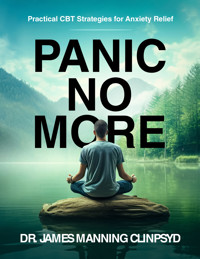
Panic No More: Practical CBT Strategies for Anxiety Relief
by Dr. James Manning
Are you tired of feeling overwhelmed by anxiety and panic attacks? "Panic No More: Practical CBT Strategies for Anxiety Relief" offers a comprehensive guide to overcoming anxiety using proven Cognitive Behavioral Therapy (CBT) techniques. Written by Dr. James Manning, a renowned psychologist, this book is packed with practical exercises and CBT worksheets designed to help you take control of your anxiety and reclaim your life.
Inside the Book:
✔️Step-by-step CBT strategies to manage and reduce anxiety
✔️Interactive exercises to help you identify and challenge negative thought patterns
✔️Case studies and examples to illustrate effective techniques
✔️Practical worksheets to track your progress and reinforce learning
Whether you're dealing with everyday stress or chronic anxiety, "Panic No More" provides you with the tools you need to build resilience and achieve lasting relief.
About the Author: Dr. James Manning is a Consultant Clinical Psychologist. With over two decades of experience, Dr. Manning specializes in CBT and has worked extensively with individuals suffering from anxiety, depression, and other mental health issues. He holds post-graduate qualifications in both Clinical Psychology and Counselling Psychology and has authored several acclaimed self-help books. Dr. Manning's expertise and compassionate approach make him a trusted authority in the field of mental health.
Explore effective strategies to conquer anxiety and live a calmer, more fulfilling life with "Panic No More."
Das E-Book können Sie in Legimi-Apps oder einer beliebigen App lesen, die das folgende Format unterstützen:
Seitenzahl: 158
Veröffentlichungsjahr: 2024
Ähnliche



















Panic No More
Practical CBT Strategies for Anxiety Relief
Dr James Manning
Copyright © 2024 Ridgeman Mental Health Books. All rights reserved.
Technical advisor Dr Nicola Ridgeway
All rights reserved. No part of this publication may be reproduced, stored in a retrievalsystem, or transmitted in any form or by any means, electronic, mechanical, recording, scanning, or otherwise, except as permitted under copyright legislation, without the prior permission of Ridgeman Mental Health Books.
Limits of liability/disclaimer of warranty –
Neither the authors nor Ridgeman Mental Health Books take responsibility for any possible consequences from any treatment, procedure, test exercise or action of any person reading or following the information in this book. The publication of this book does not constitute the practice of medicine and this book does not attempt to replace any other instructions from your doctor or qualified practitioner. The authors and Ridgeman Mental Health Books advise
the reader to check with a doctor or qualified practitioner before undertaking any course of treatment.
Whilst the authors and Ridgeman Mental Health Books have used their best efforts in preparing this book, they make no representations or warranties with respect to the accuracy or the completeness of the contents of this book and specifically disclaim any implied warranties or merchantability or fitness for a particular purpose. No warranty may be created or extended. The advice and strategies contained herein may not be suitable for your situation. You should where necessary consult with a professional where appropriate. Neither Ridgeman Mental Health Books or the authors shall be liable for any loss or profit or any other commercial damages, including but not limited to special, incidental, consequential or other damages. Case examples referred to in this book are generic and based on collective presentations. No relation to any specific person is either implied or intended.
A link to printable PDF worksheets can be found on page 28 at the bottom of the homework section at the end of the Chapter on 'Worry and Panic'.
About the authors
Dr James Manning is a Consultant Clinical Psychologist and the Managing Director of the West Suffolk CBT Service. James has post-graduate qualifications in both Clinical Psychology and Counselling Psychology. An award winning author he has regularly offered workshops and training to clinicians throughout the United Kingdom on CBT and continues to work as a therapist.
The technical advisor for this book is Dr Nicola Ridgeway. Dr Ridgeway is a Consultant Clinical Psychologist and an accredited cognitive and behavioural therapist. She lectured on Cognitive Behaviour Therapy (CBT) at the University of East Anglia, Norfolk, England, and the University of Essex for many years before becoming the Clinical Director of the West Suffolk CBT Service Ltd. Together with Dr James Manning she has co-authored several books on CBT.
By the author
Think About Your Thinking to Stop Depression
How to Help Your Loved One Overcome Depression
CBT for Panic Attacks
The Little Book on CBT for Depression
A Simple Introduction to Cognitive Behaviour Therapy for Visual Learners
CBT Worksheets
CBT: What it is and how it works (2nd Edition)
My CBT Journal
CBT Worksheets for Anxiety
CBT Worksheets for Teenage Social Anxiety
Breaking free from social anxiety
Fused: A memoir of childhood OCD and adult obsession
How to befriend, tame, manage and teach your black dog called depression using CBT
Contents
Preface
What is a panic attack?
What makes a panic attack happen in the first place?
The structure of the brain
The brain’s alarm system
How are panic attacks kept in place?
Worry and panic
Increased threat monitoring and panic
Behavioural avoidance and safety behaviours
Connecting the dots
Challenging catastrophic thoughts
Some key terms
Creating your own hypotheses
Observe yourself
Rules
Beliefs
Drawing out CBT cycles
Challenging FATs
Short-term behavioural approaches
Approaching feelings
How to respond to distressing thoughts
How worry and rumination make things worse
Retraining the subcortical mind
An easy way to reprogram the subcortical mind
Behavioural experiments with panic
What did you make of that?
How to prevent relapse
Other therapies for panic attacks
Conclusion
References and additional reading
Glossary
Common Medications
Index
Preface
By Dr James Manning
Psychologists are not immune to difficulties in life. I suffered with mental health problems for many years before I got the help I needed, and in more stressful periods of my life, I experienced panic attacks from time-to-time. Fortunately, I found a way through my panic attacks by reading self-help books.
Perhaps reading such books stimulated my interest in psychology, it’s hard to say for sure. One thing I am grateful for is the freedom that psychological knowledge has given me. It has given me a life I value living and it has offered me an opportunity to help many others along the way. At the risk of sounding a total f**k-up I’ll tell you a bit about my life. Hopefully, it will give you some kind of an idea about how I developed such a passionate interest in psychology.
I have always had quite an obsessive personality and in my early teenage years I had quite a few problems with obsessive compulsive disorder. I knew that I was different from other people at a very young age, as did my family, but I didn’t have any explanation for it. As I got older, I attempted to cope with problems that life presented me using food, drugs, gambling, and alcohol. I developed a significant alcohol problem as soon as I looked old enough to buy alcohol from an off-licence, (which was when I was about 17).
Between the ages of 15 and 30, I experienced a type of depression, known as dysthymia. Before this, I experienced sensory hyper-sensitivity, excessive avoidance, attention deficit, significant obsessive problems, paranoia, and anxiety.
In my late teenage years the emotion that affected me the most was low mood – I had a feeling of being slowed down, and an emptiness that sapped my motivation to engage in life. Normal events seemed more effortful and I found myself withdrawing from day-to-day activities. I started to feel unsettled most of the time, waking up early for no apparent reason – often at 4 am – churning thoughts over and over in my mind, and not being able to go back to sleep. I withdrew from people, preferring to be alone. I became snappy and irritable, and felt on edge. My relationships generally suffered, and I lost most of my friendships.
I didn’t have a very eventful childhood, relatively speaking, at least not when compared to stories I have heard from many of my clients. I was bullied physically by older children and bullied emotionally by my peers (mainly for being socially backward), and I experienced some mild trauma. Both of my parents were working class people who performed well in their careers and rose through the ranks of their respective companies, in my father’s case to a top management position. My father was a perfectionist and highly obsessive. His perfectionist nature paid huge dividends for him at work – financially and professionally. He supervised award winning civil engineering work. I saw an old photograph of him recently, being given an award by the Queen of England. He had a tendency to be obsessive in all areas, including at home, and became angry at even slight violations of his high standards. Let’s say as a hormonal teenager, I violated his standards pretty much all of the time and he struggled with parenting me as a teenager. In retrospect, he probably found me quite difficult to parent because he noticed things in me that he didn’t like about himself.
Both my parents emigrated from Ireland when they were teenagers. They were very young when thrust into the responsibilities of parenthood and as you might expect from young parents, they didn’t really have much experience of looking after children, but they were really no different from my friends’ parents. I think my parents did their best to bring me up, based on the knowledge they had, but I struggled with being a child. I can still hear my mother’s voice saying the words she repeated almost daily in her soft Irish accent: ‘Childhood are the best years of your life, enjoy it while you can.’ This confused me as my childhood felt terrible! And, to make matters worse it seemed like my life was going to go downhill even further if these were the best years of my life. I had low self-esteem, and deeply entrenched beliefs that I was inadequate, stupid, bad, defective, weak, weird, and worthless as a person. I had no one I could talk to so I kept my fears to myself and spent a hidden while I worked to prove them wrong.
As a young person, there were a number of positives that I could have drawn something from. By the time I reached 15, outsiders would have considered me a privileged child. I had some friends, and I had the support of a well-off family. I lived in a leafy suburb just outside London, and I had gained entry to a state selective grammar school, which at the time was one of the top schools in the country.
Unfortunately, however, I was not able to use what I had been given. By the age of 15, depression had started to hit me quite hard and my motivation to engage in life began to drop significantly. School teachers were not impressed with my academic performance and reported back to my parents that I was under-achieving academically. I passed my first set of exams at 16 and went on to do advanced exams, where I achieved less than spectacular results. By the time I was doing my advanced exams, teachers had noticed the changes in my behaviour and had begun to monitor me more closely. One day my chemistry teacher approached me with a frown etched on his forehead – even more than usual – and muttered, ‘If you’re not paranoid you should be!’ A short time later I was told that the teachers held a meeting about me and I was placed on report; this is where teachers monitor a student much more closely and have regular meetings with them.
By then I had dropped out of most of my sports teams such as rugby and cross-country, I struggled with my friendship groups and eventually found myself dropped from them. Things weren’t really going too well from a teenager’s point of view. By this time, I already felt that I was a failure in life.
After leaving school you could say that I had a lucky break and gained a position in a small commodity brokers. I struggled to retain this role, not because of my ability to do the technical part of the job, but because of my lack of ability to regulate my mood and deal with interpersonal conflict. Basically, I found it difficult to get on with people. One day I found myself challenging a commodity trader for breaking what I thought were the rules of trading. The problem was that he worked for a very important client. The next day I was invited to my Managing Director’s office and given my notice.
A number of further jobs followed, assisted at times by the support of my parents, but again I experienced interpersonal problems and had further dismissals. As time progressed, I found that my CV was beginning to look less and less promising as I moved from one job to another. On paper I thought I had begun to look unemployable and out of desperation began working for financial companies with dubious or unethical outlooks. I took a job in London working for a company that I hadn’t looked into too much. I soon discovered after reading letters from clients that the company had previously been a very sophisticated boiler house. I couldn’t work for companies like this, due to my moral stance on life. Following this, I continued to work my way down the pay scale hierarchy. Eventually the only work I could find was temporary work in factories, delivering pizza, and working as a cleaner for a minimum wage. A friend of mine Jo, a fund manager at Hill Samuel (a leading Merchant bank in London at the time) tried to call me and left messages with my parents over a period of several months. I didn’t return his calls. I treated him very poorly considering we had developed a close friendship over a number of years. I basically abandoned him with no thought about how it might affect him.
Moving from plush offices to factories and such was a bit of a culture shock for me and I was dismissed from two of my minimum wage cleaning jobs for not following the requested instructions. I am embarrassed to admit that practically the only job I didn’t get the sack from before I was 28 was my pizza delivery job at Pizza Hut, and even that job was painful sometimes. From time-to-time I found myself delivering pizza to some of my now successful Grammar School peers who appeared speechless when they opened their door to find me standing there with a pizza for them.
By that time my sense of inadequacy was fully reinforced and I had switched off emotionally. During this period of time I became quite hard-up financially and my mind set had become quite extreme and rigid. I didn’t want to use the unemployment system or to ask my parents for help as in my mind this would have confirmed to me that I really was not succeeding in life. Sometimes I couldn’t earn enough money to pay rent, so I ended up spending months living in a tent at a campsite where the rent was £4 per day. At other times I could pay the rent but was left eating potatoes and baked beans as my only source of nourishment. I continuously felt that I was failing in some way. I felt empty inside. I just didn’t feel like I had the energy to do things; I wanted to escape from my problems and myself. The only time I really felt OK was when I was asleep. I became quite avoidant and more nocturnal. I often did not attend events that I had been invited to, mostly without sending an apology or letting people know. I didn’t answer the phone to friends or return their calls. The number of friends I had dwindled to just one. I think the only way that this friend managed to tolerate me was to laugh about the way I behaved, and to recognise that my behaviour was not about him. I felt so insignificant that I genuinely believed other people wouldn’t notice or care whether I turned up late for planned events, or would even be bothered if I attended them at all. All my focus was on myself. It was a pitiful kind of self-loathing with endless self-questioning about why my life was so broken. I was so detached that I had little regard for other people’s feelings or my own. Most of the time I did not want to live anymore and hoped I would die.* It was as if my body, mind, and my personality, were so unacceptable to me that I despised myself.
Luckily, in my very late twenties and early thirties I found a few excellent therapists. I worked hard on my therapy – which in my case needed a couple of years, as I had left things for so long before getting help. I brought negative and self-defeating thoughts that I had into conscious awareness and began to make significant changes to my life. I changed my life using many of the processes I have covered in this book. I’m 49 now, and I have been fortunate to have worked with Dr Nicola Ridgeway in treating several thousand clients over the years, and I haven’t looked back since. I am still grateful to have the opportunity to help others who are stuck to move on with their lives.
I continue to use many of the exercises and coping strategies that I learnt in my therapy to keep in a good state of well-being. I can state categorically that if I were to stop using my coping strategies now, I would very quickly drift back into mental health problems. I have learnt that Cognitive Behaviour Therapy (CBT) is not a quick fix. Many people make initial positive gains after a completing a course of CBT, but most relapse after a number of years. This does not mean that CBT is not effective, as it works when people are using it. In reality, it means that people have stopped using the strategies that they worked on during their therapy. An important message that I would like to get across to you, therefore, is that CBT is delivered over a short time, but it is not a short-term therapy
*Except when I had panic attacks. I really didn’t want to die when I had those.
Chapter 1
What is a panic attack?
I remember my first panic attack quite clearly. I was 22-years-old and as you might understand the experience took me completely by surprise. I had just returned home from an ordinary evening at the pub, when all of a sudden I noticed my head felt incredibly light. My mind was spinning and I felt like I was drifting out of my body. All I could think was, ‘This is the end! This is it!’ I could hear the pounding of my heart as it began to thump like crazy in my chest and I rushed to the bathroom. I can’t remember at the time why, but I thought the bathroom might help. I was leaning over the sink, splashing water over my head, as in this state I thought somehow that this behaviour might keep me alive.
Meanwhile, my concerned brother was following me about as I rushed from one place to another. He kept trying to talk to me, asking what was wrong with me, but I had no time to listen to his questions and I couldn’t really hear what he was saying. All I can remember was feeling absolutely desperate. I recall telling my brother, ‘I’m dying! I can’t breathe!’ Nothing I tried seemed to help. My fight with what I thought was the death process seemed to go on for ages, probably about twenty minutes, until eventually, I tried watching the television and after half an hour the problem seemed to completely disappear... After that, I congratulated myself on my lucky escape and tried not to think about it anymore. I blocked the whole event from my mind and pretended it hadn’t happened. When my brother brought it up a few days later, I told him that I didn’t want to talk about it. The experience left me believing I was weak as a person for reacting that way. I felt ashamed and embarrassed.




