


9,99 €
Mehr erfahren.
- Herausgeber: 50Minutes.com
- Kategorie: Lebensstil
- Serie: Management & Marketing
- Sprache: Englisch
Expand your business with the 80/20 rule!
This book is a practical and accessible guide to understanding and implementing Pareto’s Principle, providing you with the essential information and saving time.
In 50 minutes you will be able to:
• Understand Pareto’s Principle and how to identify the 80/20 ratio in any area of your life or business
• Identify the most important 20% and focus on the main factors that result in the majority of your results
• Use Pareto’s Principle to manage your business more efficiently, increase revenue and get organized
ABOUT 50MINUTES.COM| Management & Marketing
50MINUTES.COM provides the tools to quickly understand the main theories and concepts that shape the economic world of today. Our publications are easy to use and they will save you time. They provide both elements of theory and case studies, making them excellent guides to understand key concepts in just a few minutes. In fact, they are the starting point to take action and push your business to the next level.
Das E-Book können Sie in Legimi-Apps oder einer beliebigen App lesen, die das folgende Format unterstützen:
Seitenzahl: 23
Veröffentlichungsjahr: 2015
Ähnliche















Pareto’s principle for business management
Key points
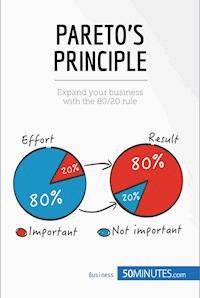
Names: Pareto’s principle, Pareto’s rule, Pareto’s law, the 80/20 rule, the law of the vital few.Uses:Economics: Business management (quality management, customer management, production management, stock control, human resources, etc.), creating commercial and marketing strategies, etc.Physics, sociology and statistics.Private sector: time management, task organisation, etc.Why is it successful? According to Pareto’s principle, ‘80% of effects are the product of 20% of causes’. This ratio allows you to quickly identify the essential part of any activity. The model is found in many areas of daily life and in the business world. For example, when a business wants to identify the customers that generate the most revenue. If the 80/20 ratio is considered, the company can focus on the 20% of customers that generate 80% of its turnover to try and make them loyal customers.Key words: Vilfredo Pareto, Pareto’s principle, the 80/20 rule, ABC analysis, turnover, Joseph Juran, time management, customer relations, relationship marketing, CRM, Pareto chart, Long Tail theory, Pareto efficiencyIntroduction
History
Pareto’s principle is an analysis and decision-making tool created by Vilfredo Pareto (1848-1923) at the end of the 19th century in 1897. The Italian economist and sociologist, who studied at the Polytechnic University of Turin in Italy, is considered to be the founding father of what is now called ‘Pareto’s Principle’. By studying the wealth of his country he found that only 20% of people owned 80% of the total wealth. He then applied this law to other states such as Russia, France and Switzerland and found the same results.
However, it wasn’t until the 1940s that Joseph Juran (1904-2008), an American engineer working in quality management, recognised the 80/20 theory and named it after Vilfredo Pareto.
Definition of the model
Pareto’s principle comes from the observation that 20% of causes are responsible for 80% of the effects. In other words, in the world of business, 20% of customers are responsible for 80% of turnover. By identifying this 20% (the most important customers) companies can pay more attention to them to save time and money. According to Joseph Juran, Pareto’s principle can be applied universally in the corporate domain and can be found in all sectors of society. You can even use the principle in most areas of daily life. However, we will see that, both in business and other areas, the 80/20 ratio is not always respected but does give an idea of reality.




