


9,99 €
Mehr erfahren.
- Herausgeber: 50Minutes.com
- Kategorie: Fachliteratur
- Serie: Management & Marketing
- Sprache: Englisch
Master time management and increase productivity
This book is a practical and accessible guide to understanding and implementing Parkinson’s Law, providing you with the essential information and saving time.
In 50 minutes you will be able to:
• Understand the three statements that Parkinson used to develop the law and assess whether they apply to your staff
• Use Parkinson’s formula to calculate the growth rate of your organization and analyze the rate compared to the workload
• Avoid employing staff unnecessarily and learn how to better control the time they spend completing set tasks
ABOUT 50MINUTES.COM | Management & Marketing
50MINUTES.COM provides the tools to quickly understand the main theories and concepts that shape the economic world of today. Our publications are easy to use and they will save you time. They provide elements of theory and case studies, making them excellent guides to understand key concepts in just a few minutes. In fact, they are the starting point to take action and push your business to the next level.
Das E-Book können Sie in Legimi-Apps oder einer beliebigen App lesen, die das folgende Format unterstützen:
Seitenzahl: 22
Veröffentlichungsjahr: 2015
Ähnliche




















Parkinson’s Law
Key information
Name: Parkinson’s Law.Uses: public management, administration, public services, human resource management.Why is it successful? It is a humorous, but very compelling, theory on the propensity of administration to grow, regardless of the amount of work required.Key words: civil servant, administration, working time, public management, bureaucracy.Introduction
Shattering traditional ideas of working time, Parkinson’s Law humorously emphasises the functioning of bureaucratic administration in the second half of the 20th century.
Full of British humour, and from a period when the perverse effects of the bureaucracy were being condemned (think of the famous novel 1984 by George Orwell, published in 1949), Cyril Northcote Parkinson (1909-1993), a British historian, published an article presenting Parkinson’s Law in 1955. The law states that amount of civil service staff grows at a given rate (produced by an imaginative mathematical formula), regardless of the amount of work there is to do.
Definition of the concept
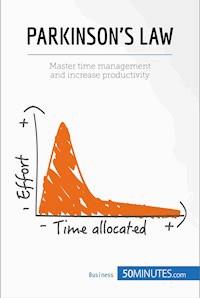
Parkinson’s Law is based on three statements:
a person with a job to do will use all of the time available to finish it;employees always prefer to have a subordinate rather than a rival;employees mutually create work.These three statements explain the natural tendency to increase the number of staff members. Although it is largely humorous, Parkinson’s Law has the advantage of intelligibly explaining the development of bureaucracy.
Theory
The State provides tasks for public powers (justice, police, diplomacy, etc.). In addition to this historical function, throughout the 20th century, social benefits have been developed to provide education, healthcare, health coverage and pensions. Although this second dimension operates differently from one nation to another, it can be found everywhere throughout Europe known as the ‘welfare state’.
To run this vast operation, agents, called civil servants, are required. In France, for example, this refers to members of the three civil services (State, hospital and territorial), but more generally it refers, in a non-legal sense, to public officials. This nuance is needed to understand the scope of Parkinson’s Law, created by a British author, as the term ‘civil servant’ is understood differently in other countries.
Staff of the three civil services in France
In 2013, France employed 2.3 million civil servants, 1.14 million hospital officials and 1.8 million territorial officials, making a total of 5.24 million people. These figures include the owners and contractors.
By adopting an economic approach, we must also include the employees of publicly-funded private structures for public services. The total then amounts to approximately 6 million people, which accounts for roughly 25% of salaried employment in France.




