


33,99 €
Mehr erfahren.
- Herausgeber: John Wiley & Sons
- Kategorie: Geisteswissenschaft
- Sprache: Englisch
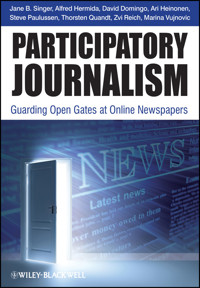
Who makes the news in a digital age? Participatory Journalism offers fascinating insights into how journalists in Western democracies are thinking about, and dealing with, the inclusion of content produced and published by the public. * A timely look at digital news, the changes it is bringing for journalists and an industry in crisis * Original data throughout, in the form of in-depth interviews with dozens of journalists at leading news organizations in ten Western democracies * Provides a unique model of the news-making process and its openness to user participation in five stages * Gives a first-hand look at the workings and challenges of online journalism on a global scale, through data that has been seamlessly combined so that each chapter presents the views of journalists in many nations, highlighting both similarities and differences, both national and individual
Sie lesen das E-Book in den Legimi-Apps auf:
Seitenzahl: 451
Veröffentlichungsjahr: 2011
Ähnliche




















Table of Contents
Cover
Table of Contents
Title page
Copyright page
Notes on Authors
Acknowledgements
Authors’ Note
1 Introduction
1.1 Participatory Journalism
1.2 Why Look at Newspaper Websites?
1.3 Chapter Preview
Part I: The Impact of Participatory Journalism
2 Mechanisms of Participation
2.1 The Emergence of Participatory Journalism
2.2 Analyzing Audience Participation
2.3 Perceptions of Participatory Journalism
2.4 Conclusion
Participate!
3 The Journalist’s Relationship with Users
3.1 Rewritten Roles
3.2 How Journalists See Users: Before the story is written
3.3 How Journalists See Users: After the story is written
3.4 A Collaborative Role: Users as co-workers
3.5 Community Members
3.6 How Journalists See Themselves
3.7 Conclusion
Participate!
Part II: Managing Change
4 Inside the Newsroom
4.1 Incentives for Innovation
4.2 Changing the Newsroom Culture
4.3 Time, Space and Staff
4.4 New Job Profiles
4.5 Outsourcing and Crowdsourcing
4.6 Organizational Structures
4.7 Conclusion
Participate!
5 Managing Audience Participation
5.1 Different Materials, Different Management Strategies
5.2 Workflow Trends in News Production Stages
5.3 Playground or Source: Two Approaches to Managing User Contributions
5.4 Best Practices: Reporters’ Involvement in Management
5.5. Best Practices: Users’ Involvement in Management
5.6 Conclusion
Participate!
6 User Comments
6.1 The Legacy of Participatory Media Spaces
6.2 Journalists’ Attitudes
6.3 Comment Management Strategies
6.4 Giving Comments the Green Light
6.5 Conclusion
Participate!
Part III: Issues and Implications
7 Taking Responsibility
7.1 Law and Ethics
7.2 The Effect of User Contributions on Journalists’ Own Legal and Ethical Practices
7.3 Ethical Issues
7.4 Legal Issues
7.5 Mechanisms for Addressing Legal and Ethical Issues
7.6 Conclusion
Participate!
8 Participatory Journalism in the Marketplace
8.1 Market Forces
8.2 Building Loyalty to the News Brand
8.3 Boosting Website Traffic
8.4 Competing Effectively
8.5 Conclusion
Participate!
9 Understanding a New Phenomenon
9.1 Public Communication and the Essence of Journalism
9.2 The Emergence of Traditional Journalism
9.3 The Emergence of Participatory Journalism
9.4 Perspectives on Participation
9.5 Conclusion
Participate!
10 Fluid Spaces, Fluid Journalism
10.1 A Participatory Culture
10.2 “Active Recipients”
10.3 New Relationships, New Roles
10.4 Working with the Audience
10.5 Guarding Open Gates
10.6 Conclusion
Participate!
Appendix
BELGIUM
CANADA
CROATIA
FINLAND
FRANCE
GERMANY
ISRAEL
SPAIN
UNITED KINGDOM
UNITED STATES of AMERICA
Glossary
References
Index
This edition first published 2011
© 2011 Jane B. Singer, Alfred Hermida, David Domingo, Ari Heinonen, Steve Paulussen, Thorsten Quandt, Zvi Reich, and Marina Vujnovic
Blackwell Publishing was acquired by John Wiley & Sons in February 2007. Blackwell’s publishing program has been merged with Wiley’s global Scientific, Technical, and Medical business to form Wiley-Blackwell.
Registered Office
John Wiley & Sons Ltd, The Atrium, Southern Gate, Chichester, West Sussex, PO19 8SQ, United Kingdom
Editorial Offices
350 Main Street, Malden, MA 02148-5020, USA
9600 Garsington Road, Oxford, OX4 2DQ, UK
The Atrium, Southern Gate, Chichester, West Sussex, PO19 8SQ, UK
For details of our global editorial offices, for customer services, and for information about how to apply for permission to reuse the copyright material in this book please see our website at www.wiley.com/wiley-blackwell.
The right of Jane B. Singer, Alfred Hermida, David Domingo, Ari Heinonen, Steve Paulussen, Thorsten Quandt, Zvi Reich, and Marina Vujnovic to be identified as the authors of this work has been asserted in accordance with the UK Copyright, Designs and Patents Act 1988.
All rights reserved. No part of this publication may be reproduced, stored in a retrieval system, or transmitted, in any form or by any means, electronic, mechanical, photocopying, recording or otherwise, except as permitted by the UK Copyright, Designs and Patents Act 1988, without the prior permission of the publisher.
Wiley also publishes its books in a variety of electronic formats. Some content that appears in print may not be available in electronic books.
Designations used by companies to distinguish their products are often claimed as trademarks. All brand names and product names used in this book are trade names, service marks, trademarks or registered trademarks of their respective owners. The publisher is not associated with any product or vendor mentioned in this book. This publication is designed to provide accurate and authoritative information in regard to the subject matter covered. It is sold on the understanding that the publisher is not engaged in rendering professional services. If professional advice or other expert assistance is required, the services of a competent professional should be sought.
Library of Congress Cataloging-in-Publication Data
Participatory journalism: guarding open gates at online newspapers / Jane B. Singer ... [et al.].
p. cm.
Includes bibliographical references and index.
ISBN 978-1-4443-3226-1 (hardback) — ISBN 978-1-4443-3227-8 (paperback)
1. Electronic newspapers. 2. Online journalism. 3. Citizen journalism. I. Singer, Jane B., 1955– II. Title.
PN4833.P37 2011
070.4–dc22
2011001829
A catalogue record for this book is available from the British Library.
This book is published in the following electronic formats: ePDFs 9781444340716; Wiley Online Library 9781444340747; ePub 9781444340723
Notes on Authors
David Domingo is a senior lecturer in online journalism at the Department of Communication Studies of Universitat Rovira i Virgili in Tarragona, Spain. Domingo, who has a PhD in Journalism from the Universitat Autònoma de Barcelona, was a doctoral fellow at the University of Tampere (2004) and visiting assistant professor at the University of Iowa (2007–2008). His research interests include online journalists’ professional ideology and work routines, as well as the dynamics of innovations such as participatory journalism and convergence. He is co-editor, with Chris Paterson, of Making Online News: The Ethnography of New Media Production (Peter Lang, 2008).
Ari Heinonen, PhD, is journalism teacher and researcher in the Department of Journalism and Mass Communication at the University of Tampere, Finland. A former newspaper journalist, he has focused his academic research on explorations of the changing nature of professionalism in journalism, concepts of journalism in the new media era and journalistic ethics. He has directed and participated in a number of national and international research and development projects in these areas.
Alfred Hermida is a digital media scholar, journalism educator and online news pioneer. Since 2006, he has been an assistant professor at the Graduate School of Journalism at the University of British Columbia, Canada. Hermida was a Knight–Wallace Fellow at the University of Michigan in 2005 and an IBM CAS Canada Research Faculty Fellow in 2010. An award-winning journalist who served for four years as a Middle East correspondent, Hermida is a 16-year-veteran of the BBC and was a founding news editor of the BBC News website in 1997. He has also written for The Wall Street Journal, The Times of London, the Guardian and NPR.
Steve Paulussen, PhD, is a part-time lecturer in journalism studies at both the University of Antwerp and the Vrije Universiteit Brussel, as well as a senior researcher at the IBBT research group for Media & ICT (MICT) at Ghent University, Belgium. In recent years, he has participated in a number of projects on different aspects of today’s digital media culture. His main research interests lie in the field of journalism studies, where he has published on developments in online journalism, newsroom convergence and the sociological profile of professional journalists. Between 2006 and 2010, he also was involved in a multi-disciplinary strategic research project on digital news trends in Flanders, Belgium (FLEET).
Thorsten Quandt, Dr. phil. habil. is a professor in Communication Studies / Interactive Media and Online Communication at the University of Hohenheim, Germany. He has served as chair of the Journalism Studies Division in the German Communication Association (DGPuK) and as an officer in the Journalism Studies Division in the International Communication Association (ICA). His widely published research includes studies on online journalism, media evolution, network communication and computer games.
Zvi Reich, PhD, is a former journalist and a researcher in journalism studies at the Department of Communication, Ben Gurion University of the Negev, Israel. His book, Sourcing the News, was published by Hampton Press in 2009. Reich’s research interests focus on online news, sociology of news, the relations between reporters and sources, authorship in journalism and the use of communication technologies in journalism. Two of his papers have won the top three papers prize of the Journalism Studies Division at ICA. Other research has appeared in Journalism Studies, Journalism & Mass Communication Quarterly and Journalism. He is a member of the editorial board of Journalism Practice.
Jane B. Singer is an associate professor in the School of Journalism and Mass Communication at the University of Iowa, USA, and a visiting professor in the School of Journalism, Media and Communication at the University of Central Lancashire, UK. From 2007 to 2010, she was the Johnston Press Chair in Digital Journalism at Central Lancashire. Her research explores digital journalism, including changing roles, perceptions, norms and practices. Before earning a PhD in Journalism from the University of Missouri, Singer was the first news manager of Prodigy Interactive Services. She also has worked as a newspaper reporter and editor.
Marina Vujnovic, PhD, is an assistant professor at Monmouth University, USA. Her primary fields of research are participatory journalism and new media studies, media history and gender, critical political economy, and cultural studies. Additional research interests include international communication and the global flow of information, as well as ethnicity and the media. She is the author of Forging the Bubikopf Nation: Journalism, Gender and Modernity in Interwar Yugoslavia (Peter Lang, 2009).
The authors have elected to donate all their proceeds from the sale of this book to Reporters Without Borders / Reporters Sans Frontières (http://www.rsf.org, http://en.rsf.org), a non-profit organization committed to press freedom around the world.
Acknowledgements
This book became a reality because dozens of journalists and news executives with precious little time to spare agreed to open their newsrooms to us and to carve out space to talk with us honestly, thoughtfully and at length. We are deeply grateful to them for their willingness to share their ideas and insights, as well as their reasons for both hope and concern as they contemplate an increasingly participatory future.
We also owe a large debt of gratitude to the Helsingin Sanomat Foundation in Finland for supporting the extensive fieldwork involved in this research. Without the foundation’s generous support through multiple phases of the project, from its planning through its execution, this multi-national, multi-authored endeavor would have been impossible to coordinate or to carry out. The rest of the authors also send a big “kiitos paljon!” to co-author Ari Heinonen and the Tampere Journalism Research and Development Centre for negotiating this foundation support, as well as overseeing the conversion of that commitment into much-appreciated dollars, euros, pounds and shekels.
Our editors at Wiley-Blackwell, particularly Elizabeth Swayze, Margot Morse and Elina Helenius, have been unflaggingly enthusiastic and remarkably patient throughout our lengthy, long-distance laboring to turn a mountain of interview data into a manageable manuscript. They have been hugely helpful right from the start, not least in soliciting reviewers whose feedback has significantly strengthened the work you are about to read. These reviewers are outstanding thinkers and scholars in this field, and they and their colleagues – including those who have provided feedback at the academic conference venues in which some of our preliminary findings were initially presented – have been a resource and an inspiration for us.
Each of the authors also wishes to thank our respective academic institutions, which provided the time, space and resources that enabled us individually and collectively to do our thinking, researching, analyzing, writing and editing.
Several of us also would like to individually thank the following people for their invaluable aid:
David Domingo wishes to thank Erin Tiesman, for her assistance in transcribing the US interviews, and Sergio Martínez Mahugo, who conducted and transcribed the interviews with Spanish journalists.
Ari Heinonen wishes to thank Pauliina Lehtonen and Riina Hautala, both of the University of Tampere, for their assistance in this research.
Alfred Hermida wishes to thank Leslie Young, who conducted and transcribed the interviews with Canadian journalists, as well as Alison Loat of Samara for providing a space to think and write.
Thorsten Quandt wishes to thank Ansgar Koch, Laura Leithold, Agatha Pohl and Fabian Schwinger for their assistance in this research.
Zvi Reich wishes to thank Tal Waxman-Kushnir from Ben Gurion University for her thoughtful contribution in conducting the interviews and analyzing the data, as well as Dror Walter from the Hebrew University and Oded Jackman from Ben Gurion University for their assistance.
These authors, along with co-authors Steve Paulussen and Marina Vujnovic, also are grateful to Jane Singer for her precise and patient work in crafting a final manuscript that succeeds in giving one voice to this collective research project.
Jane Singer wishes to thank Jean-Yves Chainon, then of the World Editors Forum in Paris, for arranging, leading and transcribing the French interviews.
Finally, we must thank you, our readers and the readers of these and other online newspapers, for all that you bring to “participatory journalism.” The future of this collective enterprise rests on you and your contributions, and we believe you will enrich it beyond measure.
Authors’ Note
This book is the result of a research project carried out by eight researchers in eight languages and in ten different countries, over a period of several months in late 2007 and early 2008. Among us, we talked one-on-one with nearly 70 journalists, at more than two dozen leading national newspapers, about user contributions to the newspaper-affiliated website. The appendix, beginning on page 192, provides more details about what we did and how we did it.
Each chapter contains information gathered by all of us, asking similar questions of our interviewees and steering our newsroom conversations in the direction we collectively decided would be most interesting and illuminating.
To turn this mountain of quotes into a book, each of us took the lead in crafting one thematic chapter that explores a particular aspect of our topic in detail. Jane Singer, with the assistance of Alfred Hermida, then worked to integrate each of these chapters into what we hope is a cohesive whole that is easy and enjoyable to read as a unified package. We did not want our own individual voices to drown out the voices of the journalists whom you will “hear” throughout the pages that follow.
However, we have included the names of each lead author in the Table of Contents and at the start of each chapter to highlight the individual effort and perspective that went into each section of the book.
1
Introduction
Sharing the Road
The English words “journalism” and “journey” are cousins. Both stem from the Latin word diurnalis, which means “daily.” Over time, one came to mean a daily record of transactions, while the other was used to describe a day’s work or travel. Today, journalism is on a journey into uncharted territory – and the road is crowded with all manner of travellers.
Only very recently has the entrenched idea of a concrete daily record, prepared by people dedicated to its compilation, begun to lose its usefulness. A printed product may still appear just once a day, but as newspapers have moved online, they have evolved into something far more fluid and amorphous. The twenty-first-century newspaper is essentially never complete, neither finished nor finite.
Nor are journalists the only ones determining what gets recorded. A great many other people also contribute content, representing their own interests, ideas, observations and opinions. That content comes in a steadily expanding volume and variety of forms and formats – words, images and sounds, alone or in combination, turning the online newspaper into an open, ongoing social experiment.
This book is about the journey of the journalistic enterprise through an increasingly collaborative present and into a collective future that you will share, whether or not you ever set foot in a newsroom. It explores how newspaper journalists are handling the transition to a world in which vast numbers of strangers contribute directly to something that those journalists alone once controlled. The story is still being written, and you are the ones writing it.
1.1 Participatory Journalism
Many terms have been coined to describe the contributions to online newspaper content from those whom media critic Jay Rosen (2006) describes as “the people formerly known as the audience.” Some call it “user-generated content.” Others prefer “citizen journalism.” One scholar likes the term “produsage” to highlight the blending of producing and consuming information (Bruns 2008; 2005).
Our choice, though, is “participatory journalism” because we feel it captures the idea of collaborative and collective – not simply parallel – action. People inside and outside the newsroom are engaged in communicating not only to, but also with, one another. In doing so, they all are participating in the ongoing processes of creating a news website and building a multifaceted community.
Others like this term, too. Back in 2003, online journalist and commentator J. D. Lasica defined “participatory journalism” as a “slippery creature” but offered a range of examples, some of them associated with mainstream media offerings and others not. Among the former, which are the focus of this book, he included , discussion and user , along with reports (including visual ones), reviews and articles supplied by readers (Lasica 2003).
Lesen Sie weiter in der vollständigen Ausgabe!
Lesen Sie weiter in der vollständigen Ausgabe!
Lesen Sie weiter in der vollständigen Ausgabe!
Lesen Sie weiter in der vollständigen Ausgabe!
Lesen Sie weiter in der vollständigen Ausgabe!
Lesen Sie weiter in der vollständigen Ausgabe!
Lesen Sie weiter in der vollständigen Ausgabe!
Lesen Sie weiter in der vollständigen Ausgabe!
Lesen Sie weiter in der vollständigen Ausgabe!
Lesen Sie weiter in der vollständigen Ausgabe!
Lesen Sie weiter in der vollständigen Ausgabe!
Lesen Sie weiter in der vollständigen Ausgabe!
Lesen Sie weiter in der vollständigen Ausgabe!




