


2,99 €
Mehr erfahren.
- Herausgeber: FinanzBuch Verlag
- Kategorie: Fachliteratur
- Sprache: Englisch
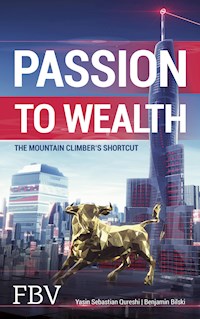
How the wheels of the international high finance machine turn is a mystery to most. Surprisingly, also to the big wheels, who don't have the divine knowledge they'd have us think they do, and maybe themselves have come to believe they have. The fact is, precious little is predictable, but also that various simple strategies can give the average person the edge in riding both the high and low waves. No matter if things on the international scene are up, down or sideways, you can make money—good money—by staying cool and just knowing what to do when. Yasin Sebastian Qureshi opens the doors to the once hallowed halls he's rendered less than magical. At 29 the youngest ever person to run a bank in Europe, Qureshi tells of the constant opposition to his simplfied ideas from those higher up who "knew better"—until his success gave abundant proof that they work. Through simple strategies, psychological tips and anecdotes from the roller coaster ride of investment, Passion to Wealth: The Mountain Climber's Shortcut, co-authored by Benjamin Bilski (Forbes "30 under 30"), shows how this can be mastered—without huge financial input, years of study or painful hours trying to decipher mind-boggling charts. And with an eye on doing what you enjoy doing in life, without selling your soul. Play, communicate, grow, enjoy. Your passion can indeed drive your wealth, and your wealth, in turn, can drive your passion. This little book will show you how.
Das E-Book können Sie in Legimi-Apps oder einer beliebigen App lesen, die das folgende Format unterstützen:
Seitenzahl: 176
Veröffentlichungsjahr: 2019
Ähnliche
















Yasin Sebastian Qureshi | Benjamin Bilski
PASSION TO WEALTH
THE MOUNTAIN CLIMBER’S SHORTCUT
PASSION TO WEALTH
THE MOUNTAIN CLIMBER’S SHORTCUT
Yasin Sebastian Qureshi | Benjamin Bilski
The Deutsche Nationalbibliothek
Lists this publication in the Deutsche Nationalbibliographie; detailed bibliographic information is available online at http://d-nb.de.
Reprint 2019
© 2019 by FinanzBuch Verlag
an imprint of the Münchner Verlagsgruppe GmbH,
Nymphenburger Straße 86
D-80636 München
Tel.: +4989 651285-0
Fax: +4989 652096
All rights reserved. No part of this publication may be reproduced, stored in a retrieval system, or transmitted, in any form or by any means, without the prior permission in writing of the publisher, nor be otherwise circulated in any form of binding or cover other than that in which it is published and without a similar condition including this condition being imposed on the subsequent purchaser.
The information and opinions have been compiled or arrived at based upon information obtained from sources believed to be reliable and in good faith, but is not guaranteed as being accurate, nor is it a complete statement or summary of the securities, markets or developments referred to. The information mentioned is not intended to be construed as a solicitation or an offer to buy or sell any securities or related financial instruments. The details and opinions are provided without any guarantee or warranty and are for information purposes only.
Editing: The NAGA Group AG
Proofreading: Hella Neukötter
Composition: The NAGA Group AG
Druck: Books on Demand GmbH, Norderstedt
Printed in Germany
ISBN Print 978-3-95972-264-3
ISBN E-Book (PDF) 978-3-96092-340-4
ISBN E-Book (EPUB, Mobi) 978-3-96092-341-1
Further informations are available at
www.finanzbuchverlag.de
CONTENT
Acknowledgements
Introduction
Chapter 1: Pro mode
1) Have you been to Harvard or Yale?
2) There will always be a next trade
3) Don’t throw good money after bad money
4) Once you join a team, you’ll cheer for your team
5) Ration the food
6) Worst drawdown can only get worse
7) Other people’s money is a great concept!
8) Prepare to lose
9) Try to lose money and other random facts
10) There is only so much a market can eat
11) A drop in the ocean
12) It’s not a zero-sum game!
13) Stop fishing and the invisible man
14) Predicting a person or a crowd?
15) Are you afraid to stand out? Or, The dilemma of the pension fund manager
16) Hypnotised rabbit
17) Trump and Brexit
18) Those that know won’t tell and those that tell won’t know
19) There is no such thing as gravity
20) Equipment
21) YOLO
22) Carpe diem
23) Variety is the spice of life
24) Never give someone your credit card without setting a limit!
25) God’s world order?
26) Call of Duty vs World War 2
27) Nurture or nature
28) Invest in teams
Chapter 2: The secret
Chapter 3: The NAGA World
Chapter 4: Requirements
Chapter 5: NAGA Trader—Making money by or when
1) Making money by “stalking” people
2) Making money by letting a robot work for you
3) Making money by piggybacking on other people—casual sex, dating, marriage and polygamy (single trade, single auto follow, multiportfolio auto follow)
4) Making money by being popular, cool or entertaining
5) Making money by scanning your “hood”
6) Making money by posting
7) Making money despite having little money
8) Making money by admiring people
9) Making money by understanding people
10) Making money when Trump or Kim go crazy
11) Making money from people buying petrol cars
12) Making money when people buy things
13) Making money based on the mood
14) Making money by “sharing is caring”
15) Making money by “herding cats”
16) Making money by switching on the turbo
17) Making money by having your cake and eating it
19) Making money by reading gossip
20) Making money by using your alarm clock
21) Making money on a random basis
22) Making money when people flip out over the newest iPhone model
23) Making money when people start hating something
24) Making money despite not knowing what a company, a share, a fund, etc. is...
25) Making money without having an idea about business and economics
Chapter 6: Useful tools
The NAGA Wallet
1) Viewing your assets
2) Analyse your portfolio and the market
3) Transfer assets
4) Invest
NAGA Card
Chapter 7: NAGA Virtual—Making money in the gaming space
1) Making money by playing games
2) Making money by knowing games
3) Making money by knowing how gamers think
4) Making money when people go crazy about a game
5) Making money when people start hating a game
6) Making money by creating your own game
Chapter 8: NAGA Exchange—Making money in the crypto space
1) Making money on geeks getting it right
2) Making money by simply following a trend
Chapter 9: NAGA Wallet—Storing and sending money
1) Making money by inviting your friends to join you storing
2) Making money by saving on transaction fees
Chapter 10: NAGA Academy and NAGA Brokers—Wealth through knowledge
1) Making money by helping others to get a degree
2) Making money by learning everything about economics, finance, cryptocurrencies and the rest of the universe
3) Making money by sending your kids to a good university!
4) Making money by joining the bootcamp!
Chapter 11: NAGA Partners—Be an ambassador
Epilogue
About NAGA
Glossary
Short overview of financial instruments
Concrete tools of turning passion into wealth—for everyone (not a theoretical “whitepaper”)Play, communicate, grow, enjoy. Your passion can indeed drive your wealth, and your wealth, in turn, can drive your passion. This little book will show you how.
Author:Yasin Sebastian Qureshi (youngest person ever licenced to run a bank in Europe)
Co-Author:Benjamin Bilski (Forbes “30 under 30”)
Acknowledgements
“In preparing Passion to Wealth: The Mountain Climber’s Shortcut, we wish to acknowledge our deep gratitude to Pascal Haller, recent graduate from the London School of Economics and Political Science and blockchain enthusiast, whose help was crucial in completing this book.”
“Furthermore, we wish to express our appreciation to Kenton Turk for his invaluable editorial assistance.”
About Yasin: Founder and Executive Director at The NAGA Group AG, the youngest person ever licenced to run his own investment bank in Europe (at the age of 29), investor, film producer, author and philanthropist. Recipient of diverse hedge fund asset management awards and trader of billions on a daily basis.
About Ben: Founder and Executive Director at The NAGA Group AG, German National Swimming Champion, serial entrepreneur, nominated in Forbes 30 under 30 Europe: Technology.
Introduction
This is how we turned our passion into wealth.
Yasin:
When I was a student in Germany, studying Fine Arts while being constantly broke, I desperately needed to make money. I took several jobs, amongst which one was in a brokerage firm. It was all pretty old school; today you would say it looked like “The Wolf of Wall Street made in Germany”, with people on their phones and analysts with rulers on financial charts.
I didn’t have a clue what a balance sheet looked like or how it was structured. I didn’t know what drove prices, what economic figures were. All I cared about was making some cash to pay the bills.
These “charts”—basically lines that illustrated the price movement of something—looked all the same to me.
It turned out that many of them actually were the same. I took a few and held them against the light to see where, how and if they overlapped. And they did overlap, no matter what they were representing.
I came to see these charts as people, representing fear, hope and greed. I even drew different emoticons on them (screaming when they fell, smiling faces when they rebounded, etc.).
I started to trade based on these patterns, simply buying and selling stuff. And it worked.
I already loved technology back in the day (though mostly for gaming), so I started to automate this “holding charts against the light and buying and selling stuff” process. And it worked.
My first thought was not to use automation to make money on a personal level but rather to use it in a professional business, it was absolutely necessary. That’s why I told my boss about it. He was euphoric and obsessed with getting this implemented to make more money for clients while getting rid of rulers and papers. And so, I showed him proof of the concept.
Then I got kicked out of my job.
Anyway—I got kicked out of every single job, whether working in retail, restaurants, warehouses or even brokerage firms. You might wonder why. Because I always believed there was a more efficient way to do things. And probably because I annoyed the hell out of every single one of my bosses.
I was literally forced into starting my own “algorithmic trading business” (which is just a fancy word for “holding charts against the light and buying and selling stuff” in an automated manner). I dropped out of university.
That was the start of several multi-hundred-million-euro businesses that I created throughout the following years—as well as my interaction with incredible people, several IPOs, a stream of awards, the run-up to a banking licence... in short, the start of a fascinating and unbelievable experience and journey.
I had absolutely no industry-related knowledge or specific skills. I had less than US $10,000 to start my business. All I had was curiosity and passion, and I was willing and committed to invest time into this odyssey.
Everyone has the ability to do this.
The purpose of this book is to make NAGA’s innovative opportunity as clear and straightforward, and as entertaining and informative as possible. The purpose of NAGA is to enable EVERYONE to turn their passion into wealth.
Welcome to an astounding and incredible experience and journey.
Welcome to NAGA.
Ben:
In 2002, I was just 14, and my entrepreneurial career started during my high-school internship at a blue chip trading firm. I saw a Chinese sales catalogue offering portable MP3 USB Players for 10 bucks each, while in Germany they were trading at 100. The minimum order amount was 1,000 pcs. I went home, started to look into how to set up a FTP server, how to host a simple page and constructed my first e-shop, and published my first eBay listings as well. In three days I sold the first 100 (which I even had in stock), made the down payment just after (accidentally just by doing it, I drop-shipped) and sold more than 2,000 within three months. My eCommerce spirit was born without thinking too much. I made a couple of hundred thousand in revenue—at the age of 14. And no, my daddy didn’t help here. I was just interested in seeing how this works.
I had another big passion: swimming. When I was 15, I made it to the German Junior National Team and became Champion. My career path was steep, but I was a hard and obsessed worker. I made it to the National Team, became German Champion a number of times, attended World Cups and won the Bronze Medal at the World Games 2009, setting a new German record.
The big problem, however, was practising six hours a day: I had no private life and I was spending all my cash. Swimming didn’t pay at all. I learnt how important consistent practice was, and that hard work is always required if you want to make a difference.
By 20, I felt I couldn’t keep up with swimming anymore (no money, no honey) and yet, I had another hobby to turn to: fishing. As I felt that my MP3 player career had ended too early, I started buying and selling fishing gear in Germany. Again, all was made online. This time (it was 2008) Google Ads drew my attention, and I started to read and learn about Search Engine Marketing, Paid Ads and all that stuff. I literally disrupted all existing fishing shops that were still selling via catalogues and sold my business at 21 with a multi-million profit. Again: because I was so interested, I read a book, and then I just did it. No magic, just doing things and learning by burning.
Being 21, I was interested in how the “elite” lived and thought. I financed my private university both for my Bachelors and Masters degree. Spoiler alert: there is no secret; it is just hard work and me feeling my advantage over other people: While they grew up with cash, I made my own cash. Give a lottery player a million. He will lose it and be depressed or commit suicide. Give an entrepreneur a million. He may well lose it too, but he will try to make a million again. And again.
University did not teach me much, and social networks and mobile apps were booming. I created a social network for dog owners. It failed. I created a price comparison site for used goods. It also failed. I created an app where you could swipe left or right for fashion (a kind of Tinder for fashion). Just because of building? I knew how to write code, I knew project management, so I learned all about technology—big time. This path brought me to Yasin. He invested in my fashion app. He was a person I respected from day one. He was a man of action, doing things without thinking whether they were possible or not. He would be so much wiser after he tried, and curiosity would lead him every time to the next step, just like me.
We decided to merge our knowledge: his knowledge from hardcore entrepreneurship in finance and my product passion and tech-skills. He said: “Do this swipe thing for finance.”
I didn’t have a single clue about finance; I didn’t even know that there was a place where people traded currencies like EUR or USD other than at an exchange office at the airport. However, I continued again with the same style: reading, doing and driving towards getting a shot at it.
All in all, this led us to creating NAGA. We had the vision, and we knew it was possible. Within two years we went public, performed an ICO and raised around US $80 million, and they even put me on the Forbes 30 under 30 Technology list in Europe.
Again: there were no rich parents, no help from the outside, no connections to powerful people. It was just curiosity, drive, and the passion to learn and to create money.
And lastly: it was the drive to make money and to become rich, this isn’t an embarrassing one; it’s a natural one, and I know, just as Yasin does: everyone can make tons of money. You just need to do it—and we are going to show you how.
Yasin:
Later on, I figured that there must be more people out there doing what I do. And whoa… there was an entire industry.
I visited them, actually I visited most of them. Some of them were residing in a basement in New Jersey, others in a castle in Connecticut with their own yacht harbour.
I started a fund by allowing investors to invest in a pool to let these guys manage their money.
I spent 15 years of my life travelling to meet these guys, trying to understand what they do and how they do it, and what the magic to their success is.
I met university drop-outs, I met people with accents so heavy that we had to write things on paper to understand each other, I met Harvard and Yale PhDs and I met bodybuilders— in short, a widely varying array of people and types. Some of these people were managing billions, some of them just around US $45,000.
I gave everyone the same time and attention, and as I came to present my own German investment bank as a potential client and investor, I got proper VIP treatment, and got to see inside their respective machine rooms.
I spent time talking to their employees, from the highest to the lowest ranks, I got them to open the bonnet and to show me the engine at work. Some of them even showed me how they tweak the engine and chip-tune it.
All these thousands of visits and countless hours of experiences and knowledge gained have been condensed into this book. What you need to know and what you can take a pass on, the indispensable dos and don’ts, the idea behind creating our own concept NAGA World, all of it.
You are about to inhale the conclusion of 15 years of interviews and in-depth due diligence and meetings and experience within the next 170 pages.
I shared all of it with my colleague, founding partner and friend, Ben. Ben tried it all out, unbiased. And he got to experience it in full effect and full force. This is what you need to succeed in the trading world.
Now we are both sharing it with you.
It looks like a mountain. But look again.
CHAPTER 1
Pro mode
1) Have you been to Harvard or Yale?
Who do you think are the most successful investors in the world? I mean long-term investors. Not as in five, ten or even 20 years, I’m talking about 50 or 100 years consistently. You’re right, it’s the endowments of the largest US universities. These guys have access to the best research, to the best brains, to the most exclusive information. This doesn’t only go for the university itself, but also for their alumni communities. Imagine the network these guys have within politics, economics, business or anywhere. So how do you think these endowments make money? Do they bet on single companies or stocks? They actually don’t. Because if anyone could predict the markets precisely and consistently, they wouldn’t make billions, they’d make trillions. The harsh truth is that despite having the best brains, the best networks, the best contacts, the best information, the best equipment and money in abundance, these universities simply diversify. They don’t put all their eggs in one basket. Their methodology is all about how to not put all the eggs in one basket, and what kind of eggs to choose.
Now, you might think that their methodology is kind of a holy grail. It isn’t. All the information is actually publicly available on their websites. And no matter who tells you what, these guys are by far the best investors. You can see their so-called allocation (this means sectors, countries, markets and instruments they invest in) in their annual reports. According to a recent report, Harvard’s allocation, for example, includes one quarter investment in private equity, one quarter in real assets, one third in foreign and domestic equities and the rest in fixed income, cash and absolute return (non-traditional) types of investments.
Of course, there are other funds and hedge funds that consistently make money. And guess what? These guys will also diversify and allocate their money in different baskets.
So, the good news is that you don’t have to be a Harvard or Yale PhD to make money in the market. This is going to save you a lot of time—time that you would better spend, spending the money. The days of having information superiority to make you rich are pretty well over. The Internet has democratised information, made it publicly available, so today it’s about how you apply this information and how you use it to make money.
Now, you don’t need to go through all their reports and study every single one of their investments. All we need to learn from these multi-billion-dollar university endowment funds and their brains, capacities, skills, network etc., is that this network of the smartest of the smartest doesn’t hold the secret holy grail of investing—they simply diversify. Even these guys hedge their bets by investing in different categories and markets.
When you diversify, try to make sure that you invest in assets, products, instruments, markets and industries that are not correlated, not connected. To give you an example: it doesn’t make sense to diversify by allocating your money between Porsche, Volkswagen and BMW shares, as they’re all German, and they’re all in the same industry with similar products. When I say diversify in non-correlated assets, I mean using common sense to ensure that if one thing goes belly up or if—excuse my French—the shit hits the fan in one industry—the other industry is not or is as little affected as possible. Experts call this “decoupling”. The truth is that today’s markets are all in some manner or form connected. So, it’s probably true that you can’t fully avoid events in one industry from affecting your investments in another. The general principle, however, still holds. Simply try to use your common sense (we know you have it) to avoid investing everything into heavily correlated industries or sectors.




