


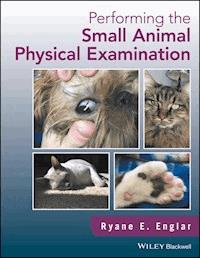
116,99 €
Mehr erfahren.
- Herausgeber: John Wiley & Sons
- Kategorie: Fachliteratur
- Sprache: Englisch
Performing the Small Animal Physical Examination offers an easy-to-follow guide to successfully executing a thorough physical exam in cats and dogs, with nearly 1,000 clinical photographs depicting step-by-step details.
- Provides comprehensive, practical information on the physical examination in small animal patients
- Presents nearly 1,000 color photographs with step-by-step details of the procedures and principles
- Offers advice on preparing the examination room, useful tips, and concrete guidance for examining each body system
- Outlines a systematic, in-depth approach to the initial examination in dogs and cats
- Supports new and experienced veterinarians and veterinary technicians alike in performing a thorough basic exam
Sie lesen das E-Book in den Legimi-Apps auf:
Seitenzahl: 1220
Veröffentlichungsjahr: 2017
Ähnliche

















Performing the Small Animal Physical Examination
Ryane E. Englar, DVM, DABVP (Canine and Feline Practice)
Assistant Professor, Small Animal Primary Care, Midwestern University College of Veterinary Medicine, Glendale, AZ, USA
This edition first published 2017 © 2017 by John Wiley & Sons, Inc.
All rights reserved. No part of this publication may be reproduced, stored in a retrieval system, or transmitted, in any form or by any means, electronic, mechanical, photocopying, recording or otherwise, except as permitted by law. Advice on how to obtain permission to reuse material from this title is available at http://www.wiley.com/go/permissions.
The right of Ryane E. Englar to be identified as the author of this work has been asserted in accordance with law.
Registered Office
John Wiley & Sons, Inc., 111 River Street, Hoboken, NJ 07030, USA
Editorial Office
John Wiley & Sons, Inc., 111 River Street, Hoboken, NJ 07030, USA
For details of our global editorial offices, customer services, and more information about Wiley products visit us at www.wiley.com.
Wiley also publishes its books in a variety of electronic formats and by print-on-demand. Some content that appears in standard print versions of this book may not be available in other formats.
Limit of Liability/Disclaimer of Warranty
The contents of this work are intended to further general scientific research, understanding, and discussion only and are not intended and should not be relied upon as recommending or promoting scientific method, diagnosis, or treatment by physicians for any particular patient. The publisher and the authors make no representations or warranties with respect to the accuracy and completeness of the contents of this work and specifically disclaim all warranties, including without limitation any implied warranties of fitness for a particular purpose. In view of ongoing research, equipment modifications, changes in governmental regulations, and the constant flow of information relating to the use of medicines, equipment, and devices, the reader is urged to review and evaluate the information provided in the package insert or instructions for each medicine, equipment, or device for, among other things, any changes in the instructions or indication of usage and for added warnings and precautions. Readers should consult with a specialist where appropriate. The fact that an organization or website is referred to in this work as a citation and/or potential source of further information does not mean that the author or the publisher endorses the information the organization or website may provide or recommendations it may make. Further, readers should be aware that websites listed in this work may have changed or disappeared between when this works was written and when it is read. No warranty may be created or extended by any promotional statements for this work. Neither the publisher nor the author shall be liable for any damages arising herefrom.
Library of Congress Cataloging-in-Publication Data
Names: Englar, Ryane E., author.
Title: Performing the small animal physical examination / Ryane E. Englar.
Description: Hoboken, NJ : Wiley, 2017. | Includes bibliographical references and index. | Identifiers: LCCN 2017025865 (print) | LCCN 2017027039 (ebook) | ISBN 9781119295327 (pdf) | ISBN 9781119295310 (epub) | ISBN 9781119295303 (cloth)
Subjects: | MESH: Physical Examination–veterinary | Veterinary Medicine–methods | Cats | Dogs
Classification: LCC SF772.5 (ebook) | LCC SF772.5 .E54 2017 (print) | NLM SF 772.5 | DDC 636.089/6075–dc23 LC record available at https://lccn.loc.gov/2017025865
Cover image: Courtesy of Ryane E. Englar
Cover design by Wiley
CONTENTS
About the Author
Preface
Acknowledgements
Part One Performing the Feline Physical Examination
1: Setting the Stage: Feline-Friendly Practice
1.1 Challenges Faced in Feline Practice
1.2 The Emergence of Feline-Friendly Practice
1.3 Key Principles of Feline-Friendly Practice
1.4 The Role of Sound
1.5 The Role of Tactile Stimulation
1.6 The Role of Scent
1.7 The Role of Advance Preparation
1.8 Examination Room Etiquette: Accessing the Cat
1.9 Recognizing Body Language
1.10 Feline-Friendly Handling
1.11 Other Feline Handling Tools
References
2: Assessing the Big Picture: the Body, the Coat, and the Skin of the Cat
2.1 Forms of Identification
2.2 Body Condition Scoring
2.3 Assessing Hydration
2.4 Inspecting the Coat: First Impressions
2.5 Identifying Coat Colors and Coat Patterns
2.6 Assessing Coat Quality
2.7 Inspecting the Skin
References
3: Examining the Head of the Cat
3.1 Skull Shape and Facial Symmetry
3.2 The Eyes and Accessory Visual Structures
3.3 The Ears
3.4 The Nose
3.5 The Extra-Oral Examination
3.6 The Intra-Oral Examination
References
4: Examining the Endocrine and Lymphatic Systems of the Cat
4.1 Evaluating the Thyroid Gland
4.2 Assessing the Lymphatic System
References
5: Examining the Cardiovascular and Respiratory Systems of the Cat
5.1 The Cardiac Patient
5.2 Assessing the Cardiovascular System Prior to Auscultation
5.3 Cardiothoracic Auscultation
5.4 The Respiratory Patient
5.5 Assessing the Respiratory System Prior to Auscultation
5.6 Understanding Normal Airway Sounds
5.7 Ausculting the Airway
5.8 Understanding Adventitious Airway Sounds
5.9 Using Airway Sounds to Corroborate Percussive Findings
5.10 Purring as an Obstruction to Auscultation
References
6: Examining the Abdominal Cavity of the Cat
6.1 Overview of the Digestive Tract as It Pertains to Presenting Complaints
6.2 The Esophagus
6.3 Visual Inspection of the Abdomen
6.4 Superficial Palpation of the Abdomen
6.5 Deep Palpation of the Abdomen
6.6 The Upper Urinary Tract
6.7 The Lower Urinary Tract
6.8 The Male Reproductive Tract
6.9 The Female Reproductive Tract
6.10 Being Presented with a Female of Unknown Sexual Status
6.11 Neonates
References
7: Examining the Musculoskeletal System of the Cat
7.1 Muscle Condition Score (MCS)
7.2 The Skeleton as a Whole
7.3 The Appendicular Skeleton: The Forelimb
7.4 The Appendicular Skeleton: The Hind Limb
References
8: Evaluating the Nervous System of the Cat
8.1 Assessing Behavior and Mental Status
8.2 Assessing Posture
8.3 Assessing Coordination and Gait
8.4 Assessing Postural Reactions
8.5 Assessing for Other Abnormal Movements
8.6 Evaluating the Spinal Reflexes
8.7 Assessing the Cranial Nerves
8.8 Assessing Nociception
References
Part Two Performing the Canine Physical Examination
9: Setting the Stage: Canine-Friendly Practice and Low-Stress Handling
9.1 Challenges Faced in Canine Practice
9.2 The Concept of Low-Stress Handling
9.3 White Coat Syndrome
9.4 The Role of Scent
9.5 The Role of Advance Preparation
9.6 Examination Room Etiquette: Setting the Tone for Initial Veterinary Interactions with the Dog
9.7 Recognizing Body Language
9.8 Creative Approaches to Challenging Interactions with Canine Patients
9.9 Other Canine Handling Tools
References
10: Assessing the Big Picture: the Body, the Coat, and the Skin of the Dog
10.1 Forms of Identification
10.2 Body Condition Scoring
10.3 Assessing Hydration
10.4 Breed Designation
10.5 Inspecting the Coat: First Impressions
10.6 Identifying Coat Colors and Coat Patterns
10.7 Assessing Coat Quality
10.8 Inspecting the Skin
10.9 Primary Skin Lesions
10.10 Secondary Skin Lesions
10.11 Miscellaneous Skin Lesions
10.12 Hyperkeratosis
10.13 Skin Folds
10.14 Nails and Paw Pads
10.15 Skin Incisions
10.16 Mammary Glands
References
11: Examining the Head of the Dog
11.1 Skull Shape: Function Versus Cosmesis
11.2 Facial symmetry
11.3 The Eyes and Accessory Visual Structures
11.4 The Ears
11.5 The Nose
11.6 The Extra-Oral Examination
11.7 The Intra-Oral Examination
References
12: Examining the Endocrine and Lymphatic Systems of the Dog
12.1 Thyroid Gland Neoplasia in the Dog
12.2 The Typical Presentation of Thyroid Gland Neoplasia in the Dog
12.3 The Pathophysiology of Hypothyroidism
12.4 The Typical Presentation of a Hypothyroid Dog
12.5 The Atypical Presentation of a Hypothyroid Dog
12.6 Assessing the Lymphatic System
12.7 Examining the Submandibular Lymph Nodes
12.8 Examining the Superficial Cervical or Pre-Scapular Lymph Nodes
12.9 Examining the Popliteal Lymph Nodes
12.10 Feeling for Lymph Nodes That Should Not Be Present
References
13: Examining the Cardiovascular and Respiratory Systems of the Dog
13.1 Congenital Heart Disease in the Dog
13.2 Acquired Heart Disease in the Dog
13.3 Assessing the Cardiovascular System Prior to Auscultation
13.4 Cardiothoracic Auscultation
13.5 The Respiratory Patient
13.6 Understanding Normal Airway Sounds
13.7 Ausculting the Airway
13.8 Understanding Adventitious Airway Sounds
13.9 Panting as an Obstruction to Auscultation
References
14: Examining the Abdominal Cavity of the Dog
14.1 Overview of the Digestive Tract
14.2 The Esophagus
14.3 Visual Inspection of the Abdomen
14.4 Auscultion and Superficial Palpation of the Abdomen
14.5 The Upper Urinary Tract
14.6 The Lower Urinary Tract
14.7 The Male Reproductive Tract
14.8 The Female Reproductive Tract
14.9 Being Presented with a Female of Unknown Sexual Status
14.10 Neonates
References
15: Examining the Musculoskeletal System of the Dog
15.1 Muscle Condition Score (MCS)
15.2 The Skeleton as a Whole
15.3 The Appendicular Skeleton: The Forelimb
15.4 The Appendicular Skeleton: The Hind Limb
References
16: Evaluating the Nervous System of the Dog
16.1 Assessing Behavior and Mental Status
16.2 Assessing Posture
16.3 Assessing Coordination and Gait
16.4 Assessing Postural Reactions
16.5 Assessing for Other Abnormal Movements
16.6 Evaluating the Spinal Reflexes
16.7 Assessing the Cranial Nerves
16.8 Assessing Nociception
References
Index
EULA




