


9,99 €
Mehr erfahren.
- Herausgeber: 50Minutes.com
- Kategorie: Fachliteratur
- Serie: Management & Marketing
- Sprache: Englisch
Prepare the best strategies in advance
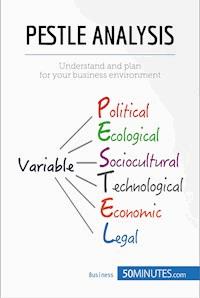
This book is a practical and accessible guide to understanding and implementing the PESTLE analysis, providing you with the essential information and saving time.
In 50 minutes you will be able to:
• Understand the uses of the PESTLE analysis and how it can be useful for your business
• Categorize the macroeconomic variables of your business into the six different sections of the PESTLE analysis: Political, Economic, Socio-cultural, Technological, Legal and Environmental.
• Analyze your findings and use the information to construct possible future scenarios and plan the best action to take in advance
ABOUT 50MINUTES.COM | Management & Marketing
50MINUTES.COM provides the tools to quickly understand the main theories and concepts that shape the economic world of today. Our publications are easy to use and they will save you time. They provide elements of theory and case studies, making them excellent guides to understand key concepts in just a few minutes. In fact, they are the starting point to take action and push your business to the next level.
Das E-Book können Sie in Legimi-Apps oder einer beliebigen App lesen, die das folgende Format unterstützen:
Seitenzahl: 28
Veröffentlichungsjahr: 2015
Ähnliche















PESTLE analysis
Key information
Names: PESTLE analysis, PESTEL analysis, PESTLE framework.Uses: the PESTLE analysis enables a manager to identify the key macroeconomic factors that may have an influence on the future development of the business.Why is it successful? The identification of future macroeconomic variables that might be of interest and the construction of different scenarios allow the manager to better anticipate the strategic decisions needed to ensure the proper development and sustainability of the business.Key words:Competitive advantage: an asset that allows an organisation to stand out positively and get ahead of its competitors in a particular sector.Competitive strategy: methodology implemented with the aim of maximising the success of the business through innovation and greater advantages than those of the competition.Economic situation: the overall position of an entity, determined by all of its political, economic and social elements. Pivot variable: an element of crucial importance that can greatly influence the development of the company.Scenario: the likely theoretical projection for the near or distant future.Introduction
The company and its environment
Characterised by an ever-changing environment, our current society differs in many ways from what it was before. Adapting to the changing and competitive environment has now become a necessity for any manager wanting to keep their business afloat and help it to prosper in the coming years. The environment (macroeconomic dimension) has actually proven itself to be a source of both opportunities and threats for any company on the market, regardless of their industry or sector.
Therefore, a confirmed anticipation of the lambda macroeconomic phenomenon will soon provide a direct competitive advantage for the manager, if this allows them to react efficiently before their competitors. On the other hand, if a manager underestimates a momentous event in the market, they will quickly find themselves struggling against competitors whose forecasts are more complete, as they will have to face their competitive and aggressive strategies. For example, companies that did not anticipate the expansion and opportunities offered by the internet in time had a hard time at the turn of the millennium.
As the ability to predict certain future events seems to be the key to the success, good development and even, in some cases, the survival of a company, there are always people who claim, after a change in the environment, that the indicators were inevitably moving in that direction anyway. Yet anticipating these indicators is far from easy, and nobody has a crystal ball for predicting the future.
It is in this context of uncertainty that the PESTLE analysis has appeared, aiming to identify and analyse the macroeconomic variable relevant to an organisation in a specific environment.
Definition of the model
The analysis was given the name PESTLE in reference to the acronym formed by the initials of the six categories of macroeconomic variables included in the model (Political, Economic, Socio-cultural, Technological, Legal and Environmental). Firstly, the model allows managers to identify the macroeconomic variables to take into consideration for the development of the business (opportunities vs. potential risks), whose likelihood is still relatively uncertain. Then, the model can help the manager to start conceptualising different scenarios based on these uncertain variables to better predict what might happen and make the right decisions now for the future.
What is the macro-environment?
The environment of an organisation can be divided into three distinct layers:
competitors and the market;




