


1,49 €
Mehr erfahren.
- Herausgeber: Maria Tsaneva
- Kategorie: Geisteswissenschaft
- Sprache: Englisch
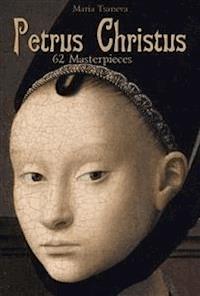
Petrus Christus was an Early Netherlandish painter active in Bruges from 1444, where, along with Hans Memling, he became the leading painter after the death of Jan van Eyck. He was influenced by van Eyck and Rogier van der Weyden and is noted for his innovations with linear perspective and a meticulous technique which seems derived from miniatures and manuscript illumination. Today, very few works are confidently attributed to him. The best-known include the 1446 Portrait of a Carthusian and c. 1470 Berlin Portrait of a Young Girl; both are highly innovative in presentation of the figure against detailed, rather than flat, backgrounds. Christus was an anonymous figure for centuries, his importance not established until the work of modern art historians. In the early to mid nineteenth century Gustav Waagen and Johann David Passavant were important in establishing Christus's biographical details and in attributing works to him.
Das E-Book können Sie in Legimi-Apps oder einer beliebigen App lesen, die das folgende Format unterstützen:
Veröffentlichungsjahr: 2014
Ähnliche



Petrus Christus: 62Masterpieces
By Maria Tsaneva
First Edition
Copyright © 2014 by Maria Tsaneva
*****
Petrus Christus: 62 Masterpieces
*****
Foreword
Petrus Christus (1420 –1476) was an Early Netherlandish painter active in Bruges from 1444, where, along with Hans Memling, he became the leading painter after the death of Jan van Eyck. He was influenced by van Eyck and Rogier van der Weyden and is noted for his innovations with linear perspective and a meticulous technique which seems derived from miniatures and manuscript illumination. Today, very few works are confidently attributed to him. The best-known include the 1446 Portrait of a Carthusian and c. 1470 Berlin Portrait of a Young Girl, both are highly innovative in presentation of the figure against detailed, rather than flat, backgrounds.
Christus was an anonymous figure for centuries, his importance not established until the work of modern art historians. Giorgio Vasari barely mentions him in his biographies of painters, written in the Renaissance, and near contemporary records merely list him amongst many others. In the early to mid nineteenth century Gustav Waagen and Johann David Passavant were important in establishing Christus's biographical details and in attributing works to him.
Christus produced at least six signed and dated works, which form the basis for any other attributions to him. These are: the Portrait of Edward Grymeston (on loan to the National Gallery, London, 1446), the Portrait of a Carthusian (Metropolitan Museum of Art, New York, 1446), the so-called St. Eligius in His Shop (Metropolitan Museum of Art Robert Lehman Collection, New York, 1449), the Virgin Nursing the Child (now in the Koninklijk Museum voor Schone Kunsten, Antwerp, 1449), the so-called "Berlin Altar Wings" with the Annunciation, Nativity, and Last Judgment (Gemäldegalerie, Staatliche Museen zu Berlin, 1452), and the Virgin and Child Enthroned with Saints Jerome and Francis (Stadelsches Kunstinstitut, Frankfurt-am-Main). In addition, a pair of panels in the Groeningemuseum in Bruges (showing the Annunciation and Nativity) bears a date of 1452.
His late work, the reserved Portrait of a Young Girl belongs among the masterworks of Early Netherlandish painting, marking a new development in Netherlandish portraiture. It no longer shows the sitter in front of a neutral background, but in a concrete space defined by the background wall panels. Christus had already perfected this format in his two portraits of 1446. The unknown woman, whose exquisite clothing suggests that she might come from France, radiates an aura of discretion and of nobility, while appearing slightly unreal in the elegant stylization of her form.
Christus died in Bruges in 1475 or 1476. Hans Memling succeeded him as the next great painter in Bruges.
Paintings and Drawings
Portrait of a Young Girl, c. 1470
Oak, 29 x 23 cm
Staatliche Museen, Berlin
Detail
Potrait of a Carthusian, 1446
Oil on wood, 29,2 x 21,6 cm
Metropolitan Museum of Art, New York




