


1,49 €
Mehr erfahren.
- Herausgeber: Maria Tsaneva
- Sprache: Englisch
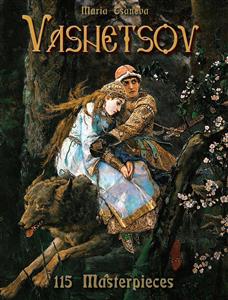
Viktor Mikhaylovich Vasnetsov (1848 – 1926) was a Russian artist who specialized in mythological and historical subjects. He is considered the co-founder of Russian folklorist and romantic modernist painting and a key figure in the revivalist movement. It is ironic, but Viktor, whose name is associated with historical and mythological paintings, initially avoided these subjects at all costs. While living in France, Viktor studied classical and contemporary paintings, academic and Impressionist alike. It was in Paris that he became fascinated with fairy-tale subjects, starting to work on Ivan Tsarevich Riding a Grey Wolf and The Firebird. The vogue for Vasnetsov's paintings would spread in the 1880s, when he turned to religious subjects and executed a series of icons. He was central in moving realism towards a more nationalist, and historical style, believing that a true work of art conveys the past, present, and even the future.
Das E-Book können Sie in Legimi-Apps oder einer beliebigen App lesen, die das folgende Format unterstützen:
Veröffentlichungsjahr: 2014
Ähnliche

Vasnetsov: 116Masterpieces
By Maria Tsaneva
First Edition
Copyright © 2014 by Maria Tsaneva
*****
Vasnetsov: 116 Masterpieces
*****
Foreword
Viktor Mikhaylovich Vasnetsov (1848 –1926) was a Russian artist who specialized in mythological and historical subjects. He is considered the co-founder of Russian folklorist and romantic modernist painting and a key figure in the revivalist movement.It is ironic, but Viktor, whose name is associated with historical and mythological paintings, initially avoided these subjects at all costs.While living in France, Viktor studied classical and contemporary paintings, academist and Impressionist alike. It was in Paris that he became fascinated with fairy-tale subjects, starting to work on Ivan Tsarevich Riding a Grey Wolf and The Firebird. The vogue for Vasnetsov's paintings would spread in the 1880s, when he turned to religious subjects and executed a series of icons.He was central in moving realism towards a more nationalist, and historical style, believing that a true work of art conveys the past, present, and maybe even the future.
Viktor Vasnetsov was born in a remote village Lopyal of Vyatka guberniya in 1848, the second of the six children. His father Mikhail Vasilievich Vasnetsov, known to be philosophically-inclined was a member of priesthood, and of scholarly dictation in the natural sciences and astronomy. His grandfather was an icon painter. Two of Mikhail Vasnetsov's three sons, Viktor and Apollinary, became remarkable painters, the third one becoming a schoolteacher. It was in Lopyal that Viktor started to paint, mostly landscapes and scenes of village life.
From the age of ten, Viktor studied in a seminary in Vyatka, each summer moving with his family to a rich merchant village of Ryabovo. During his seminary years, he worked for a local icon shopkeeper. He also helped an exiled Polish artist, Michał Elwiro Andriolli, to execute frescoes for Vyatka's Alexander Nevsky cathedral.
Having graduated from the seminary, Viktor decided to move to Saint Petersburg to study art. He auctioned his paintings of Woman Harvester and Milk-maid (both 1867) in order to raise money required for the trip to the Russian capital.In August 1867 Viktor entered the Imperial Academy of Arts. Three years later, the Peredvizhniki movement of realist painters rebelled against the Academism.Vasnetsov befriended their leader Ivan Kramskoi, referring to him as his teacher. He also became very close to his fellow student Ilya Yefimovich Repin.For his graphic composition of Christ and Pontius Pilate Before the People, the Academy awarded a small silver medal to him.In the early 1870s he executed a lot of engravings depicting contemporary life. Two of them won him a bronze medal at the World Fair in London (1874).At that period he also started producing genre paintings in oil.
In 1876 Repin invited Vasnetsov to join the Peredvizhniki colony in Paris. At that period, he painted Acrobats (1877), produced prints, and exhibited some of his works at the Salon. In 1877 he returned to Moscow.In the late 1870s Vasnetsov concentrated on illustrating Russian fairy tales and bylinas, executing some of his best known pieces but these works were not appreciated at the time they appeared. Many radical critics dismissed them as undermining the realist principles of the Peredvizhniki. Even such prominent connoisseurs as Pavel Mikhailovich Tretyakov refused to buy them.
In 1884-1889 Vasnetsov was commissioned to paint frescos in the St Vladimir's Cathedral of Kiev. This was a challenging work which ran contrary to both Russian and Western traditions of religious paintings. The influential art critic Vladimir Stasov labelled them a sacrilegious play with religious feelings of the Russian people. Another popular critic, Dmitry Filosofov, referred to these frescoes as "the first bridge over 200 years-old gulf separating different classes of Russian society".
While living in Kiev, Vasnetsov made friends with Mikhail Vrubel, who was also involved in the cathedral's decoration. While they worked together, Vasnetsov taught the younger artist a great deal. It was in Kiev that Vasnetsov finally finished Ivan Tsarevich Riding a Grey Wolf and started his most famous painting, the Bogatyrs.
In 1885 the painter travelled to Italy. The same year he worked on stage designs and costumes for Nikolai Rimsky-Korsakov's opera The Snow Maiden.The following two decades were productive for Vasnetsov. He increasingly turned to other media during this period. In 1897 he collaborated with his brother Apollinary on the theatrical design of another Rimsky-Korsakov premiere, Sadko.At the turn of the century, Vasnetsov elaborated his hallmark "fairy-tale" style of Russian Revivalist architecture. His first acclaimed design was a church in Abramtsevo (1882), executed jointly with Vasily Polenov. In 1894, he designed his own mansion in Moscow. The Russian pavilion of the World Fair in Paris followed in 1898. Finally, in 1904, Vasnetsov designed the best known of his "fairy-tale" buildings — the Tretyakov Gallery.
Between 1906 and 1911, Vasnetsov worked on the design of the mosaics for Alexander Nevsky Cathedral, Warsaw; he was also involved in the design of Alexander Nevsky Cathedral, Moscow.In 1912, he was given a noble title by Czar Nicholas II. In 1914, he designed a revenue stamp intended for voluntary collection for victims of World War I.
Even prior to the Russian Revolution, Vasnetsov became active as a regent of that gallery. He allocated a significant portion of his income to the State Historical Museum, so that a large part of the museum's collection was acquired on Vasnetsov's money.
Paintings and Drawings
Reaper, 1867
Oil on canvas
Russian proverbs and sayings, 1866-1867
Pencil
Portrait of the Artist Arkhip Kuinji, 1869
Oil on canvas
Merchant family in the theater, 1869
Girl with a bast basket, 1870
Pencil
Away, 1871
Pencil




