


0,99 €
Mehr erfahren.
- Herausgeber: Maria Tsaneva
- Kategorie: Geisteswissenschaft
- Sprache: Englisch
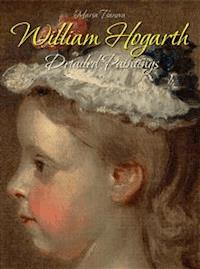
William Hogarth (1697 – 1764) was an English painter, printmaker, pictorial satirist, social critic, and editorial cartoonist who have been credited with pioneering western sequential art. His work ranged from realistic portraiture to comic strip-like series of pictures called "modern moral subjects". Knowledge of his work is so pervasive that satirical political illustrations in this style are often referred to as "Hogarthian". Hogarth was far and away the most important British artist of his generation. He was equally outstanding as a painter and engraver and by the force of his aggressive personality as well as by the quality and originality of his work he freed British art from its domination by foreign artists. Because so much of his work has a 'literary' element, his qualities as a painter have often been overlooked, but his more informal pictures in particular show that his brushwork could live up to his inventive genius.
Das E-Book können Sie in Legimi-Apps oder einer beliebigen App lesen, die das folgende Format unterstützen:
Veröffentlichungsjahr: 2015
Ähnliche

William Hogarth:
Detailed Paintings
By Maria Tsaneva
––––––––
First Edition
*****
William Hogarth: Detailed Paintings
*****
Copyright © 2015 Maria Tsaneva
Table of Contents
Title Page
Copyright Page
Foreword
Paintings
Foreword
William Hogarth (1697 – 1764) was an English painter, printmaker, pictorial satirist, social critic, and editorial cartoonist who have been credited with pioneering western sequential art. His work ranged from realistic portraiture to comic strip-like series of pictures called "modern moral subjects". Knowledge of his work is so pervasive that satirical political illustrations in this style are often referred to as "Hogarthian". Hogarth was far and away the most important British artist of his generation. He was equally outstanding as a painter and engraver and by the force of his aggressive personality as well as by the quality and originality of his work he freed British art from its domination by foreign artists. Because so much of his work has a 'literary' element, his qualities as a painter have often been overlooked, but his more informal pictures in particular show that his brushwork could live up to his inventive genius.
He was born at Bartholomew Close in London to Richard Hogarth, a poor Latin school teacher and textbook writer, and Anne Gibbons. In his youth he was apprenticed to the engraver Ellis Gamble in Leicester Fields, where he learned to engrave trade cards and similar products. Young Hogarth also took a lively interest in the street life of the metropolis and the London fairs, and amused himself by sketching the characters he saw. Around the same time, his father, who had opened an unsuccessful Latin-speaking coffee house at St John's Gate, was imprisoned for debt in Fleet Prison for five years. Hogarth never spoke of his father's imprisonment.
Hogarth trained as an engraver in the Rococo tradition and by 1720 was established in London independently as an engraver on copper of billheads and book illustrations. In his spare time he studied painting, first at the St Martin's Lane Academy and later under Sir James Thornhill, whose daughter he married in 1729. By this time he had begun to make a name with small conversation pieces, and about 1730 he set up as a portrait painter. At about the same time he invented and popularized the use of a sequence of anecdotal pictures 'similar to representations on the stage' to point a moral and satirize social abuses. A Harlot's Progress (6 scenes, c. 1731; destroyed by fire) was followed by A Rake's Progress (8 scenes, Sir John Soane's Museum, London, c. 1735), and Marriage а la Mode (6 scenes, National Gallery, London, c. 1743), which each portray the punishment of vice in a somewhat lurid melodrama. Each series was painted with a view to being engraved, and the engravings had a wide sale and were popular with all classes. They were much pirated and Hogarth's campaigning against the profiteers led to the Copyright Act of 1735. 'I have endeavoured', he wrote, 'to treat my subjects as a dramatic writer: my picture is my stage, and men and women my players.'
Hogarth, however, was much more than a preacher in paint. His satire was directed as much at pedantry and affectation as at immorality, and he saw himself to some extent as a defender of native common sense against a fashion for French and Italian mannerisms. In spite of his rabid xenophobia, Hogarth made some attempts to show he could paint in the Italian Grand Manner (Sigismunda, 1759). These, however, are generally considered his weakest works, and apart from his modern morality subjects he excelled mainly in portraiture. Captain Coram (1740), which he regarded as his highest achievement in portraiture, shows that he could paint a portrait in the Baroque manner with complete confidence and without artificiality. However, he could not flatter or compromise and had not the disposition for a successful portraitist. From 1735 to 1755 he ran an academy in St Martin's Lane (independent of the one at which he had studied), and this became the main forerunner of the Royal Academy. In 1753 he published The Analysis of Beauty, a treatise on aesthetic theory which he wrote with the conviction that the views of a practising artist should carry greater weight than the theories of the connoisseur or dilettante.
Hogarth was initiated as a Freemason before 1728 in the Lodge at the Hand and Apple Tree Tavern, Little Queen Street, and later belonged to the Carrier Stone Lodge and the Grand Stewards' Lodge; the latter still possesses the 'Hogarth Jewel' which Hogarth designed for the Lodge's Master to wear. Today the original is in storage and a replica is worn by the Master of the Lodge. Freemasonry was a theme in some of Hogarth's work, most notably 'Night', the fourth in the quartet of paintings (later released as engravings) collectively entitled the Four Times of the Day.
He was a founding Governor of the Foundling Hospital.
Among his friends and acquaintances were many English artists and satirists of the period, such as Francis Hayman, Henry Fielding, and Laurence Sterne.
Hogarth died in London on 26 October 1764 and was buried at St. Nicholas's Churchyard, Chiswick Mall, Chiswick, London




