


Erhalten Sie Zugang zu diesem und mehr als 300000 Büchern ab EUR 5,99 monatlich.
- Herausgeber: Pocket Essentials
- Kategorie: Fachliteratur
- Sprache: Englisch
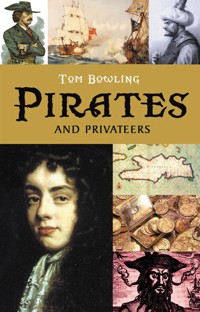
From Robert Louis Stevenson's Treasure Island to Errol Flynn in Captain Blood on to today's Pirates of the Caribbean, the romantic image of pirates in modern Western popular culture has long been with us. But of course pirates come in many guises, and not all of them as charming as Johnny Depp. Pirates are outlaws who move quickly, a form of lawlessness based on the application of immense short term power by mobile forces which fade away, similar to guerrilla warfare. In Pirates and Privateers Tom Bowling offers a lively history of piracy, from ancient times through the 'privateers' such as Morgan, with their Letters of Marque (an early example of State-sponsored terrorism), to the still real and flourishing threat of contemporary pirates that patrol the less well-regulated shipping lanes of the world today.
Sie lesen das E-Book in den Legimi-Apps auf:
Seitenzahl: 187
Veröffentlichungsjahr: 2015
Das E-Book (TTS) können Sie hören im Abo „Legimi Premium” in Legimi-Apps auf:
Ähnliche


















From Robert Louis Stevenson’s Treasure Island to Errol Flynn in Captain Blood on to today’s Pirates of the Caribbean, the romantic image of pirates in modern Western popular culture has long been with us. But of course pirates come in many guises, and not all of them as charming as Johnny Depp. Pirates are outlaws who move quickly, a form of lawlessness based on the application of immense short term power by mobile forces which fade away, similar to guerrilla warfare. In Pirates and Privateers Tom Bowling offers a lively history of piracy, from ancient times through the ‘privateers’ such as Morgan, with their Letters of Marque (an early example of State-sponsored terrorism), to the still real and flourishing threat of contemporary pirates that patrol the less well-regulated shipping lanes of the world today.
About the Author Tom Bowling is a Londoner born into a seafaring family in the Neckinger, a part of Bermondsey allegedly named after the Devil’s Neckinger or noose worn by pirates executed there. He is the author of the Pocket Essential Pirates and Privateers and historical fiction set in the Napoleonic Wars, The Antigallican.
Pirates and Privateers
TOM BOWLING
POCKET ESSENTIALS
Contents
What is a Pirate?
Becoming a Pirate
Pirate or Privateer?
The Greatest Act of Piracy
Blackbeard
Women Pirates
Pirates Aground
Notes
Bibliography
What is a Pirate?
A pirate is a sea- robber, an exploiter of weakness. If a pirate has the power he will take what’s yours. It’s simple. Historically, we see pirate captains as a form of gang leader, pirates as their gang members. But this implies piracy is more than a simple moral failing. Gangs are a social phenomenon. The pirate could be an unfortunate sailor captured and left no choice but to join the ‘gang’? He could be a soldier continuing his trade outside the law. He could even be a politician, pursuing a colonial ‘policy’ by extra-judiciary means. All of these are in the pages which follow.
The high water mark of piracy, the period of the classic buccaneer (never privateer or corsair, as we shall see) with a ring in his ear, tricorn hat, fuses in his hair, cutlass, pistols and buried treasure, the period of the iconic pirate who conformed to all the prejudices we have gained from reading books and watchingfilms, was undoubtedly the seventeenth and early eighteenth centuries. The place was the Spanish Main, by which I mean the Spanish American empire which stretched from Venezuela around the Caribbean to Florida. In the seventeenth and eighteenth centuries, Florida was a Spanish possession. The Spanish Main included some Caribbean islands. The classic Spanish Main pirate could be black or white, French, Spanish, American, Dutch or English. There are plenty of examples of each. Nor were his activities constrained by national boundaries, except in the case of a privateer, a sort of official, state-sanctioned sea-robber whose exact circumstances we will discuss later. Just as interesting as the spread of race and nationality, the pirates’ ‘class’ (perhaps too modern a term for this period; ‘social background’ might be a better description) could not be predicted. There were ‘well to do’ pirates and, famously, a few women pirates. ‘He’ could be male or female. He could be black or white. He could come from any one of a dozen seafaring countries. He could terrorise the seas for years or appear, grab a fortune and disappear again. This classic pirate, the one alluded to in the cinema performances of Johnny Depp and Errol Flynn, has gone forever. We have our own pirates now.
Though piracy is thought of as a characteristic of the Caribbean, it took place (and may today take place) around the world – in the South China Sea, South America, the Indian Ocean, the Eastern American seaboard, the shores around Britain, even on the Thames and the Hudson rivers. There are plenty of reminders of piracy in London and New York. I was brought up in a family full of sailors in London. We lived by the side of what had been the river Neckinger in Bermondsey. Notwithstanding the fact that Execution Dock in Wapping lies opposite on the north side of the Thames, the Neckinger is reputed (not least by the Mayor of London’s website) to have been named after the Devil’s Neckinger, or necktie, by which is meant the hangman’s noose. Pirates are said to have been hanged at the Neckinger river mouth. Hence the name, it is implied: a nice story, unless yours were the neck to be stretched. Certainly it is recorded that convicted pirates’ bodies were displayed in chains at Blackwall, Cuckold’s Point and Redriff (i.e. Rotherhithe), which are all within a mile of the mouth of the Neckinger. But I’ve never seen a document which condemns a pirate to be hanged at or by the Neckinger. Though I’d have loved to have seen a pirate gallows there as a boy, though I’m certain there were Thames pirates until just outside living memory, I think the Devil’s Neckinger story is showman’s puff, repeated and convenient invention, not history. It also runs contrary to all we know about place names – the names of rivers change immensely slowly and rivers in England usually have their Roman or Ancient British names. How come the Neckinger gained its name during the age of pirates? I don’t think it did.
Long before the time of my own childhood the Neckinger river had been entirely culverted and ran under our feet, save for the last couple of hundred yards of its course, which had been turned into St Saviour’s Dock. The Neckinger supplied water to Bermondsey’s last remaining tannery, then trickled below the tarmac, before running eventually into the Thames and down to the sea. My grandfather had sailed up the London river, as sailors call the Thames, at the turn of the twentieth century. My father and his brothers sailed in Royal or Merchant Navies (or both) during the 1940s and 1950s. We were a salt water family. We lived right next to the Pool of London and I often played on the muddy strand below St Saviour’s Dock, which is formed from the mouth of the Neckinger river.
As we played, the steel bellies of dried-out ships towered over us, like beached whales. Thames Division coppers came as close as they dared in their launches and bellowed at us through foghorns, ‘Get orf the shore.’ We didn’t. They couldn’t enforce their threats, we knew. They would go aground if they came any closer. We were little boys and knew no boundaries and no danger. So, at the mouth of the Neckinger, where pirates were not hanged, we played. Lacking gallows, nooses, bodies dangling above our heads (oh, how we would have loved them), lacking men with hooked hands and peg legs, lacking bags of bones left in chains, lacking secret maps and treasure chests, lacking any sort of fear or knowledge of piracy, we stumbled about on the grit and mud during the day and learned about pirates later from ‘history’ and adventure books.
If Thames pirates had existed in the 1950s, we would have known about them, just as plainly as we saw the big beefy London river coppers in their boats. There were no pirates but plenty of coppers. Equally, if there had been common and large-scale piracy in, say, the South China Sea in the 1940s, my father, who had spent that decade sailing around it in a wheezy old tramp steamer, would have known of it and talked about it. But he didn’t. He talked about everything else he’d encountered on that trip, one that lasted years and was caused by the ship-owner ‘shanghai-ing’ his crew which, in the 1940s, meant sending the tramp further and further into the lost reaches of a far-off ocean where they wouldn’t have a chance to leave the ship and get home. In the eighteenth century this might have caused the crew to mutiny, leading to accusations of piracy. Later in the book I’ve included excerpts from the Proceedings of the Old Bailey, which describe exactly this. Being ‘shanghaied’ as English sailors call it, seems to have been a common reason for men turning pirate. Unlike Teach’s, Morgan’s, Kidd’s or Avery’s men, my father and his shipmates belonged to a Trade Union. His vessel eventually fetched up on the shores of what is now Bangladesh, where the crew struck and were repatriated. But throughout they saw no pirates. The closest any of us, fathers and sons, came to meeting pirates was in our imaginations, a truly distant land.
Today there are pirates in the area between India, Indonesia and Burma. The Chinese government tried a group of them as recently as 2000. According to the Chinese People’s Daily:
14 Myanmarese1 pirates were charged with raiding a Taiwanese cargo ship and setting its 21 crew members adrift in the Andaman Sea. The pirates hijacked the Marine Master cargo ship in the small hours of March 17, 1999, which was sailing through the Andaman Sea south of Myanmar, heading from China’s eastern port of Zhangjiagang to Calcutta, India, when the pirates boarded the ship. Armed with guns and knives, the pirates hijacked the ship and seized alkali as well as crew members’ valuables with a total value of more than 5.8 million yuan (US$698,000). The crew was forced into a lifeboat, whichfloated for 10 days before being rescued byfishermen from Thailand. Meanwhile, the pirates disguised the cargo ship and sailed it to the port of Shantou in south China’s Guangdong Province, where they sold the cargo of alkali. When the ship arrived at the city of Fangchenggang in Southern Guangxi for repairs on June 8, local police spotted it and arrested the pirates.
The pirate leader was sentenced to death, the others to long terms of imprisonment. The account of the robbery could come straight from the accounts of the Admiralty courts of the eighteenth century. The Andaman Sea is the body of water between Burma and India. Burma is, of course, one of the failed and repressive regimes all too common in Asia. By western standards it is lawless, and lawlessness, often the result of wars, is one of the necessary conditions for piracy.
It hasn’t always been necessary to travel to far off places in search of pirates. Marlowe’s comment on the Thames in Conrad’s Heart of Darkness (‘this also, has been one of the dark places of the earth’) compared Romans to the Belgians on the Congo, but it might well have applied to Africans enslaved and taken to the New World a hundred years earlier, say to Chesapeake or to New York’s Hudson river (the Hudson Valley Institute suggests 15% of farms in that region were worked by African slaves in 1776). Holding a man or woman as a slave and treating them as property was without moral or legal foundation then as now. Lawlessness is a requisite of piracy.
A boy in Brooklyn or Bermondsey might have seen pirates for himself in the eighteenth and nineteenth centuries, when there was undoubtedly organised piracy on the Thames and on the New York Hudson and East rivers. Pirates exploited what was essentially a lawless environment. So the presence of pirates in London and New York led to the formation of thefirst police forces. The river piracy losses these police forces were formed to prevent were enormous, running into many hundreds of thousands of pounds sterling. Net public expenditure for Britain in 1798 was £64,000,000, so losses on the Thames of, say, half a million pounds would represent a sum approaching 1% of the national budget. At today’s prices even 1% of, for example, 2005 UK government expenditure would be of the order of £2,770,000,000 sterling.
Eighteenth-century Thames pirates were organised in gangs known, with economy of vocabulary, as ‘River Pirates’ and ‘Mudlarks’. The nineteenth century New York rivers had several groups of pirates, the most important being known as the Hole-in-the Wall gang. This was 20 years before Butch Cassidy and his co-criminals were in a gang of the same name and the two gangs are not related. The London River Police were formed in 1798. These anti-pirate river police were the veryfirst proper, state-run police force in England, predating the formation of the Metropolitan Police by 30 years. The denizens of London were disgusted by the move. The new River Police, with their fast rowboats full of constables armed with muskets and cutlasses, were considered a hugely dangerous and illiberal extension of the state, yet another revolting and interfering idea brought from Europe, where the French Revolution was in full swing. Soon after the River Police were established, a crowd estimated to be 2,000 strong demonstrated outside their rented offices in Wapping and tried to burn the building down. The Thames River Pirates and Mudlarks were making off with half a million pounds’ worth of goods a year, though. They had to be stopped. What a quandary! Sometimes it’s possible to get the feeling nothing ever changes in the English psyche.
It’s tempting to view pirates as the extreme, radical edge of free market economics. We still talk of free marketeers as having a ‘buccaneering’2 spirit, with no real sense of criticism attached. It may be from this sense that we derive the modern usage of a pirate as someone who breaks market rules (for example, on copyright, at an internet site like http://thepiratebay. org/).
It may also be that our definition of ‘pirate’ needs re-examining. The behaviour characteristic of pirates can be seen elsewhere in society. Men who prey on others, who live by their own outsider moral code, who move with speed and offer violence are common enough. Piratesfill a power vacuum left by the state. The term might be applied to Dick Turpin and the Gregory Gang in eighteenth-century England (they even tortured their victims, pirate style) or to Jesse James and the James gang in nineteenth-century USA. For that matter, it might be applied to any of the other groups of men who made the West wild in the years immediately after the American Civil War. The sheer distances and scarcity of population in America before mass immigration in the late nineteenth century meant that large areas of the country had no real government. A pirate needs lawlessness, weapons, victims, the ability to move quickly. A pirate needs a viable ‘outsider’ society. A pirate needs cash or valuables to prey upon. Does a pirate need a boat? Probably. But having a boat doesn’t make a pirate. Raphael Semmes is sometimes referred to as ‘the Confederate pirate’ when he was nothing of the sort. He was the captain of a confederate commerce raider during the American civil war and a former officer of the US Navy. He was a rebel and took his ship, the Alabama, on a world tour of destruction of Union shipping – he sunk or captured over 60 Union ships – but he was neither a pirate nor a corsair. That’s a different matter.
If the James gang and their like were the land-based pirates of the developing west of the United States, they had plenty of counterparts in the east. The rivers around Jersey, New York, Staten Island and Long Island abounded with pirates in the early part of the nineteenth century. The New York river police were formed to counter them in 1858. It was none too soon. Before New York gangsters had cars, they had boats. In the early nineteenth century, river pirates from New York City travelled in rowboats and attacked not only ships at anchor but country houses and country people on Long Island, the rural Jersey shore and in the Hudson Valley. Such were the depredations farmers suffered from Manhattan gangsters marauding the waterways that, on the Jersey shore at least, they had been reduced to meeting anyone landing from a boat with gunfire. These water-borne New York gangsters, like those in London, fulfil any conceivable definition of ‘pirates’ – they travelled by water, they were armed and they committed crimes of either theft or violence or both.
Like death and taxes, pirates have always been with us. Mediterranean pirates, either Corsican or Barbary, Balearic or Cretan, had existed back into the depths of history. Julius Caesar himself was held prisoner by Cilician (southern Turkish) pirates in 75BC. According to Plutarch:
when the pirates demanded a ransom of twenty talents, Caesar burst out laughing. They did not know, he said, who it was that they had captured, and he volunteered to payfifty. Then, when he had sent his followers to the various cities in order to raise the money and was left with one friend and two servants among these Cilicians, about the most bloodthirsty people in the world, he treated them so highhandedly that, whenever he wanted to sleep, he would send to them and tell them to stop talking.
For thirty-eight days, with the greatest unconcern, he joined in all their games and exercises, just as if he was their leader instead of their prisoner. He also wrote poems and speeches which he read aloud to them, and if they failed to admire his work, he would call them to their faces illiterate savages, and would often laughingly threaten to have them all hanged. They were much taken with this and attributed his freedom of speech to a kind of simplicity in his character or boyish playfulness.
However, the ransom arrived from Miletus and, as soon as he had paid it and been set free, he immediately manned some ships and set sail from the harbour of Miletus against the pirates. He found them still there, lying at anchor off the island, and he captured nearly all of them. He took their property as spoils of war and put the men themselves into the prison at Pergamon. He then went in person to Junius, governor of Asia, thinking it proper that he, as praetor in charge of the province, should see to the punishment of the prisoners. Junius, however, cast longing eyes at the money, which came to a considerable sum, and kept saying that he needed time to look into the case. Caesar paid no further attention to him. He went to Pergamon, took the pirates out of prison and crucified the lot of them, just as he had often told them he would do when he was on the island and they imagined that he was joking.
Pirates, as we shall see, did not always have things their own way. Perhaps the Cilician pirates (we don’t have their names) would have been best served by moving on and counting their money elsewhere. Caesar was clearly interested in maritime matters – he notes elsewhere that the Veniti (the inhabitants of Vannes in modern Brittany) used chain for their anchors. It must have been an expensive system to manufacture by the standards and with the technology of the period but would resist either pirates or Romans stealing the ships.
Though there was piracy in the early twentieth century, and there is undoubtedly piracy now, the 1940s, 1950s and 1960s seem to have been peculiarly clear of it. Why? The clues might be in maritime power, fast outboard engines and in the development of the United Nations. After the Second World War the victorious allies had a surfeit of naval power. They were capable, at least at sea, of enforcing international law. This law doesn’t only govern states and their dealings with each other but also authorises states’ forces to protect their citizens no matter where they are in the world. After the Second World War western states felt they had both power and the right to use it, at least within a legal framework. This is a question of self belief. In the 1940s the forum for regulation of international behaviour was being established – the UN. Briefly both the will and the method of enforcing the forum’s will were reaching a high water mark. The UN had been conceived as a kind of parliament of nations, the Nuremberg trials suggested a world community which sets a legal limit to tyranny, or at least implies the possibility of retribution against tyrants. The world became briefly more hopeful and lawful. Perhaps something similar is happening now with the trials of Slobodan Milosevic and Charles Taylor in The Hague. They were both pirate leaders of demoralised, immoral and chaotic states leading forces which raped, robbed and murdered with, they thought, impunity.
I’m sure it’s clear by now that I believe piracy is associated with state lawlessness and poverty. If the state does not or cannot care for its citizens it has no moral right to rule. In these circumstances a moral vacuum develops which isfilled by desperate, dangerous or simply greedy men. If the men had jobs and a proper legal structure to live by, they would be too busy to be pirates. Daniel Defoe (or was it he?3) in Captain Johnson’s General History of the Pyrates has a view on the matter:
I cannot but take Notice in this Place, that during this long Peace, I have not so much as heard of aDutch Pyrate: It is not that I take them to be honester than their Neighbours; but when we account for it, it will, perhaps, be a Reproach to our selves for our want of Industry:The Reason I take to be, that after a War, when the Dutch Ships are laid up, they have a Fishery, where their Seamenfind immediate Business, and as comfortable Bread as they had before. Had ours the same Recourse in their Necessities, I’m certain we shouldfind the same Effect from it; for a Fishery is a Trade that cannot be overstock’d; the Sea is wide enough for us all, we need not quarrel for Elbow-room: Its Stores are infinite, and will ever reward the Labourer. Besides, our own Coast, for the most Part, supply theDutch, who employ several hundred Sail constantly in the Trade, and so sell to us our own Fish. I call it our own, for the Sovereignty of the British Seas, are to this Day acknowledged us by the Dutch, and all the neighbouring Nations; wherefore, if there was a publick Spirit among us, it would be well worth our while to establish a National Fishery, which would be the best Means in the World to prevent Pyracy, employ a Number of the Poor, and ease the Nation of a great Burthen, by lowering the Price of Provision in general, as well as of several other Commodities.




