


6,99 €
Mehr erfahren.
- Herausgeber: Parkstone International
- Kategorie: Geisteswissenschaft
- Sprache: Englisch
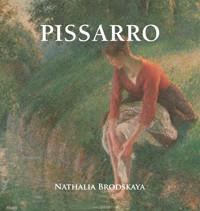
“Father Pissarro”, as his friends liked to call him, was the most restrained of the artists of the Impressionist movement. Perhaps it was his age, being older than his fellow artists Monet, Sisley, Bazille, and Renoir, or rather his maturity, which resulted in his works having such serene and sober subjects and compositions. A man of simple tastes, he enjoyed painting peasants going about their daily lives. However, Pissarro owes his belated fame to his urban landscapes, which he treated with the same passion he used to paint beautiful stormy skies and frost-whitened mornings.
Das E-Book können Sie in Legimi-Apps oder einer beliebigen App lesen, die das folgende Format unterstützen:
Seitenzahl: 56
Veröffentlichungsjahr: 2013
Author: Nathalia Brodskaya
Layout:
Baseline Co Ltd
61A-63A Vo Van Tan
4thFloor
District 3, Ho Chi Minh City,
Vietnam.
© Confidential Concepts, worldwide, USA
© Parkstone Press International, New York, USA
© Picasso Estate/Artists Rights Society, New York
All rights reserved. No part of this book may be reproduced or adapted without the permission of the copyright holder, throughout the world.
Unless otherwise specified, copyright on the works reproduced lies with the respective photographers. Despite intensive research, it has not always been possible to establish copyright ownership. Where this is the case, we would appreciate notification.
Nathalia Brodskaya
TABLE OF CONTENT
The Impressionists and Academic Painting
1. The Road from Versailles to Louveciennes, 1870.
Oil on canvas, 100 x 81 cm.
Private Collection, Zurich.
Impression: Sunrise (Impression, soleil levant,Musée Marmottan, Paris) was the prescient title of one of Claude Monet’s paintings shown in 1874 in the first exhibition of the Impressionists, or as they called themselves then, theSociété anonyme des artistes, peintres, sculpteurs, graveurs(the Anonymous Society of Artist, Painters, Sculptors, and Engravers). Monet had gone painting in his childhood hometown of Le Havre to prepare for the event, eventually selecting his best Havre landscapes for display. Edmond Renoir, journalist brother of Renoir the painter, compiled the catalogue. He criticised Monet for the uniform titles of his works, for the painter had not come up with anything more interesting thanView of Le Havre. Among these Havre landscapes was a canvas painted in the early morning depicting a blue fog that seemed to transform the shapes of yachts into ghostly apparitions. The painting also depicted smaller boats gliding over the water in black silhouette, and above the horizon the flat, orange disk of the sun, its first rays casting an orange path across the sea. It was more like a rapid study than a painting, a spontaneous sketch done in oils – what better way to seize the fleeting moment when sea and sky coalesce before the blinding light of day?View of Le Havrewas obviously an inappropriate title for this particular painting, as Le Havre was nowhere to be seen. “WriteImpression,” Monet told Edmond Renoir, and in that moment began the story of Impressionism.
On 25 April 1874, the art critic Louis Leroy published a satirical piece in the journalCharivarithat described a visit to the exhibition by an official artist. As he moves from one painting to the next, the artist slowly goes insane. He mistakes the surface of a painting by Camille Pissarro, depicting a ploughed field, for shavings from an artist’s palette carelessly deposited onto a soiled canvas. When looking at the painting he is unable to tell top from bottom, or one side from the other. He is horrified by Monet’s landscape entitledBoulevard des Capucines. Indeed, in Leroy’s satire, it is Monet’s work that pushes the academician over the edge. Stopping in front of one of the Havre landscapes, he asks whatImpression: sunrisedepicts. “Impression, of course,” mutters the academician. “I said so myself, too, because I am so impressed, there must be some impression in here… and what freedom, what technical ease!” At which point he begins to dance a jig in front of the paintings, exclaiming: “Hey! Ho! I’m a walking impression, I’m an avenging palette knife” (Charivari, 25 April 1874). Leroy called his article, “The Exhibition of the Impressionists.” With typical French finesse, he had adroitly coined a new word from the painting’s title, a word so fitting that it was destined to remain forever in the vocabulary of thehistory of art.
Responding to questions from a journalist in 1880, Monet said: “I’m the one who came up with the word, or who at least, through a painting that I had exhibited, provided some reporter fromLe Figarothe opportunity to write that scathing article. It was a big hit, as you know.” (Lionello Venturi,Les Archives de l’impressionnisme, Paris, Durand-Ruel, 1939, vol. 2, p. 340).
2. Two Women, Chatting by the Sea, Saint Thomas, 1856.
Oil on canvas, 28 x 41 cm.
National Gallery of Art, Washington.
3. The House of Père Gallien, Pontoise, 1866.
Oil on canvas, 40 x 55 cm.
Ipswich Borough Council, Museums and Galleries, Suffolk.
The Impressionists and Academic Painting
The young men who would become the Impressionists formed a group in the early 1860s. Claude Monet, son of a Le Havre shopkeeper, Frédéric Bazille, son of a wealthy Montpellier family, Alfred Sisley, son of an English family living in France, and Auguste Renoir, son of a Parisian tailor had all come to study painting in the independent studio of Charles Gleyre, whom in their view was the only teacher who truly personified neo-classical painting.
Gleyre had just turned sixty when he met the future Impressionists. Born in Switzerland on the banks of Lake Léman, he had lived in France since childhood. After graduating from the École des Beaux-Arts, Gleyre spent six years in Italy. Success in the Paris Salon made him famous and he taught in the studio established by the celebrated Salon painter, Hippolyte Delaroche. Taking themes from the Bible and antique mythology, Gleyre painted large-scale canvases composed with classical clarity. The formal qualities of his female nudes can only be compared to the work of the great Dominique Ingres. In Gleyre’s independent studio, pupils received traditional training in neo-classical painting, but were free from the official requirements of the École des Beaux-Arts.
Our best source of information regarding the future Impressionists’ studies with Gleyre is none other than Renoir himself, in conversation with his son, the renowned filmmaker Jean Renoir. The elder Renoir described his teacher as a “powerful Swiss, bearded and near-sighted” and remembered Gleyre’s Latin Quarter studio, on the left bank of the Seine, as “a big empty room packed with young men bent over their easels. Grey light spilled onto the model from a picture window facing north, according to the rules.” (Jean Renoir,Pierre-Auguste Renoir, mon père




