


5,49 €
Mehr erfahren.
- Herausgeber: Hangar 1 Publishing
- Kategorie: Ratgeber
- Sprache: Englisch
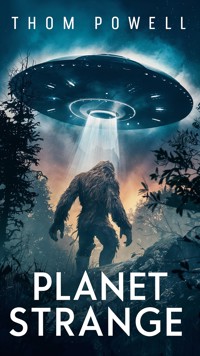
What if everything you thought you knew about Earth and humanity's history was wrong? In Planet Strange, renegade researcher Thom Powell boldly challenges conventional wisdom to unravel the shocking truths hidden beneath the surface of our world.
Drawing on insights from pioneering mystics and scientists, Powell takes you on a thrilling journey through ancient sites, lost civilizations, and clandestine government projects to expose secrets that some would kill to protect.
Discover the hidden code in crop circles that reveals messages from an advanced cosmic intelligence. Explore the strange physics behind the Bermuda Triangle's vanishing ships and planes. Learn why the Moon's origins may be far more sinister than we ever imagined.
From the Great Pyramid's power plant properties to the giants that once roamed North America, Planet Strange dares to ask forbidden questions that the establishment doesn't want you to know. Peel back the layers of mystery surrounding sacred mounds, secret underground tunnels, UFO sightings, and cattle mutilations to reveal a mind-blowing unified theory of the profound alien influence still at work on our planet today.
If you're ready to have the curtain pulled back on the greatest mysteries of our world, the answers you've been searching for await you in the pages of Planet Strange. But be warned, once you learn the shocking truths about our hidden history, you'll never look at humanity's place in the cosmos the same way again. Welcome to Planet Strange. Your journey into the unknown begins here.
Das E-Book können Sie in Legimi-Apps oder einer beliebigen App lesen, die das folgende Format unterstützen:
Veröffentlichungsjahr: 2024
Ähnliche



















PLANET STRANGE
THOM POWELL
HANGAR 1 PUBLISHING
Copyright © 2024 by Thom Powell
All rights reserved.
No part of this book may be reproduced in any form or by any electronic or mechanical means, including information storage and retrieval systems, without written permission from the author, except for the use of brief quotations in a book review.
CONTENTS
Introduction
1. Nothing New
2. Giants
3. The Great Pyramid of Tanstaafl
4. Spilling the Beans
5. The Mutes
6. Plain Sight
7. The World’s Greatest Mystery
8. Red Herrings
9. Planet Strange
Afterword
INTRODUCTION
There’s something going on beneath our feet. I first became aware of it as I investigated the Sasquatch phenomenon. I struggled to answer the question of where exactly they went when they wanted privacy and shelter.
For two decades, I studied this mystery. I wrote a few books and attended countless conferences. I met people who comb the wildernesses in search of Sasquatch evidence. Frequently, such folks happen across mysterious structures in the woods that look like teepees without the hide covering. I’d seen them many times myself, and they just didn’t look like adequate shelter from the elements. I was also fortunate to meet and learn from Native Americans who offered an alternative. They told me that the tribal perspective was that the Sasquatch live within the Earth; they have subterranean refuge from which they emanate.
I wanted to study this possibility, like the Sasquatch mystery in general, as scientifically as I could. I was never a scientist, but I was a science teacher for my entire career, and I always believed and taught that science, correctly done, could always generate accurate answers to important questions. I found out I was wrong. It was explained by one particularly great thinker named Henry Franzoni that, as much as we would like to, we cannot apply science to the Sasquatch question for two reasons: they are intelligent, and they are rogue (they wish to remain hidden).
Henry patiently explained for my benefit, “You cannot do science on intelligent, rogue beings. They’re actively concealing their whereabouts, and they are often employing trickery and deception that can confound attempts to be purely scientific.”
Think about how the CIA finally caught up with Osama bin Laden. They gathered numerous bits of information, most unverifiable, and searched for patterns that may offer some small amount of predictive value. They applied a lot of outside-the-box thinking and ultimately came to the tentative conclusion that he was hiding in plain sight; as long as ‘plain sight’ was a compound in Abbottabad near the Pakistani equivalent of West Point. Bin Laden was caught through a process that was as much spying as science, and this is a very important point when we look for answers to many questions that fall into the category of paranormal phenomena. My friend and retired scientist Ron Meyer observed that science and spying are not really opposites. The scientific method has evolved since the time of Galileo, and it continues to do so. The scientific method, laboratory experiments, pattern recognition, statistical analysis, and noticing the unusual are all part of practicing science, and spies use these same tools whenever they can. Ron observed that, in the case of killing Osama bin Laden, gut intuitions did play a role, but a lot of statistical analysis, particularly focused on pattern recognition, helped the CIA figure out where he was hiding.
On the other hand, Ron also agrees that the paradigms and models of science, particularly physics, cannot explain anomalous events and mysteries I discuss in this book. Whether the mystery involves UFOs, Sasquatches, crop circles, or other phenomenon, one must remember that, as much as we wish we could do science, not only is it difficult to do science on intelligent, rogue beings, but science as it is currently defined and practiced cannot do much with paranormal events.
I want to be a scientist. I may be a spy or simply a reporter. I began my spying/reporting by collecting all the information that might be relevant. Then combing through it, like a science-minded spy, teased out patterns that may have predictive value. I formed conclusions that seemed to answer all the questions even though I could not really test them. I did write it all down, and that is what we have here. My conclusion is that we essentially share the planet with other intelligent beings that probably have the ability to come and go from our world, but when they are here, they reside in spacious underground citadels that have been modified and greatly improved over the drippy, cold caves that we sometimes explore.
Each chapter of this book explores a separate line of evidence and reasoning to support this overarching view. The final two chapters attempt to unify all the distinct pieces of evidence and explore their implications. Still, the general direction of this book should be clear by now.
Astrophysicists have this high-profile scientific effort called SETI or Search for Extraterrestrial Intelligence. Radio telescope arrays are pointed into the cosmos in hopes of detecting intelligent signals from distant civilizations that we cannot visit in person. Logically, it seems like a worthwhile avenue of investigation. However, I would argue that this worthy project is doomed to failure because its fundamental assumptions are flawed. It is assumed that the aliens are “out there” somewhere and that if we listen to radio frequencies, we will eventually detect the electromagnetic signatures of distant alien civilizations.
A fundamental flaw is the assumption that the entities we seek are no more sophisticated than we are and, therefore, use familiar and detectable radio signals as we do, so we should be able to detect whatever communication frequencies they are using. I once had dinner with a SETI director named Seth Shostak when he visited Portland. I was given to understand that the SETI directors see no reason why the intelligent life forms we seek would wish to conceal their presence. If this assumption, or any of the previous ones, is mistaken, then the whole SETI program may be ‘barking up the wrong tree.’
I’m rooting for them, but I doubt the SETI program will ever produce the evidence it seeks. Not because we are alone in the cosmos; we most certainly are not. We just have to figure out where to look and what we are looking for. Our biases and preconceived notions take us in some wrong directions. Consider, for example, that the place to search for other intelligent life is not somewhere in the emptiness of space but somewhere a lot closer to home.
This book presents the conclusion that intelligent ‘off-planeters’ (they are no more alien than we are) presently co-inhabit our Earth, and if the SETI program wants to find detectable evidence of any so-called ‘alien’ existence, then they need to do some outside-the-box thinking. Instead of pointing their radio telescopes out into the voids of interstellar space, they might try turning their radio telescopes around, in a manner of speaking, for the beings they seek are behind them. They’re already here. As we listen intently to the murmurs of the cosmos, the beings we seek may be looking right over our collective shoulders.
Enrico Fermi, father of the hydrogen bomb, came up with the ‘zoo hypothesis’ to explain why we cannot find any evidence of off-planet intelligent life. We may be like the animals in a zoo, he speculated, blissfully unaware of the visitors who observe our comings and goings from concealed vantage points. Zoo keepers know that animals are less stressed and behave more naturally if the zoo patrons, and even the zoo keepers, are kept out of sight. Therefore, increasingly, zoo pens are fitted with two-way mirrors so that spectators and workers can see the animals without being seen. By this analogy, intelligent ‘off-planeters’ have been observing human activities with a certain interest. The keepers of our terrestrial zoo, for the most part, remain in the shadows, safely behind the figurative two-way mirrors of human perception. They can easily see us, but from our side of the glass, we cannot easily see them.
There are clues as to what is really going on. One just has to figure out what and where to look for. The clues may not be definitive, and they aren’t always obvious, but they are there, and they point to one over-arching conclusion: we are not alone, and we probably have not been since the very dawn of humanity.
Charles Fort was an author and paranormal researcher in the first decades of the twentieth century. He was the first to suggest that the UFO sightings that were happening back then were indications that we were being visited by intelligent beings from somewhere beyond Earth. Not only was he ahead of his time in this regard, but he went even farther to speculate that the extraterrestrial activity was more than casual visitors from another planet who were just passing through. “The earth is a farm,” Fort used to say, and at least one of the crops that is produced here is us.
What or who is down in the Earth? Are there living beings down under, or is the Earth itself alive and intelligent? For me, this is the ultimate mystery of Nature. Is Nature itself alive and intelligent, or is a group of hidden beings running the show? In my search for answers, I am betting on spying rather than science because, as Max Planck, a Nobel Prize-winning scientist famously said:
“Science cannot solve the ultimate mystery of nature. And that is because, in the last analysis, we ourselves are a part of the mystery we are trying to solve.”
NOTHING NEW
If we share the planet with aliens, off-planeters, or whatever you want to call them, they may even reside among us here on Earth. They probably didn’t arrive recently. Our understanding of the whole UFO deal is relatively new, dating back to the late 1800’s. Before that time, encounters with aerial phenomena were more likely regarded as divine in origin. Things changed when Percival Lowell, a wealthy businessman, mathematician, and astronomer built a pretty sizable telescope on a hill outside of Flagstaff, Arizona and used it to begin studying Mars. In his European travels in the mid-1800s, Lowell was fascinated by the sketches of canals on the surface of Mars that were produced by an Italian astronomer. Giovanni Schiaparelli directed an observatory in Milan, and he felt that he was seeing structures on Mars that were not natural features. Lowell also became aware of similar work and similar conclusions by French scientist Camille Flammarion, who published a book on Mars.
To satisfy his curiosity about Mars, Lowell founded the observatory in Arizona that still bears his name. The 24-inch diameter refracting lenses of Lowell’s telescope were primitive by today’s standards, and they were certainly not good enough to accurately view the details of the Martian surface. Lowell did, however, pioneer the idea of placing a telescope in a remote location, away from city lights so as to improve its resolution of faint amounts of light that would be drowned out by urban light pollution.
Lowell published his first book, Mars, in 1895 and The Canals of Mars in 1906. At the time, many astronomers doubted the accuracy of Lowell’s observations of putative canals on Mars, but Lowell went even further. He postulated that the canals were indicative of not just a civilization but a civilization that was in decline, maybe even collapse. Knowing what we now know about Mars, it is easy to ridicule such ideas, but the science of telescopic observations was still in its infancy, even though it seemed like Lowell had achieved a breakthrough in observatory siting and operation, which he indeed had. As telescopes improved in later decades, Lowell’s ideas about Mars and the alleged canals were, of course, convincingly refuted.
Meanwhile, a whole bunch of fiction writers seized upon Lowell’s radical ideas to craft some compelling novels. The first and most spectacular of these fictional masterpieces was H. G. Wells’ War of the Worlds (1897). Not only did Wells build on the idea of other civilizations in our solar system, but he also, for the first time, developed the terrifying idea that a civilization poised on the brink of collapse would invade its neighbors (namely us) in its desperate quest for survival. A whole bunch of other authors exploited similar themes right up to the dawn of the space age. The Red Planet by Heinlien (1949), The Martian Chroniclesby Ray Bradbury (1950), and The Gods of Mars by Edgar Rice Burroughs (1918) are perhaps the most well-known examples of the profound impact that Percival Lowell had on popular literature and popular thinking about neighboring planets and the life forms they ought to harbor. All the Flash Gordon shows of the 1950s are similarly attributable to the compelling but spectacularly wrong-headed thinking of Percival Lowell that persisted for decades after his death. Perhaps Lowell’s mis-observations about Mars persisted for not just years but decades because he made such enduring contributions to the field of astronomy. For example, Lowell was convinced that the orbits of the outermost planets then known, Uranus and Neptune, had orbital fluctuations that indicated the presence of an unknown planet that he dubbed “Planet X.” Although Lowell died in 1916, well before any more planets were discovered, Lowell did lay the groundwork for a big discovery. Lowell’s ‘Planet X,’ namely Pluto, was discovered in 1930 by Clyde Tombaugh at the Lowell Observatory.
Also, Lowell did develop the model for siting observatories that has not been improved upon since; equipment as specialized and expensive as modern telescopes are, as they MUST be, located away from the light pollution of population centers and as high in the atmosphere as is possible to minimize atmospheric distortion. Taken to its logical conclusion, the best place to locate a telescope would be outside of Earth’s atmosphere altogether. This would render the equipment immune to the effects of atmospheric distortion, air pollution and light pollution. It does make the telescopes a bit tougher to use and maintain, but the Hubble and, more recently, the Kepler space telescopes do perform spectacularly better than any Earth-based telescope of similar size, and they can be operated day and night, unlike all terrestrial telescopes except solar telescopes (which look only at the Sun). It is sometimes said that Percival Lowell was the single astronomer who had the most impact on public opinion before Carl Sagan in the late 20th century.
Not only did Percival Lowell popularize the science of astronomy more than any person prior to Carl Sagan, he popularized the notion of other worlds that contained other civilizations. This idea had not been much considered, not to mention written about, by the population at large before the time of Lowell. Western religious thought was adamant in the view that we on Earth were God’s one and only chosen people. Western religious thought uniformly drew from scripture the view that all of Heaven and Earth was for the benefit of humanity. The Earth was the only habitable planet, not just in the solar system but the whole of the cosmos. Lowell was among the first to tender the suggestion that this was definitely not necessarily the case.
In this way, Lowell laid the groundwork for a transformation in literary and even scientific thinking. One of the first to take this ball and run with it, scientifically, was New Yorker Charles Fort. As early as 1919, Dutch American author Charles Fort wrote books arguing that unexplained aerial lights (now called UFOs) represented visitors from other worlds. Fort’s The Book of the Damned was published in 1919, followed by New Lands (1925) and Lo! in 1931. Fort was perhaps the earliest collector of accounts of anomalous events, which became known in those days as Fortean phenomena. Fort would collect any and all accounts of anomalous phenomena and file them in shoe boxes. He had dozens of shoe boxes full of file cards, each with a separate account of a UFO, a hairy beast, a dinosaur-like bird, a ghostly spirit, a human abduction, missing time… you name it. Then, Fort would attempt to make sense of the whole constellation of ‘Fortean’ phenomena, which ultimately led him to the inescapable conclusion that not only was the Earth being visited and observed by beings from other planets, but that we humans were being manipulated for some unknown purpose by these presumably super-sophisticated beings. One of Fort’s most profound and succinct conclusions was that “the Earth is a farm,” the implication being that we humans were, for whatever purpose, the crop.
Fort’s most profound conclusion may have been his fundamental challenge to the so-called objectivity of the scientists of the day. Fort’s overarching view was that the dismissive and inherently skeptical nature of scientists was sometimes counterproductive, especially when attempting to explore what he called ‘marvels’ and what we now call paranormal events. Fort wrote:
“People with a psychological need to believe in marvels are no more prejudiced and gullible than people with a psychological need NOT to believe in marvels.”
Bear in mind that “marvels” as Fort used the term, is essentially synonymous with that which we today describe as ‘paranormal’ phenomena. The word “paranormal’ did not exist in the lexicon when Fort was writing in the early twentieth century. Instead, they referred to scientifically unexplainable phenomena as Fortean phenomena or sometimes just ‘marvels.’
While Fort died in 1932, others carried the torch, especially in the years after the watershed UFO sighting over Mt. Rainier, Washington, by pilot Kenneth Arnold in June of 1947. Several factors make Kenneth Arnold’s particular sighting more important than anything short of the Roswell incident. First, Kenneth Arnold was a serious and sober pilot who was not just out flying a plane on a Sunday afternoon. He was actively searching the wilderness of northwest Washington for the remains of another plane that mysteriously vanished in the area. He was essentially on a mission of mercy. Further, he witnessed not one but nine discs flying in formation, in daylight conditions, and in unlimited, cloud-free visibility. Arnold estimated the speed of the formation at a thousand miles an hour.
Arnold was a highly experienced pilot with thousands of hours of flight time in his CalAir A-2. Much of his time was spent doing search and rescue missions and other mercy missions. Arnold described the formation of objects he saw as saucer-shaped and “moving like a saucer skipping across the water.” The media took the ball and ran with it from there, and ever since then, we have been calling them ‘flying saucers.’ Arnold remained active in UFO research and even appeared at UFO conferences until his death in 1984. Arnold’s principal frustration with the UFO problem seemed to be not the question of whether they exist but what exactly it would take to get people to take the subject seriously.
“I’ve seen something and hundreds of other pilots have seen something. We have dutifully reported these things…and we have to have fifteen million witnesses before anybody is going to look into this problem?…Seriously? Well, this is utterly fantastic. This is more fantastic than flying saucers or people from Venus or anything, as far as I’m concerned.”
(Notice the similarity in logic to that which Fort expressed some forty years prior.)
Not long after the forceful assertions of Kenneth Arnold, the extraterrestrial hypothesis (ETH) began to gain traction. Jacques Vallee published a very articulate examination of UFO evidence and the implications thereof entitled “Challenge to Science.” Meanwhile, some official government and military departments WERE secretly and not-so-secretly looking into the matter. Predictably, the not-so-secret reports, like Project Blue Book, trotted out the same preposterous conclusions: mass hallucination, swamp gas, mistaken observations of the planet Venus, and so on explained away virtually all UFO sightings. Less discussed were the studies that arrived at different conclusions: A West German study conducted between 1951 and 1954 concluded that other planets are the most likely origin of at least some of the UFOs witnessed in European skies. Another study, Project Sign, was sponsored by the newly created U.S. Air Force. In 1948, they issued a concluding document entitled The Estimate of the Situation, stating that the ETH was the best explanation for unidentified flying objects. The report was rejected by General Hoyt Vandenberg for lack of proof. A Major Fournet in the Pentagon also dismissed the report as “extreme extrapolation based on scant evidence.” The project was disbanded in 1949, and the personnel were reassigned to Project Grudge. All copies of the report went to the incinerator. However, Project Sign and the resulting “Estimate of the Situation” is still thought of as the Holy Grail of Ufology. Despite the fact that no known copies survived, its existence has been confirmed by well-known government-hired UFO research consultants like Jerome Clark and J. Allen Hynek.
At this point in time, we are well past the need for more government and military studies, not to mention more debate and discussion of whether UFOs exist. We may also be past the need to further debate the origin of the crafts, at least in the general sense. Certainly, some of them are interplanetary in origin, although that conclusion may be misleading in one important aspect. While the mysterious crafts and their occupants may originate from other planets, it does not necessarily follow that they are traveling from afar on an ongoing basis. Some modern researchers have come to the conclusion that interplanetary beings have been investigating the Earth for centuries.
One of the original arbiters of this view is Swiss researcher and author Erich Von Daniken. Although his 1968 magnum opus Chariots of the Gods and the sequels have been criticized as an example of the sloppy research and distorted truths that so often characterize UFO literature, von Daniken did open the floodgates for some further research that has become increasingly difficult to dismiss out-of-hand.
Perhaps the most noteworthy of the post-Chariots of the Gods researchers is Zecharia Sitchin. Born in Azerbaijan in 1920, he was raised in Mandatory Palestine (which became Israel in 1948), educated in London, and relocated to New York in 1958. Sitchin’s multicultural and multilingual background positioned him uniquely to study Sumerian culture and then teach himself to read and translate cuneiform, the original written language used in Mesopotamia and Sumer (modern-day Iraq and Syria). Cuneiform is generally regarded as among the world’s first, maybe even the very first, written language. Clay tablets containing cuneiform (Latin for ‘wedge-shaped’ alphabet) inscriptions have been unearthed by the thousands in palaces and temples in Iraq and Syria. Many have yet to be translated. The University of Pennsylvania holds the largest collection of cuneiform tablets in the U.S. Larger collections exist in England and Iraq. Cuneiform tablets as old as 3200 B.C. have been found, but the language was more primitive then, relying more on pictographs than an alphabet, per se. Tablets on the order of 2600 B.C. show a much more sophisticated alphabet of about 600 signs and symbols.
The translation of cuneiform tablets is a bit easier than when it was first attempted in the late 1600s by Roman traveler Pietro Della Valle and English scholar Sir Thomas Herbert around 1638. French and English scholars made sustained efforts to translate cuneiform as more tablets were discovered and found their way back to Europe. By the mid-1800s, Assyriologists like Henry Rawlinson in England and Edward Hincks in Ireland were making huge progress. Proper names were obviously the most difficult things to figure out, but more clay tablets were being steadily unearthed, and names from new tablets were deciphered more easily using the older ones. By 1857, a panel of experts examined the translations of the leading experts and, upon being satisfied that there was general agreement, especially between the translations of the two leading experts, Hincks and Rawlinson, and it was declared that the translation of Akadian cuneiform was a done deal.
Meanwhile, the sheer number of newly discovered clay tablets was becoming enormous. One library in Iraq was discovered around 1850 that contained tens of thousands of tablets. Such discoveries have continued into modern times, and the number of clay tablets now stored in museums sits at anywhere from 500,000 to two million, depending on whether you want to consider broken fragments to be separate tablets. The British Museum holds the largest collection, followed by The Louvre in France, Istanbul Archaeology Museum, National Museum of Iraq, then Yale and University of Pennsylvania in the U.S. Most tablets just sit there in museums and have never been closely looked at, much less translated. Maybe only 30 or 40 thousand tablets have been translated worldwide out of the half a million that have been discovered so far. Most tablets are detailed records of transactions, but some, such as the famous Epic of Gilgamesh, tell fascinating stories or describe aspects of Sumerian and Mesopotamian society. Even today, there are only a few hundred cuneiformists in the entire world who can competently translate these priceless historical texts.
One now-deceased cuneiformist was Zecharia Sitchin. Probably as a consequence of his multilingual upbringing, Sitchin was able to achieve the remarkable feat of teaching himself cuneiform. This is where things get interesting.
When Sitchin was doing his translating, there were very few others who could verify the accuracy of his translations. It is much easier for others to cross-check each other’s translations, especially since the publication of one particular book entitled, Sumerian Lexicon in 2008.
But in Sitchin’s day, he was going it alone. After teaching himself cuneiform, he set about translating some of the enormous number of clay tablets in the British Museum, specifically certain pre-Nubian and Sumerian texts and one particular seal (cylindrical tablet) known as VA 243. Sitchin then claimed that these texts indicate that the Sumerians had interactions with a group of beings from another planet in our solar system called Nibiru. This planet was said by Sitchin to have a very oblong orbit that carries it out past Neptune, then across the orbit of the other planets, and back around the Sun every 3,600 years or so. In the book which summarized his translations, Sitchin related that Planet Nibiru also had a problem. Its atmosphere was deteriorating (sound familiar?) in a way that threatened the very survival of the resident beings, the Anunnaki. Their leader, Anu, dispatched his two sons, Enlil and Enki, to Earth to direct and supervise the extraction of large amounts of the only substance that could repair the atmospheric damage to Nibiru, namely gold. Specifically, Anu sent a squad, led by his two sons, to gather the rare, single-atom isotope of gold known as monoatomic gold.
The crew that worked under the direction of Enlil and Enki was too small for the big job of mining and transporting large amounts of gold from the rich gold fields of southern Africa. Consequently, they rebelled, and Enlil faced an acute labor shortage. Fortunately, Enki was able to use his advanced knowledge of gene splicing to create a replacement labor source. Enki took the DNA from the indigenous primates, which we know from the fossil record to be Homo erectus, also known as Java Man. He spliced their genes with their own extraterrestrial Anunnaki DNA to create a new species, namely, us.
This new species, as described in clay tablets according to Sitchin, was known at the time as ‘the Adamu,’ which not-coincidently hearkens to the biblical first human known as Adam. Needing a mate for Adamu, Enki took tissue from Adamu and created his companion, who we all know from the Old Testament as Eve. According to the Sumerian version of the story, which predates the Old Testament but bears tremendous similarities, the serpent in the Garden of Eden was not Satan but rather the incarnation of a more benevolent entity who advocated for the enlightenment of Adam and Eve. In any case, Adamu and Eve were relocated to the gold fields of Africa, which is why that very region of Africa bears the fossils that identify it as the birthplace of humanity. The story goes on and on, the Anunnaki gods are portrayed in the same ruthless, brutal manner as the deity we understand from the Old Testament.
Sitchin’s interpretation of Sumerian texts bears many other similarities to Hebrew, Arabic, and Christian scripture. Spiteful gods, bitter rivalries, epic floods and destruction of cities all manifest in Sumerian clay tablets, according to the works of Sitchin. Cain and Abel, the brothers of Old Testament infamy, were Enlil and Enki of Sumerian lore. As with Abraham’s sons, Enlil and Enki were rivals; in the end, one kills the other. At another point in the Sumerian version, the ruthless Anunnaki god Enlil tried to wipe out the fledgling human race by somehow initiating a great flood. Fortunately, Enki warns his favorite son (Noah), who survived the flood by building some sort of boat that could withstand the deluge. The Nephilim in the book of Genesis are indeed the Anunnaki themselves, who came down from the skies and took human wives. Many more details of the interaction between Anunnaki and the fledgling human race are described by Sitchin in his nine books, the first one being The Twelfth Planet. According to Sitchin, Sumerians were aware of all nine planets, including Pluto, and the Moon and Sun were also seen as planets. This left Niburu, the home of the Anunnaki, as the twelfth planet.
All specific details of this convoluted story could not be refuted when Sitchin first published his translations of Sumerian cuneiform texts beginning in 1976. After 2006, it became much easier for amateurs to translate cuneiform. Suffice it to say that the more other scholars attempted to verify or refute the translations of Zecharia Sitchin, the more his interpretations and translations were called into question. Not only were his translations considered overly loose and sometimes just plain wrong, but the science behind his claims was also challenged. The Sumerians were aware of only five planets, experts insisted, not eleven or twelve. The very idea of a large planet that took over a thousand years to complete one highly elliptical revolution around the Sun is seen by astronomers as laughable. It would be a world of perpetual darkness and cold. Whatever atmosphere such a planet held would be much thicker than Earth, and no one can think of an atmospheric issue that could be repaired with gold, monoatomic or otherwise. The list of disputes with Sitchin’s descriptions of terrestrial interaction with interplanetary beings goes on and on, to the point where Sitchin’s credibility is non-existent in the eyes of science. Still, the words of Charles Fort have a certain relevance here:
“People with a psychological need to believe in marvels are no more prejudiced and gullible than people with a psychological need NOT to believe in marvels.”
Sitchin may not have much credibility in the eyes of his fellow cuneiformologists, not to mention mainstream astronomers, but he does enjoy a strong following among ‘ancient alien theorists.’ He may even be the leading voice among those ‘New Agers’ who favor revisionist histories, including alien visitations to Earth, especially in ancient times. Sitchin most assuredly got many details of his cuniform translations wrong, but he certainly was not wrong about everything. There are even some big elements that, in hindsight, Sitchin absolutely nailed. There are even a few authors who feel they have verified some of Sitchin's extraordinary claims. The existence of a large, undiscovered planet with an elongated orbit is not laughed at now, even though it may have been when Sitchin was still alive. Also, the idea of a worldwide flood of biblical proportions was an absurdity to geologists and paleontologists of Sitchin’s day. The existence of such a flood is now a virtual certainty.
Planet X
Sitchin claimed the Sumerian texts described the Anunnaki as a god-like race of beings that originated from a distant planet in our solar system with a highly elongated orbit that brought it around the Sun once every 3600 years. Astronomers rolled their collective eyes at such an improbable suggestion, explaining the impossibility of sustaining life on such a planet.
While I tend to agree that lack of sunlight would render life as we know it impossible, others argue that only internal radioactive decay on such a planet or some unknown heat source could render conditions that could sustain life under otherwise impossible conditions. Regardless, at the time of Sitchin’s death in 2005, our most advanced scientists had absolutely no evidence that such a planet existed or even could exist.
Then, in 2015, the thinking suddenly changed. Caltech astrophysicists Konstantin Batygin and Mike Brown announced that their study of orbital perturbations of the outer planets, plus some detailed mathematical modeling, suggested (they used the word “proved”) that a planet that was ten times the size of earth with an extremely elliptical orbit actually existed. They predicted its orbit would take it around the sun every 10,000 to 20,000 years. Since the name of any newly discovered planet is determined by the discoverer, they could not go so far as naming a planet that was still unproven. So they labeled their theoretical planet Planet X, which would have pleased Percival Lowell.
You better believe that Batygin, Brown, and a whole bunch of others are today using the world’s most powerful telescopes to be the first to prove such a planet exists. Despite the much-increased power of modern telescopes, the challenge of training such equipment on the exactly correct patch of sky at the exactly correct moment is quite daunting. While Sitchin may not be completely off the hook on his claims of an unknown planet Nibiru with its hyper-elongated orbit, it’s fair to say nobody in the astrophysics community is laughing at the idea that such a planet, that Sitchin was the first in modern times to suggest, may actually exist. Time will tell.
The Flood
Recall that Zecharia Sitchin also claimed that, according to ancient Sumerian clay tablets that he translated, the Sumerians circa 3000 B.C. described a worldwide flood of positively epic proportions. Again, such a fantastic claim caused the scientific community to heap ridicule onto Sitchin, even though the book of Genesis also depicts a flood of positively biblical proportions. In fact, informed ethnologists and archeologists will tell you that every single ancient culture worldwide that kept records of significant historical events also has accounts of a mega-flood. To anyone who doubts the validity of these admittedly unverifiable historical accounts, I have two words to look up on Google or YouTube: Younger Dryas.
According to Sitchin’s admittedly far-fetched narrative, the newly developed human race had become a little too big for its collective britches in the eyes of its creators. The interbreeding between the original Anunnaki gold miners and Enki’s surprisingly attractive human species led to an emerging race of beings that were smarter and more prolific than was ever intended. Things were getting out of control, especially in the eyes of Enki’s petty and ruthless brother, Enlil. So, Enlil decided to wipe out the proto-species that had been created by his talented brother. Enki got wind of Enlil’s plan and warned a select few, specifically one Noah-like character, to prepare for a terrible flood by building a specialized boat that could be tumbled in the surf. According to the Sumerian version of this biblical story, the craft wasn’t really the familiar ark of the book of Genesis, but rather a boat that would enclose the inhabitants and enable them to survive a really rough ride. Also, the animals to be loaded aboard were not the ‘two of every species’, but rather a bunch of livestock that would serve as a food source and the seed of an animal husbandry operation that would be critical to the survival of the handful of poor saps who had to repopulate the post-flood wasteland.
Flood Science
In the 1940s, a geologist at the University of Washington in Seattle published a paper declaring that strange landforms throughout eastern Washington pointed to an enormous flood that inundated the region at the end of the last ice age, some fifteen thousand years ago. As with the radical ideas of Zecharia Sitchin, the radical ideas of J Harlan Bretz were met with uniform skepticism and outright ridicule from most of the geologic community at the time.
Bretz had three problems. First, he could not explain where all of the water would have come from that he was claiming for such a sudden and destructive event. His second problem was that no other geologist had spent the time carefully surveying all of the nooks and crannies of this vast and remote corner of the continent that is eastern Washington. Bretz had spent several summers touring the landscape with his family in tow. He knew the details of the landscape like the back of his hand and the features he explored and documented pointed clearly to a wide swath of land, which he called the Channeled Scablands, being suddenly and utterly devastated by an enormous rush of water. The area was and still is so remote and desolate that this very area of eastern Washington was chosen for the site of the Hanford Nuclear Reservation, a super-secret facility that would perform the super dangerous process of enriching the uranium and plutonium that would be the fuel of the world’s first atomic weapons. Since the whole region was so unfamiliar to the rest of the world, when Bretz tried to describe the features that all pointed to his proposed flood, no one else in the scientific community could relate.
Perhaps Bretz’s biggest hurdle was the popularity of uniformitarianism; the prevailing view in geology at the time that gradual processes, not sudden catastrophes, were the sole means by which all terrestrial landscapes were shaped. Bretz, on the other hand, was proposing something quite sudden and dramatic, even cataclysmic. There just wasn’t any support for such unconventional theories. Not only did Bretz’s flood fly in the face of accepted geologic principles that were in vogue in the 1940s and 1950s, but still worse, it harkened to one particular cataclysm that no mainstream geologist wanted to endorse: Noah’s flood.
The very idea that every landmass on planet Earth could have somehow been covered with water at the same time was so preposterous that any geologist who even hinted that such an event might happen would be committing professional suicide. And yet, this was what Bretz was doing. For the next two decades, Bretz, a respected geology professor at the University of Washington in Seattle, had reduced himself to the laughing stock of the national geologic community. One geologist who worked for the U.S. Geologic Survey, J.T. Pardee frequently mocked Bretz’ ideas. Another particularly vocal critic of Bretz’s then-radical idea was James Gilluly, also of the U.S. Geological Survey. His criticism of Bretz stemmed from the fact that Bretz’s ideas ran counter to the always gradual changes espoused in the uniformitarian doctrine that was widely accepted at the time, but also that Bretz was espousing a theory that was more scriptural than purely scientific. Despite the harsh criticism Bretz refused to recant and always insisted that other scientists would grasp his thinking if they would just visit the landscape, which admittedly wasn’t on your way to anywhere.
The ridicule went on for decades but this tragic story has a rare happy ending. Pardee and Gillully finally accepted an invitation to view the evidence in person. They joined a well-attended field trip to the Channeled Scablands of eastern Washington, which Bretz himself did not attend. The trip gave Bretz’s critics their first personal exposure to the dramatic landscape that Bretz had personally studied and described for twenty-five years. Gillully was humbled. At one point, he was heard uttering, “How could I have been so wrong?”
Bretz was not one to rub it in. There was a geologic consortium at which the evidence for the Missoula Flood (as it is sometimes called) would be presented. Specifically, a couple of grad students just published a paper that answered the open question of where all the water came from. They had found unmistakable evidence of a vast impoundment of water in west-central Montana around the town of Missoula. Bretz was still alive and invited to attend the conference where he would finally achieve vindication. He knew he was right all along. He skipped the conference and stayed home.
When scientists suggest new and radical ideas, they are seldom, if ever, vindicated in their lifetime, even if they happen to be right. Galileo was correct about the orbital paths of the solar system but his work was not verified until Newton’s math verified it a hundred years after his death. Alfred Wegener died some fifty years before his theory of continental drift was verified. Bretz must have derived some small satisfaction from the fact that his radical idea was confirmed, but he himself observed that he had no interest in I-told-ya-so’s. He famously observed, “All my detractors are dead.”
This brings us to the Younger Dryas, the new flood myth that may not be as mythical as critics allege. Authors Randall Carlson and Graham Hancock have been arguing for years that geologic evidence found throughout the planet points to an epic, worldwide flood some 12,800 years ago. The event is nick-named Younger Dryas because it is the younger of two times when pollen from an arctic plant known as the dryas flower positively proliferated in the ice core samples taken from Greenland and elsewhere in the Arctic. Ice cores are like tree rings; they are highly accurate representations of ancient climates and climatic shifts to those who know how to read them. Ice cores are new but unassailable testimony to climatic conditions thousands of years ago. Analysis of such cores indicates that the planet was thrown into a ‘nuclear winter’ of drastically colder temperatures precisely 12,800 years ago, and it stayed that way for 1200 years. During this time, one of the very few plants that was able to proliferate was the dryas flower. What Randall Carlson and Graham Hancock have been saying is not just that an object from space collided with the Earth and plunged us into winter, but that the object or objects that hit the Earth struck the vast continental glaciers that covered Greenland and North America, melting enormous quantities of ice in a matter of hours or days. Ice chunks were ballistically projected all over the northern hemisphere and everything on land was pummeled by huge chunks of flying ice that rained down from the sky. Forty species of mega-fauna like mastodons, mammoths, tigers, and horses, as well as the Clovis-era human culture, were wiped out in an instant. The melted ice pack inundated Earth and sea levels rose sixty feet overnight, worldwide, and eventually as much as three hundred feet. If there was once an Atlantis, it was submerged 12,800 years ago.
As always, main stream science wants nothing to do with such new and radical suggestions that something like Noah’s flood actually happened on a worldwide basis. That said, some courageous researchers have taken up the cause and newer and stronger evidence is being found all the time that supports the idea that the Younger Dryas event 12,800 years ago did happen and the biblical flood of Genesis is not a myth. Graham Hancock likes to say that what historians call myths are better thought of as memories, and he points out that every ancient culture, worldwide, that was keeping records or preserving oral traditions has an account of an epic flood.
Randall Carlson points to elliptical depressions in the southeast U.S., called the Carolina Bays, as indications of the pummeling of the surface by ballistically projected ice chunks of enormous size. Similar indentations are found in Nebraska, where they are called the Nebraska Rainwater Basins. In both cases, the orientation of these depressions points toward Saginaw Bay off of Lake Huron, suggesting that Saginaw Bay is, in fact, an impact crater. Scientist Antonio Zamora published a book about impact geology entitled The Neglected Carolina Bays, in which he presents a strong case that numerous geologic features throughout the continent are attributable to the Younger Dryas' impact event. As always, when a scientist suggests a catastrophic event, the scientists who favor uniform earth processes over periodic catastrophes will raise the same objection: “where is the water?” was also the principal objection to Bretz’s suggestion of a flood. In the case of impact catastrophes, the sustained objection has always been, “where is the crater?”
So far, there are not one but three candidate craters for the Younger Dryas Event. One candidate is, of course, Saginaw Bay off of Lake Huron, another is a curious circular feature that lies at the bottom of eastern Lake Ontario, and the newest one is a thirty-mile-wide crater that was discovered with ice-penetrating radar beneath the Hiawatha Ice Sheet in northern Greenland. Indeed, Carlson and Hancock have also argued that the Younger Dryas Event was so sustained that there were probably multiple impacts that rendered most of the surface of the Earth completely unlivable for the better part of a century between 12,800 and 11,600 years ago. Perhaps the most compelling new find (besides the Hiawatha Crater) that supports Carlson and Hancock’s view are the ‘black mat’ layers found in the recent rock record. Within the rock record at various places around North America are found thin layers of high carbon (presumably from widespread forest fires) as well as traces of unique substances like shock quartz and microdiamonds, which are known to be associated with high-velocity impacts, and rare elements like platinum and iridium which are more common in space than on Earth. These are the same substances that Luis Alvarez used to support the theory that dinosaurs were wiped out by an asteroid impact some 65 million years ago. Alvarez’s theory was widely disputed, and as usual, skeptics demanded to see a candidate crater, which he did not have. Eventually, petroleum geologists working around the Yucatan Peninsula stumbled upon a curious region-wide crater we now call Chixulub. Alvarez’s once-radical theory of dinosaur extinction is now mainstream. Luis Alvarez was the first to suggest that asteroids or comets strike the Earth with devastating consequences. This idea is not only more accepted today, but it is being suggested that the Earth is impacted at regular intervals of 12,000 to 15,000 years.
Still more interesting is Randall Carlson’s opinion that the Missoula Flood was triggered by the same Younger Dryas Event, as was a whole bunch of other flooding on a virtually global basis. Not only is he unifying mega-flood theory, but he is validating old testament scripture AND the seemingly specious translations of Sumerian clay tablets by Zecharia Sitchin. While I agree with the view that Sitchin might have been a bit loose in his translations of cuneiform tablets, he did get a few things right, like the flood, and probably the mysterious planet, and maybe one more thing: Earth may have been visited by off-planeters a long time ago. Sitchin went even further, claiming that, according to the cuneiform texts, Earth was just not visited. Rather, Sitchin was adamant that Earth was essentially taken over as a resource colony for a beleaguered but technologically advanced extraterrestrial civilization. This is where Sitchin’s translations seem like a bit of a stretch, although South African author Michael Tellinger has found evidence of gold mining in southern Africa that dates to a time that has always been regarded as the stone age of humanity.
In his book Slave Species of the Gods, Tellinger agrees with Sitchin that humanity was not even close to being able to extract and purify lode deposits of gold and that only by being directed could humanity have been able to accomplish such a feat as long ago as 200,000 years, or more. Tellinger grew up in the gold fields of South Africa. His investigations have identified mine tailings, mine shafts, and addits that date to an almost impossibly old date of 200,000 B.C.! This is precisely the time at which Sitchin claims that the Anunnaki gene-spliced the human race from Homo erectus. Further, Tellinger correctly disputes the view that stone-age humans could have ever developed the sophisticated processes of not just gold mining, but gold ore mining. Alluvial gold could have been easily collected from surface deposits and rivers, but digging for gold in subterranean veins and lodes would have been way beyond any stone-age human sophistication or motivation. Further, the process of purifying and processing the gold using cyanide and mercury heap-leach extraction would have been impossibly sophisticated to have been developed by humans even 50,000 years B.C. In Tellinger’s view, and certainly Sitchin would agree, only with outside direction from a much more intelligent set of beings could such primitive humans ever have figured out how to extract and purify subterranean gold deposits. Not to mention figuring out what to do with gold once they obtained it.
Whether Earth was once simply visited or full-on occupied by off-planeters, a logical step must be explored as a consequence. From a purely logical perspective, it stands to reason that if Earth was visited once, then at the very least, they return periodically, and quite possibly, they never left. That naturally implies that they are still here, or at least they, whomever they are, come back every once in a while to check on things. We humans don’t go to all the trouble to visit distant planets and moons just once. We plan multiple visits to conduct increasingly sophisticated tests. Why wouldn’t they?
If they are here, why then, don’t we see them? Well, we do. We see them all the time. Whenever the UFO phenomenon manifests, we may be seeing our off-planet overlords. It may also be that they have decided to take a back seat to human evolution and development, so we see indications that they are around, but it is a bit presumptuous to assume that they have any intention of stepping out of the shadows to shake our collective hands. They’re here alright, they just stay in the shadows. Maybe there is even a rule, like the ‘prime directive’ that was featured in Star Trek episodes: Do not interfere. Let the locals find their own way.




