


102,99 €
Mehr erfahren.
- Herausgeber: John Wiley & Sons
- Kategorie: Fachliteratur
- Serie: Real Estate Issues
- Sprache: Englisch
Winner of the Royal Town Planning Institute award for research excellence
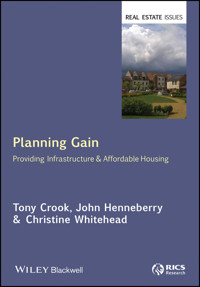
This critical examination of the development and implementation of planning gain is timely given recent changes to the economic and policy environment.
The book looks both at the British context as well as experience in other developed economies and takes stock of how the policy has evolved. It examines the rationale for planning gain, how it has delivered substantial funds for infrastructure and affordable housing and, in the light of this, how it might continue to play a role in the funding of these. It also draws on overseas experience, for example on impact fees and public sector land assembly. It looks at lessons from the past for future policy, both for Britain and for countries overseas.
Mechanisms to tap development value are also a global phenomenon in developed market economies - whether through formal taxation or negotiated contributions. As fiscal austerity becomes an increasingly challenging issue, ‘planning gain’ has grown in importance as a potential source of funding for infrastructure and new affordable housing, with many countries keen to examine, learn from, and adapt the experience of others.
- a critical commentary of planning gain as a policy
- timely post credit crunch analysis
- addresses recent planning policy changes
Sie lesen das E-Book in den Legimi-Apps auf:
Seitenzahl: 679
Veröffentlichungsjahr: 2015
Ähnliche


















Table of Contents
Real Estate Issues
Books in the series
Title Page
Copyright
Acknowledgements
Foreword
Preface
Notes on Contributors
Chapter 1: Introduction
Purpose of the book
Factors affecting effective development value capture
Key factors behind the development of planning gain policy in England
Definitions
The structure of the book
References
Chapter 2: The Economics of Development Value and Planning Gain
Introduction
Why is land and its value special?
The potential to tax increasing land values without generating inefficiency
The impact of planning on development values – the creation of planning gain
Instruments available to capture planning gain
Overview
References
Chapter 3: Capturing Development Value Through de jure National Taxation: The English Experience
Introduction
Betterment and development value defined
Compensation and betterment: the Uthwatt principles
Taxing development value: post-war national schemes
Lessons learned
References
Chapter 4: Planning Obligations Policy in England: de facto Taxation of Development Value
Introduction
Planning obligations: the key principles
Using planning obligations to secure land and funding for affordable housing
Recent policy initiatives
Conclusions
References
Chapter 5: Development Viability
Introduction
Development viability
Development appraisal
Estimating the residual value of a residential development site
Assessing the impact of planning obligations and developer's contributions on the viability of development proposals
Accounting for spatial and temporal variations in the development market
Conclusion: addressing the viability dilemma?
References
Chapter 6: The Incidence and Value of Planning Obligations
Introduction
The growth of obligations
Methods for measuring the incidence and calculating the value of planning obligations in England
The number of obligations in England
Affordable housing obligations in England
The total value of planning obligations agreed in England
Planning obligations in Scotland and Wales
Rural exceptions schemes
Who pays for the obligations?
Conclusions
References
Chapter 7: Spatial Variation in the Incidence and Value of Planning Obligations
Introduction
Defining and disseminating good practice in planning obligations
Regional variations in the value of planning obligations
Quantitative analysis of the drivers of the incidence and value of planning obligations
Qualitative explanations for spatial variations in planning obligations
Conclusions
References
Chapter 8: Delivering Planning Obligations – Are Agreements Successfully Delivered?
Introduction
Why consider delivery of planning obligations?
Types of planning obligations
Case-study evidence of successful delivery of planning obligations
Quantitative evidence on the delivery of obligations
The factors affecting the delivery of affordable housing obligations
Trends in the delivery of affordable housing
The impact of the economic downturn on delivery
Implementing the community infrastructure levy
Conclusions
References
Chapter 9: International Experience
Introduction: making comparisons and transferring experience
Australia
Germany
The Netherlands
United States
Summary and conclusions: comparing the English and international experience
References
Chapter 10: Summary and Conclusions
Introduction
Policies for capturing development value
The economics of planning obligations
The financial aspects of planning obligations
Conclusions
References
Index
Advertisements
End User License Agreement
Pages
xiii
xiv
xv
xvi
xvii
xviii
xix
xxi
xxii
xxiii
1
2
3
4
5
6
7
8
9
10
11
12
13
14
15
16
17
18
19
20
21
22
23
24
25
26
27
28
29
30
31
32
33
34
35
36
37
38
39
40
41
42
43
44
45
46
47
48
49
50
51
52
53
54
55
56
57
58
59
60
61
62
63
64
65
66
67
68
69
70
71
72
73
74
75
76
77
78
79
80
81
82
83
84
85
86
87
88
89
90
91
92
93
94
95
96
97
98
99
100
101
102
103
104
105
106
107
108
109
110
111
112
113
114
115
116
117
118
119
120
121
122
123
124
125
126
127
128
129
130
131
132
133
134
135
136
137
138
139
140
141
142
143
144
145
146
147
148
149
150
151
152
153
154
155
156
157
158
159
160
161
162
163
164
165
166
167
168
169
170
171
172
173
174
175
176
177
178
179
180
181
182
183
184
185
186
187
188
189
190
191
192
193
194
195
196
197
198
199
200
201
202
203
204
205
206
207
208
209
210
211
212
213
214
215
216
217
218
219
220
221
222
223
224
225
226
227
228
229
230
231
232
233
234
235
236
237
238
239
240
241
242
243
244
245
246
247
248
249
250
251
252
253
254
255
256
257
258
259
260
261
262
263
264
265
266
267
268
269
270
271
272
273
274
275
276
277
278
279
280
281
282
283
284
285
286
287
288
289
291
292
293
294
295
296
297
298
299
300
301
Guide
Table of Contents
Foreword
Preface
Begin Reading
List of Illustrations
Chapter 2: The Economics of Development Value and Planning Gain
Figure 2.1 The impact of land taxation. (a) Land in fixed supply, (b) Land supply in a particular use.
Figure 2.2 The impact of land-use planning; some scenarios.
Chapter 5: Development Viability
Figure 5.1 The financial structure of development.
Figure 5.2 Property development within the wider property market.
Figure 5.3 Example of simple land value residual.
Figure 5.4 Example of basic cash-flow land value residual.
Figure 5.5 The impact of planning requirements on residual land value.
Figure 5.6 The impact of planning obligations and CIL on development viability.
Figure 5.7 Trends in new house prices and tender prices (in current prices; Q1 1985 = 100).
Chapter 6: The Incidence and Value of Planning Obligations
Figure 6.1 Percentage of all non-householder planning permissions that were accompanied by S106 planning agreements 1987–2011.
Figure 6.2 Value of residential land with planning permission in England and Wales outside London.
Figure 6.3 Numbers of planning permissions for housing.
Figure 6.4 Number of affordable units granted planning permission in S106 agreements.
Chapter 7: Spatial Variation in the Incidence and Value of Planning Obligations
Figure 7.1 Transitions in policy and practice.
Figure 7.2 Variability in the number of obligations per 1000 residents by local authority type 2005–2006.
Figure 7.3 Variability in the number of obligations per 1000 residents by local authority type 2007–2008.
Chapter 8: Delivering Planning Obligations – Are Agreements Successfully Delivered?
Figure 8.1 Method of delivery for most common planning obligations for case study schemes.
Figure 8.2 New affordable homes secured on S106 sites in England.
Figure 8.3 Completions of all new affordable homes in England and S106 completions as a percentage of the total.
List of Tables
Chapter 3: Capturing Development Value Through de jure National Taxation: The English Experience
Table 3.1 The four national attempts to tax development value
Chapter 5: Development Viability
Table 5.1 Regional variation in development values, costs and viability
Chapter 6: The Incidence and Value of Planning Obligations
Table 6.1 A typology of planning obligations
Table 6.2 Proportions of dwelling developments with planning agreements attached
Table 6.3 Average number of planning agreements per local authority
Table 6.4 Average number of planning obligations per planning agreement by local authority family
Table 6.5 Use of an officer(s) dedicated to negotiating or monitoring agreements
Table 6.6 The percentage of LPAs using standard charging to secure planning obligations
Table 6.7 Average number of total obligations per LPA by obligation type (proportion that were in-kind in brackets)
Table 6.8 The nominal value of all new affordable homes agreed
Table 6.9 Average value of direct payment planning obligations per authority by type of obligation (thousands)
Table 6.10 Total value of planning obligations agreed in England (£ billions)
Chapter 7: Spatial Variation in the Incidence and Value of Planning Obligations
Table 7.1 Total Value of planning obligations (including affordable housing and land contributions)
Table 7.2 Total value of planning obligations (excluding affordable housing and land contributions)
Table 7.3 The key variables in the average number of planning obligations by LPA across 2003–2004, 2005–2006 and 2007–2008
Table 7.4 The key variables in the average value of planning obligations by LPA across 2003–2004, 2005–2006 and 2007–2008
Table 7.5 Use of an officer(s) dedicated to negotiating or monitoring agreements
Table 7.6 Ranking of the main reasons for any changes between 2005–2006 and 2007–2008 in the number and value of planning agreements
Chapter 8: Delivering Planning Obligations – Are Agreements Successfully Delivered?
Table 8.1 Types of contributions secured on case study schemes
Table 8.2 Typology of delivery of planning obligations 2007–2008
Table 8.3 Tenures of affordable completions on S106 sites by region
The Royal Institution of Chartered Surveyors is the mark of property professionalism worldwide, promoting best practice, regulation and consumer protection for business and the community. It is the home of property related knowledge and is an impartial advisor to governments and global organisations. It is committed to the promotion of research in support of the efficient and effective operation of land and property markets worldwide.
Real Estate Issues
Series Managing Editors
Clare Eriksson
Head of Research, Royal Institution of Chartered Surveyors
John Henneberry
Department of Town and Regional Planning, University of Sheffield
K.W. Chau
Chair Professor, Department of Real Estate and Construction, The University of Hong Kong
Elaine Worzala
Director of the Carter Real Estate Center, College of Charleston, USA
Real Estate Issues is an international book series presenting the latest thinking into how real estate markets operate. The books have a strong theoretical basis – providing the underpinning for the development of new ideas.
The books are inclusive in nature, drawing both upon established techniques for real-estate market analysis and on those from other academic disciplines as appropriate. The series embraces a comparative approach, allowing theory and practice to be put forward and tested for their applicability and relevance to the understanding of new situations. It does not seek to impose solutions, but rather provides a more effective means by which solutions can be found. It will not make any presumptions as to the importance of real-estate markets but will uncover and present, through the clarity of the thinking, the real significance of the operation of real-estate markets.
Further information on the Real Estate Issues series can be found at: http://eu.wiley.com/WileyCDA/Section/id-380013.html
Books in the series
Greenfields, Brownfields & Housing Development
Adams & Watkins
9780632063871
Planning, Public Policy & Property Markets
Adams, Watkins & White
9781405124300
Housing & Welfare in Southern Europe
Allen, Barlow, Léal, Maloutas & Padovani
9781405103077
Markets & Institutions in Real Estate & Construction
Ball
9781405110990
Building Cycles:
Growth & Instability
Barras
9781405130011
Neighbourhood Renewal & Housing Markets:
Community Engagement in the US and UK
Beider
9781405134101
Mortgage Markets Worldwide
Ben-Shahar, Leung & Ong
9781405132107
The Cost of Land Use Decisions:
Applying Transaction Cost Economics to Planning & Development
Buitelaar
9781405151238
Urban Regeneration & Social Sustainability:
Best Practice from European Cities
Colantonio & Dixon
9781405194198
Urban Regeneration in Europe
Couch, Fraser & Percy
9780632058419
Urban Sprawl in Europe:
Landscapes, Land-Use Change & Policy
Couch, Leontidou & Petschel-Held
9781405139175
Transforming Private Landlords
Crook & Kemp
9781405184151
Real Estate & the New Economy:
The Impact of Information and Communications Technology
Dixon, McAllister, Marston & Snow
9781405117784
Economics & Land Use Planning
Evans
9781405118613
Economics, Real Estate & the Supply of Land
Evans
9781405118620
Management of Privatised Housing:
International Policies & Practice
Gruis, Tsenkova & Nieboer
9781405181884
Development & Developers:
Perspectives on Property
Guy & Henneberry
9780632058426
The Right to Buy:
Analysis & Evaluation of a Housing Policy
Jones & Murie
9781405131971
Housing Markets & Planning Policy
Jones & Watkins
9781405175203
Office Markets & Public Policy
Colin Jones
9781405199766
Challenges of the Housing Economy:
An International Perspective
Jones, White& Dunse
9780470672334
Mass Appraisal Methods:
An International Perspective for Property Values
Kauko & d'Amato
9781405180979
Economics of the Mortgage Market:
Perspectives on Household Decision Making
Leece
9781405114615
Towers of Capital:
Office Markets & International Financial Services
Lizieri
9781405156721
Making Housing More Affordable:
The Role of Intermediate Tenures
Monk & Whitehead
9781405147149
Global Trends in Real Estate Finance
Newell & Sieracki
9781405151283
Housing Economics & Public Policy
O'Sullivan & Gibb
9780632064618
International Real Estate:
An Institutional Approach
Seabrooke, Kent & How
9781405103084
Urban Design in the Real Estate Development Process:
Policy Tools & Property Decisions
Tiesdell & Adams
9781405192194
Real Estate Finance in the New Economy
Tiwari & White
9781405158718
British Housebuilders:
History & Analysis
Wellings
9781405149181
European Housing Finance
Lunde
9781118929452
Dynamics of Housing in East Asia
Cho
9780470672662
Planning Gain
Crook
9781118219812
Planning Gain
Providing Infrastructure and Affordable Housing
EDITED BY
Tony Crook
Emeritus Professor of Town and Regional Planning The University of Sheffield
John Henneberry
Professor of Property Development Studies The University of Sheffield
Christine Whitehead
Emeritus Professor of Housing Economics The London School of Economics
This edition first published 2016
© 2016 by John Wiley & Sons Ltd
Registered office
John Wiley & Sons, Ltd, The Atrium, Southern Gate, Chichester, West Sussex, PO19 8SQ, United Kingdom.
Editorial offices:
9600 Garsington Road, Oxford, OX4 2DQ, United Kingdom.
The Atrium, Southern Gate, Chichester, West Sussex, PO19 8SQ, United Kingdom.
For details of our global editorial offices, for customer services and for information about how to apply for permission to reuse the copyright material in this book please see our website at www.wiley.com/wiley-blackwell.
The right of the authors to be identified as the authors of this work has been asserted in accordance with the UK Copyright, Designs and Patents Act 1988.
All rights reserved. No part of this publication may be reproduced, stored in a retrieval system, or transmitted, in any form or by any means, electronic, mechanical, photocopying, recording or otherwise, except as permitted by the UK Copyright, Designs and Patents Act 1988, without the prior permission of the publisher.
Designations used by companies to distinguish their products are often claimed as trademarks. All brand names and product names used in this book are trade names, service marks, trademarks or registered trademarks of their respective owners. The publisher is not associated with any product or vendor mentioned in this book.
Limit of Liability/Disclaimer of Warranty: While the publisher and author(s) have used their best efforts in preparing this book, they make no representations or warranties with respect to the accuracy or completeness of the contents of this book and specifically disclaim any implied warranties of merchantability or fitness for a particular purpose. It is sold on the understanding that the publisher is not engaged in rendering professional services and neither the publisher nor the authors shall be liable for damages arising herefrom. If professional advice or other expert assistance is required, the services of a competent professional should be sought.
Library of Congress Cataloging-in-Publication Data
Crook, Tony, 1944- editor.
Planning gain : providing infrastructure & affordable housing / Tony Crook, John Henneberry, Christine Whitehead.
pages cm
Includes bibliographical references and index.
ISBN 978-1-118-21981-2 (cloth)
1. Real estate development–Great Britain. 2. Housing development–Great Britain. 3. Land use–Great Britain–Planning. 4. City planning–Great Britain. I. Henneberry, John, editor. II. Whitehead, Christine, editor. III. Title.
HD596.C765 2016
711′.40941—dc23
A catalogue record for this book is available from the British Library.
Wiley also publishes its books in a variety of electronic formats. Some content that appears in print may not be available in electronic books.
Acknowledgements
We have worked together on research and policy development about the issues described and discussed in this book for more than two decades. Over this period, many colleagues have worked with us on ‘planning gain’ and on related matters. We are especially grateful to those who collaborated with us on a long series of research projects and who readily agreed to contribute chapters to the book. Many thanks are, therefore, due to Dr Gemma Burgess and Sarah Monk from the Cambridge Centre for Housing and Planning Research in the Department of Land Economy at the University of Cambridge, to Dr Steven Rowley from the Business School, Curtin University, Western Australia, and to Richard Dunning, Dr Ed Ferrari and Professor Craig Watkins from the Department of Urban Studies and Planning at the University of Sheffield.
We also wish to record our thanks to the many other colleagues and organisations who worked with us on some of the projects referred to in this book, including Peter Bibby, Professor Heather Campbell, Jennie Currie, Three Dragons consultancy, Dr Hugh Ellis, Caroline Gladwell, Professor Barry Goodchild, The Halcrow Group, Alistair Jackson, Michael Jones, Diane Lister, Dr Roland Lovatt, Fiona Lyall-Grant, Christina Short, Kerry Smith, Dr Robin Smith, Dr Connie Tang and Roger Tym & Partners.
We gratefully acknowledge the support and funding we received on topics discussed in the book from the Department of Communities and Local Government (and its forerunners, the Department of the Environment and the Office of the Deputy Prime Minister), The Countryside Agency, The Homes & Communities Agency (and its forerunner, The Housing Corporation), Inspire East, The Joseph Rowntree Foundation, The Royal Institution of Chartered Surveyors and the Institution's Foundation, The Royal Town Planning Institute, and The Welsh Assembly Government. The views expressed in this book are those of the authors and not necessarily those of the government departments, agencies and other organisations who funded the work.
Many local authorities, house-builders, housing associations and the staff of professional institutes, trade bodies, government departments and government agencies participated in the research through patiently filling in our questionnaires, helping with case studies, guiding us through official statistics, and sitting on focus and advisory groups. Without their unstinting help, we could not have conducted the research we report on in this volume. Thanks are also due to the four anonymous referees who reviewed our proposal for this book in the RICS Real Estate research series and also to the editorial team at Wiley Blackwell for commissioning the book and for their advice and help throughout its preparation. We are also grateful to Dame Kate Barker for agreeing to write the Foreword to the book.
We wish to thank the following for permission to use data and reprint tables in previously published research reports and journal articles: Davis Langdon in relation to Table 5.1; the Department for Business Innovation and Skills in relation to Figure 5.7; the Department for Communities and Local Government for permission in relation to Figures 6.1, 6.3, 6.4, 7.2, 7.3, 8.2 and 8.3, Tables 6.2–6.10 and Tables 7.5, 7.6 and 8.3; Nationwide Building Society in relation to Table 5.1 and Figure 5.7; Prentice Education, Inc. for Figure 5.2; the editors of People, Place & Policy Online for Figure 8.1 and for Tables 8.1 and 8.2; and the Valuation Office Agency for Figure 6.2.
We would also like to thank the following publishers for permission to quote significant text from the following government publications, journal articles and research reports: Her Majesty's Stationery Office (and its successor body the Stationery Office) for permission to quote from the 1942 Uthwatt report, from the 2007 Command Paper 7191 ‘Homes for the Future’, from the National Audit Office 2013 report on the New Homes Bonus; and from the Communities & Local Government Select Committee 2014 report on the Operation of the National Planning Policy Framework; the Department of Communities & Local Government (and its forerunners) to quote from Planning Policy Guidance Note 1 of 1988, Circular 5/05 of 2005, from the National Planning Policy Framework, 2012 and from the 2014 Consultation Paper on the Development Benefits pilot; the Royal Institution of Chartered Surveyors to quote from its 2012 publication ‘Financial Viability’, the Royal Town Planning Institute for permission to quote from its evidence to the 2007 consultation on Planning Gain Supplement; and Thomson Reuters (Professional) UK Ltd. on behalf of Sweet & Maxwell to quote from a 1989 article by Nathaniel Lichfield and from 1992 and 2000 articles by Malcolm Grant, all in the Journal of Planning and Environment Law.
Foreword
Planning gain is complex. The history of various attempts at national development taxation followed by a succession of locally negotiated schemes for planning obligations indicates the persistent dissatisfaction, which arises from the impossibility of devising a perfect solution. This book makes a tremendous contribution to the subject by bringing together a rigorous theoretic approach, a clear narrative of developments since 1947 and a good deal of data on the revenue that has been gained for the public purse and on the new affordable homes secured from planning obligations.
In particular, it is welcome to read a very clear account of why the taxation of land can be rather more distorting of land use than is sometimes supposed. It was also salutary for me to be reminded of why my own suggestion of a Planning Gain Supplement ultimately failed to be adopted. The evidence that the burden from planning gain generally seems to fall on the landowner is a nice confirmation of what theory would predict. However, a big question on land prices of what is the ‘right price’ to use in a viability calculation is also raised, but perhaps unsurprisingly is not resolved.
There is much stress here on how locally based systems have worked better than attempts at national taxation. However, this also leads to inconsistency in practice, and in monitoring of delivery. While it is encouraging to read that the vast bulk of obligations are delivered, it is also dispiriting that some local authorities do not seem able to devote resources to ensuring that what is negotiated gets done.
There are some real nuggets too, for example, it is often argued that it would be better for there to be more certainty in advance about what planning obligations will be on a particular site. But the international evidence suggests that the flexible negotiations we have in England, which are better able to handle the fact that every site is of course different, are also able to yield more planning gain.
For the tidy-minded economist, it is a bit unsatisfactory that planning gain is seeking to do two things: extract the gain from the public decision to grant planning permission and finance consequential infrastructure. But it is clear this works in practice if not in theory. However, the concluding comment about ‘requiring developers to contribute to the infrastructure costs they impose on local communities’ concerns me a little. The reason we need more infrastructure as a country is because we have more people. Of course, the location of building affects where we need it. But it is important that this is given the right profile as a national issue – not purely a local one.
This is a highly important book. The stress in the conclusion on moving towards public land banking is one I support. It also draws out the truth that government prefers to raise money from charges on development, rather than from property values (which, perhaps more rationally, could also be used to fund infrastructure) because this is not a tax and the effects are more hidden from the public.
Dame Kate Barker
Dame Kate Barker is a non-executive director of several finance and housing companies. She is also a former member of the UK's Monetary Policy Committee and of the board of the Homes & Communities Agency. She undertook independent reviews for the UK government of housing supply and of the planning system in England.
Preface
Whether and how to capture the development value created through spatial and land-use planning decisions has dominated many conceptual, policy and practice planning debates for several decades, not only in Britain but also in many other countries. Since the early days of planning legislation, Britain has made several attempts, especially after World War II, to capture development value through national taxation. None of these succeeded and, although each new attempt learned something from past failures, they generally led to land being withheld from the market whilst attempts to bring development land into public ownership to counter land withholding were also largely ineffective.
These failures have not stopped debates on the arguments for, and methods of capturing development value. Far from it, scholarly and policy debates on the issue continue to be lively. Over the last three decades, a different means of capturing development value has emerged in Britain, one that does not rely on nationally imposed and levied taxation – and initially did not rely on a national policy initiative. It is colloquially referred to as ‘Planning Gain’. This is the long-standing system of planning obligations which permits local planning authorities to negotiate financial and ‘in-kind’ contributions with developers when they are seeking planning permission. Since 1990, the use of this system has spread from a few innovative authorities experimenting with the system of obligations to raise funds so that now most authorities have adopted and use it to some extent. It has raised large amounts of funding at a time when public funds are increasingly scarce. When the costs that developers incur in making these contributions are passed back to landowners in the form of lower land prices, this effectively captures development value to help pay for local infrastructure such as the roads and schools needed for new development and to pay for new community needs, including affordable housing. Although far from a ‘first best’ means of capturing development value it has been a successful means of doing so, but one which depends heavily for its success on the buoyancy of local property markets and on the policies and professional skills of local planning authorities.
We have written this book describing how the system of ‘planning gain’ has developed in Britain for two reasons. First, we and our colleagues have been monitoring the system of planning obligations for two decades. We have published extensively on the results of our work in research reports, in evidence to government consultations and to parliamentary select committees' inquiries, in short articles in professional magazines, and in scholarly refereed journal articles. We have also spoken regularly on the topic at many professional and academic conferences and in briefings for members of the policy and practice communities, including those in government, in the legal, property and planning professions, and in the trade bodies and lobby groups of housing organisations in the private and not-for-profit sectors. This has given us a privileged ‘seat’ at policy and other debates, as we have provided independent evidence on how the system of planning obligations has been working and critically commented on its effectiveness and on the many policy changes regularly proposed (and implemented) throughout the period under study. So, the first reason for this book is to pull together this evidence so that the ‘story’ of how planning obligations have emerged as an effective means of capturing development value in England and for charging developers for infrastructure is readily accessible to researchers and policy analysts in this country. Our intention is that the book will form a useful basis for informed policy and scholarly discussion.
Our second reason for writing the book is to ensure that this planning gain ‘story’ is equally accessible to policy analysts and researchers in other countries. We know from our own experience that many of those working in the research and policy communities in other countries often look to our experience to find lessons about what works in England to use in their own countries. Yet we know that there are limits to what can be transferred. In particular, account needs to be taken both of the specific contexts within which planning gain developed in England and of the often quite different contexts in other countries before any assessment of the legitimacy and likely impact of policy transfer can be made. We also know that the experience in England is all too easily misunderstood and yet there are messages which can be of value in many different circumstances. So our second reason for this book is to try to tell our story with sufficient clarity and detail that it is of value to those in other countries who are looking to fund infrastructure and housing through their planning regimes. This is why we have devoted one chapter out looking at the experience in four other countries to help point to the similarities and differences between those countries and England.
Although the empirical evidence we present throughout this book comes largely from our own recent work on planning obligations, we also draw on the work of others who have researched and written on the topic. We hope this ensures that the book is a comprehensive coverage of the academic and policy debates and of the evidence about the workings and effectiveness of planning obligations policies and practices. The drafting of this book drew to an end in December 2014 and it is from that time we look back and tell the story of planning obligations in England, conscious that the details will inevitably change after publication of this volume. Because we in the United Kingdom now live in a state which has handed over much domestic policy to devolved governments in Northern Ireland, Scotland, and Wales we have dealt very largely with the experience of England.
Tony Crook, John Henneberry and Christine WhiteheadSheffield and London, January 2015
Notes on Contributors
Dr Gemma Burgess is a Senior Research Associate at the Cambridge Centre for Housing and Planning Research, Department of Land Economy, University of Cambridge. Her research focuses on land supply and the delivery of housing through the planning system; in particular, she has conducted extensive research on planning obligations, the Community Infrastructure Levy and affordable housing. She recently led research for the House of Commons Communities and Local Government Select Committee on the nature of planning constraints. Her research also encompasses housing options for older people.
Professor Tony Crook is a chartered town planner, Emeritus Professor of Town & Regional Planning and former Pro Vice Chancellor, University of Sheffield. His current research focuses on planning obligations and affordable housing and on the supply side of the private rented housing sector. His co-authored book with Professor Peter A Kemp, Transforming Private Landlords, was published by Wiley Blackwell in 2011. He is also actively engaged in policy and practice. He is the Chair Emeritus of the Shelter Trustee Board, Deputy Chair of the Orbit Housing Group, a non-executive director of a regional house-builder, a Trustee of the Coalfields Regeneration Trust, a council member of the Academy of Social Sciences, and a member of the Royal Town Planning Institute Trustee Board. He is a Fellow of the Academy of Social Sciences and was appointed CBE in 2014 for his services to housing and the governance of charities.
Richard Dunning is a Research Associate in the Department of Urban Studies and Planning, University of Sheffield. He completed his MA in Commercial Property in the department and worked as an Industrial Agent for GVA Grimley, returning to the department in 2009 to work on a number of research projects and subsequently to do his PhD in housing economics. His principal research interest is in applying behavioural analysis approaches to issues related to infrastructure, housing and real-estate markets. Richard has recently undertaken research projects for the EU, RICS, the Department for Communities and Local Government, the French Government, the Joseph Rowntree Foundation and local governments.
Dr Ed Ferrari is a Senior Lecturer in the Department of Urban Studies and Planning, University of Sheffield. Having completed his BA and PhD in the department, he left Sheffield to take up a post as GIS Officer for Birmingham City Council and then as a Research Fellow and Lecturer at the Centre for Urban and Regional Studies, University of Birmingham. He returned to Sheffield in 2006. His main research interests are in the analysis of housing markets, mobility in the social rented sector, application of GIS to housing research, and use of secondary datasets for policy research and evaluation. His work involves a wide range of local and central government clients aimed at developing evidence bases for spatial strategy and housing investment purposes. He was closely involved in the development of the evidence base for the government's Housing Market Renewal programme (2002–2010) and was a lead member of the consortium undertaking the national evaluation of the HMR Pathfinders for the Department of Communities and Local Government. He is also a former Chair of the Housing Studies Association, the learned society of all housing researchers in the UK.
Professor John Henneberry is a charted town planner, a chartered surveyor and Professor of Property Development Studies, Department of Urban Studies and Planning, University of Sheffield. His research focuses on the structure and behaviour of the property market and its relation to the wider economy and state regulatory systems. He has particular interests in property development and investment and their contribution to urban and regional development. He has developed a distinctive ‘old’ institutional approach to property research that focuses on the impact of social, cultural and behavioural influences on market actors, structures, processes and outcomes. He is a Fellow of the Academy of Social Sciences.
Sarah Monk is an applied economist and currently a Departmental Fellow in the Department of Land Economy, University of Cambridge. She was the Deputy Director of the Cambridge Centre for Housing and Planning Research (CCHPR) from 1999 until her retirement in 2014. She remains a Senior Associate of the Centre. Her research interests have focused on the delivery of affordable housing through the planning system and she has published widely on this topic. She has jointly edited two books with Christine Whitehead, the founding Director of CCHPR: Restructuring Housing Systems: From Social to Affordable Housing in 2000 and Making Housing More Affordable: The Role of Intermediate Tenures published by Wiley Blackwell in 2010. She is a Fellow of the Academy of Social Sciences.
Dr Steven Rowley is an Associate Professor and Head of the Department of Economics and Property at Curtin University, Perth, Western Australia. He is also Director of the Australian Housing and Urban Research Institute's Curtin Research Centre. Prior to joining Curtin, he worked as a Research Fellow in the Department of Urban Studies and Planning, University of Sheffield for nine years, focusing mainly on research, particularly UK Government funded research projects on planning and affordable housing, including being part of the team that calculated the incidence and value of planning obligations in both England and Wales. He also worked on commercial property markets and the impact of environmental improvements on land values. He also consulted for Fordham Planning Consultants in London, specialising in the development viability of residential and commercial development projects with a particular focus on the impact of planning obligations and affordable housing.
Professor Craig Watkins is an applied economist and Professor of Planning and Housing in the Department of Urban Studies & Planning, University of Sheffield. He is also Director of Research and Innovation in the Faculty of Social Science and Director of the Sheffield Urban Institute, a research centre that spans Social Science and Engineering departments and seeks to develop socio-technical solutions to urban problems. His research focuses on understanding the structure and operation of property markets, particularly local housing systems, and on exploring the interaction between planning, public policy and property market behaviour.
Professor Christine Whitehead is Emeritus Professor of Housing Economics at the London School of Economics and was for 20 years the Director of the Cambridge Centre of Housing and Planning Research, University of Cambridge. She is an internationally respected applied economist working mainly in the fields of housing economics, finance and policy. Major themes in her recent research have included analysis of the relationship between planning and housing; the role of private renting in European housing systems; financing social housing in the UK and Europe; and more broadly the application of economic concepts and techniques to questions of public resource allocation with respect to housing, education, policing and urban regeneration. Her latest book, with Kath Scanlon and Melissa Fernandez, Social Housing in Europe, was published by Wiley Blackwell in July 2014. She is a Fellow of the Academy of Social Sciences and was appointed OBE in 1991 for services to housing.
Chapter 1Introduction
Tony Crook1, John Henneberry and Christine Whitehead
Lesen Sie weiter in der vollständigen Ausgabe!
Lesen Sie weiter in der vollständigen Ausgabe!
Lesen Sie weiter in der vollständigen Ausgabe!
Lesen Sie weiter in der vollständigen Ausgabe!
Lesen Sie weiter in der vollständigen Ausgabe!
Lesen Sie weiter in der vollständigen Ausgabe!
Lesen Sie weiter in der vollständigen Ausgabe!
Lesen Sie weiter in der vollständigen Ausgabe!
Lesen Sie weiter in der vollständigen Ausgabe!
Lesen Sie weiter in der vollständigen Ausgabe!
Lesen Sie weiter in der vollständigen Ausgabe!
Lesen Sie weiter in der vollständigen Ausgabe!




