


Platelet Rich Fibrin in Regenerative Dentistry E-Book
119,99 €
Mehr erfahren.
- Herausgeber: John Wiley & Sons
- Kategorie: Fachliteratur
- Sprache: Englisch
The first book devoted exclusively to the subject, Platelet Rich Fibrin in Regenerative Dentistry offers comprehensive, evidence-based coverage of the biological basis and clinical applications of PRF in dentistry. Co-edited by a leading researcher in tissue regeneration and the inventor of the PRF technique, it brings together original contributions from expert international researchers and clinicians. Chapters cover the biological foundation of PRF before addressing specific uses of the technology within clinical dentistry. Topics describe the use of PRF in many dental applications, including extraction socket management, sinus lifting procedures, root coverage, periodontal regeneration, soft tissue healing around implants, guided bone regeneration, and facial esthetics. The text is supplemented with color photographs and explanatory illustrations throughout. Platelet Rich Fibrin in Regenerative Dentistry: Biological Background and Clinical Indications is an indispensable professional resource for periodontists, oral surgeons and oral and maxillofacial surgeons, as well as general dentists who use PRF or are interested in introducing it into their practices. It is also an excellent reference for undergraduate and postgraduate dental students.
Sie lesen das E-Book in den Legimi-Apps auf:
Seitenzahl: 511
Veröffentlichungsjahr: 2017
Ähnliche




















Platelet Rich Fibrin in Regenerative Dentistry
Biological Background and Clinical Indications
Edited by
Richard J. Miron, Dr. med. dent., DDS, BMSC, MSc, PhD
Department of Periodontology College of Dental Medicine Nova Southeastern University Fort Lauderdale, Florida, USA
Joseph Choukroun, MD
Private practice, Pain Therapy Center Nice, France
This edition first published 2017© 2017 John Wiley & Sons Ltd
All rights reserved. No part of this publication may be reproduced, stored in a retrieval system, or transmitted, in any form or by any means, electronic, mechanical, photocopying, recording or otherwise, except as permitted by law. Advice on how to obtain permission to reuse material from this title is available at http://www.wiley.com/go/permissions.
The right of Richard J. Miron and Joseph Choukroun to be identified as the authors of the editorial material in this work has been asserted in accordance with law.
Registered OfficesJohn Wiley & Sons, Inc., 111 River Street, Hoboken, NJ 07030, USAJohn Wiley & Sons Ltd, The Atrium, Southern Gate, Chichester, West Sussex, PO19 8SQ, UK
Editorial Office9600 Garsington Road, Oxford, OX4 2DQ, UK
For details of our global editorial offices, customer services, and more information about Wiley products visit us at www.wiley.com.
Wiley also publishes its books in a variety of electronic formats and by print-on-demand. Some content that appears in standard print versions of this book may not be available in other formats.
Limit of Liability/Disclaimer of Warranty The contents of this work are intended to further general scientific research, understanding, and discussion only and are not intended and should not be relied upon as recommending or promoting scientific method, diagnosis, or treatment by physicians for any particular patient. In view of ongoing research, equipment modifications, changes in governmental regulations, and the constant flow of information relating to the use of medicines, equipment, and devices, the reader is urged to review and evaluate the information provided in the package insert or instructions for each medicine, equipment, or device for, among other things, any changes in the instructions or indication of usage and for added warnings and precautions. While the publisher and authors have used their best efforts in preparing this work, they make no representations or warranties with respect to the accuracy or completeness of the contents of this work and specifically disclaim all warranties, including without limitation any implied warranties of merchantability or fitness for a particular purpose. No warranty may be created or extended by sales representatives, written sales materials or promotional statements for this work. The fact that an organization, website, or product is referred to in this work as a citation and/or potential source of further information does not mean that the publisher and authors endorse the information or services the organization, website, or product may provide or recommendations it may make. This work is sold with the understanding that the publisher is not engaged in rendering professional services. The advice and strategies contained herein may not be suitable for your situation. You should consult with a specialist where appropriate. Further, readers should be aware that websites listed in this work may have changed or disappeared between when this work was written and when it is read. Neither the publisher nor authors shall be liable for any loss of profit or any other commercial damages, including but not limited to special, incidental, consequential, or other damages.
Library of Congress Cataloging-in-Publication Data
Names: Miron, Richard J. (Richard John), 1983– editor. | Choukroun, Joseph, 1952– editor.Title: Platelet rich fibrin in regenerative dentistry : biological background and clinical indications / edited by Richard J. Miron, Joseph Choukroun.Description: Hoboken, NJ : Wiley, 2017. | Includes bibliographical references and index. |Identifiers: LCCN 2017017750 (print) | LCCN 2017018765 (ebook) | ISBN 9781119406891 (pdf) | ISBN 9781119406808 (epub) | ISBN 9781119406815 (cloth)Subjects: | MESH: Oral Surgical Procedures | Fibrin--therapeutic use | Platelet-Rich Plasma | Tissue Engineering | Bone RegenerationClassification: LCC RK307 (ebook) | LCC RK307 (print) | NLM WU 600 | DDC 617.522--dc23LC record available at https://lccn.loc.gov/2017017750
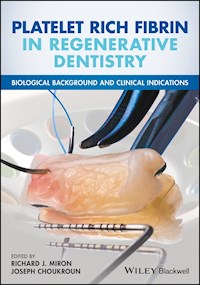
Cover Design: WileyCover Images: (Foreground, PRF clot & instruments) Courtesy of Jonathan Du Toit; (Background, centrifuge image) Courtesy of Joseph Choukroun
To my parents, family, and friends who have all sacrificed far too often in my pursuit of a career in academic dentistry
To my classmates, colleagues, and mentors who constantly raised the bar and strived for better
To the team at Advanced PRF Education who made excellence in teaching a top priority
In gratitude to my Mentors and Professors at the University of Montpellier and Strasbourg, France. Your education and mentorship has given me the means to innovate in the treatment of pain and wound healing.
Contents
About the Authors
Foreword
Preface
1 Platelet Rich Fibrin: A Second-Generation Platelet Concentrate
1.1 Introduction
1.2 Brief history of platelet concentrates
1.3 The development of PRF from PRP
1.4 Effect of PRF on periosteum behavior
1.5 The first case treated with PRF
1.6 Conclusion
References
2 Biological Components of Platelet Rich Fibrin: Growth Factor Release and Cellular Activity
2.1 Introduction
2.2 Cell components of PRF
2.3 Advantages of a three-dimensional fibrin network
2.4 Growth factors in blood
2.5 PRP versus PRF for growth factor release
2.6 L-PRF versus A-PRF vs A-PRF+—new findings with the low-speed centrifugation concept and low-time induces even higher growth factor release
2.7 i-PRF versus PRP—growth factor release
2.8 Cell behavior in response to L-PRF, A-PRF, and A-PRF+
2.9 Cell behavior in response to PRP, i-PRF
2.10 Future prospective
References
3 Introducing the Low-Speed Centrifugation Concept
3.1 Introduction
3.2 Development of advanced solid PRF matrices following the low speed centrifugation concept (LSCC)
3.3 Development of an injectable PRF (i-PRF) following the low speed centrifugation concept (LSCC)
3.4 Platelets and leukocytes are key elements in the regeneration process
3.5 Clinical insights
3.6 Conclusion
References
4 Uses of Platelet Rich Fibrin in Regenerative Dentistry: An Overview
4.1 Introduction
4.2 Extraction socket management with PRF
4.3 Sinus elevations procedures with PRF
4.4 Use of PRF for soft-tissue root coverage
4.5 Use of PRF for periodontal regeneration
4.6 Use of PRF for the regeneration of soft tissues around implants
4.7 Use of PRF in guided bone regeneration
4.8 Use of PRF in various other aspects of dentistry and medicine
4.9 Conclusion
References
5 Use of Platelet Rich Fibrin for the Management of Extraction Sockets: Biological Basis and Clinical Relevance
5.1 Introduction
5.2 Natural dimensional changes occurring post-extraction
5.3 Conventional socket grafting and ridge preservation techniques
5.4 Immediate implant placement into fresh extraction sockets
5.5 Overview of utilizing PRF in extraction sockets
5.6 Discussion and future research
References
6 Maxillary Sinus Floor Elevation in the Atrophic Posterior Maxillae: Anatomy, Principles, Techniques, Outcomes, and Complications
6.1 Introduction
6.2 Anatomical considerations
6.3 Biological principles
6.4 Surgical techniques
6.5 Clinical outcomes
6.6 Surgical and post-surgical complications
6.7 Conclusion
References
7 Maxillary Sinus Floor Elevation Procedures with Platelet Rich Fibrin: Indications and Clinical Recommendations
7.1 Introduction
7.2 PRF as a sole grafting material during sinus lifting procedures
7.3 PRF for the repair of Schneiderian membranes
7.4 PRF for the closure of the lateral maxillary access window
7.5 Discussion and future outlook
References
8 Use of Platelet Rich Fibrin for the Treatment of Muco-Gingival Recessions: Novel Improvements in Plastic Aesthetic Surgery Utilizing The Fibrin Assisted Soft Tissue Promotion (FASTP) Technique
8.1 Introduction
8.2 Plastic periodontal procedures with PRF
8.3 Fibro promotion: the basic mechanism of Fibrin-Assisted Soft Tissue Promotion (FASTP) technique
8.4 FASTP: the surgical technique
8.5 Conclusion
References
9 Use of Platelet Rich Fibrin for Periodontal Regeneration/Repair of Intrabony and Furcation Defects
9.1 Introduction
9.2 Role of barrier membranes in periodontal regeneration
9.3 Role of bone-grafting materials in periodontal regeneration
9.4 Biologic agents/growth factors for periodontal regeneration
9.5 Platelet rich fibrin (PRF) as a potential autologous biological agent for periodontal regeneration
9.6 Intrabony defect regeneration with PRF: results from controlled clinical trials
9.7 Furcation defect regeneration with PRF
9.8 Discussion and future research
References
10 Platelet Rich Fibrin as an Adjunct to Implant Dentistry
10.1 Introduction
10.2 PRF treatment of peri-implant defects
10.3 PRF and soft-tissue healing at implants
10.4 Osseointegration
10.5 Techniques to improve primary stability in poor bone quality
10.6 The use of PRF at osteotomy preparation
10.7 The future of PRF and implants
References
11 Guided Bone Regeneration with Platelet Rich Fibrin
11.1 Introduction
11.2 Overview of GBR
11.3 Available options of GBR
11.4 Non-resorbable PTFE membranes
11.5 Titanium mesh
11.6 Collagen-based resorbable membranes
11.7 Synthetic resorbable membranes
11.8 Plasma-rich proteins as growth factors for membranes
11.9 Choice of bone-grafting materials during GBR procedures
11.10 Alternative strategies to induce new bone formation during GBR procedures
11.11 Recent surgical approaches using PRF in combination with GBR
11.12 PRF as a barrier membrane in GBR procedures
11.13 PRF in combination with bone-grafting materials
11.14 Studies investigating PRF for GBR
11.15 Discussion and future research
References
12 Modern Approach to Full Arch Immediate Loading: The Simonpieri Technique with PRF and i-PRF
12.1 Introduction
12.2 Immediate loading in implant dentistry—what is success?
12.3 Biological requirements
12.4 Anatomical and surgical requirements
12.5 Prosthetic requirements
12.6 Final results
12.7 Documented long-term stability
12.8 Long-term statistical results: full arch immediate implant placement and loading
12.9 Conclusion
References
13 Use of Platelet Rich Fibrin in Facial Aesthetics and Rejuvenation
13.1 Introduction
13.2 Features of the skin
13.3 Aging and the epidermal barrier function mechanisms in skin aesthetics
13.4 Pre-evaluation and patient selection
13.5 Conventional therapies in facial aesthetics
13.6 Lasers and epidermal barrier function
13.7 Overview of utilizing platelet derivatives in facial aesthetics
13.8 Clinical procedures utilizing PRF in facial aesthetics
13.9 i-PRF injections with a derma rollers
13.10 i-PRF injections with a derma pen
13.11 i-PRF and PRF for mesotherapy by syringe injections
13.12 Platelet concentrate during the vampire technique
13.13 Augmentation techniques with PRF matrix and i-PRF—combination Therapies
13.14 Nasolabial fold rejuvenation with PRF and i-PRF
13.15 Use of PRF and i-PRF for lip augmentation
13.16 PDO threads using PRF and i-PRF
13.17 Conclusion
References
14 Use of Platelet Rich Fibrin in Other Areas of Medicine
14.1 Introduction
14.2 Effects of PRF on cell activity in vitro
14.3 Evidence that PRF improves soft-tissue wound healing/regeneration in vivo
14.4 Clinical studies evaluating the use of PRF in medicine
14.5 PRF for regeneration of chronic leg ulcers
14.6 PRF for cartilage (knee) regeneration
14.7 PRF for the regeneration of ligaments and tendons
14.8 PRF in orthopedic medicine
14.9 PRF for skin regeneration
14.10 Discussion and future perspectives
References
15 Future Research with Platelet Rich Fibrin
15.1 PRF and centrifugation speeds
15.2 Effect of hematocrit count on PRF scaffolds
15.3 The influence of PRF for the treatment of osteonecrosis of the jaw
15.4 Injectable platelet rich fibrin as a potential therapy for temporomandibular joint disorders
15.5 Potential use of platelet rich fibrin for pulp regeneration
15.6 Platelet rich fibrin and periodontal regeneration
15.7 Potential use of stem cells derived from blood
15.8 PRF: regeneration by growth factors, leukocytes, or fibrin?
15.9 PRF and its degradation properties
15.10 PRF and osteoinduction
References
Index
EULA
List of Tables
Chapter 1
Table 1.1
Chapter 5
Table 5.1
Chapter 6
Table 6.1
Chapter 7
Table 7.1
Chapter 8
Table 8.1
Table 8.2
Chapter 9
Table 9.1
Table 9.2
Chapter 11
Table 11.1
Table 11.2
Table 11.3
Guide
Cover
Table of Contents
Preface
Pages
iii
xiii
xiv
xv
xvii
1
2
3
4
5
6
7
8
11
12
13
14
15
16
18
19
20
21
22
23
24
25
26
29
30
31
33
34
35
36
37
38
39
40
41
42
43
44
45
46
47
48
49
50
51
54
55
56
57
59
60
62
63
64
65
66
68
69
71
73
74
75
77
78
79
80
81
82
83
84
85
86
87
88
89
91
92
93
94
95
96
97
98
99
100
101
103
104
105
106
107
109
111
112
113
115
116
117
118
119
120
121
123
124
125
126
127
128
129
130
131
134
135
136
137
138
139
140
141
142
143
144
145
146
147
148
149
150
151
152
153
154
155
156
157
159
160
161
162
166
167
169
170
171
172
173
174
177
178
179
180
181
182
183
185
186
187
188
189
191
192
193
194
195
197
200
201
202
203
204
205
206
207
208
209
210
211
212
213
214
215
216
217
218
219
220
221
222
223
224
225
226
227
228
229
230
231
234
235
237
238
239
240
241
242
243
244
245
246
247
248
249
251
252
253
255
256
257
258
259
260
261
263




