


16,99 €
Mehr erfahren.
- Herausgeber: John Wiley & Sons
- Kategorie: Geisteswissenschaft
- Sprache: Englisch
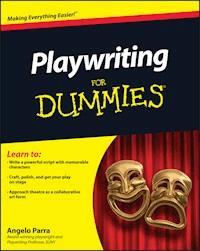
The easy way to craft, polish, and get your play on stage
Getting a play written and produced is a daunting process. From crystallizing story ideas, formatting the script, understanding the roles of the director stagecraft people, to marketing and financing your project, and incorporating professional insights on writing, there are plenty of ins and outs that every aspiring playwright needs to know. But where can you turn for guidance?
Playwriting For Dummies helps any writer at any stage of the process hone their craft and create the most dramatic and effective pieces.
- Guides you through every process of playwriting?from soliloquies, church skits, and one act plays to big Broadway musicals
- Advice on moving your script to the public stage
- Guidance on navigating loopholes
If you're an aspiring playwright looking to begin the process, or have already penned a masterpiece and need trusted advice to bring it into the spotlight, Playwriting For Dummies has you covered.
Das E-Book können Sie in Legimi-Apps oder einer beliebigen App lesen, die das folgende Format unterstützen:
Veröffentlichungsjahr: 2011
Ähnliche




















Playwriting For Dummies®
Visit www.dummies.com/cheatsheet/playwriting to view this book's cheat sheet.
Table of Contents
Playwriting For Dummies®
by Angelo Parra
Playwriting For Dummies®
Published byWiley Publishing, Inc.111 River St.Hoboken, NJ 07030-5774www.wiley.com
Copyright © 2011 by Wiley Publishing, Inc., Indianapolis, Indiana
Published simultaneously in Canada
No part of this publication may be reproduced, stored in a retrieval system or transmitted in any form or by any means, electronic, mechanical, photocopying, recording, scanning or otherwise, except as permitted under Sections 107 or 108 of the 1976 United States Copyright Act, without either the prior written permission of the Publisher, or authorization through payment of the appropriate per-copy fee to the Copyright Clearance Center, 222 Rosewood Drive, Danvers, MA 01923, (978) 750-8400, fax (978) 646-8600. Requests to the Publisher for permission should be addressed to the Permissions Department, John Wiley & Sons, Inc., 111 River Street, Hoboken, NJ 07030, (201) 748-6011, fax (201) 748-6008, or online at http://www.wiley.com/go/permissions.
Trademarks: Wiley, the Wiley Publishing logo, For Dummies, the Dummies Man logo, A Reference for the Rest of Us!, The Dummies Way, Dummies Daily, The Fun and Easy Way, Dummies.com, Making Everything Easier, and related trade dress are trademarks or registered trademarks of John Wiley & Sons, Inc. and/or its affiliates in the United States and other countries, and may not be used without written permission. All other trademarks are the property of their respective owners. Wiley Publishing, Inc., is not associated with any product or vendor mentioned in this book.
LIMIT OF LIABILITY/DISCLAIMER OF WARRANTY: THE PUBLISHER AND THE AUTHOR MAKE NO REPRESENTATIONS OR WARRANTIES WITH RESPECT TO THE ACCURACY OR COMPLETENESS OF THE CONTENTS OF THIS WORK AND SPECIFICALLY DISCLAIM ALL WARRANTIES, INCLUDING WITHOUT LIMITATION WARRANTIES OF FITNESS FOR A PARTICULAR PURPOSE. NO WARRANTY MAY BE CREATED OR EXTENDED BY SALES OR PROMOTIONAL MATERIALS. THE ADVICE AND STRATEGIES CONTAINED HEREIN MAY NOT BE SUITABLE FOR EVERY SITUATION. THIS WORK IS SOLD WITH THE UNDERSTANDING THAT THE PUBLISHER IS NOT ENGAGED IN RENDERING LEGAL, ACCOUNTING, OR OTHER PROFESSIONAL SERVICES. IF PROFESSIONAL ASSISTANCE IS REQUIRED, THE SERVICES OF A COMPETENT PROFESSIONAL PERSON SHOULD BE SOUGHT. NEITHER THE PUBLISHER NOR THE AUTHOR SHALL BE LIABLE FOR DAMAGES ARISING HEREFROM. THE FACT THAT AN ORGANIZATION OR WEBSITE IS REFERRED TO IN THIS WORK AS A CITATION AND/OR A POTENTIAL SOURCE OF FURTHER INFORMATION DOES NOT MEAN THAT THE AUTHOR OR THE PUBLISHER ENDORSES THE INFORMATION THE ORGANIZATION OR WEBSITE MAY PROVIDE OR RECOMMENDATIONS IT MAY MAKE. FURTHER, READERS SHOULD BE AWARE THAT INTERNET WEBSITES LISTED IN THIS WORK MAY HAVE CHANGED OR DISAPPEARED BETWEEN WHEN THIS WORK WAS WRITTEN AND WHEN IT IS READ.
For general information on our other products and services, please contact our Customer Care Department within the U.S. at 877-762-2974, outside the U.S. at 317-572-3993, or fax 317-572-4002.
For technical support, please visit www.wiley.com/techsupport.
Wiley also publishes its books in a variety of electronic formats and by print-on-demand. Some content that appears in standard print versions of this book may not be available in other formats. For more information about Wiley products, visit us at www.wiley.com.
Library of Congress Control Number: 2011930315
ISBN 978-1-118-01722-7 (pbk); ISBN 978-1-118-12095-8 (ebk); ISBN 978-1-118-12096-5 (ebk); ISBN 978-1-118-12097-2 (ebk)
Manufactured in the United States of America
10 9 8 7 6 5 4 3 2 1
About the Author
Angelo Parra, an award-winning playwright and playwriting instructor, has had productions of his plays Off-Broadway in New York City and in Los Angeles, Chicago, and Washington, D.C. He’s also had productions at many prestigious regional venues, including Hartford Stage, Florida Stage, Cape (Cod) Playhouse, George Street Playhouse, Theatre Memphis, Passage Theatre, Penguin Rep Theatre, and Florida Rep, and at the Edinburgh International Theatre Festival.
Angelo is the author of The Devil’s Music: The Life and Blues of Bessie Smith, the critically acclaimed play with music named among the “Top Ten Off-Broadway Experiences of 2001” by The New York Daily News. Another of his plays, Journey of the Heart (which dramatizes the seesaw struggle of a hospital committee to decide who gets a heart for transplant), won the Jewel Box Theatre Award, Mixed Blood Versus America Award, and David James Ellis Memorial Award. His screenplay adaptation of Journey of the Heart was a finalist in the Sundance Institute Feature Film Program. Two other plays, Casino and The Slope, were the recipients of a Fund for U.S. Artists at International Festivals and Exhibitions grant (a partnership of the National Endowment for the Arts, the U.S. Information Agency, the Rockefeller Foundation, and the Pew Charitable Trusts), awarded to sponsor the plays at the 1993 Edinburgh International Theatre Festival.
Angelo’s honors include two New York Foundation for the Arts Fellowships in Scriptwriting, the 1998 Chicano/Latino Literary Award (University of California), and a prize for his play, Song of the Coquí, in the 1998 “The American Dream” competition sponsored by Repertorio Español. In 2000, he was named a Tennessee Williams Scholar at the renowned Sewanee Writers Conference. He is a member of the Dramatists Guild and a member emeritus of the BMI/Lehman Engel Musical Theatre Workshop. He was awarded a National Endowment for the Humanities Landmarks of American History and Culture grant in 2008 and, in 2011, a New York State Council on the Arts/Arts Council of Rockland grant to underwrite a new play in conjunction with the Kurt Weill Foundation for Music.
Angelo studied playwriting at Roundabout Theatre Conservatory’s Professional Playwright’s Unit, New Dramatists Playwrights Forum, the playwrights workshop at Playwrights Horizons, and the Playwrights Lab at T. Schreiber Studio, among others. He holds a B.A. in journalism from Fordham University and a master of fine arts degree in playwriting, earned under the late Jack Gelber at Brooklyn College.
Angelo Parra is the founder and director of the Hudson Valley Professional Playwrights Lab, teaches playwriting and performing arts at SUNY Rockland Community College, and is president of the board of Penguin Rep Theatre.
Dedication
To the four most important figures in my life:
My parents, Edith and Angelo, who always believed in me, no matter how harebrained my ambitions seemed to be.
My best friend, Sandy — also my proofreader, cheerleader, and wife (not necessarily in that order) — for her love, support, and patience.
And Charlie, who makes me laugh.
Author’s Acknowledgments
This book would not have happened without the theatre career I’ve had, which, in turn, would not have been possible without significant help and encouragement and support along the way. My most heartfelt thank you:
To Joe Brancato and Andrew Horn for their confidence in me and my work and for allowing their gem of a showplace, Penguin Rep Theatre, to be my artistic home.
To the generous and perpetually optimistic Terry Schreiber and his T. Schreiber Studio and its Playwrights Unit, where my first plays were staged; to the Roundabout Theatre Company Conservatory, where my early plays were developed; to Peter Sylvester and his late, lamented Synchronicity Theatre Group for their friendship and presentations of my plays; and to Mark Judelson and Patrick Cacciola at the Arts Council of Rockland for their continuing support and encouragement.
To Nancy Golladay and the members of her Librettists Workshop at the BMI Lehman-Engel Musical Theatre Workshop for their expertise and friendship.
To my friends and fellow theatre-lovers Kim Hendrickson and Joe Grosso for advocating for me and encouraging me to take on the writing of this book. To the generosity of Sandoz (now Novartis) Pharmaceuticals.
To Patty Maloney-Titland who graciously allows me to teach playwriting in her Performing Arts Department at SUNY Rockland Community College.
And especially to my friends and playwriting colleagues who endured my self-doubts and whining over tight deadlines, and, more importantly, who functioned as an informal editorial board, providing me with input and feedback. These theatre troopers include: Neil Berg, Miche Braden, Bill Bruehl, Steve Burch, Holly Caster, Tom Dudzick, Mike Folie, Jeff Fuerst, Earl Graham (of The Graham Agency), Erik Johnke, Jane Landers, Richard Manichello, Don Monaco, Jim G. Ramsay, Jennie Redling, Elaine Schloss, Paul Schwartz, Ralph Sevush (of The Dramatists Guild), Ric Siler, Judy Stadt, Staci Sweden, and Deborah Vines.
Publisher’s Acknowledgments
We’re proud of this book; please send us your comments at http://dummies.custhelp.com. For other comments, please contact our Customer Care Department within the U.S. at 877-762-2974, outside the U.S. at 317-572-3993, or fax 317-572-4002.
Some of the people who helped bring this book to market include the following:
Acquisitions, Editorial, and Media Development
Project Editor: Elizabeth Rea
Acquisitions Editor: Michael Lewis
Copy Editor: Caitlin Copple
Assistant Editor: David Lutton
Editorial Program Coordinator: Joe Niesen
Technical Editor: Todd Ristau
Editorial Manager: Michelle Hacker
Editorial Assistant: Alexa Koschier
Cover Photos: iStockphoto.com/James Steidl
Cartoons: Rich Tennant (www.the5thwave.com)
Composition Services
Project Coordinator: Patrick Redmond
Layout and Graphics: Claudia Bell, Corrie Socolovitch, Kim Tabor
Proofreader: Nancy L. Reinhardt
Indexer: Ty Koontz
Publishing and Editorial for Consumer Dummies
Diane Graves Steele, Vice President and Publisher, Consumer Dummies
Kristin Ferguson-Wagstaffe, Product Development Director, Consumer Dummies
Ensley Eikenburg, Associate Publisher, Travel
Kelly Regan, Editorial Director, Travel
Publishing for Technology Dummies
Andy Cummings, Vice President and Publisher, Dummies Technology/General User
Composition Services
Debbie Stailey, Director of Composition Services
Introduction
I’m guessing you’re an individual who likes to have fun. Why? Because playwriting is fun (most of the time) and you’ve got this book in your hands; ergo you’re the kind of person who enjoys a good time. Well, you’ve come to the right place. Pull up a chair, sit back, put your feet up, and stay a while as I give you a relaxed and user-friendly look the art and craft of playwriting.
Everybody comes to playwriting in their own way. My discovery of the art form was roundabout. Throughout my school days, I was terrified of standing in front of the class and speaking. Even reading aloud from a book caused me to stammer and tremble. This stage fright, I guess you’d call it, tagged along with me into my career as a writer for a big corporation. Making presentations or even voicing a point of view in a meeting would cause my throat to tighten and my hands to shake. If you had told me then that I would one day routinely and comfortably stand at the front of a college classroom with dozens of playwriting and theatre students eagerly awaiting my words of wisdom, I would have gone to court to have you committed.
Eventually, I decided to face my fears. I enrolled in an improvisation class, and, to my astonishment, I found that I loved hamming it up in front of the other students. The theatricality of the experience tapped into something in me. I enrolled as a student playwright in a theatrical studio where I discovered the exhilaration of writing lines late at night and having my words acted out by student actors at the studio the next evening. Writing had always been part of my life, but I had stumbled into my niche — playwriting.
Playwriting opened up a whole new world of artistic satisfaction, personal fulfillment, new and fascinating friends and colleagues, and just plain fun. I welcome you to join me.
About This Book
Writing plays for theatre is an exciting and enjoyable experience. I wouldn’t trade away a day of it. But admittedly, at times it can be challenging and frustrating. Playwriting For Dummies is designed to maximize the “exciting and enjoyable” part of the experience and to smoothly and easily navigate you through those “challenging and frustrating” moments.
This book is about the art and craft of playwriting, but it’s not intended to be a heavy-duty textbook or philosophical study of the field. Playwriting For Dummies is a practical, convenient, and nondemanding reference for people who are new to playwriting as well as people who are experienced in the art form but would like to explore further specific aspects of playwriting.
Don’t feel like you have to read this book in order from cover to cover. Think of this book as a supermarket and each chapter as a particular aisle in that supermarket. As the reader — or shopper in this metaphor — you’re free to wander every aisle to check out what you need and can use. Or, you can head immediately for the freezer aisle if all you want is a half gallon of chocolate ice cream.
Whether you’re a casual browser or highly focused and goal-oriented, you’ll find informative and useful information in this book.
Conventions Used in This Book
This book isn’t heavy on special or unusual conventions, but here are a few you should be aware of:
I italicize any words you may not be familiar with and follow them with definitions. I also use italic for titles of films, books, and plays I use as examples, and occasionally I use it to emphasize an important point.
I use bold to draw your attention to key words and phrases in bulleted lists and to the actionable steps in numbered lists.
In a few chapters, I use some lines from some of my own plays to illustrate how certain components of a play actually appear in a script. I do my best to replicate the standard style and formatting of a script in the text.
All websites and e-mail addresses appear in monofont. When this book was printed, some web addresses may have needed to break across two lines of text. If that happened, rest assured that I haven’t put in any extra characters (such as hyphens) to indicate the break.
What You’re Not to Read
Anytime you see a Technical Stuff icon, you can skip that paragraph if you want to without missing key information. You can also skip the shaded gray boxes known as sidebars if you’re short on time or if you conclude that that material isn’t relevant to you. Sidebars contain interesting insights that can deepen your understanding of a topic, but you’ll do fine without them, so take ’em or leave ’em; it’s your dime.
Foolish Assumptions
In writing this book, I made certain assumptions about you, my reader, and your interest in playwriting. These assumptions are reflected in my efforts to give you what you need to quickly and skillfully get into the exciting world of playwriting. Here’s how I imagine you:
You’ve seen or read a play and enjoyed it.
You want to understand what plays are and how they work.
You want to experiment with writing in a genre — plays — that may be new and unfamiliar to you.
You understand that before you break the rules, you should know and understand them.
You’ve written a play and you want to improve it, or you’re eager to write your first play.
In terms of your existing exposure to plays and playwriting, when I cite scenes from classic plays as models of the playwriting topics being discussed, I don’t assume that you have seen or read the play, and you don’t need to do so to understand the examples. Each time I bring up a famous play, the analysis of the scene and its relevance to the topic stand on their own. No prior experience with any given play is necessary to get the point.
That being said, if you have the time and interest in familiarizing yourself with the plays most often considered in this book, here are titles of most of them:
Hamlet, by William Shakespeare
A Doll House, by Henrik Ibsen
A Raisin in the Sun, by Lorraine Hansberry
A Streetcar Named Desire, by Tennessee Williams
West Side Story, by Arthur Laurents, Leonard Bernstein, Stephen Sondheim, and Jerome Robbins
The Miracle Worker, by William Gibson
Death of a Salesman, by Arthur Miller
Arsenic and Old Lace, by Joseph Kesselring
Bell, Book and Candle, by John van Druten
Inherit the Wind, by Jerome Lawrence and Robert E. Lee
If you haven’t had to opportunity to see or read a lot of plays, the list above can serve as a suggested-but-not-required reading list. These plays are likely available at most public libraries, bookstores, and online. (A word about Hamlet: If you choose to read the play and you’re not familiar with Shakespeare, it may be tough going. You may want to look for a copy of the play that features the text side-by-side with an explanation of Shakespeare’s vocabulary and poetic turns of phrase. It’ll make your first experience with Shakespeare a more enjoyable one.)
How This Book Is Organized
Playwriting is an art and a craft and, like it or not, a business. To be a success in this field, you need inspiration, particular skills, and the willingness to promote your work. This book is organized to help you deal with these and other aspects of playwriting. You can start at the beginning, or you can jump to the part or chapter of the book that has the information you’re looking for. The road ahead is open and awaiting you. Follow the route that serves your needs best. And by the way, don’t forget to have fun as you go.
Part I: Catching the Playwriting Bug
Warning: Playwriting and theatre are habit-forming. After you’re bitten by the bug, you’ll be itching to see, read, and write plays. But that’s a good thing. In this part, you’re introduced to the art and craft of playwriting. You explore what makes a play a play. You also delve into the sources of inspiration for plays and find out how you can use plays and playwriting to share your views and experiences with the world. You also get a glimpse of what the playwriting life is like.
Part II: Creating a Blueprint for Your Play
Having a focused vision of your play enables you to work more efficiently in the composition of your play. This part looks at some of the basic decisions and skills involved in writing a play. You zoom in on who and what your play is about. You explore all the factors involved in creating characters that are as detailed and complex as any real person you know, and you find out how to make them drive the story with action and effective dialogue. Furthermore, I guide you through some of the practical considerations involved in writing and staging a story that’s enacted by real people in real time and staged by a small army of theatre craftspeople.
Part III: The Nuts and Bolts of Putting Your Story Together
Plays are composed of acts, and acts are composed of scenes. Each scene represents a crucial moment in the story you’re telling, and how you tell the story involves a number of decisions, not the least of which is where your play starts. This part explores your play’s point of attack and the obstacles your main character needs to face on his or her journey. It examines the concept of the climax, the point to which all events of the play are headed. And it also discusses the concept of a play’s resolution — how the dust settles. Finally, in this part I also take a look at musicals and how a libretto (the story and dialogue of a musical) resembles and differs from a play.
Part IV: The Show Must Go On
Writing your play is only part of the playwriting experience. Another crucial component of playwriting success is getting your play produced and performed before an audience. This part walks you through all the steps involved in production: getting your play read and considered, working with your many theatre collaborators, and participating in rehearsals and using that experience to the advantage of your play’s development.
Part V: The Part of Tens
In this, the final part of the book, you are exposed to three important lists of ten items that can help every playwright. You look at ten things every playwright should know about writing plays, ten hallmarks of great plays, and ten playwrights to know and emulate. Every artist stands on the shoulders of those who’ve come before, so you may as well take lessons from accomplishments of your illustrious predecessors.
Icons Used in This Book
To draw your attention to important and particularly noteworthy bits of information or advice, I use the following eye-catching icons in this book:
This icon points to time- or frustration-saving ideas.
For basic rules and information that you should take from the discussion and store away in your mental file cabinet, look for this icon.
This icon marks information that you don’t necessarily need to know but may find interesting.
This icon alerts you to a pitfall or potential problem that you’ll want to avoid. It signals a word (well, more than one word) to the wise.
Where to Go from Here
Pressing on with my supermarket metaphor, the store is now open for shopping! You can begin at aisle 1 or you can proceed to any aisle that features what you came to the supermarket for. In other words, you can go anywhere you like in Playwriting For Dummies and come away with interesting and useful advice and information.
The table of contents may spark some ideas and draw your attention, or you can head to the index if you’re looking for information on a particular topic. You can jump to Chapter 3 to get a real feel for what a play is and its place in the world of theatre. If you have an idea for a play and want to start fleshing it out, head to Part II to create your blueprint and then to Part III to start writing. And Part IV can help you getter a better idea of how to get your play produced and performed.
Wherever you choose to start, good luck and happy playwriting!
Part I
Catching the Playwriting Bug
In this part . . .
You’re here because you’re writing a play, or you have an idea for one, or you’re just plain curious about this art form. Not surprising. Men and women have been writing plays for more than 2,500 years. The idea and act of composing a story and then seeing it enacted by performers for a live audience are seductive and thrilling. Theatre is truly as real as storytelling gets. This first part of the book introduces you to the art and craft of playwriting, explores the sources of play ideas, and provides a glimpse into the life of a playwright.
Chapter 1
Introducing the Art and Craft of Playwriting
In This Chapter
Looking at what playwriting is all about
Getting your bearings as a playwright and getting to work
Bringing your play to the stage
Playwriting is fun. Writing words that become the basis for what actors do and say in the presence of an audience is a heady experience. And fortunately, the enjoyment and satisfaction of writing plays is not reserved for some small, elite cluster of linguistic masterminds.
Anyone can write plays. It doesn’t require formal training. But like any other pursuit in life, the more you know about a subject, the quicker you’ll catch on and the better you’ll be at it. This book is here to help. It provides you, in a straightforward and uncomplicated manner, with the practical knowledge and tools you need to get down to the joy of writing plays, sooner rather than later.
This chapter lets you get your toes wet in the world of playwriting so you can see how you like the water. It also offers you an overview of how this book will help you write and appreciate plays.
Lesen Sie weiter in der vollständigen Ausgabe!
Lesen Sie weiter in der vollständigen Ausgabe!
Lesen Sie weiter in der vollständigen Ausgabe!
Lesen Sie weiter in der vollständigen Ausgabe!
Lesen Sie weiter in der vollständigen Ausgabe!
Lesen Sie weiter in der vollständigen Ausgabe!
Lesen Sie weiter in der vollständigen Ausgabe!
Lesen Sie weiter in der vollständigen Ausgabe!
Lesen Sie weiter in der vollständigen Ausgabe!
Lesen Sie weiter in der vollständigen Ausgabe!
Lesen Sie weiter in der vollständigen Ausgabe!
Lesen Sie weiter in der vollständigen Ausgabe!
Lesen Sie weiter in der vollständigen Ausgabe!
Lesen Sie weiter in der vollständigen Ausgabe!
Lesen Sie weiter in der vollständigen Ausgabe!
Lesen Sie weiter in der vollständigen Ausgabe!
Lesen Sie weiter in der vollständigen Ausgabe!
Lesen Sie weiter in der vollständigen Ausgabe!
Lesen Sie weiter in der vollständigen Ausgabe!
Lesen Sie weiter in der vollständigen Ausgabe!
Lesen Sie weiter in der vollständigen Ausgabe!
Lesen Sie weiter in der vollständigen Ausgabe!
Lesen Sie weiter in der vollständigen Ausgabe!
Lesen Sie weiter in der vollständigen Ausgabe!
Lesen Sie weiter in der vollständigen Ausgabe!




