


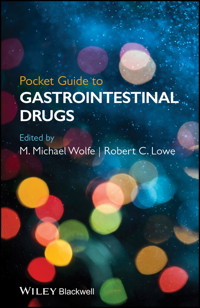
Pocket Guide to GastrointestinaI Drugs E-Book
50,99 €
Mehr erfahren.
- Herausgeber: John Wiley & Sons
- Kategorie: Fachliteratur
- Sprache: Englisch
Learn all you need to know about gastrointestinal drugs and their clinical use with this one-stop, rapid reference pocket guide.
Brought to you by many of the world's leading GI drug experts, Pocket Guide to Gastrointestinal Drugs provides comprehensive guidance to the pharmacological properties of drugs used to treat gastrointestinal conditions, including mechanisms of action, appropriate administration, and potential adverse effects associated with their use.
Organized by class of drug and ranging from PPIs to immunosupressants, each chapter first examines the specific agents within that class and then their appropriate and judicious use across a range of specific GI disorders.
Key features include:
- Introduction of drug class
- Basic pharmacology, including mechanism of action, bioavailability, metabolism, interactions, adverse effects, toxicity, and special considerations
- Dosing information for each GI condition and on- and off-label use
- Consistent use of both generic and trade names throughout
- Specific reference to drug use in pediatric patients and during pregnancy
Perfect for quick consultation on the wards and in the office, Pocket Guide to Gastrointestinal Drugs is the ideal tool for all those managing patients with GI conditions, including gastroenterologists, GI trainees, emergency physicians, GI specialist nurses, primary care physicians and residents, intensivists and pharmacists.
Sie lesen das E-Book in den Legimi-Apps auf:
Seitenzahl: 352
Veröffentlichungsjahr: 2014
Ähnliche




















Contents
Cover
Title Page
Copyright
List of contributors
Preface
PART I: UPPER GI TRACT
Chapter 1: Prokinetic agents and antiemetics
Prokinetics
Antiemetic agents
Recommended reading
Chapter 2: Proton pump inhibitors
Introduction
Mechanism of action, pharmacodynamics, kinetics
Clinical use and dosing
Adverse effects/safety
Recommended reading
Chapter 3: Histamine H2-receptor antagonists
Introduction
Mechanism of action
Pharmacology
Clinical effectiveness
Adverse events
Recommended reading
Chapter 4: Prostaglandins and other mucosal protecting agents
Introduction of drug class
Physicochemical properties
Formulations and recommended dosages
Mechanism of action
Drug interactions
Pharmacokinetics
Clinical effectiveness
Toxicity
Pregnancy classes
Other mucosal protecting agents
Recommended reading
PART II: SMALL AND LARGE INTESTINE
Chapter 5: 5-HT modulators and other antidiarrheal agents and cathartics
Introduction
5-HT modulators used in the management of GI disorders
5-HT agents approved in the US for specific GI indications
Medications used for the treatment of chronic constipation
Medications used for the treatment of narcotic-induced constipation
Antidiarrheal agents
Conclusion
Recommended reading
Chapter 6: 5-aminosalicylates
Introduction
Preparations
Clinical use and efficacy
Pharmacology: preparations and dosing
Mechanism of action
Bioavailability and metabolism
Adverse effects and toxicity
Pregnancy (Table 6.7)
Drug interactions (package inserts)
Precautions and contraindications (Table 6.8)
Special considerations: effectiveness in colorectal cancer prevention
Conclusion (Table 6.9)
Recommended reading
Chapter 7: Immunosuppressive agents
Introduction
Thiopurines
Low-dose methotrexate (MTX)
Calcineurin inhibitors
Recommended reading
Chapter 8: Biological agents
Biological agents approved to treat IBD
Optimal treatment strategies with anti TNF therapies in IBD
Safety of biological agents in IBD
Emerging biologicals
Recommended reading
PART III: LIVER AND PANCREAS
Chapter 9: Interferons
Introduction
Mechanism of action
Pharmacology
Clinical effectiveness
Toxicity
Interferon types with generic and brand names
Pregnancy classes
Initial interferon dosing regimens for chronic hepatitis C
Recommended reading
Chapter 10: Nucleoside analogs
Introduction
Mechanism of action
Pharmacology
Clinical effectiveness
Nucleoside analogs
Nucleotide analogs
Summary
Recommended reading
Chapter 11: Ursodeoxycholic acid, chelating agents, and zinc in the treatment of metabolic liver diseases
Ursodeoxycholic acid
Treatment of copper overload
Recommended reading
Chapter 12: Agents for the treatment of portal hypertension
Introduction
Nonselective beta-blockers (NSBB)
Nitrates
Vasopressin analogs
Somatostatin analog
Midodrine
Albumin
Loop diuretics
Aldosterone antagonist
Aquaretics
Disaccharides
Antibiotics
Recommended reading
Chapter 13: Pancreatic enzymes
Introduction
Mechanism of action
Dosing and schedule of administration
Monitoring therapy
Adverse effects
Recommended reading
PART IV: ANTIMICROBIALS AND VACCINES
Chapter 14: Antibiotics for the therapy of gastrointestinal diseases
Introduction
Pharmacologic properties
Clinical uses
Recommended reading
Chapter 15: Antimicrobials for parasitic diseases
5-Nitroimidazoles
Benzimidazoles
Ivermectin
Praziquantel
Treatment dosages (Table 15.3)
Recommended reading
Chapter 16: Vaccines for viral hepatitides
Hepatitis A vaccination
Hepatitis B vaccination (Table 16.1)
Recommended reading
Chapter 17: Rotavirus and other enteric vaccinations
Rotavirus vaccination
Typhoid fever vaccination
Recommended reading
PART V: NUTRITION AND PROBIOTICS
Chapter 18: Parenteral and enteral nutrition feeding formulas
Introduction
Indications for nutrition support
Energy and macronutrient requirements
Protein
Carbohydrate
Lipids
Enteral liquid feeding formulations
Disease-specific formulas
Selection of an appropriate enteral formula
Implementation of enteral nutrition
Parenteral nutrition
Summary
Recommended reading
Chapter 19: Probiotics
Introduction
Pharmacology
Mechanisms of action
Clinical indications (Table 19.2)
Safety/toxicity
Summary
Recommended reading
Index
This edition first published 2014 © 2014 by John Wiley & Sons, Ltd.
Registered office:John Wiley & Sons, Ltd, The Atrium, Southern Gate, Chichester, West Sussex, PO19 8SQ, UK
Editorial offices:9600 Garsington Road, Oxford, OX4 2DQ, UK The Atrium, Southern Gate, Chichester, West Sussex, PO19 8SQ, UK 111 River Street, Hoboken, NJ 07030-5774, USA
For details of our global editorial offices, for customer services and for information about how to apply for permission to reuse the copyright material in this book please see our website at www.wiley.com/wiley-blackwell
The right of the author to be identified as the author of this work has been asserted in accordance with the UK Copyright, Designs and Patents Act 1988.
All rights reserved. No part of this publication may be reproduced, stored in a retrieval system, or transmitted, in any form or by any means, electronic, mechanical, photocopying, recording or otherwise, except as permitted by the UK Copyright, Designs and Patents Act 1988, without the prior permission of the publisher.
Designations used by companies to distinguish their products are often claimed as trademarks. All brand names and product names used in this book are trade names, service marks, trademarks or registered trademarks of their respective owners. The publisher is not associated with any product or vendor mentioned in this book. It is sold on the understanding that the publisher is not engaged in rendering professional services. If professional advice or other expert assistance is required, the services of a competent professional should be sought.
The contents of this work are intended to further general scientific research, understanding, and discussion only and are not intended and should not be relied upon as recommending or promoting a specific method, diagnosis, or treatment by health science practitioners for any particular patient. The publisher and the author make no representations or warranties with respect to the accuracy or completeness of the contents of this work and specifically disclaim all warranties, including without limitation any implied warranties of fitness for a particular purpose. In view of ongoing research, equipment modifications, changes in governmental regulations, and the constant flow of information relating to the use of medicines, equipment, and devices, the reader is urged to review and evaluate the information provided in the package insert or instructions for each medicine, equipment, or device for, among other things, any changes in the instructions or indication of usage and for added warnings and precautions. Readers should consult with a specialist where appropriate. The fact that an organization or Website is referred to in this work as a citation and/or a potential source of further information does not mean that the author or the publisher endorses the information the organization or Website may provide or recommendations it may make. Further, readers should be aware that Internet Websites listed in this work may have changed or disappeared between when this work was written and when it is read. No warranty may be created or extended by any promotional statements for this work. Neither the publisher nor the author shall be liable for any damages arising herefrom.
Library of Congress Cataloging-in-Publication Data
Pocket guide to gastrointestinai drugs / edited by M. Michael Wolfe, Robert C. Lowe.
p. ; cm.
Includes bibliographical references and index.
ISBN 978-1-118-48157-8 (paperback)
I. Wolfe, M. Michael, editor of compilation. II. Lowe, Robert C., 1966- editor of compilation.
[DNLM: 1. Gastrointestinal Agents–therapeutic use–Handbooks. 2. Gastrointestinal Agents–pharmacology–Handbooks. 3. Gastrointestinal Diseases–drug therapy–Handbooks. QV 39]
RM365
615.7′3–dc23
2013041991
A catalogue record for this book is available from the British Library.
Wiley also publishes its books in a variety of electronic formats. Some content that appears in print may not be available in electronic books.
Cover image: iStock #10849434 © Mordolff
Cover design by Meaden Creative
List of contributors
Uri Avissar, MD
Boston Medical Center
Assistant Professor of Medicine
Boston University School of Medicine
Boston, MA, USA
Samra S. Blanchard, MD
Associate Professor
Division Head, Pediatric Gastroenterology and Nutrition
University of Maryland School of Medicine
Baltimore, MD, USA
Wanda P. Blanton, MD
Assistant Professor of Medicine
Section of Gastroenterology
Boston Medical Center
Boston University School of Medicine
Boston, MA, USA
Andrew K. Burroughs, MB. BCh Hons, FEB, FEBTM, Hon DSc (Med), FRCP, FMedSci
Consultant Physician and Hepatologist
The Royal Free Sheila Sherlock Liver Centre
Royal Free London NHS Foundation Trust;
Professor of Hepatology
Institute for Liver and Digestive Health
University College London
London, UK
Andrés Cárdenas, MD, MMSc, AGAF
Faculty Member and Senior Specialist
Institute of Digestive Diseases and Metabolism
University of Barcelona
Hospital Clinic
Barcelona, Spain
Raymond T. Chung, MD
Director of Hepatology, Medicine Service
Massachusetts General Hospital;
Associate Professor of Medicine
Harvard Medical School
Boston, MA, USA
Steven J. Czinn, MD
Professor and Chair, Department of Pediatrics
University of Maryland School of Medicine
Baltimore, MD, USA
James S. Dooley, BSc, MB, BS, MD, FRCP
Emeritus Reader in Medicine
Institute for Liver and Digestive Health
University College London;
Consultant Hepatologist
The Royal Free Sheila Sherlock Liver Centre
Royal Free London NHS Foundation Trust
London, UK
Douglas Drossman, MD
Adjunct Professor of Medicine and Psychiatry
University of North Carolina;
Co-director Emeritus
University of North Carolina Center for Functional GI and Motility Disorders
Drossman Center for the Education and Practice of Biopsychosocial Care
Chapel Hill, NC, USA
Francis A. Farraye, MD, MSc
Clinical Director, Section of Gastroenterology
Boston Medical Center;
Professor of Medicine
Boston University School of Medicine
Boston, MA, USA
Ronnie Fass, MD
Professor of Medicine Care, Western Reserve University;
Director, Division of Gastroenterology and Hepatology
Head, Esophageal and Swallowing Center
MetroHealth Medical Center
Cleveland, OH, USA
Gerald M. Fraser, MD, FRCP
Associate Professor of Medicine
Director, Inflammatory Bowel Disease Unit
Division of Gastroenterology
Rabin Medical Center
Beilinson Hospital
Petah Tikva;
Sackler Faculty of Medicine
Tel-Aviv University
Tel-Aviv, Israel
Albena Halpert, MD
Assistant Professor of Medicine
Section of Gastroenterology
Boston Medical Center
Boston University School of Medicine
Boston, MA, USA
Esther Jacobowitz Israel, MD
Assistant Professor, Pediatrics Harvard Medical School;
Director, Inpatient Quality and Safety
Associate Chief, Pediatric Gastroenterology and Nutrition
Mass General Hospital for Children
Boston, MA, USA
Savio John, MBBS
Assistant Professor of Medicine
SUNY Upstate
Syracuse, NY, USA
Hemangi Kale, MD
Assistant Professor of Medicine
Case Western Reserve University;
Fellowship Program Director
Division of Gastroenterology and Hepatology
MetroHealth Medical Center
Cleveland, OH, USA
Karen L. Krok, MD
Associate Professor of Medicine
Penn State Milton S. Hershey Medical Center
Hershey, PA, USA
Angel Lanas, MD, PhD
Chair, Digestive Diseases Service
University Hospital, IIS Aragón
University of Zaragoza, CIBERehd
Zaragoza, Spain
Lev Lichtenstein, MD
Senior Physician
Inflammatory Bowel Disease Unit
Division of Gastroenterology
Rabin Medical Center
Beilinson Hospital
Petah Tikva, Israel
Robert C. Lowe, MD
GI Fellowship Director
Boston Medical Center;
Associate Professor of Medicine
Boston University School of Medicine
Boston, MA, USA
Hannah L. Miller, MD
Assistant Professor of Medicine
Section of Gastroenterology
Boston Medical Center
Boston University School of Medicine
Boston, MA, USA
Christopher J. Moran, MD
Instructor in Pediatrics
Harvard Medical School;
Assistant in Pediatrics
Mass General Hospital for Children
Boston, MA, USA
David P. Nunes, MD
Director of Hepatology
Boston Medical Center;
Associate Professor of Medicine
Boston University School of Medicine
Boston, MA, USA
Melissa Osborn, MD
Associate Professor of Medicine
Division of Infectious Diseases
MetroHealth Medical Center
Case Western Reserve University
Cleveland, OH, USA
Dominic N. Reeds, MD
Assistant Professor of Medicine
Division of Geriatrics and Nutritional Science
Washington University School of Medicine
St. Louis, MO, USA
Joachim Richter, MD
Adjunct Professor of Tropical Medicine
University Hospital for Gastroenterology, Hepatology and Infectious Diseases
Heinrich-Heine-University
Düsseldorf, Germany
Carlos Sostres, PhD
Research Faculty
Digestive Disease Service
University Hospital, IIS Aragón
Zaragoza, Spain
Kentaro Sugano, MD
Chief Professor, Division of Gastroenterology
Department of Medicine
Jichi Medical University
Shimotsuke, Tochigi, Japan
Christina M. Surawicz, MD
Professor of Medicine
Department of Medicine
Division of Gastroenterology
Washington University School of Medicine
Seattle, WA, USA
Beth Taylor MS, RD, CNSC, FCCM
Nutrition Support Specialist
Barnes-Jewish Hospital
St. Louis, MO, USA
Gert Van Assche, MD, PhD
Professor of Medicine
University of Leuven
Leuven, Belgium;
Division of Gastroenterology
University of Toronto;
Division of Gastroenterology
Mount Sinai Hospital
Toronto, ON, Canada
M. Michael Wolfe, MD
Chair, Department of Medicine
MetroHealth Medical Center;
Charles H. Rammelkamp, Jr. Professor of Medicine
Case Western Reserve University School of Medicine
Cleveland, OH, USA
Preface
In the mid-1970s, Sir James Black developed the first H2-receptor antagonist, cimetidine, a remarkable achievement that revolutionized the treatment of acid-peptic disorders and led to the awarding of his Nobel Prize in Medicine. One year after its approval by the US Food and Drug Administration in 1977, cimetidine became the most widely prescribed drug in the world. Three other H2-receptor antagonists were subsequently marketed worldwide, and in the late 1980s, the first proton pump inhibitor omeprazole was approved for use and likewise became the most prescribed drug worldwide. Since that time, there has been a virtual explosion in the number of pharmaceutical agents available for the treatment of gastrointestinal diseases, from new biologic immunomodulators for inflammatory bowel disease to novel antiviral agents for the treatment of hepatitis B and C.
This handbook has been carefully formulated and written to provide the busy clinician with a concise, yet scholarly, review of the major classes of drugs used in the treatment of gastrointestinal and hepatobiliary disorders. Each chapter discusses the pharmacology and clinical effectiveness of classes of medications, including indications for use, dosing, and adverse events. The outstanding group of authors who have contributed their wisdom and experience represent academic centers from around the world, with contributions from Europe, Asia, and North America. The authors were selected primarily for their record of excellence as investigators, clinicians, and educators. All are engaged in clinical or basic investigation and are particularly proficient in the application of basic scientific information to the realm of patient management.
The target audience for this handbook includes gastroenterologists, gastrointestinal surgeons, and all physicians who care for patients afflicted with digestive disorders. The authors have used great care and discrimination in presenting their materials, and the subject matter has been composed in a concise, yet thorough, format. Accordingly, medical students, internal medicine, family medicine, and surgery residents, and gastroenterology fellows will view this guide as an invaluable adjunct to their educational needs, and it should be regarded as useful to the practices of emergency room and primary care physicians, hospitalists, intensivists, pharmacists, and other health care providers involved in the management of diseases of the gastrointestinal tract and hepatobiliary systems. While generic drug names are used throughout the text, each chapter also lists the international trade names for each drug to enable rapid identification of each agent.
We, the editors, dedicate this book to our colleagues and trainees, whose contributions to clinical care, research, and teaching have made our academic careers intellectually challenging and personally rewarding. We also thank Claire Brewer and Oliver Walter at Wiley, who approached the formidable task of publishing this handbook with the utmost care and who provided immeasurable assistance and advice throughout the course of formulating the content and producing the final product.
M. Michael Wolfe and Robert C. Lowe
PART: I
UPPER GI TRACT
CHAPTER 1
Prokinetic agents and antiemetics
Hemangi Kale and Ronnie Fass
MetroHealth Medical Center, Cleveland, OH, USA
Prokinetics
Introduction
Prokinetic agents enhance coordinated gastrointestinal motility by increasing the frequency and/or the amplitude of contractions without disrupting normal physiological pattern and rhythm of motility.
Acetylcholine is the principle immediate mediator of muscle contractility in the GI tract. However, most clinically useful prokinetic agents act “upstream” of acetylcholine, at receptor sites on the motor neuron itself, or even more indirectly, on neurons that are one or two orders above. Acetylcholine itself is not pharmacologically utilized because it lacks selectivity. It acts on both nicotinic and muscarinic receptors and is rapidly degraded by acetylcholinesterase. Dopamine is present in significant amounts in the GI tract and has an inhibitory effect on motility. It reduces both lower esophageal sphincter basal pressure and intragastric pressure. These effects are mediated by D receptors through suppression of acetylcholine release from myenteric motor neurons. Thus, dopamine receptor antagonists are effective prokinetic agents because of antagonizing the inhibitory effect of dopamine on myenteric motor neurons. Additionally, they act centrally on the chemoreceptor trigger zone (CTZ), thereby relieving nausea and vomiting. Presently, very few prokinetics are available in the market, primarily due to the failure of many of these compounds to demonstrate significant symptom improvement when compared with placebo in pivotal indication trials. In addition, these agents have an unacceptable safety profile. The exact reasons for the former are unknown but are believed to be related to disassociation between severity and/or frequency of symptoms and the severity or even the presence or absence of a motility abnormality.
Lesen Sie weiter in der vollständigen Ausgabe!
Lesen Sie weiter in der vollständigen Ausgabe!
Lesen Sie weiter in der vollständigen Ausgabe!
Lesen Sie weiter in der vollständigen Ausgabe!
Lesen Sie weiter in der vollständigen Ausgabe!
Lesen Sie weiter in der vollständigen Ausgabe!
Lesen Sie weiter in der vollständigen Ausgabe!
Lesen Sie weiter in der vollständigen Ausgabe!
Lesen Sie weiter in der vollständigen Ausgabe!
Lesen Sie weiter in der vollständigen Ausgabe!
Lesen Sie weiter in der vollständigen Ausgabe!
Lesen Sie weiter in der vollständigen Ausgabe!
Lesen Sie weiter in der vollständigen Ausgabe!
Lesen Sie weiter in der vollständigen Ausgabe!
Lesen Sie weiter in der vollständigen Ausgabe!
Lesen Sie weiter in der vollständigen Ausgabe!
Lesen Sie weiter in der vollständigen Ausgabe!
Lesen Sie weiter in der vollständigen Ausgabe!
Lesen Sie weiter in der vollständigen Ausgabe!
Lesen Sie weiter in der vollständigen Ausgabe!
Lesen Sie weiter in der vollständigen Ausgabe!
Lesen Sie weiter in der vollständigen Ausgabe!
Lesen Sie weiter in der vollständigen Ausgabe!




