


116,99 €
Mehr erfahren.
- Herausgeber: John Wiley & Sons
- Kategorie: Fachliteratur
- Sprache: Englisch
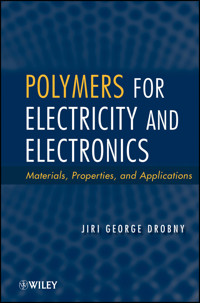
The comprehensive, practical book that explores the principles, properties, and applications of electrical polymers
The electrical properties of polymers present almost limitless possibilities for industrial research and development, and this book provides an in-depth look at these remarkable molecules. In addition to traditional applications in insulating materials, wires, and cables, electrical polymers are increasingly being used in a range of emerging technologies.
Presenting a comprehensive overview of how electrical polymers function and how they can be applied in the electronics, automotive, medical, and military fields, Polymers for Electricity and Electronics: Materials, Properties, and Applications presents intensive and accessible coverage with a focus on practical applications. Including examples of state-of-the-art scientific issues, the book evaluates new technologies—such as light emitting diodes, molecular electronics, liquid crystals, nanotechnology, optical fibers, and soft electronics—and explains the advantages of conductive polymers as well as their processibility and commercial uses.
This book is an essential resource for anyone working with, or interested in, polymers and polymer science. In addition, appendices that detail the electrical properties of selected polymers as well as list additional ASTM and corresponding international testing standards and methods for testing electrical properties are also included.
Sie lesen das E-Book in den Legimi-Apps auf:
Seitenzahl: 444
Veröffentlichungsjahr: 2011
Ähnliche



















CONTENTS
Preface
Chapter 1: Introduction
1.1 Electric Charge
1.2 Coulomb’s Law
1.3 Conductors and Insulators
1.4 Capacitors
1.5 Dielectrics and Capacitance
1.6 Dielectric Polarizability
1.7 Voltage
1.8 Electric Currents
1.9 Resistance and Resistivity
1.10 Ohm’s Law
1.11 Semiconductors
1.12 Superconductivity and Superconductors
1.13 Piezoelectricity
1.14 Pyroelectricity
1.15 Ferroelectricity
1.16 Methods for Generating Electric Energy
Further Readings
Chapter 2: Polymeric Materials
2.1 Introduction
2.2 Polymerization
2.3 Molecular Weights and Molecular Weight Distributions
2.4 Configuration
2.5 Glass Transition Temperature and Melting Temperature
2.6 Solutions of Polymers
2.7 Polymer Compatibility
2.8 Deformation Behavior
2.9 Polymeric Foams
2.10 Liquid Crystals
2.11 Nanocomposites
2.12 Commercial Polymers
2.13 General Technological Characteristics of Polymers
2.14 Processing of Polymers
2.15 Adhesion and Adhesives
Further Readings
Chapter 3: Polymers as Electrical Insulators
3.1 Dielectric Constants of Polymers
3.2 Dielectric Relaxation
3.3 Tangent of the Dielectric Loss Angle
3.4 Dielectric Breakdown of Polymers
3.5 Static Charges
Further Readings
Chapter 4: Specialty Polymers
4.1 Intrinsically Conductive Polymers
4.2 Ferroelectric Polymers
4.3 Thermotropic Liquid-Crystal Polymers
4.4 Ionomers
Further Readings
Chapter 5: Commercial Polymers Used in Practical Electrical and Electronic Applications
5.1 Polymeric Materials Used as Insulators
5.2 Wire and Cable Technology
5.3 Other Applications of Polymers and Polymeric Systems
Further Readings
Chapter 6: Applications of Specialty Polymers
6.1 Applications of Conjugated Polymers
6.2 Applications of Ferroelectric Polymers
6.3 Applications of Liquid-Crystal Polymers
6.4 Applications of Ionomers
6.5 Lithium Ion Polymer Batteries
Further Readings
Chapter 7: Testing of Electrical Properties of Polymers
7.1 Introduction
7.2 Individual Tests of Electrical Properties
Further Readings
Chapter 8: Current Trends and Developments
8.1 Molecular Electronics
8.2 Intelligent Material Systems
8.3 Other Developments and Trends
Further Readings
Appendix I: Typical Values of Electrical Properties of Selected Polymers
Appendix II: Electrical Properties, ASTM Test Methods, and Specifications
Appendix III: Basic Electrical Tests: ASTM and Corresponding International Standards
Appendix IV: Nobel Prize 2000 for Chemistry, Title Page
Acronyms and Abbreviations
Glossary
Bibliography
Index
Copyright © 2012 by John Wiley & Sons, Inc. All rights reserved
Published by John Wiley & Sons, Inc., Hoboken, New Jersey
Published simultaneously in Canada
No part of this publication may be reproduced, stored in a retrieval system, or transmitted in any form or by any means, electronic, mechanical, photocopying, recording, scanning, or otherwise, except as permitted under Section 107 or 108 of the 1976 United States Copyright Act, without either the prior written permission of the Publisher, or authorization through payment of the appropriate per-copy fee to the Copyright Clearance Center, Inc., 222 Rosewood Drive, Danvers, MA 01923, (978) 750-8400, fax (978) 750-4470, or on the web at www.copyright.com. Requests to the Publisher for permission should be addressed to the Permissions Department, John Wiley & Sons, Inc., 111 River Street, Hoboken, NJ 07030, (201) 748-6011, fax (201) 748-6008, or online at http://www.wiley.com/go/permission.
Limit of Liability/Disclaimer of Warranty: While the publisher and author have used their best efforts in preparing this book, they make no representations or warranties with respect to the accuracy or completeness of the contents of this book and specifically disclaim any implied warranties of merchantability or fitness for a particular purpose. No warranty may be created or extended by sales representatives or written sales materials. The advice and strategies contained herein may not be suitable for your situation. You should consult with a professional where appropriate. Neither the publisher nor author shall be liable for any loss of profit or any other commercial damages, including but not limited to special, incidental, consequential, or other damages.
For general information on our other products and services or for technical support, please contact our Customer Care Department within the United States at (800) 762-2974, outside the United States at (317) 572-3993 or fax (317) 572-4002.
Wiley also publishes its books in a variety of electronic formats. Some content that appears in print may not be available in electronic formats. For more information about Wiley products, visit our web site at www.wiley.com.
Library of Congress Cataloging-in-Publication Data:
Drobny, Jiri George.
Polymers for electricity and electronics : materials, properties, and applications / Jiri George Drobny.
p. cm.
Includes bibliographical references and index.
ISBN 978-0-470-45553-1 (hardback)
1. Electronic apparatus and appliances—Materials. 2. Polymers. I. Title.
TK7871.15.P6D76 2012
621.381—dc23
2011026135
To Julia, Joshua, Daniel, Abigail, and Leah
PREFACE
There have been several excellent books published recently that mainly concentrate on the theoretical aspects of polymers for electronics. Therefore an updated publication focusing on the practical side of this subject and complementing it would be very useful. This book has two goals. One is to provide a ready reference for professionals working in industrial practice and the other is as a textbook for advanced students of electrical and electronic engineering, material science, polymer science, and engineering. It will also be useful for educators, attorneys, and marketing specialists.
The introduction concentrates on the basic principles involved with the electrical properties of materials. Chapter 2 covers polymeric materials and focuses on structure–property relationships as well as standard process technologies. The main purpose of Chapter 2 is to cover the basic concepts of polymer science and the technology deemed necessary to understand polymers as valuable materials, which are used in electrical and electronic applications. Chapter 3 covers the specific electrical and electronic behavior of polymers, not only as well-established insulating materials, but also as conductive materials of equal importance. Chapter 4 provides essential information on special polymers, including intrinsically conductive and ferroelectric polymers, and so on. Chapters 5–7 deal with some examples of specific industrial fabrication methods. These methods include examples of formulations (essentially compounding concepts and starting formulations for different applications) and practical applications of polymers and polymer-based materials with their essential measuring methods. Chapter 8 covers current known developments and trends. There are numerous references at the end of each chapter, which may be used for additional information and/or an in-depth study. In addition, a list of recommended publications for further reading on the subjects covered in that chapter is provided. The appendices include a table of electrical properties of selected polymers and lists of additional ASTM testing standards and corresponding international standards. In addition, there is a list of pertinent acronyms and abbreviations, as well as a general bibliography and a rather comprehensive glossary.
Throughout the text, SI units are preferred, although occasionally, other units are also shown (e.g., degrees Fahrenheit for temperature, pounds for weight, pounds per square inch for pressure, and poise for viscosity).
My thanks go the John Wiley & Sons team for bringing this work to fruition: To Jonathan Rose for encouragement and coordination of this demanding project, to Kristen Parrish for production, and to Jeannette Stiefel for meticulous copyediting.
Thanks are also due to the American Institute of Physics, Cambridge University Press, Elsevier Books, Hanser Punlishers, Institute of Electrical and Electronic Engineers, Nature Publishing Group, Panasonic Corporation, Springer SBM, Springer Verlag, Taylor and Francis, and others for permissions to reprint their copyrighted material. The following companies provided valuable illustrations: Arkema Inc., Bayer Material Science, Belden Wire & Cable Co., Davis Standard, LLC, DuPont Company, Energy Sciences, Inc., IBA Industrial, The Okonite Company, Royle Systems Group, RTP Company, and Teknor Apex Company.
Special thanks go to my friend Professor Ivan Chodak from the Polymer Institute of the Slovak Academy of Sciences for providing valuable materials and for his cooperation on many projects related to this publication.
Jiri G. Drobny
Merrimack, NH and Prague, The Czech Republic, April 2011
CHAPTER 1
INTRODUCTION
Electricity is one of the most important parts of modern everyday life. It is used to run product machinery, transportation, communications, medical procedures, military operations, research, and so on. Most of the principles that explain electricity as a form of energy have been known since the 19th century. Scientists like Faraday, Ampère, and Maxwell did most of the fundamental work. Since then, every decade has brought some refinements, new discoveries, and new applications. Polymers (i.e., plastics and elastomers) are very essential materials in electrical applications.
The first known use of a polymeric substance (a natural one at that) as insulation of the first Transatlantic telephone cable was gutta-percha (trans-polyisoprene) in the 1860s. Natural rubber (cis-polyisoprene) (NR) became a very important insulation material after the invention of vulcanization in the late 1840s.
With the development of synthetic polymers, the selection of insulating materials has been steadily growing (Table 1.1). Today, there are dozens of polymers serving as insulators at extremely low and high temperatures, at a wide range of frequencies, in adverse environments. There are special polymers or their compounds that are conductors or semiconductors and exhibit other specialized properties.
Table 1.1 Milestones in the Development of Synthetic Polymers for Electrical and Electronic Applicationsa
Year/YearsPolymer1907Phenolic resin1926Aniline–formaldehyde resins1928Urea–formaldehyde resins1929Styrene–butadiene rubber (SBR)1930Nitrile–butadiene rubber (NBR)1931Polychloroprene rubber (Neoprene)1937Butyl rubber (IIR)Polyurethanes1938Epoxy resinsPTFE (Teflon)Poly(vinyl chloride) (PVC)Polyethylene (PE)1940Polyamide (Nylon)1944Silicones1950Linear polyethylene1951Chlorosulfonated PE (Hypalon)1950s (late)Ethylene–propylene rubbers (EPM, EPDM) elastomersFluorocarbon elastomers (Kel-F)1964Carbon (graphite) fibers1960s (late)Styrenic block copolymers (Kraton)Polyvinylidene fluoride (PVDF)Ethylene–tetrafluoroethylene copolymer (ETFE)Fluorinated ethylene propylene (FEP)Tetrafluoroethylene–perfluoroalkyl vinyl ether copolymer (PFA)1970s (late)Conductive polymersPolyamide-based thermoplastic elastomers (Pebax)Copolyesters (Hytrel)Thermoplastic vulcanizates (TPV, Santoprene),1980sThermoplastic polyolefins (TPO)PolyanilineIodine-doped polyaniline (2000 Nobel Prize)1990s to early 2000sConducting electroactive polymers (CEPs), including polypyrrole, polythiophene, sulfonated polyanilineOrganic (polymeric) light-emitting diodes (OLEDs)2001 to dateOrganic (polymer) solar cellsa Due to the current multitude of projects involving new products and technologies, it is difficult to show exact years for the individual items.
1.1 ELECTRIC CHARGE
Elementary quantity of charge is ±1 e, with the electron carrying a charge of −1 e and the proton +1 e. The unit of charge is 1 C (coulomb); in some cases this unit is extremely large. A more practical unit is the microcoulomb (μC), which is one millionth of a coulomb. The magnitude of the electron charge is 1.6021 × 10⁻¹⁹ C or 1.6021 × 10⁻¹³ μC.
1.1.1 Static Electricity
Static electricity refers to the build up of electric charge on the surface of objects. The static charges remain on an object until they either bleed off to ground or are quickly neutralized by a discharge. Although charge exchange can happen whenever any two surfaces come into contact and separate, a static charge only remains when at least one of the surfaces has a high resistance to electrical flow (as an electrical insulator). The effects of static electricity are familiar to most people because we can feel, hear, and even see the spark as the excess charge is neutralized when brought close to a large electrical conductor (e.g., a path to the ground), or a region with an excess charge of the opposite polarity (positive or negative). The familiar phenomenon of a static “shock” is caused by the neutralization of charge.
Electric charge is an intrinsic characteristic of the fundamental particles making up those objects; that is, it is a characteristic that automatically accompanies those particles wherever they exist. Essentially, many objects contain equal amounts of two kinds of charge: and charge and they are said to be . If the two types of charge are not in balance, then there is a net charge either positive or negative. Charged objects interact by exerting forces on one another. Charges with the same electrical sign repel each other, while charges with opposite sign attract each other.
Lesen Sie weiter in der vollständigen Ausgabe!
Lesen Sie weiter in der vollständigen Ausgabe!
Lesen Sie weiter in der vollständigen Ausgabe!
Lesen Sie weiter in der vollständigen Ausgabe!
Lesen Sie weiter in der vollständigen Ausgabe!
Lesen Sie weiter in der vollständigen Ausgabe!
Lesen Sie weiter in der vollständigen Ausgabe!
Lesen Sie weiter in der vollständigen Ausgabe!
Lesen Sie weiter in der vollständigen Ausgabe!
Lesen Sie weiter in der vollständigen Ausgabe!
Lesen Sie weiter in der vollständigen Ausgabe!
Lesen Sie weiter in der vollständigen Ausgabe!
Lesen Sie weiter in der vollständigen Ausgabe!
Lesen Sie weiter in der vollständigen Ausgabe!
Lesen Sie weiter in der vollständigen Ausgabe!




