


9,99 €
Mehr erfahren.
- Herausgeber: 50Minutes.com
- Kategorie: Fachliteratur
- Serie: Economic Culture
- Sprache: Englisch
Avoid scam investments
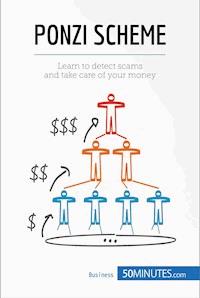
This book is a practical and accessible guide to understanding Ponzi schemes, providing you with the essential information and saving time.
In 50 minutes you will be able to:
• Learn about the inspiration behind the scheme, Charles Ponzi, and how he fraudulently pocketed profits on postage stamps while deceiving his investors
• Follow our advice on how to avoid Ponzi schemes and make the right investment
• Understand why the Ponzi scheme has appeared in all parts of the world right up to today by looking at some more recent examples
ABOUT 50MINUTES.COM | Management & Marketing
50MINUTES.COM provides the tools to quickly understand the main theories and concepts that shape the economic world of today. Our publications are easy to use and they will save you time. They provide elements of theory and case studies, making them excellent guides to understand key concepts in just a few minutes. In fact, they are the starting point to take action and push your business to the next level.
Das E-Book können Sie in Legimi-Apps oder einer beliebigen App lesen, die das folgende Format unterstützen:
Seitenzahl: 26
Veröffentlichungsjahr: 2015
Ähnliche


















Ponzi scheme
Key information
Names: Ponzi scheme, Ponzi pyramid, Ponzi system.Uses: the Ponzi scheme is a fraudulent financial package which pays investors on the basis of funds provided by new entrants.Is it successful? Performance is only guaranteed when new investments are fuelling the pyramid. Its viability is called into question when the incoming funds can no longer pay early investors.Key words:Currency devaluation: loss of value of a currency relative to others. For example, if today one euro is needed to buy one dollar (1€ = $1) and tomorrow the US Central Bank decides to devalue its currency, the dollar will cost less than one euro. Following this logic, for that same one euro, I will receive an amount greater than one dollar (1€ = $1.20). Currency devaluation generally leads to decreasing imports (the country whose currency was devalued will buy less externally, as this will cost more, but it will export more because other countries will be interested in buying its products for lower prices).Financial structure: process under constraints that combines financial techniques in order to reach a financial objective.Foreign currency: the currency of one country compared to that of another.Funds or investment companies: a company which manages and owns portfolios of financial assets (stocks, bonds, etc.). Investors are the individuals who put money into these companies in order to receive a profit, known as a return.Inflation: from the Latin word inflatio (‘swelling’), a generalised increase in prices.Universal Postal Union (UPU): the agency grouping all the world’s postal administrations since 1878. In 1907, the UPU decided to issue universal postal stamps through the creation of international reply coupons. These coupons could be sent anywhere in the world and the recipient who received one of them could exchange it against one or more stamps of a value corresponding to the postage of a letter through international service, in any post office in the country.The Ponzi scheme is named after the world famous scam of Charles Ponzi (Italian-American, 1882-1949) in Boston in the 1920s. After the First World War, the major financial impact of the international conflict largely facilitated the dishonest business.
Many currency devaluations were implemented in the hope of reviving the countries’ economies through exports. These devaluations affected the price of postage stamps, widening the gap between the different national postal administrations.The trend of inflation and rising prices of goods and services was becoming widespread. On the one hand, countries had suffered from considerable human and material losses and on the other hand, they were in debt. Governments were then forced to borrow substantially; interest rates, and consequently the cost of borrowing, increased. The businesses required to produce faced the same reality: money was more expensive, which means that production was also more expensive, while consumption decreased.




