


12,99 €
Mehr erfahren.
- Herausgeber: John Wiley & Sons
- Kategorie: Fachliteratur
- Sprache: Englisch
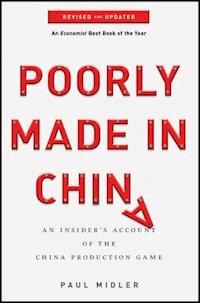
An insider reveals what can—and does—go wrong when companies shift production to China
In this entertaining behind-the-scenes account, Paul Midler tells us all that is wrong with our effort to shift manufacturing to China. Now updated and expanded, Poorly Made in China reveals industry secrets, including the dangerous practice of quality fade—the deliberate and secret habit of Chinese manufacturers to widen profit margins through the reduction of quality inputs. U.S. importers don’t stand a chance, Midler explains, against savvy Chinese suppliers who feel they have little to lose by placing consumer safety at risk for the sake of greater profit. This is a lively and impassioned personal account, a collection of true stories, told by an American who has worked in the country for close to two decades. Poorly Made in China touches on a number of issues that affect us all.
Das E-Book können Sie in Legimi-Apps oder einer beliebigen App lesen, die das folgende Format unterstützen:
Seitenzahl: 465
Veröffentlichungsjahr: 2010
Ähnliche


















Contents
Cover
Half Title
Title Page
Copyright
Dedication
Foreword
Introduction
Half Title
Chapter 1: Vanishing Act
Chapter 2: Trouble Is My Business
Chapter 3: “All We Need Is Your Sample”
Chapter 4: Vice President of Disadvantaged Neighborhoods
Chapter 5: “I Do Now”
Chapter 6: Lurid Carnival of Global Commerce
Chapter 7: And That's a Good Thing
Chapter 8: Grains of Toil
Chapter 9: The China Game
Chapter 10: The Seven Steps of Problem Solving
Chapter 11: Counterfeit Culture
Chapter 12: No Animal Testing
Chapter 13: Joint Venture Panacea
Chapter 14: Take the Long Way Home
Chapter 15: Lucky Diamonds
Chapter 16: Trophy Trash
Chapter 17: “You Heard Me Wrong”
Chapter 18: “Price Go Up!”
Chapter 19: You Wouldn't Want to Be There
Chapter 20: Of Course, You Would Think So
Chapter 21: The New Factory
Chapter 22: Profit Zero
Afterword
Acknowledgments
Copyright © 2009 and 2011 by Paul Midler. All rights reserved.
Published by John Wiley & Sons, Inc., Hoboken, New Jersey. Published simultaneously in Canada.
No part of this publication may be reproduced, stored in a retrieval system, or transmitted in any form or by any means, electronic, mechanical, photocopying, recording, scanning, or otherwise, except as permitted under Section 107 or 108 of the 1976 United States Copyright Act, without either the prior written permission of the Publisher, or authorization through payment of the appropriate per-copy fee to the Copyright Clearance Center, Inc., 222 Rosewood Drive, Danvers, MA 01923, (978) 750-8400, fax (978) 646-8600, or on the web at www.copyright.com. Requests to the Publisher for permission should be addressed to the Permissions Department, John Wiley & Sons, Inc., 111 River Street, Hoboken, NJ 07030, (201) 748-6011, fax (201) 748-6008, or online at http://www.wiley.com/go/permissions.
Limit of Liability/Disclaimer of Warranty: While the publisher and author have used their best efforts in preparing this book, they make no representations or warranties with respect to the accuracy or completeness of the contents of this book and specifically disclaim any implied warranties of merchantability or fitness for a particular purpose. No warranty may be created or extended by sales representatives or written sales materials. The advice and strategies contained herein may not be suitable for your situation. You should consult with a professional where appropriate. Neither the publisher nor author shall be liable for any loss of profit or any other commercial damages, including but not limited to special, incidental, consequential, or other damages.
For general information on our other products and services or for technical support, please contact our Customer Care Department within the United States at (800) 762-2974, outside the United States at (317) 572-3993 or fax (317) 572-4002.
Wiley also publishes its books in a variety of electronic formats. Some content that appears in print may not be available in electronic books. For more information about Wiley products, visit our web site at www.wiley.com.
ISBN 978-0-470-92807-3 (paper); ISBN 978-1-118-00418-0 (ebk); ISBN 978-1-118-00419-7 (ebk); ISBN 978-1-118-00420-3 (ebk)
It is better to know some of the questions than all of the answers. —James Thurber
All war is based on deception: When able to attack, we must pretend to be incapable; When employing forces, we must seem inactive; When we are near, we must make the enemy believe we are far; Offer bait to lure him; If he appears humble, make him arrogant; If he is rested, wear him down; If his forces are united, divide them; Take action when it is unexpected. —Sunzi (the strategist formerly known as Sun Tzu)
The first condition of right thought is right sensation—the first condition of understanding a foreign country is to smell it. —T. S. Eliot
Foreword
It is a long and crooked road that carries the merchandise we consume from the factory floors of China to store shelves in the United States. No maps are available for this road; there are no rules; contracts and agreements are not often honored; there are no police on the highways of commerce. The result of such system defects, not surprisingly, has been a long series of production scandals. Toxic melamine in milk products, poisonous lead paint on children's toys, and numerous other cases have made global headlines. In this vivid narrative, Paul Midler accompanies us down the twisted road of international trade, showing us what is wrong in China today by taking us through numberless, anonymous factories. He introduces us to many of the Western businessmen who have been drawn to China by the appeal of outsourcing. In the process, he reveals the perils of an economy that lacks transparency; he shows us how sharp the Chinese are, and not least, how willfully gullible Americans can be. For me, as a China specialist of more than thirty years, it is one of those rare books amid shelves filled with distorted hype or doom that elicits, “Yes! That's actually what it is like.”
Midler is an agent for hire, a go-between who makes his living by connecting American importers with Chinese suppliers, and he monitors arrangements made in an attempt to be sure something like satisfaction is achieved. American executives have little, if any, appetite for the tedious and opaque transactions, and so his role as middleman, dealmaker, and inspection agent is indispensable to many. Through many years of seemingly mundane negotiations over products like ceramic pots, scaffolding, and architectural hardware (to name but a few of the goods in which he has dealt and which he describes here), he has acquired deep knowledge of China and its export economy.
His insights take us to the heart of Chinese society in a way that few accounts do; they are the real treasure in his book. Midler is at home in China. That, and not somewhere else, is where his life is. His living depends on having a working knowledge of how to get things done in that place, something even most professional China specialists lack. Such a working understanding has not been confined to limited product categories or to the obscure precincts where these certain products can be found. Rather, by its nature, such knowledge must be comprehensive. What works in business works in other areas of life as well, from friendships to politics.
So we must read Midler's book on two levels. At first, Poorly Made in China seems to be an engrossing, picaresque account of his endless adventures and misadventures among merchants, Chinese and foreign, each intent on getting the better of the other. The primary narrative arc here is the author's attempt to manufacture soap and shampoo for American discount store chains. That is not a compelling premise perhaps, but the story has the drama of a suspense novel. The narrative seesaws back and forth, pivoting on minor issues in manufacturing like the mysterious thinning of plastic bottles used to package cheap shampoo. The factory in this case is bemused by its customer's attempts to insist on fundamental things such as consistent product specifications. Meanwhile, the American importer in this tale goes nearly insane worrying that the importation of one faulty piece of product may cost him millions in lost contracts.
As a tour guide in China many years ago, I experienced numerous instances of unscrupulous and frustrating behavior, along the lines of what Midler describes in this book, and I even found myself reflecting on historical references, as well. Analogies can be drawn to government fiscal and monetary arrangements made between foreign countries and China, and even treaty negotiations are of a piece. If you have Midler's concrete knowledge, many mysteries of China can be cracked. If you do not, you will find yourself at sea, drifting rapidly away from the destination you had in mind.
At this second level, Midler's book is not so much a business book about China—though for any trader it is must reading—as it is a description, told through the language of commerce to be sure, of how China as a whole works, with some hard-earned insights about how to navigate its confusing currents and cross-currents.
In this swift narrative, we meet a cast of real-life characters. “Sister” Zhen is the enigmatic owner of the health and beauty care company from which Bernie, a Syrian-Jewish importer from New York, hopes to purchase shampoo and related beauty care products for the discount chains stores of America. Sister is a Chinese woman driven to achieve, and her ambition matches her cunning. She is engaging to know, yet almost impossible to know well. She exhibits tremendous savvy at cutting Bernie's already exiguous margin by introducing last-minute price increases. When her customer points to an agreement already in place, the same tough woman who has driven a brutal bargain is now seen tugging at Midler's sleeve and coquettishly appealing to the deep relationship between her factory and her client's business.
Students of Chinese history may recall the Washington Conference (1920–21), which was meant to resolve a number of security issues in the Pacific. The delegate representing the United States stayed up half the night with his Chinese counterpart, whom he counted a good friend, and tried to reach compromises on numerous issues, only to be excoriated mercilessly the following day in the general session as a blood-sucking and duplicitous imperialist. Progress was somehow made in the talks and some rather good treaties were actually signed, but it is remarkable how these two opposing approaches somehow coexisted in Chinese negotiations. Midler does an excellent job of revealing these cultural nuances, and his book provides lessons for all who deal with China.
In this book, we meet many American businessmen driven by greed but limited by their naïveté. Arriving in China, they know nothing except what they have heard, that it is the place to be, and, softened by China's red-carpet treatment, they reflect numerous hollow clichés on modern China: this is the world's fastest growing economy; this is the future; our company must expand here or else it will perish—and perhaps most importantly of all, that doing business in China is easy. There are no pesky unions or state regulations to speak of, after all; the barriers to doing business are surprisingly low. You talk directly with the boss, shake hands, and the deal is done. As if by magic, your company's catalogue is suddenly filled with new and astonishingly inexpensive merchandise.
This is fantasy, of course, and it is the sort of mirage shared not only by businessmen, but also by politicians. President Richard Nixon and his adviser Henry Kissinger knew next to nothing about China, but nevertheless assigned it a central role in their diplomatic strategy. All seemed to go well on their first visit to the Middle Kingdom: the Chinese fascinated their foreign visitors with a seeming sophistication and factual command. Rough spots were there, of course, as when Nixon presented to Chinese leader Mao Zedong his hope for a panoramic view of the world, considering not only the bilateral relationship between the two countries, but also dynamics involving India, Japan, the Soviet Union, and all powers in between. Mao slapped Nixon down, suggesting that his idea was boring and unimportant. Expectations of the two sides in these landmark talks were clearly different, and so diplomatic documents agreed upon then were necessarily kept vague, to the point almost of meaninglessness. The relationship between Beijing and Washington has been as complex and strained as the relationship between U.S. importers and their Chinese suppliers.
The Chinese display extraordinary skill at manipulating foreign perceptions and feelings, as we see in this book, and they also play on foreign apprehensiveness on the issue of raising meaningful questions. When visiting the shampoo factory for the first time, Midler is put through a rigmarole of careful hand washing, the donning of sterile scrubs and caps, and so forth, before going on to the factory floor. It is all very impressive, professional looking, and confidence inducing. Midler instinctively holds his tongue on his maiden tour, and later learns that once the contracts are signed and funds have been transferred, these rituals fall by the wayside and are no longer practiced. Midler's book is in part an awakening to the realization that so much of what goes on in China is façade. Through a business fable that entertains and educates, he allows us to see past that front.
I remember once accompanying a former speaker of the House of Representatives on a trip to China. Though I thought I had seen it all, I have never experienced such elaborate courtesy. Our chauffeured vehicles were preceded and followed by police cars complemented with flashing lights and sirens. It was an empty display, yet it did wonders for the egos of those who were in our entourage.
On the trip, specially designated gates were opened on certain streets, so as to allow us the chance to inspect immaculate precincts of a “peach blossom spring,” or Chinese Eden. These were picture-perfect quarters undreamed of by ordinary Chinese citizens. They were party compounds reserved for the elite. The lawns inside the compounds were impeccable; soothing fountains played; our rooms were cool, quiet, and equal in comfort to the best that the West has to offer. Our hosts seemed to anticipate our every wish; the food was magnificent. Yet what did we really see of China?
Cocooned in such hospitality, it was not surprising that the American delegation proved docile. Questioning was softball, with all of us visitors feeling the onus not to spoil things by embarrassing our hosts. The only rough spot in the official visit came when I posed what I thought was an interesting question to the foreign minister. Mongolia, I pointed out, is a possession of the former Qing dynasty (1644–1912) that China now recognizes as an independent state. At the same time, Taiwan, which the Qing held only briefly and partially, is hotly argued as belonging absolutely to China today. How do we explain this seeming contradiction?
The foreign minister became angry and dismissed my question as being without merit. I felt a tinge of guilt for having ruffled feathers on the trip, but then I thought: What are high officials supposed to do if not answer difficult questions? The rest of the group believed that I had overstepped the bounds of good manners, but make no mistake–the minister had understood me exactly and later sent a colleague, who spent more than two hours, trying to explain the political point.
This sort of incident is typical of so many Sino-American interchanges, whether the issues be about dollar-store shampoo or national security. American delegations feel obliged to constrain questioning and to tip toe around the very issues they should be discussing. Politeness is all well and good, but what does an inherent lack of openness say about the hope of increasing economic and political ties between the United States and China?
One of the more disturbing aspects of this book is evidence of companies not delivering on the promises they make. Chinese contracts are subject to indefinite renegotiation, as anyone knows. American buyers who expect their product to be manufactured properly find that their samples are taken only as rough guides, or suggestions. Manufacturers make unilateral changes to the goods without discussion and hope that no one will notice. At one point in the story, after the shampoo factory unexpectedly alters many of the contracted fragrances to a generic almond scent and is caught, Sister offers nothing but ingenuous excuses about how to her the cheaper substitute seemed to smell all right.
I once renovated a bathroom in a rambling Edwardian house in the city of Providence, Rhode Island. I strove to reconstruct features as they would have been when the house was built. As a part of the project, I installed a complex brass bath faucet and shower nozzle, with period black-on-white enamel labels (for “hot” and “cold”). The apparatus, which was made in China, had been masterfully copied in the correct style, but I suspect it must have been the ruin of any number of American and British plumbing suppliers. All worked fine for about six months. Then the faucet assembly began to fall apart—the shower hose unraveled, the valves became loose, the whole thing just went to pieces. The product had been “poorly made in China.” Its eventual replacement was a characterless, late-twentieth-century American fixture, which spoiled the effect I was seeking, but at least it delivered a good bath.
This book is not merely about faltering product quality out of China. One of its broader themes is of people who promise one thing and then deliver another. This is a book about Chinese obfuscation and subterfuge. It is about gaming, strategy, and tactics.
It reminded me of many important issues facing U.S.-China relations, and in particular it had me recalling the year 1982 and the negotiation then of U.S. arms supplies to Taiwan. The key to the talks then was the claim by the Chinese that their “fundamental” policy toward Taiwan was to remain peaceful towards the island. The American side took this as a renunciation of force and agreed to limit future arms sales. Had the U.S. side understood the Chinese language better, they would have realized that, in Mandarin, a “fundamental principle” is typically meant to suggest the preface to an exception. Like the French en principe, the Chinese statement that “fundamentally” something is held as a value is not so much meant to assure as to hint at what rule is about to be broken (owing to special circumstances, naturally). And just look at what China has done. Although the nation's policy is supposedly peaceful, China's arms buildup in recent years has been without precedent in scale and scope.
The prognosis for a rising China may be negative, but this is not necessarily a negative book. Midler clearly has a deep, if indirectly expressed, affection for China and its people. No one can attain an understanding of such a complex culture without an affinity for the place. Midler has lived in China for many years; he gets around easily in the language, and in fact he has no other home. Nor, it seems, does he want another. With his graduate training at an elite business school, he could have become a financier on Wall Street. His many years spent preparing himself for a career in China might have been applied toward subjects such as chemistry and biology, and with the same time spent he might have made a contribution to science instead. But he settled on a path in China, and by doing so he has made it possible for us to understand the place just a little better.
One can learn a lot about how the whole of China works by mastering one corner of it, for institutional and behavioral patterns do not change much whether your workplace is a cruise ship for tourists or a factory that makes shampoo and similar products. Knowledge and instinct are transferrable. That is why I hope this book will find an audience, not only in the business community, but also among diplomats, scholars, and others dealing with China, as well as among ordinary people who want to know what China is really like, at ground level.
Arthur Waldron Lauder Professor of International Relations University of Pennsylvania Bryn Mawr, Pennsylvania
Introduction
This book started as an article written for the Wharton School of Business during the quality crisis of 2007. This was the year in which pets were found poisoned with melamine, tires made in China began falling apart, and American parents worried about lead paint in their children's toys. The piece that I wrote was in part a rebuttal to the claim made then that U.S. importers were somehow to blame for failures of products coming out of China. Having worked with Chinese manufacturers for many years, I had a slightly different understanding of the situation. The way I saw it, American companies were doing the best they could, but they were no match for savvy Chinese industrialists who often went out of their way to manipulate product specifications to widen profit margins.
Chinese factory owners played games. They delivered customers a quality product at the start of a project and over time withdrew key ingredients (or else they substituted inferior inputs for quality ones). Changes made to merchandise were never announced, and alterations were typically imperceptible to buyers. The incremental degradation was subtle and continuous, and importers had no idea what was being done until the products they represented failed. I called it “quality fade,” and it was meant to be a partial explanation for why quality seemed to be heading south all at once, and across so many sectors.
Outside of China, few knew that this sort of thing went on, and much of the response from U.S. readers of the article was genuine surprise. But those who worked in the industry knew better, and insiders suggested that I hadn't gone far enough. “Your stories about quality out of China are nothing,” I was told. “You should hear what happened to us!”
The disparate responses to the article—the confirmation from industry types on one end and the incredulity on the other—led me to believe that an expansion of the original piece might be worthwhile. I'd never written anything longer than an article before; nevertheless, I was offered a book contract. The more I wrote, the more I realized there were other things to say on the subject of China in general.
The book you hold in your hands is little more than a few stories, anecdotes collected from a career spent in a foreign country. Work episodes were chosen for their entertainment value; at the same time, I was careful to select scenes that I thought were representative of the experience.
It may be worth noting that when I first arrived in China, I had no preconceived notions. At the outset I was, in fact, something of an optimist. Over time, though, certain experiences caused me to develop other opinions, and I eventually found a framework. When I set out to write Poorly Made in China, my thinking went like this: If I could show some of what I had seen, perhaps others might also arrive at the same place.
When asked to summarize this book, I tend to take the easy way out by suggesting it may be simply about how culture matters. Culture can impact an economy's macroeconomic development—China's rise has undoubtedly been helped by certain cultural elements—and, on a smaller scale, culture (and the understanding of culture) can facilitate or impede success at transaction level. The book at the very least helps dispel a notion promoted by some that doing business in China is like doing business anywhere else in the world.
One complaint that I've heard voiced about this book is that while it highlights a number of problems related to China, it doesn't offer any solutions. I find it curious that some are willing to accept a book on a cultural theme only as long as it comes prepackaged with answers from the author. No matter what problems China faces, or what problems the rest of the world must now deal with, we can't arrive at solutions except through dialogue—and we can't have meaningful dialogue before we have some basic understanding of the issues. This book might be seen as little more than an introduction. It was never meant to be a final word of any kind, but a beginning.
Chapter 1
Vanishing Act
China manufactured everything in the world, and along with it, every imaginable smell. Walking through its many factories, you could catch some of those smells: the heady fumes from adhesives used to make leather shoes, the nutty scents of ceramic vases as they were baked in gas-fired kilns, the sour notes of polypropylene plastics as they melted and were injected at high temperatures. Each manufacturing process was its own olfactory experience, and if you worked in export manufacturing long enough, you might be able to guess the kind of factory you were standing in by using your nose alone.
During the years I worked in South China, I visited more types of factories than I ever imagined could exist. Oddly enough, while the impact on the senses was strong, occasionally bludgeoning, I rarely met a factory owner who was bothered in the least by the smells.
At one sinus-punishing factory, I stood at the gates with the boss, looking out over a field blanketed in a white haze. Some distance behind us, workers were dipping stainless steel tubes into a chemical bath. It was a nickel-plating process. I could actually taste the metal in my mouth, and my nose involuntarily wrinkled.
“Hao chou,” I said. “What a stink.” As soon as the words left my mouth, I regretted making the comment, though I half expected the factory boss would agree.
He tossed away his cigarette and turned in my direction. “You foreigners,” he said. “You come to China and complain about the pollution, but I don't know why.” He then gestured at the blurred landscape around us. “To me, this place smells like money.”
For many in China who dreamed of a better life, those winds of industry correlated with better economic opportunities, and the poorer corners of China, the ones that smelled fresh or of nothing much at all, were not envied, but pitied.
Wherever my factory work took me, I always paid attention to the various odors, mainly because of my first project. The factory made what the Chinese called daily use chemicals—consumer products like soap, shampoo, and hand creams.
The factory, King Chemical, was located in the countryside, at the foot of a large hill. Heading toward the plant on a bright, sunny day, with the fragrance of health and beauty care products filling the air, I thought: so, this is what a sweatshop smells like. The sweet and floral fragrance was immediately recognizable. You smelled it at the bank and at the grocery store, everywhere really. It was the common scent that perfumed soaps and shampoos across South China.
The factory was run by a small, attractive woman who insisted that I call her by her nickname, Zhen Jie.
It was a familiar term—Zhen was her last name, and Jie signified her as an “older sister.” She said that she had the workers call her by this name because she wanted to be seen as someone that her workers might look up to and admire.
“Sister” Zhen explained that her husband could not join us on the tour because he was out of town on business. Instead, a small entourage of managers came along.
“Here. You must wear this before we go inside.” She handed me a white lab coat and gave me cloth coverings for my shoes, making sure that I put them on before slipping a pair of coverings over her black, high-heeled boots.
These precautions were all about maintaining a hygienic environment, Sister explained. Chinese manufacturers did not commonly concern themselves with cleanliness, but it was a critical concern in the health and beauty care industry. Hygiene had also come up in my conversation with Bernie, who had sent me on this unusual assignment.
Before identifying this one company as a supplier, Bernie had tried to manufacture his product line in another location with disastrous results. A large shipment was contaminated with bacteria, resulting in significant losses to his company. This sort of thing, he warned, could not happen again.
The rituals of preparation created anticipation, and I was anxious to get onto the factory floor. Through a glass window, I could see most of what awaited. The place was busy, and I noticed that the workers inside were also dressed in white.
We washed our hands next. The managers who joined the tour lined up at a row of sinks. They took turns at the basins. In their white lab coats, scrubbing all the way up to their elbows, they looked like a team of doctors heading into surgery.
Scrubbed up now, I took a step toward the door, but a hand stopped me. Someone plonked a white cap on my head. In a final dash of ceremony, the doors to the plant were flung open and held wide while we passed through.
The factory was a hive of activity, and as someone not familiar with this kind of operation, I strained to grasp how things worked. The workers were busy making a hand lotion, I saw, and I watched as pink bottles moved down the assembly line. Some workers filled the bottles, while others either capped them or wiped them down. I asked if I could take a closer look at the finished product and was handed a bottle from a packed carton. The printing on the bottle was in Chinese. The company manufactured health and beauty care products for the domestic market. Bernie's company was going to be its first export customer.
As we walked down one assembly line, heads that were already bowed low bent further at our approach, the pace of work noticeably quickening. Wherever we hovered, workers seemed to hold their breath. Everyone in our small entourage was either oblivious to the fact that we were causing the workers to become anxious, or else they did not care.
I watched one young woman with short hair take a bottle off the conveyor belt. She wiped it down in an almost obsessive fashion and refused to pass it along until she had another in hand to replace it. I tried to make eye contact with the workers, but none would allow it. Even those who were less flustered by the tour seemed conscious of being observed.
One worker, who screwed caps onto bottles, did so with an added flourish. Next to her stood a worker whose job it was to place the bottles into cardboard cartons. Instead of tossing the bottles into the box, she was cradling each with two hands—almost in the same respectful manner that the Chinese offer a business card.
The man who had asked me to make this visit was an importer who knew only that I lived in China. We had met in passing and only once; I received his phone call out of the blue, and his instructions to me had been vague.
“Have a good look around,” Bernie said. He wanted me to remark on anything that seemed out of the ordinary. Not noticing anything so unusual, I pretended to have some questions.
“How many workers do you employ?” I asked.
Sister nodded as if it were the right question.
“Two hundred,” she said.
I had not counted, but there seemed to be fewer than that many workers around. “When did the workers take their breaks?” I asked next. Sister said that they broke for lunch and dinner. I asked how many days off they got each month. She said that most got only one day off every other weekend.
Running out of questions, I told her that the factory was impressive. Sister complimented my Mandarin and said that Bernie was lucky to have found me. She hoped that we would work together beyond the one visit, and she went so far as to suggest that there was much she could learn from someone like me. While new to the world of manufacturing, I had already lived in China for a number of years, and this much at least I understood about the place: when you said nice things, you received unbounded compliments in return.
So much of the factory work was done by hand and, I noticed, sometimes by foot. We walked over to a station where hand cream was being pumped into bottles. The machine had been set up so that its operator could activate it by a pedal on the floor. When triggered, a pressurized squirt nozzle filled the bottle with formulation. The worker who sat at the station did not seem very good at the timing involved though, because the front of her uniform was covered in lotion—presumably from missing her mark.
I paused for a moment and watched more closely as the worker filled bottles. It seemed that she had been recently trained because there was something missing from her performance. It was more than nerves, I thought. It was as if she was doing the job for the very first time.
Just then, I felt the pressure of a hand at my elbow. It was Sister indicating it was time to leave.
This gesture of hers was a bit forward, I thought, but instead of misinterpreting the squeeze as something personal, I took it for what it was—a desire to end the visit. I had flown from another city to visit this factory, and the tour had not lasted very long at all. I had the feeling of coming off an amusement park ride that had ended too quickly. No sooner had I begun to get a sense of the factory than the exit doors were opened and we were again standing in sunlight.
“We will take you to the airport,” said Sister.
She then brought me to a waiting room near her office, and I was given a cup of instant green tea. After sitting in the waiting room for a while, I wondered whether I had been forgotten. Workers came and went, and no one paid me any mind. I looked over my notes and realized that I had few impressions, none of them well formed. When someone came along to tell me that the driver was running late, I took it to mean that they were not sure where he was.
Still curious about the factory, I thought I might go back to have one last look. No one would probably even notice that I had gone, and maybe there was something to be gleaned from seeing workers when they were less self-conscious about being watched by their managers.
The factory was just behind the office and up a small incline. There was no one outside, only the sound of a slight breeze coming down the hillside. It was a peaceful and bucolic setting. I thought if this factory visit turned into some kind of regular assignment with Bernie, I wouldn't mind.
When I got to the plant, I went over to a window and pressed my face against the glass. For a moment I figured I might have been lost.
Was I at the wrong building?
I looked through the window again. It seemed to be the right place, but the factory was deserted. Where before there had been around 50 or 60 workers, now there was only an old man with a broom in hand. He spotted me at the window and started toward the front door, as if to let me in, but then he did a rethink, turned, and hurried out a rear door instead.
What in the hell is going on?
With my forehead near the glass, I glanced down at my watch. It was just past three. Chinese factories did not have the tradition of an afternoon siesta, and Sister had already mentioned that the factory broke only for lunch and then at dinnertime.
I heard the sound of heels clicking on the pavement behind me. What at first seemed like not such a bad idea was quickly turning into a situation. I felt guilty all of a sudden, as though caught doing something illicit, putting my nose in where it didn't belong.
What excuse could I possibly offer, and how would I address the matter of what I was seeing—or, rather, what I was not seeing? Out of sheer embarrassment, someone might have to get upset about me wandering off.
The sound of fast-approaching heels grew louder until it was no longer possible to act like I could not hear them.
Clack-clack-clack-clack.
I turned around, expecting the worst. Instead of an angry expression, Sister was forcing a smile, one that widened as she approached until it appeared more like a wince. She reached me slightly out of breath.
“The workers are resting,” she said.
It was a conversation stopper, like when someone in America said they were off to run an errand. You weren't meant to ask what kind. The very notion of rest was sacrosanct in China, and then saying something like that to a foreigner gave it an additional weight. Chinese have worked hard for thousands of years. If someone said they needed a breather, no further explanation was necessary.
“Let's go back,” Sister said and quietly led the way.
Trying to process what had just happened, I felt as though I had been to a magic show and seen a large elephant disappear. Where the workers had gone was a mystery. They were nowhere to be seen, and there was nothing to do but rub my eyes and wonder how—or why—it had been done. How could a factory be in full swing one moment and gone the next?
That evening, I telephoned Bernie. I was apprehensive. Surely, nothing like such a vanishing act ever happened in America, and telling him about it would probably only succeed in making me appear foolish. At the very least, it would make me the bearer of bad news.
I decided that I would report on the factory visit—but only in a general way. There were other details to provide. I would tell him all about the visit, but I would leave out the last part since I was not supposed to have seen it anyway.
“Did they seem busy?” he asked.
It was just about the only thing that he was interested in discussing—the general busyness of the place. I decided to tell him about the very end of the trip in detail. He not only believed what happened, but he laughed about it. He had been to the factory himself several weeks earlier and suspected that a similar show had been put on for him, as well.
He was not at all worried. Quite the opposite, he said that what I was reporting was good news. I told him I didn't understand. What happened earlier that day troubled me, and I thought: Any factory that was willing to go to such great lengths to pretend it was busy probably had a few other tricks up its sleeve.
Bernie did not see it that way, though. He figured if business was that slow and they were trying that hard, then it would translate into favorable pricing for his company.
It was interesting to me how Bernie viewed things differently than I might have. He saw what the factory had done as somewhat flattering. If they were so motivated, he might also benefit from the company's undivided attention, which might also mean better quality.
“Tell me, was the warehouse full?”
“The warehouse?”
Bernie had not specifically asked about the warehouse before my visit, but it had been a part of the tour. I told him that I remembered it being rather empty.
He asked me to estimate the number of pallets, and I told him that there could not have been more than 50 or so.
“Fantastic,” he said. “They're desperate for my business.”
Chapter 2
Trouble Is My Business
After graduating from business school in 2001, I returned to China, the place where I had already spent the majority of my career. One reason for feeling drawn back to the place was personal—I was at home in Asia—but there was also a business reason. The global economy was experiencing a tectonic shift, and China's economy was growing like no other. By being there, I felt that I was placing myself at the center of a unique, perhaps even historic, time and place.
I had studied Chinese history and language as an undergraduate, and while working towards an MBA at Wharton, I picked up an additional degree in East Asian business. It seemed natural that I would return to China. I had worked there for a number of years, and I even spoke the language. While my background should have prepared me for what was happening in export manufacturing, my first real glimpse of the sector suggested that I was in uncharted territory.
Exports contributed significantly to the Chinese economic miracle, and yet, none of the courses in business school or informal discussions had been about this interesting and important part of the new economy. My classmates had gone off to pursue traditional careers in investment banking, management consulting, or private equity. Coming from a finance background, I had nearly gone down a similar road myself.
I wanted to settle in South China, where manufacturing was concentrated, and I was looking for any excuse to get involved. Lucky for me, I didn't have to look all that far.
As little as I knew about the production landscape, there were many others who knew even less. Small and medium-size American importers were streaming into the marketplace, and I was recognized as someone who could help them with their businesses.
American importers contacted me, but typically, they only did so after their projects had begun to fall apart, after they had tried and exhausted other options. One reason they waited to ask for help was hubris, but also, as I would later come to understand, Chinese manufacturers were in the habit of making things look easy.
In any event, importers who contacted me were often at the end of their rope. They were desperate, and at times I felt like Philip Marlowe from one of Raymond Chandler's detective stories. I had no office with a pebbled-glass front door, but clients made their way to me in a similarly random manner. They were looking for help navigating China's “mean streets.”
China was, to borrow a phrase, a world gone wrong, and the work was easy to get; it was just lying around. I had no real job description. I took care of things that needed handling. Typically called on after everything had unraveled, I was asked to put things back on track, to smooth things out, to make things right. Clients called and kept the details to themselves. “I got a job for you,” was how it usually started, and without realizing it, I was soon knee deep in it. Trouble was my business.
I didn't know how long I would work these projects, but I figured it would be a while. My plan was to take whatever work came my way, and rather than deal with one or two large companies, I would assist a larger number of small and medium-size importers. The idea of diversity held some appeal because I was trying to give myself an education.
By getting involved with smaller companies, I could gain from a broader experience involving varied industries. I would have more data points, as it were, and this would offer a better sense of what was going on in this enigmatic, but important, part of the global economy. Perhaps at the end of it all, I figured, I might even draw a few conclusions.
After the soap and shampoo project kicked off, I received a call from Howard, a businessman who dealt in home furnishings.
Howard had a project that had gone swimmingly for a number of months, but then his supplier had gone incommunicado. He had never actually been to China himself, which added to his panic, but then he had never felt the need to go there. The business had been effortless. Then, one week, when he was about to place an order, the manufacturer vanished. Howard could not get anyone to return his phone calls or his email messages. This one was a missing persons case.
South China manufacturers, for whatever reason, had an aversion to the telephone. They were not particularly good with written forms of communication either. Given the incredible volumes of business these factories were doing with foreign importers of China-made goods, it was a particularly inexplicable quirk.
Howard thought the worst when his supplier could not be reached, but I told him not to worry, not just yet. It took a few tries, but eventually I found Kevin, the owner of the company. While I had succeeded in getting Kevin to the phone, he remained apprehensive and would not offer information regarding Howard's case.
At Howard's insistence, I asked Kevin if it would be all right if I stopped by his factory.
“Be my guest.”
“How about Tuesday afternoon?”
“Just call me when you're in town.”
“But it's a two-hour drive. Do you mind if we say Tuesday?”
“Give me a call when you arrive.”
It was another one of their endearing habits: manufacturers in South China didn't like to set appointments either. They preferred to be spontaneous. They didn't like to commit to anything. Getting pinned down to a specific time and place meant that an industrialist might miss out on a more important opportunity. It meant the possibility of regret.
I hired a car on a Tuesday and traveled to the factory, which was near the city of Chaozhou in the eastern part of Guangdong Province, just a couple of hours from the shampoo factory. My driver, who was from Henan Province, had to stop several times to ask for directions, and each time he did, a big cloud of yellow dust caught up with us and covered the taxi.
China was home to a number of manufacturing clusters, and Chaozhou focused on the ceramics trade. It was said to have been a center for ceramics for thousands of years because of something to do with the soil in the area. As we drove into town, I noticed that many of the small shops had considerable amounts of fine-grained sand piled up in front of or off to the sides of their places of business.
Typically, factories in South China were built along major roads, but the way to Kevin's factory was down a narrow lane. His place was built like a fortress; instead of the standard accordion-style metal gate that fronted most plants, his had a high brick wall and a gigantic steel door at the entrance. I found the doorbell and rang it. Dogs started barking and kept at it until someone came along and hushed them.
Kevin was much friendlier in person than he had been on the phone, and he apologized to me for the long drive. He asked if I had any trouble finding the place. He introduced himself next, saying that he was from Los Angeles.
“You're American?”
“No. I'm a Chinese.”
“You moved to the United States?”
“No,” he said.
He enjoyed the exchange and told me about Los Angeles with a sly grin on his face. I told him that I was confused. From what he explained next, I was able to gather that he had only been abroad for pleasure—and not on many occasions either. His accent indicated that he was local Chinese, and he confirmed that he had never actually lived in Southern California.
I asked him why he called it home, and he only offered in a dreamy tone, “I love Los Angeles.” It was hard for anyone who never spent much time in China to understand the extent to which intention could be mistaken for reality there.
Kevin's factory made pottery, and the kind most commonly produced was a faux Italian style that might have been vaguely antique looking, if only it had not been so vividly colored and glazed. Pieces were just coming off the production line, and Kevin showed them to me. One had the word “Italianate” incorporated into the design. Looking around at his factory, I gathered that this new style was suddenly popular in the United States.
We worked our way backwards through the processes at the plant, moving from the area where the pieces were finished to the section where workers were painting the dried pots by hand. The operation was paint by numbers. Girls who appeared too young to work sat at wooden benches and patiently dabbed away with long brushes. I took a closer look and could see that each piece of pottery had an outline. The workers kept paint in small bowls, or in some cases, shallow dishes similar to those used in Chinese calligraphy, working with no more than a few colors at a time.
The workers all sat on either side of a long table, one row of girls facing another. They worked quietly and at a leisurely pace, and I thought that the workroom had the feel of an art class.
Off in a corner—away from the girls at the long tables—was a skinny boy who held a scalpel in his hand. We stopped for a moment and watched as he used the instrument to carve up a block of yellow foam. Having cut away a small piece, he blew off the synthetic crumbs and tested his work by dipping the block into an ink tray. He then pressed the block against a large sheet of paper, revealing the outline of a floral decoration.
“This is the hardest job in the factory,” Kevin said. “Not everyone is accurate.”
The foam blocks were used as a stamp to outline the designs that would be painted on the pottery pieces, and the images had to be created in reverse. It was impressive, and I started to remove a small digital camera from my bag. I thought sending pictures back to Howard might be a good idea. “Sorry,” Kevin said. “Pictures are not allowed.”
Kevin was protective, as I would soon understand. He took me to his office and asked me to have a seat. On his desk were two computer screens from which he could see the entire factory floor. I took an interest in the system, and with the controls, he showed me how he could change the camera angles and zoom in or out.
He said it was important for him to stay on top of the workers, and he explained that his employees were not allowed to leave the premises. Many factories had such policies in place, but Kevin went even further by holding the identification cards of his employees for additional protection.
“Why all the security?” I asked.
“We have many secrets,” Kevin said.
There were other things that he did to maintain control. He explained that in his factory, no more than one-fourth of the workers ever came from a single province. When too many workers came from the same place, he said, groups were more willing to conspire.
Another trick of his was to hire more workers than necessary. When there was enough work for everyone, the workers felt that they were needed and were more inclined to make demands on management. When there wasn't enough work, employees tried harder to prove their worth.
Kevin asked me to follow him to a showroom. The styles of the pottery pieces there did not match. While some of the pieces struck me as American in style, others seemed more European or possibly even Middle Eastern. The mix of styles made the factory's collection of samples look something like a rummage sale.
A delivery was in progress, and Kevin turned his attention to the arriving workers. There were three of them, and they carried in a number of samples that included vases as well as lamps. Kevin was drawn to one object, a brass-colored lamp. He inspected it immediately and then moving its tag out of the way, he took a picture of it.
I asked Kevin if the delivery workers were his employees.
He gave me a mischievous look. “No, they are my spies.” As he said this, he looked at me carefully, gauging my reaction as he had done earlier when he told me that he was from Los Angeles.
Kevin explained that he had all sorts of people combing the area for samples. There were so many factories all clustered together that it made such activities possible. I imagined that workers on the inside of some factories might have snuck out samples for a small fee, or maybe the samples were taken right off the trucks before they left for export.
New designs were valuable to Kevin. If he saw a design that he liked, he took a picture and sent it off to his customers. If an order was placed, he could consider asking another factory to produce it or he could simply copy the product himself. He was not all that interested in producing electrical items, he said, so the lamp was something he would outsource.
I had never met anyone quite like Kevin. He was charming, in a devilish way, and he was of a sharper breed than most. He was defensive in keeping his workers behind a high wall—because he did not want his secrets leaked out—yet he aggressively sought to acquire the secrets of his competitors.
Copying was rampant in China, and this made manufacturers behave in strange ways. One manufacturer that I ran into produced shoes with designs “borrowed” from Europe. In China, the company worried that competitors would rob them of these newly acquired designs. Factory employees were given the chance to buy a pair of the shoes they made (at a discounted rate), but they were not allowed to take the shoes out of the factory for a full year—not until that shoe's design was more generally known to the marketplace.
In China, Kevin's behavior was understood, and most people would have said that he was wise to be cautious. And for aggressively seeking out the original designs of others, some would have called him clever.
What did his factory sell anyway but sand and water covered with paint and glaze? Any number of factories in the area could have made the same product at the same price, if not for less.
As it turned out, the problem with Howard, my frantic client, was that he had no proprietary designs of his own. Other importers from the United States were sending over interesting new samples, and Kevin was anxious to get hold of those.
Kevin said that he would like to help Howard, but that he was in a tough spot. He could not sell proprietary designs that came from American importers to others who were also from the United States. He would not say so, but I had the feeling that some of those designs might be available for sale, if only Howard had been from another market instead.
In the end, Kevin said that he could only provide Howard with product from his warehouse. Some of the designs were out of date, but they would suit Howard's product line. “What choice do I have?” Howard asked me. “I'm running out of stock.”
I inspected the pottery on a later visit, and based on the amount of dust on the pieces, it looked as though they had been in the warehouse for two or three years. The items had all been made for other importers, and on the bottom of the pieces were bar codes made for specific retailers. One was for TJ Maxx, a major retail chain. If these styles were no longer in fashion, I thought, then TJ Maxx might not mind that they were being sold by their China supplier, but then what was the benefit to a customer like Howard if he purchased out-of-fashion merchandise?
The worst part about the pottery that Kevin wanted to sell was that the prices listed were high. An importer like Howard should have been paying about one-fourth of retail, but he was paying closer to 50 percent. Howard was probably paying more than what he would have paid if TJ Maxx marked the product down in an end-of-season closeout sale.
Importers that provided original designs were quoted low prices by Chinese manufacturers. They were offered a bargain in part because smaller importers paid more. Watching as some of Kevin's factory workers packed up boxes for Howard, I noticed that some of the pieces were even defective, and I had an uneasy feeling about Howard's business prospects.
Howard was disappointed, but resigned. He did not have the volume to justify hiring someone to design original pieces, and therefore, he felt at the mercy of the manufacturer. Howard also reiterated that he was in a hurry and that he needed to take whatever he could get.
We loaded Howard's product and shipped it overseas. Another few shipments later, Howard ran into trouble.




