


25,99 €
Mehr erfahren.
- Herausgeber: D'Ermes Gennaro
- Kategorie: Fachliteratur
- Sprache: Englisch
Usually, those who enter the world of Project Management gets immediately passionate about the subject and starts to make assessments on how to carry out the profession of Project Manager, which skills are needed, what studies could help and in which sectors a Project Management methodology is used, which potential could have the P.M. profession and which are the difficulties.
This introduction to Project Management intends to increase students’ personal skills and to enhance their employability in the world of work. The project management methodology provides skills in planning, managing risks, resources, time and costs, as well as transversal skills useful to identify priorities, distinguish a project or process into phases, activate a process of planning and control of activities in order to achieve the objectives on time and, last but not least, it helps to develop the ability to work in a team. Furthermore, Project Management can develop or expand better problem solving and business skills and also a strong managerial mindset.
This Project Management course enables students, or participants in general, to organize their work with a view to achieving an objective, whatever the type and complexity, in a way that ensures the achievement of the expected benefits.
The book is divided into 3 modules:
1. The first module is a good introduction to Project Management dealing with the fields of application, the relative professional figures and the areas of knowledge touched by Project Management.
2. The second module is about the project, touching on the organization, causes of failure and risks associated with a project and their management.
3. The third and last module is an illustration of what comprises an entire project management and thus its life cycle until closure.
The explication of the topics in this book takes place directly and with practical examples in order to allow the reader to better fix the contents. I always say:
“It’s the book I wanted to read before starting in project management”.
Das E-Book können Sie in Legimi-Apps oder einer beliebigen App lesen, die das folgende Format unterstützen:
Veröffentlichungsjahr: 2021
Ähnliche



















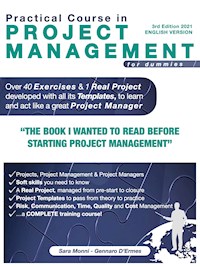
Practical Course inProject Management - for dummies -
Over 40 Exercises and the development, like a great Project Manager, of a real Simple Project with all its Templates
“The book I wanted to read before starting project management”
What’s a project and project management
Which soft skills you need to know
Read and Study a real project, managed from pre-start to closure
Pass from theory to practice through the project templates
Complete the over 40 exercises
Learn Just like a COMPLETE training course!
3rd Edition 2021
ENGLISH VERSION
Sara Monni - D’Ermes Gennaro
The index figures, tables and examples in this work are the property of the author and all rights are reserved. For any images for which it was not possible to find the sources, the author is available for regularization.
We welcome any reports of typing or other errors to the author, in order to improve future versions of this work.
Author: Gennaro D'Ermes - [email protected] - www.gennarodermes.com
Author of the Translation: Sara Monni – [email protected]
Italian version: year of publication I edition 2014
Italian version: year of publication II edition 2015
English Version: year of publication III edition 09/2021
“We will start slowly, we will first introduce you to the subject of projects, project management, soft skills and other useful tips, to then let you get involved in the middle of a real project from start to finish, following all its phases until closure. We will guide you step by step passing from theory to practice through the project templates and exercises, just like a training course.”
Index
Foreword and brief overview of the course
First Module
1. Introduction to Project Management
1.1. History and origin of Project Management
1.2. Importance of Project Management
1.3. The Project Management orientation of Enterprises
1.4. The Project Manager in real life and Soft Skills
1.4.1. Communication
1.4.2. Leadership
1.4.3. Team Building
1.4.4. Conflict Management and Problem Solving
1.5. What is a Project
Exercises on: Soft Skills and Hard Skills
Solutions
2. Utility of the Course, fields of application of the subject and professional opportunities
2.1. The Business Plan
2.2. Internationals Projects (e.g. European Projects)
2.3. Project Team Member
2.4. Personal projects
2.5. Professional and / or Business Consultant
Exercises on: The Project and Project Management
Solutions
3. Project Management Knowledge Areas
3.1. Integration management
3.2. Scope Management
3.3. Time management
3.4. Procurement management
3.5. Human resources management
3.6. Communication management
3.7. Quality management
3.8. Cost management
3.9. Risk management
4. Introduction to the 5 Stage of a Project
4.1. Definition or Initiating a Project
4.2. Planning
4.3. Execution
4.4. Monitoring and Control
4.5. Closing
Exercises on: Project life cycle and management products
Solutions
Second Module
5. Projects
5.1. Internal and external projects
5.1.1. Project Management Office - PMO
5.2. Large and small projects
6. Organization - Roles and Responsibilities in a Project
6.1. The Stakeholders
6.1.1. The Project Manager
6.1.2. The Team Manager or Team Leader
6.1.3. Other figures in Project Management
6.2. The Customer and Quality Expectations
6.3. The Team Principles
6.4. Create a successful team
7. Project failure: causes and effects
7.1. Top Ten causes of project failure
8. Risk Management in Project Management
8.1. What is a risk
8.1.1. Description of the Risk in terms of Cause-Event-Effect
8.2. Risk Management Procedure in 5 Steps
8.2.1. Identify
8.2.2. Evaluation/Examination
8.2.2.1. Assessing the risk: estimation
8.2.2.2. Assessing the risk: the assessment
8.2.3. Planning
8.2.4. Implement
8.2.5. Communicating
8.3. The Risk Budget
Exercises on: Risk Management
Solutions
Third Module
9. Project Management
9.1. Introduction to Project Management: The Practice
10. Processes and lifecycle of a Project
10.1. Gadgets Project: Project Scenario
10.2. Definition/Initiation
10.2.1. Business Plan, Project Mandate or Business Case
GADGETS PROJECT: [ PROJECT DEFINITION] > PROJECT MANDATE
10.2.2. Project Approach
GADGETS PROJECT: [ PROJECT DEFINITION] > PROJECT APPROACH
10.2.3. Project Management Team
GADGETS PROJECT: [ PROJECT DEFINITION] > PROJECT TEAM STRUCTURE
10.2.4. Stakeholders
10.2.5. The Project Manager
10.2.6. Project Product Description
GADGETS PROJECT: [ PROJECT DEFINITION] > PROJECT PRODUCT DESCRIPTION
10.2.7. Charter
GADGETS PROJECT: [ PROJECT DEFINITION] > CHARTER
10.3. Planning
10.3.1. Lessons Learned & Lessons LOG
GADGETS PROJECT: [ PROJECT PLANNING] > LESSON LOG
10.3.2. Project Plan
10.3.2.1. WBS and PBS
10.3.2.2. Schedule or Time schedule
10.3.2.3. Resources
10.3.2.4. Critical Path
10.3.2.5. PERT diagram
GADGETS PROJECT: [ PROJECT PLANNING] > PROJECT PLAN
10.3.3. Work Package
GADGETS PROJECT: [ PROJECT DEFINITION] > WORK PACKAGE
10.3.4. Risk Management
10.3.4.1. Risk Management Strategy
GADGETS PROJECT: [PROJECT PLANNING] > RISK MANAGEMENT STRATEGY
10.3.4.2. Risk Register
GADGETS PROJECT: [PROJECT PLANNING] > RISK REGISTER
10.3.5. Quality Management
10.3.5.1. Quality planning
10.3.5.1.1. Customer quality expectations
10.3.5.1.2. Acceptance criteria
10.3.5.1.3. Project Product Description
10.3.5.1.4. Quality Management Strategy Document
GADGETS PROJECT: [PROJECT PLANNING] > QUALITY MANAGEMENT STRATEGY
10.3.5.1.5. Products Descriptions
GADGETS PROJECT: [PROJECT PLANNING] > PRODUCTS DESCRIPTION
10.3.5.1.6. Quality Register
GADGETS PROJECT: [PROJECT PLANNING] > QUALITY REGISTER
10.3.6. Communication Management Strategy
GADGETS PROJECT: [PROJECT PLANNING] > COMMUNICATION MANAGEMENT STRATEGY
10.3.7. Project presentation and launch
Exercises on: Planning process
Solutions
Exercises on: GANTT diagram, WBS and Critical Path
Solutions
Exercises on: Quality Management
Solutions
10.4. Execution and Control
10.4.1. State of Progress (Status Report or Checkpoint Report) of the Product or Project
10.4.1.1 Indexes and Benchmarks for Costs Monitoring and Controll
10.4.1.2 Indexes and Benchmarks for Time Monitoring
GADGETS PROJECT: [EXECUTION & CONTROL] > CHECKPOINT REPORT
Exercises on: Execution and Control Process
Solutions
10.4.2. Change Management and Change Requests
10.4.3. Issue Register and Issue Report
GADGETS PROJECT: [EXECUTION & CONTROL] > ISSUE REGISTER & ISSUE REPORT
10.4.4. The Exception and Exception Report
10.4.5. Highlight Report
GADGETS PROJECT: [EXECUTION & CONTROL] > HIGHLIGHT REPORT
Exercises on: Change Management
Solutions
10.5. Closing
10.5.1. End Project Report
GADGETS PROJECT: [CLOSING] > END PROJECT REPORT
10.5.2. Lessons Report
GADGETS PROJECT: [CLOSING] > LESSONS REPORT
10.5.3. Project closure
Exercises on: Management Products (Templates)
Solutions
11. Conclusions
Some Reviews
Index of Figures
About the author Gennaro D'Ermes
About co-author and translator Sara Monni
Bibliography
1.5. What is a Project
A project is seen as a way to introduce change and is unique by nature. It is not possible for two projects to be the same. Therefore, if there are 2 identical “projects”, they are processes and not projects. A process is repetitive and refers to the operational business of a company.
The are several definitions of a project, the most impartial being the one provided by Wikipedia: "A project is a set of interrelated activities aimed at creating products or services that meet specific and determined objectives."
We well-known project management methodology provides the following definition of a project: “a project is a temporary organization that is created in order to provide one or more business products in compliance with a pre-established Business Case”. We mean “by organization” all the people involved in the project and how they relate to each other. Each project has a specific beginning and end, and for these reasons it is temporary.
A project differs from traditional operational activity in that it has the following 5 characteristics:




