


40,99 €
Mehr erfahren.
- Herausgeber: John Wiley & Sons
- Kategorie: Fachliteratur
- Sprache: Englisch
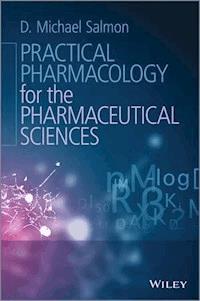
Practical Pharmacology for the Pharmaceutical Sciences is a lab survival guide for those studying Pharmacology, providing hands-on advice on developing pharmacology laboratory and data handling skills. Suitable for both undergraduates and postgraduates, it focuses on laboratory techniques rather than computer-simulated data. It also guides the reader through the process of communicating experimental results in a variety of formats, including posters, oral presentations and project reports.
Split into three main areas, the following topics are covered in detail:
Preparation for Experimental Pharmacology
- Legal aspects
- Fundamentals of Pharmacology
- Definitions, calculations and statistics
Experiments in Pharmacology
- Microtitre-based techniques using isolated cells
- In vitro techniques using isolated tissues and organs
- Biochemical techniques using cell-free systems
Communicating experimental results
- Data presentation
- How to write scientific reports
- Pharmacological literature
Supported with numerous questions throughout the text, as well as step by step instructions for practical experiments, this book presents an approach to learning pharmacology through an appreciation of authentic experimental data.
Sie lesen das E-Book in den Legimi-Apps auf:
Seitenzahl: 286
Veröffentlichungsjahr: 2013
Ähnliche



















Contents
Cover
Title Page
Copyright
Preface
REFERENCES
Acknowledgements
Chapter 1: Before Entering the Pharmacology Laboratory
1.1 SAFETY AND RISK ASSESSMENT
1.2 THE LABORATORY RECORD BOOK
1.3 USE OF ANIMALS IN PRACTICAL PHARMACOLOGY
1.4 EXPERIMENTAL DESIGN
1.5 UNITS, DILUTIONS AND LOGARITHMS
1.6 ESSENTIAL STATISTICS
REFERENCES
Chapter 2: Basic Pharmacological Principles
2.1 DRUG–RECEPTOR INTERACTION
2.2 BIOASSAYS
REFERENCES
Chapter 3: Isolated Tissues and Organs
3.1 EQUIPMENT FOR IN VITRO EXPERIMENTS
3.2 ORGAN BATHS
3.3 PHYSIOLOGICAL SALT SOLUTIONS
3.4 TRANSDUCERS
3.5 RECORDING EQUIPMENT AND SOFTWARE
3.6 DOSING
3.7 ELECTRICALLY STIMULATED PREPARATIONS
3.8 FAULT-FINDING OF IN VITRO ISOLATED TISSUE PREPARATIONS
REFERENCES
Chapter 4: Smooth Muscle Preparations
4.1 GASTROINTESTINAL SMOOTH MUSCLE PREPARATIONS
4.2 GUINEA PIG ISOLATED ILEUM
4.3 RABBIT ISOLATED JEJUNUM AND THE FINKLEMAN PREPARATION
4.4 ISOLATED TRACHEAL RINGS
4.5 ISOLATED VAS DEFERENS
QUESTIONS ON ISOLATED TISSUE PREPARATIONS
ANSWERS TO PROBLEMS
REFERENCES
Chapter 5: Cardiovascular Preparations
5.1 ISOLATED PERFUSED HEART PREPARATIONS
5.2 THORACIC AORTA PREPARATION
REFERENCES
Chapter 6: Skeletal Muscle
6.1 TYPES OF SKELETAL MUSCLE
6.2 MULTIPLY-INNERVATED SKELETAL MUSCLE PREPARATIONS
6.3 FOCALLY INNERVATED SKELETAL MUSCLE PREPARATIONS
REFERENCES
Chapter 7: Isolated Cells
7.1 FRESHLY ISOLATED AND CULTURED CELLS
7.2 PLATELETS
7.3 NEUTROPHILS
REFERENCES
Chapter 8: Biochemical Pharmacology
8.1 PHARMACOLOGICAL APPLICATIONS OF COMMON BIOCHEMICAL TECHNIQUES
8.2 ENZYME INHIBITORS
8.3 ACETYLCHOLINESTERASE INHIBITORS
8.4 MONOAMINE OXIDASE INHIBITORS
8.5 THROMBIN INHIBITORS
8.6 ATP ASE INHIBITORS
REFERENCES
Chapter 9: Complementary Methods for Teaching Practical Pharmacology
9.1 THE COMPARATIVE MERITS OF AVAILABLE METHODS
9.2 INTERPRETATION OF EXPERIMENTAL DATA
ANSWERS TO QUESTIONS
REFERENCES
Chapter 10: Communicating Results
10.1 PRELIMINARY REPORTS
10.2 POSTER PRESENTATIONS
10.3 ORAL PRESENTATIONS
10.4 PROJECT REPORTS
10.5 PHARMACOLOGICAL LITERATURE
10.6 HOW TO CITE SCIENTIFIC INFORMATION SOURCES
10.7 PLAGIARISM
REFERENCES
Appendix 1: Molecular Weights of Commonly Used Drugs
MOLECULAR WEIGHTS (MW OR FW) OF COMMONLY USED DRUGS
Appendix 2: Useful Resources for Practical Pharmacology
Index
This edition first published 2014 © 2014 John Wiley & Sons, Ltd
Registered officeJohn Wiley & Sons Ltd, The Atrium, Southern Gate, Chichester, West Sussex, PO19 8SQ, United Kingdom
For details of our global editorial offices, for customer services and for information about how to apply for permission to reuse the copyright material in this book please see our website at www.wiley.com.
The right of the author to be identified as the author of this work has been asserted in accordance with the Copyright, Designs and Patents Act 1988.
All rights reserved. No part of this publication may be reproduced, stored in a retrieval system, or transmitted, in any form or by any means, electronic, mechanical, photocopying, recording or otherwise, except as permitted by the UK Copyright, Designs and Patents Act 1988, without the prior permission of the publisher.
Wiley also publishes its books in a variety of electronic formats. Some content that appears in print may not be available in electronic books.
Designations used by companies to distinguish their products are often claimed as trademarks. All brand names and product names used in this book are trade names, service marks, trademarks or registered trademarks of their respective owners. The publisher is not associated with any product or vendor mentioned in this book.
Limit of Liability/Disclaimer of Warranty: While the publisher and author have used their best efforts in preparing this book, they make no representations or warranties with respect to the accuracy or completeness of the contents of this book and specifically disclaim any implied warranties of merchantability or fitness for a particular purpose. It is sold on the understanding that the publisher is not engaged in rendering professional services and neither the publisher nor the author shall be liable for damages arising herefrom. If professional advice or other expert assistance is required, the services of a competent professional should be sought.
The advice and strategies contained herein may not be suitable for every situation. In view of ongoing research, equipment modifications, changes in governmental regulations, and the constant flow of information relating to the use of experimental reagents, equipment, and devices, the reader is urged to review and evaluate the information provided in the package insert or instructions for each chemical, piece of equipment, reagent, or device for, among other things, any changes in the instructions or indication of usage and for added warnings and precautions. The fact that an organization or Website is referred to in this work as a citation and/or a potential source of further information does not mean that the author or the publisher endorses the information the organization or Website may provide or recommendations it may make. Further, readers should be aware that Internet Websites listed in this work may have changed or disappeared between when this work was written and when it is read. No warranty may be created or extended by any promotional statements for this work. Neither the publisher nor the author shall be liable for any damages arising herefrom.
Library of Congress Cataloging-in-Publication Data
Salmon, Michael (D. Michael), author. Practical pharmacology for the pharmaceutical sciences / Dr. Michael Salmon. p. ; cm. Includes bibliographical references and index. ISBN 978-1-119-97550-2 (pbk.) I. Title. [DNLM: 1. Pharmacology--Laboratory Manuals. 2. Chemistry, Pharmaceutical--Laboratory Manuals. 3. Pharmaceutical Preparations--Laboratory Manuals. QV 25] RM301.25 615.1078--dc23 2013037819
A catalogue record for this book is available from the British Library.
ISBN: 9781119975502
Preface
It is a startling fact that it is 30 years since the last text book on pharmacology laboratory practicals (Kitchen, 1984) was published. An obvious assumption would be that there has been a drastic fall in demand. A common response is that laboratory practicals are redundant and have been replaced by computer-assisted learning (CAL) and simulated experiments (Hughes, 2003). This is due to the challenges of increasing student numbers, decline in staff numbers and the high cost of maintaining laboratories and animal facilities (Hughes, 2001). It has been claimed that CAL experiments and problem-based learning provide an equal or superior student learning experience (Hughes, 2001, 2002). Yet surveys of the curriculum of pharmacology courses in the United Kingdom (Dewhurst and Page, 1998), and currently using a world-wide Internet survey, quickly reveals that this is not the case. “Wet” laboratory practicals remain a central part of most courses, and clearly many universities and colleges are reluctant to abandon them completely, as employers in the pharmaceutical industry and academia expect hands-on experience of pharmacological techniques. In the United Kingdom, the British Pharmacology Society (www.bps.ac.uk/Education/Universityresources/Core curricula in pharmacology, (accessed June 2013)) currently recommends an undergraduate pharmacology core curriculum in which skills in pharmacological experimentation form an essential component (see www.bps.ac.uk/education/universityresources/core curricula). Most courses now appear to rely on in-house schedules of variable quality. Meanwhile, the equipment available for the pharmacology laboratory has greatly improved mainly through the use of computers to control experiments and record data, which makes them easier to use and improve the quality of data obtained by novice students. It is a fear that some of the skills involved in real, wet experimentation may be lost as new lecturers themselves have not been taught these methods. It is therefore timely to produce a book for use in pharmacology practical classes using state-of-the-art equipment and using modern nomenclature. Several books have recently described laboratory techniques and calculations for the biosciences in general. In contrast, this book specifically aims to introduce practical pharmacology to the pharmaceutical sciences undergraduate student.
The book opens with an outline of how to prepare to work in the pharmacology laboratory, and progresses to briefly describe some of the basic principles of pharmacology, which I believe are most clearly understood from a historical perspective. The central core includes experiments using in vitro tissues, isolated cells and cell-free biochemical systems, focusing on those that are unique to pharmacology. Some of these are classical experiments which were introduced some years ago, and form the basis of the discipline of pharmacology. However, it is important to note that they are still topical in that they are still being interpreted in new ways in the light of current research. Several techniques included in the BPS core curriculum, such as molecular biology, biochemistry, electrophysiology and tissue culture widely used in pharmacological research are only alluded to, as these have been well covered elsewhere. In conclusion, since no experiment is complete without communicating the results, there is a section on the presentation and interpretation of results and how to use and cite information sources. This book aspires to be useful for students in all pharmaceutical science courses that include pharmacology modules giving a real life experience in learning pharmacology.
Powerpoint slides to accompany this book can be downloaded from http://booksupport.wiley.com by entering the book name, author or isbn information.
REFERENCES
Dewhurst, D.G. and Page, C.P. (1998) A survey of the content of B.Sc. courses in Pharmacology in UK universities – is it time for a core curriculum? Trends Pharmacol. Sci. 19: 262–265.
Hughes, I.E. (2001) Do computer simulations of laboratory practicals meet learning needs? Trends Pharmacol. Sci. 22: 71–74.
Hughes, I.E. (2002) Simulations – as much learning as with wet practicals? in Teaching Pharmacology Tomorrow: Tools and Techniques.
Hughes, I.E. (2003) Teaching pharmacology in 2010–new knowledge, new tools, new attitudes. Folia. Pharmacol JPN 122: 411–418. doi:10.1254/fpj.122.41
Kitchen, I. (1984) Textbook of In Vitro Practical Pharmacology, Blackwell Scientific Publications. ISBN 0-632-01216-1.
Acknowledgements
I am indebted to many colleagues at the University of East London with whom I worked for many years. Without their experience and fortitude this book would not have been written. I am especially indebted to my fellow lecturers, Barry Jones, Alun Morrinan, Wilson Steele, Pat Freeman and Gill Sturman. I also received unstinting technical support from Nick Seeley and Kevin Clough. Finally, I must take the blame for any errors in this book that have been overlooked, and would be most grateful if they are brought to my attention.
1
Before Entering the Pharmacology Laboratory
Before embarking on any new activity, it is wise to be familiar with the language, concepts and possible risks of the venture. So this book begins with a number of topics with which an experimenter must be familiar, such as health and safety, ethical and legal considerations and fundamental principles of experimental pharmacology. No experiment has much value unless a coherent design has been devised first. The design of an experiment is crucial if it is to yield meaningful results. Having obtained the experimental data, it is important to decide on the relevant statistical methods that will be employed to evaluate the results. Obvious as this may seem, it is shocking, even in professional research, how many experiments are wasted due to a lack of planning in design.
1.1 SAFETY AND RISK ASSESSMENT
All activities which involve the use of chemicals, from the factory floor to the research laboratory, are subject to the Health and Safety legislation. In the United Kingdom, this is done by the Health and Safety Executive (HSE), and of particular relevance in the laboratory is the Control of Substances Hazardous to Health Regulations (COSSH, 2002). In the United States, the body is the Occupational Safety and Health Administration (OSHA), who require a Chemical Hygiene Plan (CHP) for each experiment, whilst in the EC the relevant body is the European Agency for Safety and Health at Work (EU-OSHA).
Lesen Sie weiter in der vollständigen Ausgabe!
Lesen Sie weiter in der vollständigen Ausgabe!
Lesen Sie weiter in der vollständigen Ausgabe!
Lesen Sie weiter in der vollständigen Ausgabe!
Lesen Sie weiter in der vollständigen Ausgabe!
Lesen Sie weiter in der vollständigen Ausgabe!
Lesen Sie weiter in der vollständigen Ausgabe!
Lesen Sie weiter in der vollständigen Ausgabe!
Lesen Sie weiter in der vollständigen Ausgabe!
Lesen Sie weiter in der vollständigen Ausgabe!
Lesen Sie weiter in der vollständigen Ausgabe!
Lesen Sie weiter in der vollständigen Ausgabe!




