


30,99 €
Mehr erfahren.
- Herausgeber: John Wiley & Sons
- Kategorie: Geisteswissenschaft
- Serie: Architectural Design Primer
- Sprache: Englisch
Integrate poetics into real-world spaces by bringing theory down to earth
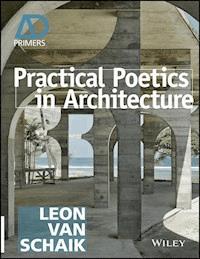
Practical Poetics in Architecture takes poetics out of the theory class and into the design studio, showing architects how the atmospheric and experiential qualities of built structures can be intentionally considered and planned. With an emphasis on analysing and explaining the sensibility of poetics at work in designing and constructing architecture, this book features projects from architects around the world that demonstrate the principles of poetics come to life. The rich illustration of two hundred colour images, including analytical diagrams, plans, sections, and photos, make this insightful guide a highly visual foray into a topic that has thus far remained more theoretical than practical. The text is matter-of-fact and concrete, yet remains richly connected to its forbears and the writings of William Lethaby, Gaston Bachelard, and Steen Eiler Rasmussen. The perspective is contemporary in its examples and its connections to the evolving science of perception.
An established seminar topic in theory classes around the world, poetics tends to rely heavily on classic philosophic texts — until now. Practical Poetics in Architecture brings theory down to earth to show architects how to invoke poetics when designing real projects.
- Integrate poetics principles into real-world designs
- Consider atmosphere in terms of form, space, and acoustics
- Study actual projects that bring poetics into real spaces
- Take cues from analytical diagrams of projects accounting for context
Poetics — the accumulated experience of place, space, and culture — has become more critical in recent years as the atmospheric and experiential qualities of built spaces have become more elusive in the virtual age. Practical Poetics in Architecture provides real guidance for real projects, and brings poetics out of the mind and onto the plans.
Sie lesen das E-Book in den Legimi-Apps auf:
Seitenzahl: 304
Veröffentlichungsjahr: 2015
Ähnliche




















Practical Poetics in Architecture
LEON VAN SCHAIK
©2015 John Wiley & Sons Ltd
Registered office John Wiley & Sons Ltd, The Atrium, Southern Gate, Chichester, West Sussex, PO19 8SQ, United Kingdom
For details of our global editorial offices, for customer services and for information about how to apply for permission to reuse the copyright material in this book please see our website at www.wiley.com.
The right of the author to be identified as the author of this work has been asserted in accordance with the Copyright, Designs and Patents Act 1988.
All rights reserved. No part of this publication may be reproduced, stored in a retrieval system, or transmitted, in any form or by any means, electronic, mechanical, photocopying, recording or otherwise, except as permitted by the UK Copyright, Designs and Patents Act 1988, without the prior permission of the publisher.
Wiley publishes in a variety of print and electronic formats and by print-on-demand. Some material included with standard print versions of this book may not be included in e-books or in print-on-demand. If this book refers to media such as a CD or DVD that is not included in the version you purchased, you may download this material at http://booksupport.wiley.com. For more information about Wiley products, visit www.wiley.com.
Designations used by companies to distinguish their products are often claimed as trademarks. All brand names and product names used in this book are trade names, service marks, trademarks or registered trademarks of their respective owners. The publisher is not associated with any product or vendor mentioned in this book. This publication is designed to provide accurate and authoritative information in regard to the subject matter covered. It is sold on the understanding that the publisher is not engaged in rendering professional services. If professional advice or other expert assistance is required, the services of a competent professional should be sought.
Executive Commissioning Editor: Helen Castle Production Editor: David Sassian Assistant Editor: Calver Lezama
ISBN 978-1-118-82889-2 (paperback) ISBN 978-1-118-82892-2 (ebk) ISBN 978-1-118-82894-6 (ebk) ISBN 978-1-118-82893-9 (ebk) ISBN 978-1-118-82888-5 (ebk)
Cover design, page design and layouts by Karen Willcox, www.karenwillcox.comCover image ©Peter Bennetts
I dedicate this book to all those who strive in the immensely complex practice of architecture.
Acknowledgements
I acknowledge with great gratitude the help of my assistant Melisa McDonald, and of the publishing team: Helen Castle, the commissioning editor at Wiley; Calver Lezama, her assistant; Abigail Grater, the copy editor; and Karen Willcox, the designer. I am also indebted to successive editors of Architecture Australia and Architectural Review who have given me the opportunity to develop a style of reviewing, in particular Cameron Bruhn and Michael Holt. The architects who feature are central to the book, and their candour is the lifeline of my research. I am especially indebted to Esther Anatolitis, Vivian Mitsogianni, Ayse Senturer and Zeynep Mennan, as well as to Andrew Keen and Michael Spooner for their comments on the introductory essay and on sample case studies. I hope they find that the book merits a second reading. In the back of my mind, I have imagined the book being read by mentors and friends like William and Lena Lim, Peter Cook and Yael Reisner, CJ Lim, Will Hunter, Catherine Stutterheim, and all the architects and architects in the making I have ever had the pleasure to work with thus far.
CONTENTS
Preface
References
Introduction
The Concept of an Architectural Reality as the Basis for the Practical Use of Poetics in Architecture
Architecture's Relationship to the Pursuit of Knowledge in Other Fields
References
Chapter 1: Making Home
Treehouse, Hobart, Tasmania, Australia
WoodBlock House, London
FAB house prototype, Calgary, Alberta, Canada
Remodelling and new Plant Room at Eagle's Nest, Zennor, Cornwall, England
Wattle Avenue House, Mildura, Victoria, Australia
References
Chapter 2: Feeding, Body, Mind and Soul
Melbourne Food and Wine Festival (MFWF) Greenhouse, Melbourne
't Raboes Project, Eemnes, Netherlands
Precinct Energy Project, Dandenong, Australia
Arrow Studio, Tylden, Victoria, Australia
Borgarfjördur College, Borgarnes, Iceland
RMIT Design Hub, Melbourne
Abedian School of Architecture, Robina, Queensland, Australia
References
Chapter 3: Healing our City
Community Police Station, Marysville, Victoria, Australia
Canada Water Library, Surrey Quays, Southwark, London
Saw Swee Hock Student Centre, London School of Economics and Political Science (LSE), London
South Molton Street Building, London
Three University Makeovers: University of Cincinnati Masterplan, Cincinnati, Ohio
Central European University remodelling, Budapest
RMIT New Academic Street, Melbourne
References
Chapter 4: Capturing Nature
University of Queensland Aquatic Centre, Brisbane
The Oliv, Singapore
La Plage du Pacifique, Vanuatu
PARKROYAL on Pickering, Singapore
Poolhouse 1, Home Counties, England
References
Conclusion
A Reflection on Practical Poetics
References
Select Bibliography
Index
Picture Credits
EULA
List of Illustrations
Preface
Peter Lyssiotis, Montage, Melbourne, 1998
While this image may be read as surrealist, prosaically it evokes an insight into what could be done to a door to enable a view of a crescent moon.
‘Sensing Spaces: Architecture Reimagined', Royal Academy of Arts, London, 25 January to 6 April 2014 (curated by Kate Goodwin): installation by Grafton Architects
This installation completely reversed the spatial configuration of the gallery, although conforming to the same top-lit paradigm. The space shifts from being one that rises to rooflights that wash the walls, to a weighty space with paradoxically elusive connections to the ground.
‘Sensing Spaces: Architecture Reimagined', Royal Academy of Arts, London, 25 January to 6 April 2014 (curated by Kate Goodwin): installation by Pezo von Ellrichshausen
An installation that brought people into contact with the details of the gallery. Designed to be seen from far below, this intimate relationship to the detail was startling, as was the appreciation of the actual rather than the apparent height of the space.
‘Sensing Spaces: Architecture Reimagined', Royal Academy of Arts, London, 25 January to 6 April 2014 (curated by Kate Goodwin): installation by Li Xiaodong
A wintry external space was created within the warm Beaux-Arts interior of the gallery. Offsetting this behind one of these grey sapling walls was a glowing honey-coloured cabin interior.
Lesen Sie weiter in der vollständigen Ausgabe!
Lesen Sie weiter in der vollständigen Ausgabe!
Lesen Sie weiter in der vollständigen Ausgabe!
Lesen Sie weiter in der vollständigen Ausgabe!
Lesen Sie weiter in der vollständigen Ausgabe!
Lesen Sie weiter in der vollständigen Ausgabe!
Lesen Sie weiter in der vollständigen Ausgabe!
Lesen Sie weiter in der vollständigen Ausgabe!
Lesen Sie weiter in der vollständigen Ausgabe!
Lesen Sie weiter in der vollständigen Ausgabe!
Lesen Sie weiter in der vollständigen Ausgabe!




