



Erhalten Sie Zugang zu diesem und mehr als 300000 Büchern ab EUR 5,99 monatlich.
- Herausgeber: Paraclete Press
- Kategorie: Religion und Spiritualität
- Sprache: Englisch
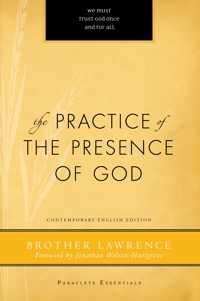
This edition of a timeless classic--enhanced by Emergent leader Tony Jones--will appeal to college students, readers new to Christian classics, and anyone else who desires to learn how to make spirituality a moment-by-moment way of life. Brother Lawrence's Practice of the Presence of God has stood the test of time because it chronicles the life of a very ordinary person who became an extraordinary Christian. Through a life of humility and service, Brother Lawrence achieved something that many Christians aspire to: he was so concentrated on God that God became a part of his every breath. Whether deep in prayer or peeling potatos in the kitchen, he knew God's presence. This readable translation, replete with enlightening background notes, will appeal to today's reader in ways that no other edition has been able to do.
Sie lesen das E-Book in den Legimi-Apps auf:
Seitenzahl: 167
Veröffentlichungsjahr: 2007
Das E-Book (TTS) können Sie hören im Abo „Legimi Premium” in Legimi-Apps auf:
Ähnliche















PRACTICING THE PRESENCE OF GOD
A Modernized Christian Classic
by Brother Lawrence
Translation by Robert J. Edmonson, CJIntroduction and Notes by Tony Jones
Practicing the Presence of God
2007 First Printing
Copyright © 2007 by The Community of Jesus, Inc.Notes and Introduction copyright © 2007 by Tony Jones
ISBN: 978-1-55725-465-8
Library of Congress Cataloging-in-Publication Data
Lawrence, of the Resurrection, Brother, 1611–1691. [Pratique de la présence de Dieu. English] Practicing the presence of God : a modernized Christian classic / byBrother Lawrence ; translation by Robert J. Edmonson ; introduction and notes by Tony Jones. p. cm. Originally published: The practice of the presence of God. 1895. With new introd. and notes. ISBN-13: 978-1-55725-465-8 1. Christian life--Catholic authors. I. Edmonson, Robert J. II. Jones, Tony, 1968- III. Title. BX2350.3.L3813 2007 248.4’82--dc22 2007025372
10 9 8 7 6 5 4 3 2 1
All rights reserved. No portion of this book may be reproduced, stored in an electronic retrieval system, or transmitted in any form or by any means—electronic, mechanical, photocopy, recording, or any other—except for brief quotations in printed reviews, without the prior permission of the publisher.
Published by Paraclete Press
Brewster, Massachusetts
www.paracletepress.com
Printed in the United States of America
Contents
Translator’s Note
Introduction by Tony Jones
Eulogy of Brother Lawrence of the Resurrection
Conversations with Brother Lawrence
Letters of Brother Lawrence
The Spiritual Maxims
Brother Lawrence’s Way of Life
Study Guide
Translator’s Note
Before I set out to translate the book you are about to read, I had an image of Brother Lawrence as a jolly monk who took pleasure in cleaning pots and cooking. What could he have to say to me?
As I began to read the sections of the book in which others wrote about Brother Lawrence, I felt a growing awareness that this humble lay brother led a life that does, indeed, have much to say to me, and when I read his own writings, I was struck by the depth of his love for God and his life lived in obedience, humility, and concern for others. Then I understood why I was translating this book: it was because I so needed to hear what it has to say. Session after session in front of the typewriter brought deeper and deeper conviction of who I am, and greater and greater hope for what God can do in a life wholly given to Him.
It is my prayer that you will also be blessed by this book, and that as you follow the example of Brother Lawrence, you, too, will be filled with the presence of God.
ROBERT J. EDMONSON
Introduction by Tony Jones
“Pray without ceasing.”
When the apostle Paul first wrote these words to the church he had planted in Thessalonica, he may have thought that it was entirely natural for a person to pray continually. Maybe that was his experience.
But since those words were penned, Christians have struggled with how to apply them to their own lives. Paul was exaggerating, right?, we wonder, for surely he didn’t mean that literally! It’s just not possible to pray without ceasing.
So, for two millennia, saints and those of us who are not-quite-saints have endeavored to live a life that in some way aspires toward Paul’s vision of ceaseless prayer.
In the history of our faith, it may be that no one has exemplified a life of continual prayer—and taught others about it—better than a humble monk who lived in seventeenth-century France. Brother Lawrence was not a saint, and he’s never been made a saint. He wasn’t even a priest. Instead, he was a simple man who committed his life to living every waking moment in the presence of God.
His words—simple like the man himself—have with-stood four centuries. We live in a much different time than Lawrence, a time of mobile phones and Internet access and twenty-four hour news, but his little book may be more popular today than ever before. Indeed, maybe it’s because the world is so un-simple now that Brother Lawrence’s words endure.
The Man and His Time
The seventeenth century was a time of transition, especially in France. In Europe, the Protestant Reformation, begun by Martin Luther, John Calvin, and others, was only one hundred years old, the printing press only two hundred. When Brother Lawrence was just nine years old, the persecuted Pilgrims boarded the Mayflower and set off to find religious freedom on a new continent. Many people must have felt that the longstanding religious landscape was shifting beneath their very feet. Across Europe, other sweeping changes were initiated by geniuses such as Galileo Galilei, Rene Descartes, Blaise Pascal, and Isaac Newton, men who birthed modern science and philosophy.
Meanwhile, France was enjoying its preeminence in the world. Louis XIV (a.k.a., Louis the Great, “The Sun King”) reigned from 1643 until 1715. He saw the Thirty Years War to a close in 1648 and fought several other wars during his tenure as king, all of which solidified France’s political and cultural clout across Europe, and established the French presence in the colonization of the Americas.
Into this world, Nicholas Herman was born in 1611. A peasant, he joined the army as a footman for the nobility and was thus guaranteed meals and a small salary. But at age eighteen, he saw a vision that altered the course of his life: looking at a dormant tree in the winter, he recognized that he, too, felt completely barren. However, he knew that the tree would come back to life in the spring, and Nicholas felt that God was about to bring him new life as well.
Circumstances demanded that he continue his service in the army for six more years, after which he arrived at the doorstep of the Carmelite monastery in Paris. The Carmelite Order had been founded in the twelfth century on Mt. Carmel in Israel, with an emphasis on the practice of contemplative prayer. But the order had become lax and political over the centuries, until St. Teresa of Avila and St. John of the Cross led a reform movement in the sixteenth century. They founded the Discalced (“without shoes”) Carmelites, and it was this order of Carmelites that Nicholas Herman joined.
Lacking the education necessary to become a priest, Nicholas was given the name Brother Lawrence of the Resurrection and put to work doing the menial tasks of the uneducated brothers. He spent the majority of the next five decades working in the kitchen until he became too old and infirm for that and was reassigned to making sandals. Brother Lawrence died on February 12, 1691.
At first glance, his was the seemingly trivial life of a peasant monk who spent fifty-plus years working in the kitchen and the shoe shop. But what compelled Brother Lawrence during his decades of monastic life was basically this: How can one be in a spirit of prayer, even while peeling potatoes? That is, how can a person commune with God, even while performing the most mundane tasks?
His answer: practice—more specifically, the practice of the presence of God.
In the following pages, you will read the thoughts of a man whose commitment to God is breathtaking and beautiful. Brother Lawrence made a habit of thinking about God in all things, drawing near to God at all times. Indeed, he was so disciplined in his ceaseless recollection of the Lord that it became habitual for him. It became a way of life.
The Book You Hold in Your Hands
This little book is a collection, really. At the beginning and end stand reflections on the life of Brother Lawrence, written by a man named Abbe Joseph de Beaufort, an influential churchman of that day. Between these two reflections stand de Beaufort’s notes on four conversations he had with Brother Lawrence; sixteen letters that Brother Lawrence wrote; and a list of “Spiritual Maxims” that was found on Brother Lawrence’s bedside stand after his death.
At times, Brother Lawrence’s thoughts—recorded both by his own hand and by de Beaufort—may seem redundant. But Brother Lawrence would not have minded that criticism, for his was a simple message: By continual recollection of God’s immediate presence with us, we can actually live in that presence. This practice of the presence of God so transformed Brother Lawrence’s life that he found that the usual monastic disciplines of spiritual retreats, spiritual direction, and even daily worship were no longer that helpful to him. It can be said that he transcended those more traditional modes of spirituality and prayer. Indeed, at one point, he claims that he actually transcended belief in God and achieved the pure experience of God.
No secret prayers lie at the center of Brother Lawrence’s spirituality, and there is no special knowledge required. Instead, he offers this simple thesis: By disciplining ourselves to think of God constantly, we can place ourselves in God’s presence. Or, to say it differently, we are already in God’s presence, since God is with us and in us; our job is to be mindful of that presence.
This message has resonated with millions of readers over the centuries, and it will likely resonate with you, too. This little book is the legacy of a simple peasant monk from a long time ago, but it contains the very key to life with Christ that so many of us long for.
PRACTICING THE PRESENCE OF GOD
Brother Lawrence died on February 12, 1691. At his funeral two days later, this eulogy was delivered by Joseph de Beaufort, a prominent church leader in Paris at the time. De Beaufort had been inspired by Lawrence over the years, but Lawrence’s spiritual brilliance was known by few others. This address at Lawrence’s funeral served as the first introduction of Lawrence to the world, and his address was much acclaimed when de Beaufort later published it.
Eulogy of Brother Lawrence of the Resurrection
It is a consistent truth in the Scriptures that the arm of God is not shortened and that His mercy is not exhausted by our miseries. The strength of His grace is no less today than it was in the early days of the Church. It is His desire to perpetuate a life of holiness in men and women in every age. He always seeks out those who are willing to offer Him worship worthy of His greatness and majesty, and who, by the saintliness of their examples, can be models of virtue. He was not content just to place such people in the first centuries, but still raises up some from time to time whose lives demonstrate the worship of which He is worthy and are therefore a good example to others. These men and women, while retaining in themselves the first fruits of the Spirit, transmit that spirit to others and cause it to live in them as well.
The one whose life I would now call to your attention is Brother Lawrence of the Resurrection, a Discalced Carmelite brother whom God raised up in our time to render to Him all the honor that is due Him, and to quicken all Christians by the rare example of his faithfulness in the practice of all Christian virtues.
The “Discalced Carmelites” are the monks who go without shoes, the most severe and disciplined monks of the Carmelite order.
His name before entering the monastic life was Nicholas Herman. His father and mother were very upright persons who led exemplary lives, instilling in him the fear of God from his youth up. They took particular care with his moral training, teaching him only those holy principles that are in conformity with the Gospel.
He was born at Herimenil in Lorraine, where he had the misfortune of becoming involved in its military operations. While he was in the army, God was already showing him His goodness and mercy.
Herimenil is a small village in Lorraine, a county in northeastern France on the border with Germany.
Some German troops who were marching on a campaign took Nicholas prisoner and treated him as a spy.
In early modern France, peasants like Nicholas were often forced into military service. While only the aristocracy and the upper classes bore arms, the peasants carried supplies and often delivered messages across enemy lines. They were, of course, considered expendable.
He never lost his patience and tranquility even in such an unpleasant situation. They threatened to hang him, but he responded that he was not what they thought him to be, and in any case, since he was guilty of no crime, he was quite ready to die. And on hearing that, the officers released him.
The Swedes also made an incursion into Lorraine, attacking the little town of Rambervillers as they passed by it. There Nicholas was wounded, and he had to go back to his parents’ home to recover.
This adventure caused him to leave the military profession and to undertake a more holy way of life under the banner of Jesus Christ. It was not the vain enthusiasm of an indiscreet devotion that gave him a distaste for the military. Rather, it was true piety that caused him to give himself wholly to God and gave him a desire to make amends for his past conduct. The God of all consolation, who had destined him to a more holy life, made him aware of how fleeting the world’s vanities are and touched him with the love of heavenly things.
These initial impressions of grace, however, did not achieve their full effect at first. He often went over in his own mind the dangers of the military profession, the vanities and corruptions of this life, the instability of men, the betrayals of enemies, and the unfaithfulness of his friends. It was only after keen reflections, after a powerful inner struggle, after tears and sighs, that, conquered finally by the force of God’s eternal truths, he made a firm resolve to follow the way of the Gospel. His uncle was a Discalced Carmelite brother and it was he who made him understand that the air of the world is so contagious that if it does not strike dead all who breathe it, it inevitably alters or corrupts the morals of those who follow its ways.
While meditating on the promises of his baptism, the disorderliness of his youth, the mysteries of the Christian faith, and above all, the passion of Jesus Christ (about which he never thought without being inwardly moved), he was changed into another man. The humility of the cross seemed more beautiful to him than all the glory of the world.
Inflamed with a divine fervor, he searched for God in the simplicity and sincerity of his heart. His only desire was to be alone, so that he might weep for his faults. Since he was old enough not to have to reproach himself for any youthful haste, he thought more than once about with-drawing into solitude, and a favorable opportunity appeared.
There was a certain member of the nobility whom Herman knew whose noble birth and personal merit ought to have provided him with a satisfying life. Yet he was thoroughly dissatisfied with himself, always restless amid his riches. Persuaded that God alone could fulfill his desires, and preferring the poverty of the Gospel to all the treasures of the earth, this gentleman entered a hermitage. His desire was to taste there how sweet the Lord is to those who search for Him with all their heart. Herman, following his example, entered the hermitage as well. His soul was weary of the toilsome life it was leading and had begun to seek rest. Accompanied by his faithful friend, he retired into the wilderness, where the zeal for Christ within him dispelled his fears, and where he grasped ahold of God more than ever.
But although a hermit’s life may be excellent for the advanced and mature, it is not usually best for beginners. Herman soon realized this, for the changing emotions of joy, sadness, peace, trouble of spirit, fervor and lack of devotion, confidence and despondency that ruled his soul, made him doubt the correctness of his path. He decided then to seek entrance into a monastic community in order to embrace a type of life whose rules, founded on the firm rock of Jesus Christ and not on the unstable sand of passing feelings, might strengthen him against the instability of his conduct.
In other words, Herman discovered that he was an extrovert. The solitary life in a hermitage didn’t suit him, but, as we will see, the communal life in a monastery did.
Nevertheless, frightened by the prospect of an unending spiritual battle—and perhaps tempted by the devil—he found himself unable to make this decision immediately. Day by day he was more unresolved. Finally, listening once again to the tender call of God within, he came to Paris to ask permission to enter an order and there he became a lay brother among the Discalced Carmelites, taking the name of Brother Lawrence of the Resurrection.
From the beginning of his novitiate, he applied himself fervently to the practice of the religious life. He was most devoted to the Holy Virgin and had a son-like confidence in her protection. She was his refuge in all the difficulties of his life, in the troubles and the anxieties with which his soul was agitated, and it was his custom to call her his “Good Mother.” He devoted himself particularly to the practice of prayer. However great his duties might be, they never made him lose track of the time set aside in the monastic day for prayer. The presence of God and the love He pours into the soul were his greatest virtues, and they made him in a short time the model for his fellow novices. By the victorious grace of Jesus Christ, he eagerly embraced penance and sought out the austerities from which nature flees with so much aversion.
The novitiate is the beginning time of a monastic profession. A “tryout” of sorts, a novice may still opt out of the monastic life before taking on the full vows of the community.
Penance is the practice of confessing one’s sins to a priest and then submitting to discipline (usually prayers) to show repentance. Following the time of penance, the priest offers forgiveness of sins on behalf of God.
Although his superiors assigned Lawrence to the most abject duties, he never let any complaint escape his lips. On the contrary, the grace that refuses to be disheartened by harshness and severity always sustained him in the most unpleasant and annoying assignments. Whatever repugnance he may have felt from his nature, he nevertheless accepted his assignments with pleasure, esteeming himself to be too happy either to suffer or to be humiliated by following the example of the Saviour.
The novice-master, sensing his merits and seeing the esteem he acquired by his courageous behavior, felt the need to test the genuineness of his vocation and the steadfastness of his spirit by increasing his difficulties, pressing him by different assignments. Rather than being put down by such experiences, or becoming disheartened by these trials, Lawrence endured them with all the faithfulness one could expect from him.
It seems that even during his novitiate, Brother Lawrence’s superiors could hardly believe how devout and holy he was.
On one occasion, when a brother came to tell him there was talk of sending him away from the monastery, his response was, “I am in the hands of God. He will do with me what may please Him. I do not act out of respect to others. If I do not serve Him here, I will serve Him elsewhere.”
When the time came for him to take his monastic vows, he did not hesitate. I could report here several beautiful actions that would convince the reader of the completeness of his self-sacrifice, but I will pass over them in order to emphasize the interior suffering with which his soul was afflicted. This suffering came about in part by divine Providence, which permitted it in order to purify him, and in part through his lack of experience and his wish to walk his own path in the spiritual life.




