


97,99 €
Mehr erfahren.
- Herausgeber: John Wiley & Sons
- Kategorie: Fachliteratur
- Serie: Wiley Finance Editions
- Sprache: Englisch
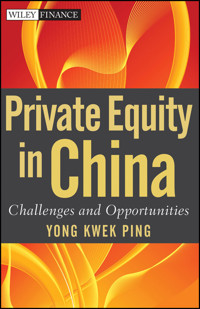
Learn valuable lessons from the newly successful private equity players in China and explore the challenges and opportunities offered in Chinese markets The first book to deal with private equity finance in China, Private Equity in China: Challenges and Opportunities provides much-needed guidance on an investment concept that has so far proved elusive in Asia. Focusing on the opportunities that the Chinese finance market offers to private equity firms, the book shows how these firms can strategically position themselves in order to maximize success in this new marketplace. Private Equity in China includes in-depth case studies illustrating both successful and failed ventures by private equity firms operating in China, outlining the challenges faced by private equity firms in setting up new funds. It contains a collection of valuable experience and insights about acquiring companies and turning them around essential for any firm currently operating in, or considering entering, the Chinese market. * Discusses the challenges faced by private equity firms in China including setting up the initial fund, fund raising, deal sourcing, deal execution, and monitoring and exit strategies * Provides key insights drawn from keen observations and knowledge of the more mature private equity market in Western countries, analyzing the way forward for the Chinese private equity industry * Discusses the role of renminbi-denominated funds in the development of the private equity industry in China Breaking new ground in exploring and explaining the private equity market in China, the book offers incredible new insight into how equity companies can thrive in the Chinese marketplace.
Sie lesen das E-Book in den Legimi-Apps auf:
Seitenzahl: 509
Veröffentlichungsjahr: 2012
Ähnliche


















Contents
Preface
Acknowledgments
Chapter 1: Private Equity: An Introduction
Overview
Inventis Private Equity Model
Structure of a Private Equity Fund
Private Equity Investment Process
Chapter 2: Overview of the Political, Macroeconomic, and Financial Landscape in China
Overview
China’s Macroeconomic Conditions and Trends
China’s Financial Markets
Trust Financing
China’s Futures Markets: Commodity Exchanges and Derivatives Exchanges
Summary
Chapter 3: Private Equity in China
Overview
Key Market Trends and Developments
Private Equity Funds in China
Private Equity Investment Structures in China
Leveraged Buyouts
Valuation Adjustment Mechanism
Exit Strategies for Private Equity Investment in China
Benefits of Private Equity for China
Chapter 4: Renminbi Private Equity Fund
Overview
Setting Up and Fund-Raising in China
Investing in China
The Renminbi Private Equity Fund
Challenges and Opportunities for FOPE-RMB Funds
Impacts of RMB Convertibility on RMB Private Equity Funds
Chapter 5: Investment Opportunities for Private Equity in China
Overview
Foreign Acquisition and National Security Review
China’s Five-Year Plan for National Economic and Social Development
China’s Seven Emerging Strategic Industries
Investment Opportunities in China’s Energy Sector
Chapter 6: Challenges and the Future of Private Equity in China
Overview
Fund-Raising
Deal Sourcing
Due Diligence
Deal Structuring
Portfolio Management
Exit
Foreign Exchange Controls and RMB Convertibility
The RMB Fund Advantage—Artificial and Temporary?
Media Reports and Public Perception
Guanxi Management
FOPE-RMB Funds
COPE-USD Funds
Leveraged Buyouts
Private Equity Professionals in China
Conclusion
Appendix A: Government Structure of the People’s Republic of China
Appendix B: Key Points in a Private Placement Memorandum
Appendix C: Geography of China
Appendix D: Selected Private Equity Funds in Greater China
About the Author
Index
Founded in 1807, John Wiley & Sons is the oldest independent publishing company in the United States. With offices in North America, Europe, Australia and Asia, Wiley is globally committed to developing and marketing print and electronic products and services for our customers’ professional and personal knowledge and understanding.
The Wiley Finance series contains books written specifically for finance and investment professionals as well as sophisticated individual investors and their financial advisors. Book topics range from portfolio management to e-commerce, risk management, financial engineering, valuation and financial instrument analysis, as well as much more.
For a list of available titles, please visit our Web site at www.WileyFinance.com.
Copyright © 2012 John Wiley & Sons Singapore Pte. Ltd.
Published in 2012 by John Wiley & Sons Singapore Pte. Ltd. 1 Fusionopolis Walk, #07-01, Solaris South Tower, Singapore 138628
All rights reserved.
No part of this publication may be reproduced, stored in a retrieval system, or transmitted in any form or by any means, electronic, mechanical, photocopying, recording, scanning, or otherwise, except as expressly permitted by law, without either the prior written permission of the Publisher, or authorization through payment of the appropriate photocopy fee to the Copyright Clearance Center. Requests for permission should be addressed to the Publisher, John Wiley & Sons (Asia) Pte. Ltd., 1 Fusionopolis Walk, #07-01, Solaris South Tower, Singapore 138628, tel: 65–6643–8000, fax: 65–6643–8008, e-mail: [email protected].
This publication is designed to provide accurate and authoritative information in regard to the subject matter covered. It is sold with the understanding that the Publisher is not engaged in rendering professional services. If professional advice or other expert assistance is required, the services of a competent professional person should be sought. Neither the author nor the Publisher is liable for any actions prompted or caused by the information presented in this book. Any views expressed herein are those of the author and do not represent the views of the organizations he works for.
Other Wiley Editorial Offices
John Wiley & Sons, 111 River Street, Hoboken, NJ 07030, USA
John Wiley & Sons, The Atrium, Southern Gate, Chichester, West Sussex, P019 8SQ, United Kingdom
John Wiley & Sons (Canada) Ltd., 5353 Dundas Street West, Suite 400, Toronto, Ontario, M9B 6HB, Canada
John Wiley & Sons Australia Ltd., 42 McDougall Street, Milton, Queensland 4064, Australia
Wiley-VCH, Boschstrasse 12, D-69469 Weinheim, Germany
Library of Congress Cataloging-in-Publication Data
ISBN 978-0-470-82651-5 (Hardcover)
ISBN 978-0-470-82653-9 (ePDF)
ISBN 978-0-470-82652-2 (Mobi)
ISBN 978-0-470-82654-6 (ePub)
For
My family
Kelvin Fu
Joshua Lim
Yuan Ye
Preface
Private equity was relatively unknown among the Chinese general public in the 1990s and early 2000s. Even if one were to have heard of private equity in China, they often had a poor understanding of it and often mistook private equity simply as an equity investment firm. Early private equity deals did not attract much media attention. It was not until the mid-2000s when foreign private equity firms started to make inroads into the Chinese market that the media started to pay attention to private equity.
The term private equity became more widely known to the general Chinese consciousness only recently, at the height of the economic boom in 2006, when China Investment Corporation (CIC) paid a hefty US$3 billion for a slightly less than 10 percent stake in Blackstone. This was its first investment deal—even before it was officially incorporated—and the Chinese public started to find out what “a Blackstone” is. Foreign private equity firms were aggressively seeking investments in domestic companies and were looked upon as an important source of capital, as the capital markets in China were not well developed yet. The Chinese bond market was undeveloped or still developing, and the stock market was not easily accessible to domestic companies in order to raise funds. The primary source of capital for domestic companies was through the local banks, namely the state-owned and policy banks, provincial and city commercial banks, and rural cooperatives. To a certain extent, the lack of easy access to capital restricted the expansion of local companies. Furthermore, the mismanagement of the economy prior to the economic reforms had taken its toll on the finances, operational capabilities, human resources, and technological know-how of the local companies. Hence, foreign capital and expertise was greatly valued by the country. To this end, private equity plays a crucial role in the development of the Chinese capital markets with its allure of capital, management expertise, and international networks.
Only a small number of foreign private equity firms had entered the Chinese market, lured by its large domestic market and increasing liberalization of the capital market. Some of the pioneers include The Carlyle Group, KKR, and Blackstone, which have thus far had mixed success in China. Despite being an early mover into the Chinese market, foreign private equity firms still faced stiff competition from other new foreign private equity firms and domestic private equity firms looking to enter the playing field.
As economic reform gained pace and the domestic populace began to become wealthier and exposed to financial markets, an underlying nationalistic sentiment was being stoked. Foreign private equity firms were charged with buying Chinese assets on the cheap and making very high returns at the expense of Chinese workers who got fired due to the restructuring exercise. The central government became aware of the local sentiment and sought to defend their position that they were not selling Chinese assets on the cheap. It was argued that some of the state-owned enterprises were unprofitable and that the only way to sustain its operations was to sell it to a party that was capable of turning it around. Due to the misrepresentation of the workings of private equity by the Chinese media that labeled private equity firms as corporate raiders, the exact role and functions of a private equity firm is hitherto still a mystery to many in China.
With the preceding as a background, the aim of this book is to demystify the functions of the private equity firm operating in China. As if trying to comprehend private equity alone was not complicated enough, a private equity firm operating in China will likely confound many people who do not have a basic understanding of how business is conducted in China. Needless to say, a private equity firm in China faces many challenges and opportunities. To this end, this book aims to provide a better understanding of private equity in China.
The target audience for this book is investors and professionals who want to gain a better understanding of the operating environment in China and how to carry out investments into Chinese companies. With the constantly evolving economic landscape in China, as well as the myriad of regulatory changes that are taking place, foreign investors are often befuddled by the fluid nature of things in China. Private equity, as an asset class dealing with business, relies heavily on the management expertise of the general partners to deliver on the high rates of returns demanded by limited partners. In addition, due to its illiquid nature, private equity has sparked concerns in the foreign investor community that fear losing their investments due to the high risks that are associated with doing business in China. Readers of this book will find that investing in China certainly poses its own unique set of challenges and opportunities, but this is no different from investing in any foreign market. Indeed, by reading this book, the author hopes to demystify the workings of private equity in China and to dispel any false misconceptions that investors or people have about doing business in China.
This book is organized into six chapters. Chapter 1, Private Equity: An Introduction, provides an overview of the private equity industry, its characteristics, and functions. With a basic understanding about private equity, the readers will be able to appreciate the differences between operating private equity firms in the West compared with those in China. For readers who are familiar with the workings of private equity firms, this section will still be useful insofar as the illustrations and models that are used in this chapter are proprietary models that have been created by the author and implemented in China. The Inventis Private Equity Model will be introduced to assist readers in understanding the dynamics of the private equity cycle from entry to exit and the investment mix that private equity investment could make. This chapter will cover the entire private equity investment cycle starting from the planning, fund-raising, and sourcing stages to the due diligence process, deal structuring, portfolio management, and finally the exit strategy. Readers who are familiar with private equity as an asset class may choose to skip this chapter.
Chapter 2, Overview of the Political, Macroeconomic, and Financial Landscape in China, sets the stage for this book. The political and business environment is intertwined with the private equity industry in China. This is because private equity is fundamentally about investing and growing a business. Without an understanding and appreciation of the diversity and challenges of China’s political and business environment, business management will find it difficult to overcome these challenges. This chapter will highlight the centers of power in China and their relevance to the private equity practitioners. In addition, the key macroeconomic trends and developments that are unfolding in China will be highlighted to provide readers with a macroeconomic view and to see how it relates to the development of the private equity industry in China and the opportunities that lie ahead.
In Chapter 3, Private Equity in China, an overview of the private equity industry in China is discussed. This is followed by an analysis of key milestones and developments that have happened in the past decade and their significance to the industry as a whole. The private equity industry in China is constantly adjusting to the evolving regulatory framework in China. The regulatory framework shapes the type and form of private equity funds being developed in China. In addition to the regulatory impacts on funds formation, the exit strategy for private equity funds can also be affected, as the Chinese government is wary of Chinese companies that are avoiding taxes through offshore restructuring. In this regard, a detailed look at the types of investment structure that are permitted and being used is explored. This chapter ends with a look at the challenges and benefits of doing private equity in China.
Chapter 4, Renminbi Private Equity Fund, provides an in-depth discussion on RMB-denominated private equity funds that have increasingly become the investment vehicle of choice when it comes to private equity investment in China. Indeed, large Western private equity firms have started to make inroads into the RMB private equity funds by setting up and registering funds in cities that have announced preferential policies for fund management companies. The concept of an RMB private equity fund is still relatively new and it is rapidly evolving. There are numerous issues that will need to be resolved, such as the potential conflicts of interest that arise from general partners who run two separate private equity funds (denominated in RMB and USD) and that are backed by different limited partners vying for the same deals. RMB private equity funds pose a different set of opportunities and challenges compared to the USD-denominated private equity funds. This chapter aims to address these issues and to highlight the way forward for RMB private equity funds.
Chapter 5, Investment Opportunities for Private Equity in China, discusses the investment opportunities for private equity investment in China and the future direction of the industry. There are enormous investment opportunities in China and this chapter alone will not be able to capture all of the opportunities. Instead, the approach for this chapter is to leverage the 12th Five-Year Plan as announced by the National Party Congress in China in 2011, and to examine the industry sectors that may benefit from favorable policies. In addition, the Chinese government has also announced seven key strategic industries that it is actively encouraging investment into. In this regard, this chapter will cover the industry sectors as identified by the Chinese government as key investment opportunities in the coming decade.
Chapter 6, Challenges and the Future of Private Equity in China, looks at the current state of the private equity industry in China and highlights the positive developments and challenges that the industry as a whole may face in the near future. Needless to say, it is impossible to predict the future; however, it is the author’s intention to provoke readers to think deeply about the way ahead and how to overcome possible challenges in the future.
This book was written from the point of view of a practitioner to engage the reader. Each chapter will draw on real-life cases in the form of exhibits. The exhibits are intentionally kept brief with sufficient background and analysis. Hence, readers should not expect to see a full-blown case study akin to those used in business schools. The aim of the exhibits in this book is to highlight key lessons that the author wants the readers to take away regarding investing in private equity in China.
Acknowledgments
Private equity is an exciting and fulfilling career that takes general partners around the world. Writing this book has been an enriching and interesting journey. Private equity itself is sometimes mysterious and the same goes for China. It has been a challenging journey to attempt to put these two elephants together and to be able to articulate and organize my thoughts on these two topics into a book.
My sincere gratitude runs deep to the many outstanding individuals who have been involved in the production of this book. I am most thankful to Kelvin, Josh, and Yuan Ye, for their indefatigable support and research into the subjects. They have painstakingly gone through all my drafts and provided many invaluable comments. Their intelligence is ubiquitous throughout the book. I would like to dedicate this book to all three of them. During the initial planning of this book, Chai Ming Jie, Wong Qing Yuan, Kenny Ng, Yeo Zhi Aik, Ryan Li, and Daryl Poon provided me with excellent suggestions on the structure and contents of this book. I am grateful to these young friends of mine. They are all the most important people in my life.
The private equity courses that I teach continue to be a great source of inspiration and learning for me. I would like to express my appreciation to Professor Annie Koh, Chiew Yee, Jacque, Clara, Diane, Vivien, Clare, and the entire team at the Financial Training Institution for their patience and support.
Last but not least, my deep appreciation to Nick Wallwork for his initiation and support of this book; Jules Yap for telling me what to do next during the writing phase; and my most sincere thanks to Helen Cho, for her editorial guidance and work throughout the entire manuscript, and to Todd Tedesco for the production of this book. It is really a huge privilege to work with such a professional team at John Wiley & Sons together with the staff at Cape Cod Compositors. Thank you all very much.
Long Live Chairman Mao!
Mao Ze Dong
Listen to Mao’s Instructions. Follow Mao’s Decisions.
Hua Guofeng
Open and Reform
Deng Xiaoping
Three Representatives
Jiang Zeming
Scientific Development
Hu Jintao
CHAPTER 1
Private Equity: An Introduction
This chapter provides the reader with an overview of the basic fundamentals of private equity as an asset class. In addition, the reader will be introduced to the Inventis Private Equity Model, which encapsulates the workings of private equity from entry to exit. This is particularly useful as it provides a model for readers to apply throughout subsequent chapters of the book. Readers who are familiar with the basics of private equity may skip this chapter.
OVERVIEW
Private equity is an asset class consisting of equity securities in companies that are not publicly traded on a stock exchange. Private equity consists of long-dated capital commitments from its investors aimed at achieving long-term value creation through active management of the invested companies in order to achieve higher investment returns than the public markets. Private equity funds are typically deployed to invest in companies in control or quasi-control situations. This differs from public equity that consists of capital that is invested in liquid markets and can be redeemed in a short time period. Public equity funds are typically characterized by a passive approach to shareholder governance. Private equity firms can invest in public companies through private-investments-in-public-equity (PIPE) deals.
For purposes of this book, private equity investments will refer to investments made in firms that are in the expansion-to-maturity stage. This delineation is important to highlight, as the considerations behind a venture capital (VC) and private equity (PE) investment can vary widely. Many people use the terms venture capital and private equity interchangeably. This, however, fails to account for some significant differences between the two. In order to understand these differences, it is important to understand the various stages of development of a company.
Stages of Development of a Company
A typical investment life cycle of a company goes through five main stages: seed, start-up, expansion, and maturity, to distressed. It is important to note that not all companies go through the distressed stage, but it is deliberately included here because distressed companies can sometimes be attractive for private equity investors. As the company expands, there is a perennial need for capital and the absolute amount of funds required will vary across the stages. Correspondingly, its market value will increase; as a result its equity will become more expensive to own for investors and the risk of failure will reduce. In the early seed and start-up stage, the types of investment into such firms are generally called venture capital.
Seed Stage
In the seed stage, equity investments are made in companies that are in the early development stages or companies that are perceived to have a breakthrough invention or idea. Due to the small size of the company, venture capital investments are relatively small, in the range from a few hundred thousand dollars to several million dollars. Investing in early stage investments are high-risk ventures, as the company does not have any solid track record yet. Hence, investors will demand a higher return to compensate for the high risks. Venture capital firms have a long investment horizon that can easily be more than five years, depending on how fast the development of the company is. Venture capital firms can exit their investments through subsequent rounds of financing and by selling their equity stake to other investment firms. An initial public offering (IPO) is typically the most favored exit for venture capital investments.
Lesen Sie weiter in der vollständigen Ausgabe!
Lesen Sie weiter in der vollständigen Ausgabe!
Lesen Sie weiter in der vollständigen Ausgabe!
Lesen Sie weiter in der vollständigen Ausgabe!
Lesen Sie weiter in der vollständigen Ausgabe!
Lesen Sie weiter in der vollständigen Ausgabe!
Lesen Sie weiter in der vollständigen Ausgabe!
Lesen Sie weiter in der vollständigen Ausgabe!
Lesen Sie weiter in der vollständigen Ausgabe!
Lesen Sie weiter in der vollständigen Ausgabe!
Lesen Sie weiter in der vollständigen Ausgabe!




