


63,99 €
Mehr erfahren.
- Herausgeber: John Wiley & Sons
- Kategorie: Fachliteratur
- Serie: Wiley Finance Editions
- Sprache: Englisch
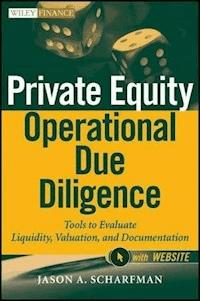
A step-by-step guide to develop a flexible comprehensive operational due diligence program for private equity and real estate funds Addressing the unique aspects and challenges associated with performing operational due diligence review of both private equity and real estate asset classes, this essential guide provides readers with the tools to develop a flexible comprehensive operational due diligence program for private equity and real estate. It includes techniques for analyzing fund legal documents and financial statements, as well as methods for evaluating operational risks concerning valuation methodologies, pricing documentation and illiquidity concerns. * Covers topics including fund legal documents and financial statement analysis techniques * Includes case studies in operational fraud * Companion website includes sample checklists, templates, spreadsheets, and links to laws and regulations referenced in the book * Equips investors with the tools to evaluate liquidity, valuation, and documentation * Also by Jason Scharfman: Hedge Fund Operational Due Diligence: Understanding the Risks Filled with case studies, this book is required reading for private equity and real estate investors, as well as fund managers and service providers, for performing due diligence on the noninvestment risks associated with private equity and real estate funds.
Sie lesen das E-Book in den Legimi-Apps auf:
Seitenzahl: 678
Veröffentlichungsjahr: 2012
Ähnliche
















Contents
Cover
Series
Title Page
Copyright
Dedication
Preface
CHAPTER 1: Introduction to Private Equity Operational Risk
INTRODUCTION TO OPERATIONAL RISK
OPERATIONAL RISK COMPARED TO OPERATIONAL DUE DILIGENCE
WHAT IS OPERATIONAL DUE DILIGENCE?
OPERATIONAL DUE DILIGENCE IN THE FIELD OF PRIVATE EQUITY
OPERATIONAL DUE DILIGENCE AS DISTINGUISHED FROM OPERATIONAL MANAGEMENT OF PORTFOLIO COMPANIES
TIMING OF OPERATIONAL DUE DILIGENCE IN THE INVESTING PROCESS
OPERATIONAL DUE DILIGENCE PROCESS
HISTORICAL PERSPECTIVES OF PRIVATE EQUITY OPERATIONAL RISK
ITEMS TYPICALLY COVERED DURING THE OPERATIONAL DUE DILIGENCE PROCESS
CORE VERSUS EXPANDED OPERATIONAL DUE DILIGENCE REVIEWS
SHARED COMMONALITIES BETWEEN PRIVATE EQUITY AND REAL ESTATE OPERATIONS RISK
DIFFERENCES IN OPERATIONAL RISK FACTORS BETWEEN PRIVATE EQUITY AND REAL ESTATE
COUNTRY- AND INDUSTRY-SPECIFIC RISK CONSIDERATIONS
INVESTMENT AND OPERATIONAL DUE DILIGENCE: NEXUS OR BLURRED LINES?
DIFFERENCES AND SIMILARITIES WITH HEDGE FUND OPERATIONAL DUE DILIGENCE
CHAPTER 2: Importance of Operational Due Diligence for Private Equity Funds
UNDERSTANDING THE GOALS OF THE OPERATIONAL DUE DILIGENCE PROCESS
COMMON ARGUMENTS AGAINST OPERATIONAL REVIEWS OF PRIVATE EQUITY FUNDS
COMMON ARGUMENTS IN FAVOR OF PERFORMING OPERATIONAL REVIEWS OF PRIVATE EQUITY FUNDS
CONCLUSION
CHAPTER 3: Beginning the Operational Due Diligence Review: Core Issues
GOAL SELF-ASSESSMENT
DESIGNING AN OPERATIONAL DUE DILIGENCE PROGRAM FOR PRIVATE EQUITY
WHEN DOES THE OPERATIONAL DUE DILIGENCE PROCESS BEGIN?
SIGNALING EFFECTS OF OPERATIONAL FLAGS
REQUESTING AND COLLECTING DOCUMENTATION
NONDISCLOSURE AND CONFIDENTIALITY AGREEMENTS
DOCUMENT COLLECTION: WHAT DOCUMENTS SHOULD INVESTORS REQUEST?
DOCUMENT COLLECTION NEGOTIATION TECHNIQUES: AVOIDING A PASS-THE-BUCK ENVIRONMENT
DOCUMENT COLLECTION: HARD COPY OR ELECTRONIC?
FUND MANAGER ON-SITE DUE DILIGENCE CONSIDERATIONS
KEY RISK CONSIDERATION AREAS TO COVER
CONCLUSION
CHAPTER 4: Additional Operational Due Diligence Considerations: An Expanded Analysis
CORE ISSUES VERSUS EXPANDED ANALYSIS
COMPENSATION STRUCTURES
INTRODUCTION TO PRIVATE EQUITY FUND FEES
MANAGER INVESTMENT IN FUNDS
EVALUATING SERVICE PROVIDERS
ADDITIONAL ON-SITE VISIT CONSIDERATIONS: NEGATIVE OPERATIONAL DUE DILIGENCE
ADDITIONAL ON-SITE VISIT CONSIDERATIONS: INTERVIEW TECHNIQUES AND QUESTION DESIGN
ASSET RAISING AND THE USE OF PLACEMENT AGENTS AND THIRD-PARTY MARKETERS
CASH MANAGEMENT AND CONTROLS
BUSINESS CONTINUITY AND DISASTER RECOVERY
UNDERSTANDING THE TRADE LIFE CYCLE PROCESS
LEGAL, COMPLIANCE, AND REGULATORY RISKS
INSURANCE
TECHNOLOGY AND SYSTEMS
TAX PRACTICES
DIAGNOSING AND MITIGATING REPUTATIONAL RISK
CONCLUSION
CHAPTER 5: Valuation Techniques, Methodologies, and Standards
LIMITED PARTNER DISTINCTION BETWEEN FUND LEVEL AND PORTFOLIO COMPANY VALUATION APPROACHES
VALUATION CONSIDERATIONS FOR NEWLY FORMED FUNDS
INTRODUCTION TO VALUATION
GIPS STATEMENT ON PRIVATE EQUITY
IPEV GUIDELINES
FAS 157
USE OF THIRD-PARTY VALUATION CONSULTANTS
VALUATION OUTPUT PROCESS DOCUMENTATION
VALUATION COMMITTEE REVIEW SCOPE
ADDITIONAL LIMITED PARTNER VALUATION CONSIDERATIONS
CONCLUSION
CHAPTER 6: Legal Due Diligence
OPERATIONAL DUE DILIGENCE SPECIALISTS VERSUS GENERALISTS
COMMON PRIVATE EQUITY FUND STRUCTURES
UNDERSTANDING THE PRIVATE PLACEMENT MEMORANDUM
COMMON DOCUMENT RISK ASSIGNMENT TERMS
EXCULPATION AND INDEMNITY
TRENDS IN INDEMNIFICATION AND EXCULPATION CLAUSES
OTHER LEGAL DOCUMENTS CONSIDERATIONS
CONCLUSION
CHAPTER 7: Financial Statement Due Diligence
AUDIT STANDARDS
ACCOUNTING STANDARDS
OTHER FINANCIAL STATEMENT FORMATS
CONSIDERATIONS THAT ARE UNIQUE TO PRIVATE EQUITY AND REAL ESTATE FINANCIAL STATEMENTS
UNDERSTANDING FINANCIAL STATEMENT SECTIONS
OTHER FINANCIAL STATEMENT SECTIONS
UNDERSTANDING FAS 157
CONCLUSION
CHAPTER 8: Distinguishing the Assets Class: Real Estate–Specific Concerns
REAL ESTATE TRADE FLOW PROCESS
SAMPLE REAL ESTATE PROCESS
REAL ESTATE VALUATION
MONITORING CONFLICTS OF INTEREST
FRAUD CONSIDERATIONS: MORTGAGE FRAUD AND STRAW-MAN BORROWERS
UNDERSTANDING REAL ESTATE FUND FEES
PROPERTY HOLDINGS LEGAL CONSIDERATIONS
CONCLUSION
CHAPTER 9: Putting It All Together: Asset Allocation and Ongoing Monitoring
INCORPORATING THE RESULTS OF OPERATIONAL DUE DILIGENCE INTO ASSET ALLOCATION
EVOLUTION OF MINIMUM OPERATIONAL RISK REGIME (MORR)
OPERATIONAL RISK CORRELATIONS TO PORTFOLIO TRANSACTION FREQUENCY
OPERATIONAL LIFT-TO-DRAG RATIO
NEGOTIATING PRIVATE EQUITY SIDE LETTERS
ONGOING MONITORING: OPERATIONAL DUE DILIGENCE MONITORING FOR PRIVATE EQUITY FUNDS
CONCLUSION
APPENDIX 9A: Mathematical Concepts
THE DERIVATIVE
THE CHAIN RULE
THE SECOND PARTIAL DERIVATIVE TEST
CHAPTER 10: Boards, Committees, and Activism
PRIVATE EQUITY FUND ADVISORY BOARDS
DIFFERENT TYPES OF ADVISORY BOARDS: LIMITED PARTNERS VERSUS PURE ADVISORS
ONGOING OPERATIONAL DUE DILIGENCE MONITORING ADVISORY BENEFITS
BALANCING THE ROLE OF INNER CIRCLE VERSUS BROADLY REPRESENTATIVE ADVISORY BOARDS
ADVISORY BOARD CRITICISMS: CROWDING OUT, POWER AGGREGATION, AND REDUNDANT BOARD LAYERS
INFORMATION FLOW CONSIDERATIONS FROM UNDERLYING PORTFOLIO GENERAL PARTNER TO LIMITED PARTNERS
LIMITED PARTNER DUE DILIGENCE CONSIDERATIONS FOR A PRIVATE EQUITY FUND OF FUNDS
ADDITIONAL PRIVATE EQUITY ADVISORY BOARD CONSIDERATIONS
CONCLUSION
CHAPTER 11: Case Studies and Scenarios
CASE STUDIES
HYPOTHETICAL SCENARIOS
CHAPTER 12: Trends and Future Developments
USE OF THIRD-PARTY ADMINISTRATORS
INCREASED FOCUS ON MATERIAL NONPUBLIC INFORMATION IN THE UNITED STATES
INCREASED RELIANCE ON AUDIT-TYPE CERTIFICATIONS
INCREASED USE OF OPERATIONAL DUE DILIGENCE CONSULTANTS
POOLING OPERATIONAL DUE DILIGENCE RESOURCES AMONG MULTIPLE LPS
OPERATIONAL BENCHMARKING
ILPA GUIDELINES
FROM SELF-REGULATION TO MANDATORY REGISTRATION
IMPACT OF DODD-FRANK ON OPERATIONAL DUE DILIGENCE
CONCLUSION
About the Author
About the Website
Index
Founded in 1807, John Wiley & Sons is the oldest independent publishing company in the United States. With offices in North America, Europe, Australia and Asia, Wiley is globally committed to developing and marketing print and electronic products and services for our customers’ professional and personal knowledge and understanding.
The Wiley Finance series contains books written specifically for finance and investment professionals as well as sophisticated individual investors and their financial advisors. Book topics range from portfolio management to e-commerce, risk management, financial engineering, valuation and financial instrument analysis, as well as much more.
For a list of available titles, visit our Web site at www.WileyFinance.com.
Copyright © 2012 by Jason A. Scharfman. All rights reserved.
Published by John Wiley & Sons, Inc., Hoboken, New Jersey. Published simultaneously in Canada.
No part of this publication may be reproduced, stored in a retrieval system, or transmitted in any form or by any means, electronic, mechanical, photocopying, recording, scanning, or otherwise, except as permitted under Section 107 or 108 of the 1976 United States Copyright Act, without either the prior written permission of the Publisher, or authorization through payment of the appropriate per-copy fee to the Copyright Clearance Center, Inc., 222 Rosewood Drive, Danvers, MA 01923, (978) 750-8400, fax (978) 646-8600, or on the Web at www.copyright.com. Requests to the Publisher for permission should be addressed to the Permissions Department, John Wiley & Sons, Inc., 111 River Street, Hoboken, NJ 07030, (201) 748-6011, fax (201) 748-6008, or online at http://www.wiley.com/go/permissions.
Limit of Liability/Disclaimer of Warranty: While the publisher and author have used their best efforts in preparing this book, they make no representations or warranties with respect to the accuracy or completeness of the contents of this book and specifically disclaim any implied warranties of merchantability or fitness for a particular purpose. No warranty may be created or extended by sales representatives or written sales materials. The advice and strategies contained herein may not be suitable for your situation. You should consult with a professional where appropriate. Neither the publisher nor author shall be liable for any loss of profit or any other commercial damages, including but not limited to special, incidental, consequential, or other damages.
For general information on our other products and services or for technical support, please contact our Customer Care Department within the United States at (800) 762-2974, outside the United States at (317) 572-3993 or fax (317) 572-4002.
Wiley also publishes its books in a variety of electronic formats. Some content that appears in print may not be available in electronic books. For more information about Wiley products, visit our web site at www.wiley.com.
Library of Congress Cataloging-in-Publication Data:
Scharfman, Jason A., 1978–
Private equity operational due diligence : tools to evaluate liquidity, valuation, and documentation / Jason A. Scharfman.
pages cm. – (The Wiley finance series ; 731)
Includes bibliographical references and index.
ISBN 978-1-118-11390-5; ISBN 978-1-118-22416-8 (ebk);
ISBN 978-1-118-23747-2 (ebk); ISBN 978-1-118-26243-6 (ebk)
1. Private equity. 2. Real estate investment. 3. Reasonable care (Law) I. Title.
HG4751.S33 2012
332.63′2–dc23
2011048538
I dedicate this book to my wife, Rachel, for her endless support, to my brother, Barry, to my parents, Gloria and Michael, and to my entire family for their never-ending encouragement.
Preface
People tend to not take operational due diligence in the field of private equity very seriously. The risk category that operational due diligence is supposed to evaluate—operational risk—is not as narrowly defined as other related types of risks, such as credit risk, counterparty risk, currency risk, and so forth. Depending on the context, the implications of the term operational risk can change. In part, the broadness of the field and subsequent confusion about exactly what is meant when discussing operational risk and operational due diligence are likely contributing factors to the lack of attention paid to this risk category.
When an investor first decides to take the plunge into private equity investing, it is often an anticlimactic choice. In some cases, hundreds of millions of dollars are committed by institutional Limited Partners (LPs) to private equity funds, but the money may not generate returns for years. Yet, with such a long-term commitment of capital into a traditionally illiquid and complex asset class, it would seem only logical that LPs would seek to perform at least as rigorous a due diligence analysis on a private equity fund as they perform on other asset classes, such as hedge funds. In investing arenas outside of private equity, operational due diligence has slowly gained acceptance over the years. Within the alternative investment arena in general and hedge funds in particular, a key driver of increased focus is the losses that have been caused by fraudulent activity, which in turn was facilitated by weak operations. In recent memory, investors have seen a number of headlines and articles about the hundreds of millions in losses associated with names such as Bernard Madoff, R. Allen Stanford, Jerome Kerviel, Tom Petters, and Samuel Israel III, which help to explain the meteoric rise in interest in operational due diligence in the alternative space. Even as this book is being written, alleged UBS rogue trader Kewku Adoboli has been charged with fraud that resulted in a loss of over $2 billion. Because of a series of similar private equity frauds, LPs and, however begrudgingly, General Partners (GPs) have begun to respect the need for private equity operational due diligence.
But operational due diligence involves a great deal more than fraud detection. Sometimes honest GPs and LPs simply do not have the requisite skills, resources, or foresight to avoid underperformance or losses due primarily to operational concerns. Proper operational risk management within a fund is not simply a matter of throwing experience or money at the problem. Rather, operational risk evolves within a fund organization over time. To effectively manage its own internal operational risk exposure, a fund's management must be actively involved in all aspects of operations oversight. At different times and during different types of market events, private equity funds may react differently and the ensuing consequences may not be uniform for their internal fund operations.
Operational due diligence is an ongoing diagnostic process. Much like private equity investing itself, however, operational due diligence on private equity investments requires a measured dose of patience. Due diligence can be more art than science, and a thorough analysis will allow investors to detect funds that will have an increased likelihood for underperformance or for failure in the event of unexpected stresses.
This book seeks to accomplish several goals, but in particular the author wishes to convince LPs of the benefits of designing, performing, and maintaining a robust operational due diligence program for private equity funds. To support this cause, I have outlined a brief history of operational risk coupled with an introduction to the unique aspects of operational due diligence on private equity funds.
The second aim of this book is to provide LPs with the tools necessary to execute detailed comprehensive operational due diligence reviews of private equity funds. To accomplish this, I have outlined the elements of core and expanded operational due diligence reviews. I have provided comprehensive chapters dedicated to analyzing approaches to valuation, legal, and financial statement risks. In Chapters and you will see a red flag icon (like the one set next to this paragraph) that indicates key operational risk areas in which deficiencies have historically tended to signal larger problems.
I also offer a summary of historical private equity frauds and hypothetical case studies to familiarize LPs with the scenarios they may encounter when performing operational due diligence. This discussion also includes a review of the key considerations LPs should take into account when reviewing real estate funds.
Additionally, this book seeks to broaden the discussion surrounding operational risk assessment in private equity funds beyond the notions of “pass” or “fail.” To accomplish this, I have provided an introduction to incorporating the results of operational due diligence reviews into the asset allocation process. This book also includes discussions regarding ongoing operational monitoring techniques and the role of advisory boards in due diligence.
Finally, one of the other goals of this book is to foster an increased understanding among investors in the private equity community about the rights of LPs to perform comprehensive operational due diligence reviews and the ways in which GPs approach operational risk management. It is likely that there will be readers who disagree with some of the opinions and conclusions presented in this book. Debates are welcomed, and I encourage all those interested in private equity to throw their hats into the arena, to join in and discuss the issues and enhance the larger community's understanding and focus in the field of operational risk.
A detailed, comprehensive operational due diligence program for private equity funds requires time, resources, and skill to develop and refine over time. The benefits of implementing such a program with discipline, uniformity, and caution are that it will allow Limited Partners to weed out managers with weaker operations, make investment decisions with stronger convictions, facilitate ongoing monitoring, and avoid losses associated with operational risks. It is my hope that the techniques and advice in this book are taken up by LPs and more risk-conscious GPs. Perhaps Ben Franklin's saying best sums up the importance of operational due diligence in the illiquid, complex, and often opaque field of private equity investing: “An ounce of prevention is worth a pound of cure.”
JASON SCHARFMANMarch 2012
CHAPTER 1
Introduction to Private Equity Operational Risk
Private equity investing is a unique asset class that can offer a number of attractive benefits to investors. Compared to more traditional investments, some of the benefits associated with private equity investing can include the ability to focus on long-term capital growth with higher uncorrelated returns. Despite these benefits, as is the case with any asset class, private equity investing is also fraught with a number of unique risk sets and challenges that investors must consider. These risks can include traditional investment-related risks such as style drift, excessive risk taking, and overall poor performance. When investing in private equity, investors are also exposed to a series of what may be thought of as risks that are not purely related to investments. These risks have become commonly grouped together under the moniker of operational risks. But what exactly is this mysterious risk category known as operational risk?
INTRODUCTION TO OPERATIONAL RISK
Noninvestment-related risks can be often grouped into different categories due to certain shared similarities. These noninvestment risks also go by many names depending on with whom you are speaking. Some may refer to these noninvestment related risks as fat-tail risks. The term fat-tail risks is used due to the severe effects that these risk may have, coupled with the perceived infrequency with which they actually cause damage. Others may use the terms business risk or organizational risk. The term that most individuals who focus on analyzing and monitoring these risks have settled on in recent years is operational risk.
The concept of operational risk is not unique to the world of private equity. Indeed, it is not even unique to asset management or the financial industry in general. Concerns related to risk management falling under the heading of operational risk are present across a number of industries that have nothing whatsoever to do with the business of investing or managing money. The FAA System Safety Handbook for pilots has a section dedicated to Operational Risk Management (ORM) and defines the goals of ORM as “protecting people, equipment, and other resources, while making the most effective use of them.”1 In the medical field, surgeons have procedures in place to mitigate literal operational risk, to prevent mistakes such as wrong-side surgery when conducting actual operations on patients.2
With such a well-developed field spanning multiple disciplines, why in recent years has there been a flurry of interest in a subject that is supposedly so well fleshed out? After all, with a large body of research on operational risk in other fields not related to asset management or private equity, could a discussion of operational risk and due diligence in a private equity context actually yield anything new? While the field of private equity investing has continued to increase in complexity and specialization, the issues of operational risk and due diligence areas applicable to private equity as they are in other fields. This ambivalent situation can perhaps be best summed up by a comment that Pablo Picasso is rumored to have made following a viewing at Lascaux Cave of some of the earliest prehistoric cave paintings ever discovered: “We have invented nothing.”
Regardless of the field or context in which operational risk is being discussed, often times it seems both practitioners and academics alike have a difficult time pinning down an appropriate definition of this broad topic. Part of this problem perhaps stems from the typically broad number of topics and disciplines that operational risk generally encompasses. Within the financial and specifically asset management world, defining operational risk is often a contentious exercise at best. Indeed, as Chapter 2 discusses in more depth, many in the asset management world and private equity communities in particular, may not even see a real need to devote material resources toward analyzing operational risk in private equity funds.
Indeed, why bother attempting to develop a definition of something if there is a commonly held belief that the very thing attempting to be defined is not itself of any consequence? Stated plainly, as the reader may be able to gather from the title of this book, operational risk not only matters but should be of paramount importance to any investor even considering investing in private equity. As an aside, for those in the private equity community who may disagree with this statement, I invite them to read this book, fully consider the benefits of developing a private equity operational risk assessment program and ultimately think about whether or not they would find making a more informed decision (e.g., a decision based on an understanding of not only the investment risks of a particular private equity investment, but the operational risks as well) to be the most prudent course by which to proceed. Ultimately, more informed investors tend to make better investment decisions and realize fewer losses due to operational risks.
Lesen Sie weiter in der vollständigen Ausgabe!
Lesen Sie weiter in der vollständigen Ausgabe!
Lesen Sie weiter in der vollständigen Ausgabe!
Lesen Sie weiter in der vollständigen Ausgabe!
Lesen Sie weiter in der vollständigen Ausgabe!
Lesen Sie weiter in der vollständigen Ausgabe!
Lesen Sie weiter in der vollständigen Ausgabe!
Lesen Sie weiter in der vollständigen Ausgabe!
Lesen Sie weiter in der vollständigen Ausgabe!
Lesen Sie weiter in der vollständigen Ausgabe!
Lesen Sie weiter in der vollständigen Ausgabe!
Lesen Sie weiter in der vollständigen Ausgabe!
Lesen Sie weiter in der vollständigen Ausgabe!
Lesen Sie weiter in der vollständigen Ausgabe!
Lesen Sie weiter in der vollständigen Ausgabe!




