


38,99 €
Mehr erfahren.
- Herausgeber: John Wiley & Sons
- Kategorie: Fachliteratur
- Sprache: Englisch
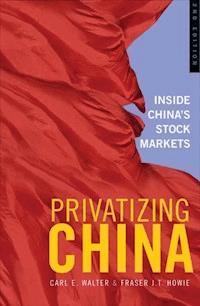
PRIVATIZING CHINA INSIDE CHINA'S STOCK MARKETS In more depth than any other, this highly readable book lays bare why China's capital markets have fallen so far short of their promise. It is required reading for anyone seeking to understand the realities and the future of an extraordinary economic transformation. - James Kynge, Former Beijing Bureau Chief, Financial Times, Author, China Shakes the World Carl Walter and Fraser Howie bring together a wealth of experience to this complex and deeply important topic. Their book contains a mine of invaluable quantitative and qualitative information as well as an incredible depth of knowledge. It is essential reading for anyone investing in companies from mainland China. - Professor Peter Nolan, Judge Institute of Management Studies, University of Cambridge Privatizing China is essential for anyone who wants to understand China's companies and stock markets. no one should invest in China without reading it. - Arthur Kroeber, Managing Editor, China Economic Quarterly Carl Walter and Fraser Howie combine a deep knowledge of China and finance to provide an unflinching perspective on the country's effort to build functioning capital markets. China may have wowed the world with its high-speed economic growth and manufacturing prowess, but this book is compelling evidence that Beijing's mastery of the universe does not yet extend to the stock market. - Richard MacGregor, beijing Correspodent, FinancialTimes This book will answer many people's questions regarding SOEs and the stock market. I think it is destined to become the standard reference work on the subject. - Jean C. Oi, Director, Center for East Asian Studies, Stanford University
Sie lesen das E-Book in den Legimi-Apps auf:
Seitenzahl: 639
Veröffentlichungsjahr: 2011
Ähnliche



















Copyright © 2009 John Wiley & Sons (Asia) Pte. Ltd.
Published in 2009 by John Wiley & Sons (Asia) Pte. Ltd.
2 Clementi Loop, #02-01, Singapore 129809
All rights reserved.
No part of this publication may be reproduced, stored in a retrieval system, or transmitted in any form or by any means, electronic, mechanical, photocopying, recording, scanning, or otherwise, except as expressly permitted by law, without either the prior written permission of the Publisher, or authorization through payment of the appropriate photocopy fee to the Copyright Clearance Center. Requests for permission should be addressed to the Publisher, John Wiley & Sons (Asia) Pte. Ltd., 2 Clementi Loop, #02-01, Singapore 129809, tel: 65-64632400, fax: 65-64646912, e-mail: enquiry@wiley.com.sg.
This publication is designed to provide accurate and authoritative information in regard to the subject matter covered. It is sold with the understanding that the publisher is not engaged in rendering professional services. If professional advice or other expert assistance is required, the services of a competent professional person should be sought.
Other Wiley Editorial Offices
John Wiley & Sons, 111 River Street, Hoboken, NJ 07030, USA
John Wiley & Sons, The Atrium, Southern Gate, Chichester, West Sussex, P019 8SQ, United Kingdom
John Wiley & Sons (Canada) Ltd., 5353 Dundas Street West, Suite 400, Toronto, Ontario, M9B 6HB, Canada
John Wiley & Sons Australia Ltd, 42 McDougall Street, Milton, Queensland 4064, Australia
Wiley-VCH, Boschstrasse 12, D-69469 Weinheim, Germany
Library of Congress Cataloging-in-Publication Data:
ISBN 13-978-0-470-82214-0
ISBN 10-0-470-82214-7
Once again, for our families and friends
Table of Contents
Preface
List of Abbreviations
Chronology
1. “You’re None of Those!”
2. How China’s Stock Markets Came to Be
The Evolution of the Shenzhen and Shanghai Securities Markets
Original Structure of the Shanghai and Shenzhen Exchanges
The Stock Exchange Executive Council and the Electronic Markets (STAQ and NETS)
The regional trading centers
The auction houses
The Third Board
3. Who Minds the Fox: The Regulators
The PBOC: Market player or market regulator?
Building the CSRC
The internationalization of the CSRC
The Stock Exchange OF Hong Kong goes to the top
The CSRC’s domestic struggle
Regulatory philosophy
The CSRC takes the initiative, 2000–02
4. Defining Ownership: Share Types
Shares of what?
The 1992 Standard Opinion
The 1994 Company Law
Listed company shares
The 1999 Securities Law
5. Packaging SOEs: Restructuring and Listing
Evolution of Chinese corporate law
How to “package” an SOE
Corporate restructuring for international listing
6. The Fortunate Few: Listed Companies
Who decides who lists?
International pricing
A share pricing
Analysis of listed companies
A note on private companies
7. Where Have All the (Retail) Investors Gone?
How many investors?
Who are China’s investors?
8. Sliced and Diced: China’s Segmented Stock Markets
Segmented markets
Is there a company value?
Economic inefficiencies of segmented markets
Circles of ownership
Privatization with Chinese characteristics?
9. Searching for the Big Fix, 2001–05
Trying to merge the segmented markets
The character of the market in the new century
Coming up with the Big Fix
The terms of the debate about state shares
The securities industry debacle
10. How CSRC Sought to Merge the Markets: the G Company Reform
SASAC: defender of state property rights
The CSRC’s “Final Fix”
Pilot projects for the new policy: Sany Industrial
Warrants and SASAC’s champion: BaoSteel
11. Foreign Investors in China’s Stock Market
All about QFII
How is QFII being used?
QFII investment allocation
Does QFII matter?
Foreign investment in non-tradable (then tradable) shares
12. Bulls and Bears: Summing Up
China’s bull markets, 1990–2001
The end of an era: China’s Internet boom and bust, 2000–05
Taking the market’s measure
A summing up
Appendix 1: China’s Red-Hot Primary Markets
Appendix 2: Glossary of English/Chinese Securities Terminology
Endnotes
Select Bibliography
Index
Preface
Three years have passed since the publication of Privatizing China, which we thought presented a definitive version of China's stock markets after a decade of development. Writing in late 2002, when the notional capitalization of the markets, at more than US$500 billion, was the second largest in non-Japan Asia, we were optimistic that it was poised to break through the obstacles holding it back. After all, China was entering the hottest period of its post-reform development, and talk was ubiquitous about the 21st century belonging to the Chinese. A major investment bank even wrote a report showing that the country's GDP would by mid-century exceed that of the U.S. Entry into a framework leading to full membership in the World Trade Organization in late 2006 led to a boom in China's exports and world recognition of the country's emergence into the global economy. And in truth, the past five years have seen the creation of more wealth in China's coastal cities and provinces than at possibly any time in world history except the post-war U.S. The place has simply boomed. But the stock market together with the securities industry itself collapsed. How, with GDP growth averaging near 10% per annum, could this have happened?
The simple answer is that Deng Xiaoping was wrong: stock markets cannot be successfully adapted to an economy lacking private property and dominated in all important aspects by agencies of the government. As this book attempts to show, the compromises made by the government to prevent stock markets from leading to outright privatization of state-owned companies did create a very vibrant market, just not one for listed companies. They created multiple markets for the shares of the same issuer, each with different rules, regulators, and pricing mechanisms! What is particularly ironic is that a policy designed to prevent state property from falling into private hands was easily twisted by market forces: by year-end 2005, some 26% of listed companies in China were controlled by private individuals.
Then, after nine years of wild speculation and rampant fraud, the government in mid-2001 sought to bring together the two principal domestic markets—A shares and non-tradable shares. What would have been the modest start of a long, drawn-out process to achieve this led directly to the collapse of the A share markets in Shanghai and Shenzhen. The markets continued their fall for four years, losing more than 50% of their value by mid-2005 amid bungled policies, regulatory indecisiveness, and ferocious lobbying by the securities industry to restore the status quo.
During this time, all market stakeholders came to realize that restoring the markets to health would be impossible without resolving the problem of non-tradable shares. Unwilling to take endless losses, retail investors fled the market in droves—by year-end 2005 official reports noted that nearly two-thirds of investor accounts were empty. The consequent decline of trading volume and massive securities fraud drove the industry into bankruptcy. More industry lobbying for a favorable way out resulted in a “final solution” to the problem of divided markets in mid-2005, the so-called “G company” reform. Of course, the industry was the principal short term beneficiary. In addition, many of the major securities companies (but not their shareholders) survived bankruptcy thanks to a massive recapitalization led by the central government. How this all happened, and the bureaucratic infighting over the corpse of the securities industry is amply documented in this revised edition.
In spite of the huge market run-up beginning in early 2006, it is too early to know whether the non-tradable share problem has finally been resolved. These shares have been locked up for three years, only after which can their holders monetize them. In other words, the ultimate impact of this “final solution” has been pushed off onto the plates of future officials. What is clear at this point in time is that China fever is back in strength in the H share, the A share, and the skyrocketing commodities markets. If a conclusion can be drawn at this early date, we believe that very little has yet to change in the practical reality of how China's markets work. Whether China can yet develop a true market, allocating scarce capital to those sectors and companies yielding the highest return remains an open question.
We have had tremendous fun writing and then revising this book. China's stock markets, no matter what else they may do, produce endless stories that illuminate the true character of the economy as a whole and the conundrum faced by a state that desperately seeks modernization on its own terms. No matter how distorted by government intervention, the stock market in China is a market driven by an unceasing demand for capital. What is for sale will be sold so that the ultimate outcome is plain for all to see.
Many people have helped make this book possible, in particular our readers. Over the years, we have received continuous support from them that has encouraged us in what otherwise might only have been seen as an arcane and somewhat academic hobby. There has even been a Chinese translation (Minyinghua zai Zhongguo; ISBN 7-5058-4628-0), which makes us particularly proud. Of course, without the continuing support of the folks at John Wiley & Sons none of this would have happened. Nick Wallwork, our publisher, has been unceasingly supportive, and we are much indebted to him. Our editors, Robyn Flemming and David Rule, have penetrated our arcane facts and obscure prose to produce a much more readable book. Janis Soo and Pauline Pek, who have worked with us on the details of the manuscript have been responsive and fun to deal with. Once again, our families have suffered mightily from our continuing fascination. We promised after the first edition never to do it again, but we were wrong. We are grateful for their understanding and continuing support. This time, no promises!
There are, no doubt, many errors or omissions in this edition that we have still not caught. They are our responsibility. We again point out that the contents and views herein represent only our own opinions and not those of the firms with which we are associated. We remain hopeful that in the not too distant future we can put this now academic work to practical use directly in China's securities markets. This should have happened long since.
Carl E. Walter
Fraser J.T. Howie
Beijing
August 2006
List of Abbreviations
AMCasset management companyBoCommBank of CommunicationsCBconvertible bondsCGBChinese government bondCIRCChinese Insurance Regulatory CommissionCSRCChina Securities Regulatory CommissionEPSearnings per shareFMCfund management companyGEMHong Kong Growth Enterprise MarketHSCCIHang Seng China-Affiliated Corporations IndexIPOinitial public offeringLPlegal person (shares)MBOmanagement buy-outMOFMinistry of FinanceMOFERT Ministry of Foreign Economic Relations and TradeMOFTECMinistry of Foreign Trade and Economic CooperationNAVnet asset valueNDRCNational Development and Reform CommissionNETSNational Electronic Trading SystemNSSFNational Social Security FundOTCover the counterPBOCPeople's Bank of ChinaP/Eprice/earnings ratioPTparticular treatment (shares)QDIIQualified Domestic Institutional InvestorQFIIQualified Foreign Institutional InvestorSACSecurities Association of ChinaSAFEState Administration of Foreign ExchangeSAMBState Asset Management BureauSASACState-owned Assets Supervision and Administration CommissionSCRESState Committee for the Restructuring of the Economic SystemSDBShenzhen Development BankSEC(U.S.) Securities and Exchange CommissionSEECStock Exchange Executive CouncilSEHKStock Exchange of Hong KongSOEstate-owned enterpriseSPCState Planning CommissionSSEShanghai Stock ExchangeSTspecial transfer (shares)SZSEShenzhen Stock ExchangeChronology
Historical Performance, Shanghai and Shenzhen Stock Exchanges
1882China's first share trading company, Shanghai Pinghuai Stock Co., founded in October1891Shanghai Stock Exchange founded to broker foreign stocks1905Shanghai People's Exchange founded in Hong Kong1914Shanghai Stock Commercial Association founded: China's first formal stock trading association; Northern Government issues “Stock Exchange Law”1918Beijing Securities Trading Exchange founded1920Shanghai Securities and Commodities Exchange founded and becomes the largest trading center in China; Shanghai Stock Commercial Association changes name to Shanghai Huashang Securities Trading Exchange1921Tianjin Securities Trading Exchange founded1949Tianjin Military Command decides to establish a securities exchange. It opens on June 1, four months before Liberation, with five listed stocks1950Beijing Securities Exchange opens on February 11952Government closes Tianjin and Beijing exchanges in February and July, respectively1978December 22Third Plenum of 11th Party Congress focuses party work from 1979 on economic construction, marking a formal end to the Cultural Revolution and the return of Deng Xiaoping1979July 3State Council issues “Decision on Several Problems on the Development of Commune and Brigade Enterprises” suggesting that rural enterprises could self-finance through selling shares. The shareholding experiment finds its origin in the countrysideOctober 20Liaoning Fushun No. 1 Brick Factory gets party approval for a share issue1980January 1Fushun No. 1 Brick Factory issues shares. This appears to be the first stock issue in post-1949 ChinaJulyChengdu Shudu Office Building Co. Ltd. issues shares. Idea sprang from a movie; also has a claim to be the first offering1981Ministry of Finance revives issuance of treasury bonds1982State Council approves Shenzhen Special Economic Zone to establish shareholding companies1983JulyShenzhen Baoan County United Investment Co. Ltd. issues shares. Often cited as the first share offering1984January 1Central Committee releases “Notice on 1984 Agricultural Work” that permits peasants to invest in shares, marking first-time individuals encouraged to do soApril 16SCRES permits enterprise employees to buy shares of their enterpriseJulyShanghai “Eight Articles” released: first formal regulations for the nascent securities marketSeptemberICBC Shanghai Trust and Investment Company, Jingan Office, establishes first OTC counter for treasury securitiesBeijing Tianqiao Department Store Co. Ltd. issues shares. Often cited as first share offeringOctoberThird Plenum of 12th Party Congress passes “Decision on Reform of the Economic System”—partially resolving the family name game: do shares belong to Mr. Capitalism's family only, or can they also belong to Comrade Socialism's family?November 14Shanghai Feile Acoustics offers shares to the public: first “relatively standardized” public share offering. Feile is seen as the first IPO of the New EraDecemberShanghai has recorded 1,700 share issues raising RMB240 million; Shenyang 502, including 14 public issues, raising RMB400 million1985September 27First specialized securities company established. PBOC Beijing approves Shenzhen Special Economic Zone (SEZ) Securities Company. Opening delayed for two more years due to ideological disputes1986January 7State Council announces “Provisional Regulations on the Administration of Banks” giving PBOC authority over the financial sector, including, as an afterthought, securitiesMarch 10State Council in conference summary notes that “Some Chinese companies may implement a completely new system based on shareholding.”August 5China's first securities exchange opens: the Shenyang Securities Exchange sponsored by the Shenyang City Trust Company and owned by PBOC Shenyang BranchSeptember 26Shanghai ICBC, Jingan Office, starts OTC share tradingOctober 15Shenzhen Provisions released. These were the first comprehensive attempt to define and regulate the corporatization and listing processNovember 11Deng Xiaoping receives the chairman of the NYSE in the Great Hall of the People. The gift presented—a single (fake!) share in Feile Acoustics—caused a great tizzyDecember 5State Council releases regulations permitting local governments to select a few large and medium-size SOEs as pilots for shareholding experiments1987March 25Premier Li Peng's Government report to the National People's Congress encourages the shareholding experimentMarch 28State Council formally makes PBOC the regulator and supervisory agency for the corporatization and securities listing experimentMaySales begin of Shenzhen Development Bank IPO shares, including 170,000 shares denominated in Hong Kong dollarsSeptemberShenzhen Securities Company at last establishedOctober 2513th Party Congress report confirms continuation of shareholding experiment1988To facilitate sales and transfer of treasury securities, the PBOC sets up 34 securities companies; by year-end, there were over 100 trading counters in operation across the countryMarchGao Xiqing, Wang Boming, and Wang Wei submit to senior party leadership “Policy Suggestions for Promoting the Legalization and Standardization of China's Securities Markets (Preliminary Draft)”Lesen Sie weiter in der vollständigen Ausgabe!
Lesen Sie weiter in der vollständigen Ausgabe!
Lesen Sie weiter in der vollständigen Ausgabe!
Lesen Sie weiter in der vollständigen Ausgabe!
Lesen Sie weiter in der vollständigen Ausgabe!
Lesen Sie weiter in der vollständigen Ausgabe!
Lesen Sie weiter in der vollständigen Ausgabe!
Lesen Sie weiter in der vollständigen Ausgabe!
Lesen Sie weiter in der vollständigen Ausgabe!
Lesen Sie weiter in der vollständigen Ausgabe!
Lesen Sie weiter in der vollständigen Ausgabe!
Lesen Sie weiter in der vollständigen Ausgabe!
Lesen Sie weiter in der vollständigen Ausgabe!
Lesen Sie weiter in der vollständigen Ausgabe!
Lesen Sie weiter in der vollständigen Ausgabe!
Lesen Sie weiter in der vollständigen Ausgabe!
Lesen Sie weiter in der vollständigen Ausgabe!




