


42,99 €
Mehr erfahren.
- Herausgeber: John Wiley & Sons
- Kategorie: Fachliteratur
- Serie: Wiley Finance Series
- Sprache: Englisch
Mathematical finance requires the use of advanced mathematical techniques drawn from the theory of probability, stochastic processes and stochastic differential equations. These areas are generally introduced and developed at an abstract level, making it problematic when applying these techniques to practical issues in finance.
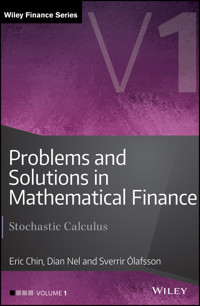
Problems and Solutions in Mathematical Finance Volume I: Stochastic Calculus is the first of a four-volume set of books focusing on problems and solutions in mathematical finance.
This volume introduces the reader to the basic stochastic calculus concepts required for the study of this important subject, providing a large number of worked examples which enable the reader to build the necessary foundation for more practical orientated problems in the later volumes. Through this application and by working through the numerous examples, the reader will properly understand and appreciate the fundamentals that underpin mathematical finance.
Written mainly for students, industry practitioners and those involved in teaching in this field of study, Stochastic Calculus provides a valuable reference book to complement one’s further understanding of mathematical finance.
Sie lesen das E-Book in den Legimi-Apps auf:
Seitenzahl: 282
Veröffentlichungsjahr: 2014
Ähnliche



















Table of Contents
Title Page
Copyright
Dedication
Preface
Prologue
In The Beginning Was The Motion…
About the Authors
Chapter 1: General Probability Theory
1.1 Introduction
1.2 Problems and Solutions
Chapter 2: Wiener Process
2.1 Introduction
2.2 Problems and Solutions
Chapter 3: Stochastic Differential Equations
3.1 Introduction
3.2 Problems and Solutions
Chapter 4: Change of Measure
4.1 Introduction
4.2 Problems and Solutions
Chapter 5: Poisson Process
5.1 Introduction
5.2 Problems and Solutions
Appendix A: Mathematics Formulae
Indices
Surds
Exponential and Natural Logarithm
Quadratic Equation
Binomial Formula
Series
Summation
Trigonometric Functions
Hyperbolic Functions
Complex Numbers
Derivatives
Standard Differentiations
Taylor Series
Maclaurin Series
Landau Symbols and Asymptotics
L'Hospital Rule
Indefinite Integrals
Standard Indefinite Integrals
Definite Integrals
Derivatives of Definite Integrals
Integration by Parts
Integration by Substitution
Gamma Function
Beta Function
Convex Function
Dirac Delta Function
Heaviside Step Function
Fubini's Theorem
Appendix B: Probability Theory Formulae
Probability Concepts
Bayes' Rule
Indicator Function
Discrete Random Variables
Univariate Case
Bivariate Case
Continuous Random Variables
Univariate Case
Bivariate Case
Properties of Expectation and Variance
Properties of Moment Generating and Characteristic Functions
Correlation Coefficient
Convolution
Discrete Distributions
Continuous Distributions
Integrable and Square Integrable Random Variables
Convergence of Random Variables
Relationship Between Modes of Convergence
Dominated Convergence Theorem
Monotone Convergence Theorem
The Weak Law of Large Numbers
The Strong Law of Large Numbers
The Central Limit Theorem
Appendix C: Differential Equations Formulae
Separable Equations
First-Order Ordinary Differential Equations
Second-Order Ordinary Differential Equations
Homogeneous Heat Equations
Stochastic Differential Equations
Black–Scholes Model
Black Model
Garman–Kohlhagen Model
Bibliography
Notation
Set Notation
Mathematical Notation
Probability Notation
Index
End User License Agreement
Pages
ix
x
xi
xii
xiii
xv
1
2
3
4
5
6
7
8
9
10
11
12
13
14
15
16
17
18
19
20
21
22
23
24
25
26
27
28
29
30
31
32
33
34
35
36
37
38
39
40
41
42
43
44
45
46
47
48
49
51
52
53
54
55
56
57
58
59
60
61
62
63
64
65
66
67
68
69
70
71
72
73
74
75
76
77
78
79
80
81
82
83
84
85
86
87
88
89
90
91
92
93
95
96
97
98
99
100
101
102
103
104
105
106
107
108
109
110
111
112
113
114
115
116
117
118
119
120
121
122
123
124
125
126
127
128
129
130
131
132
133
134
135
136
137
138
139
140
141
142
143
144
145
146
147
148
149
150
151
152
153
154
155
156
157
158
159
160
161
162
163
164
165
166
167
168
169
170
171
172
173
174
175
176
177
178
179
180
181
182
183
185
186
187
188
189
190
191
192
193
194
195
196
197
198
199
200
201
202
203
204
205
206
207
208
209
210
211
212
213
214
215
216
217
218
219
220
221
222
223
224
225
226
227
228
229
230
231
232
233
234
235
236
237
238
239
240
241
242
243
244
245
246
247
248
249
250
251
252
253
254
255
256
257
258
259
260
261
262
263
264
265
266
267
268
269
270
271
272
273
274
275
276
277
278
279
280
281
282
283
284
285
286
287
288
289
290
291
292
293
294
295
296
297
298
299
300
301
302
303
304
305
306
307
308
309
310
311
312
313
314
315
316
317
318
319
320
321
322
323
324
325
326
327
328
329
330
331
332
333
334
335
336
337
338
339
341
342
343
344
345
346
347
348
349
350
351
352
353
354
355
357
358
359
360
361
362
363
365
366
367
369
370
371
372
373
374
375
376
377
378
379
Guide
Cover
Table of Contents
Preface
Begin Reading
Problems and Solutions in Mathematical Finance
Volume 1: Stochastic Calculus
Eric Chin, Dian Nel and Sverrir Ólafsson
This edition first published 2014
© 2014 John Wiley & Sons, Ltd
Registered office
John Wiley & Sons Ltd, The Atrium, Southern Gate, Chichester, West Sussex, PO19 8SQ, United Kingdom
For details of our global editorial offices, for customer services and for information about how to apply for permission to reuse the copyright material in this book please see our website at www.wiley.com.
All rights reserved. No part of this publication may be reproduced, stored in a retrieval system, or transmitted, in any form or by any means, electronic, mechanical, photocopying, recording or otherwise, except as permitted by the UK Copyright, Designs and Patents Act 1988, without the prior permission of the publisher.
Wiley publishes in a variety of print and electronic formats and by print-on-demand. Some material included with standard print versions of this book may not be included in e-books or in print-on-demand. If this book refers to media such as a CD or DVD that is not included in the version you purchased, you may download this material at http://booksupport.wiley.com. For more information about Wiley products, visit www.wiley.com.
Designations used by companies to distinguish their products are often claimed as trademarks. All brand names and product names used in this book are trade names, service marks, trademarks or registered trademarks of their respective owners. The publisher is not associated with any product or vendor mentioned in this book.
Limit of Liability/Disclaimer of Warranty: While the publisher and author have used their best efforts in preparing this book, they make no representations or warranties with the respect to the accuracy or completeness of the contents of this book and specifically disclaim any implied warranties of merchantability or fitness for a particular purpose. It is sold on the understanding that the publisher is not engaged in rendering professional services and neither the publisher nor the author shall be liable for damages arising herefrom. If professional advice or other expert assistance is required, the services of a competent professional should be sought.
Library of Congress Cataloging-in-Publication Data
Chin, Eric,
Problems and solutions in mathematical finance : stochastic calculus / Eric Chin, Dian Nel and Sverrir Ólafsson.
pages cm
Includes bibliographical references and index.
ISBN 978-1-119-96583-1 (cloth)
1. Finance— Mathematical models. 2. Stochastic analysis. I. Nel, Dian, II. Ólafsson, Sverrir, III. Title.
HG106.C495 2014
332.01′51922— dc23
2013043864
A catalogue record for this book is available from the British Library.
ISBN 978-1-119-96583-1 (hardback) ISBN 978-1-119-96607-4 (ebk)
ISBN 978-1-119-96608-1 (ebk) ISBN 978-1-118-84514-1 (ebk)
Cover design: Cylinder
“the beginning of a task is the biggest step”
Plato, The Republic
Preface
Mathematical finance is based on highly rigorous and, on occasions, abstract mathematical structures that need to be mastered by anyone who wants to be successful in this field, be it working as a quant in a trading environment or as an academic researcher in the field. It may appear strange, but it is true, that mathematical finance has turned into one of the most advanced and sophisticated field in applied mathematics. This development has had considerable impact on financial engineering with its extensive applications to the pricing of contingent claims and synthetic cash flows as analysed both within financial institutions (investment banks) and corporations. Successful understanding and application of financial engineering techniques to highly relevant and practical situations requires the mastering of basic financial mathematics. It is precisely for this purpose that this book series has been written.
In Volume I, the first of a four volume work, we develop briefly all the major mathematical concepts and theorems required for modern mathematical finance. The text starts with probability theory and works across stochastic processes, with main focus on Wiener and Poisson processes. It then moves to stochastic differential equations including change of measure and martingale representation theorems. However, the main focus of the book remains practical. After being introduced to the fundamental concepts the reader is invited to test his/her knowledge on a whole range of different practical problems. Whereas most texts on mathematical finance focus on an extensive development of the theoretical foundations with only occasional concrete problems, our focus is a compact and self-contained presentation of the theoretical foundations followed by extensive applications of the theory. We advocate a more balanced approach enabling the reader to develop his/her understanding through a step-by-step collection of questions and answers. The necessary foundation to solve these problems is provided in a compact form at the beginning of each chapter. In our view that is the most successful way to master this very technical field.
No one can write a book on mathematical finance today, not to mention four volumes, without being influenced, both in approach and presentation, by some excellent text books in the field. The texts we have mostly drawn upon in our research and teaching are (in no particular order of preference), Tomas Björk, Arbitrage Theory in Continuous Time; Steven Shreve, Stochastic Calculus for Finance; Marek Musiela and Marek Rutkowski, Martingale Methods in Financial Modelling and for the more practical aspects of derivatives John Hull, Options, Futures and Other Derivatives. For the more mathematical treatment of stochastic calculus a very influential text is that of Bernt Øksendal, Stochastic Differential Equations. Other important texts are listed in the bibliography.
Note to the student/reader. Please try hard to solve the problems on your own before you look at the solutions!
Prologue
In The Beginning Was The Motion…
The development of modern mathematical techniques for financial applications can be traced back to Bachelier's work, Theory of Speculation, first published as his PhD Thesis in 1900. At that time Bachelier was studying the highly irregular movements in stock prices on the French stock market. He was aware of the earlier work of the Scottish botanist Robert Brown, in the year 1827, on the irregular movements of plant pollen when suspended in a fluid. Bachelier worked out the first mathematical model for the irregular pollen movements reported by Brown, with the intention to apply it to the analysis of irregular asset prices. This was a highly original and revolutionary approach to phenomena in finance. Since the publication of Bachelier's PhD thesis, there has been a steady progress in the modelling of financial asset prices. Few years later, in 1905, Albert Einstein formulated a more extensive theory of irregular molecular processes, already then called Brownian motion. That work was continued and extended in the 1920s by the mathematical physicist Norbert Wiener who developed a fully rigorous framework for Brownian motion processes, now generally called Wiener processes.
Other major steps that paved the way for further development of mathematical finance included the works by Kolmogorov on stochastic differential equations, Fama on efficient-market hypothesis and Samuelson on randomly fluctuating forward prices. Further important developments in mathematical finance were fuelled by the realisation of the importance of Itō's lemma in stochastic calculus and the Feynman-Kac formula, originally drawn from particle physics, in linking stochastic processes to partial differential equations of parabolic type. The Feynman-Kac formula provides an immensely important tool for the solution of partial differential equations “extracted” from stochastic processes via Itō's lemma. The real relevance of Itō's lemma and Feynman-Kac formula in finance were only realised after some further substantial developments had taken place.
The year 1973 saw the most important breakthrough in financial theory when Black and Scholes and subsequently Merton derived a model that enabled the pricing of European call and put options. Their work had immense practical implications and lead to an explosive increase in the trading of derivative securities on some major stock and commodity exchanges. However, the philosophical foundation of that approach, which is based on the construction of risk-neutral portfolios enables an elegant and practical way of pricing of derivative contracts, has had a lasting and revolutionary impact on the whole of mathematical finance. The development initiated by Black, Scholes and Merton was continued by various researchers, notably Harrison, Kreps and Pliska in 1980s. These authors established the hugely important role of martingales and arbitrage theory for the pricing of a large class of derivative securities or, as they are generally called, contingent claims. Already in the Black, Scholes and Merton model the risk-neutral measure had been informally introduced as a consequence of the construction of risk-neutral portfolios. Harrison, Kreps and Pliska took this development further and turned it into a powerful and the most general tool presently available for the pricing of contingent claims.
Within the Harrison, Kreps and Pliska framework the change of numéraire technique plays a fundamental role. Essentially the price of any asset, including contingent claims, can be expressed in terms of units of any other asset. The unit asset plays the role of a numéraire. For a given asset and a selected numéraire we can construct a probability measure that turns the asset price, in units of the numéraire, into a martingale whose existence is equivalent to the absence of an arbitrage opportunity. These results amount to the deepest and most fundamental in modern financial theory and are therefore a core construct in mathematical finance.
In the wake of the recent financial crisis, which started in the second half of 2007, some commentators and academics have voiced their opinion that financial mathematicians and their techniques are to be blamed for what happened. The authors do not subscribe to this view. On the contrary, they believe that to improve the robustness and the soundness of financial contracts, an even better mathematical training for quants is required. This encompasses a better comprehension of all tools in the quant's technical toolbox such as optimisation, probability, statistics, stochastic calculus and partial differential equations, just to name a few.
Financial market innovation is here to stay and not going anywhere, instead tighter regulations and validations will be the only way forward with deeper understanding of models. Therefore, new developments and market instruments requires more scrutiny, testing and validation. Any inadequacies and weaknesses of model assumptions identified during the validation process should be addressed with appropriate reserve methodologies to offset sudden changes in the market direction. The reserve methodologies can be subdivided into model (e.g., Black-Scholes or Dupire model), implementation (e.g., tree-based or Monte Carlo simulation technique to price the contingent claim), calibration (e.g., types of algorithms to solve optimization problems, interpolation and extrapolation methods when constructing volatility surface), market parameters (e.g., confidence interval of correlation marking between underlyings) and market risk (e.g., when market price of a stock is close to the option's strike price at expiry time). These are the empirical aspects of mathematical finance that need to be a core part in the further development of financial engineering.
One should keep in mind that mathematical finance is not, and must never become, an esoteric subject to be left to ivory tower academics alone, but a powerful tool for the analysis of real financial scenarios, as faced by corporations and financial institutions alike. Mathematical finance needs to be practiced in the real world for it to have sustainable benefits. Practitioners must realise that mathematical analysis needs to be built on a clear formulation of financial realities, followed by solid quantitative modelling, and then stress testing the model. It is our view that the recent turmoil in financial markets calls for more careful application of quantitative techniques but not their abolishment. Intuition alone or behavioural models have their role to play but do not suffice when dealing with concrete financial realities such as, risk quantification and risk management, asset and liability management, pricing insurance contracts or complex financial instruments. These tasks require better and more relevant education for quants and risk managers.
Financial mathematics is still a young and fast developing discipline. On the other hand, markets present an extremely complex and distributed system where a huge number of interrelated financial instruments are priced and traded. Financial mathematics is very powerful in pricing and managing a limited number of instruments bundled into a portfolio. However, modern financial mathematics is still rather poor at capturing the extremely intricate contractual interrelationship that exists between large numbers of traded securities. In other words, it is only to a very limited extent able to capture the complex dynamics of the whole markets, which is driven by a large number of unpredictable processes which possess varying degrees of correlation. The emergent behaviour of the market is to an extent driven by these varying degrees of correlations. It is perhaps one of the major present day challenges for financial mathematics to join forces with modern theory of complexity with the aim of being able to capture the macroscopic properties of the market, that emerge from the microscopic interrelations between a large number of individual securities. That this goal has not been reached yet is no criticism of financial mathematics. It only bears witness to its juvenile nature and the huge complexity of its subject.
Solid training of financial mathematicians in a whole range of quantitative disciplines, including probability theory and stochastic calculus, is an important milestone in the further development of the field. In the process, it is important to realise that financial engineering needs more than just mathematics. It also needs a judgement where the quant should constantly be reminded that no two market situations or two market instruments are exactly the same. Applying the same mathematical tools to different situations reminds us of the fact that we are always dealing with an approximation, which reflects the fact that we are modelling stochastic processes i.e. uncertainties. Students and practitioners should always bear this in mind.
About the Authors
Eric Chinis a quantitative analyst at an investment bank in the City of London where he is involved in providing guidance on price testing methodologies and their implementation, formulating model calibration and model appropriateness on commodity and credit products. Prior to joining the banking industry he worked as a senior researcher at British Telecom investigating radio spectrum trading and risk management within the telecommunications sector. He holds an MSc in Applied Statistics and an MSc in Mathematical Finance both from University of Oxford. He also holds a PhD in Mathematics from University of Dundee.
Dian Nel has more than 10 years of experience in the commodities sector. He currently works in the City of London where he specialises in oil and gas markets. He holds a BEng in Electrical and Electronic Engineering from Stellenbosch University and an MSc in Mathematical Finance from Christ Church, Oxford University. He is a Chartered Engineer registered with the Engineering Council UK.
Sverrir Ólafsson is Professor of Financial Mathematics at Reykjavik University; a Visiting Professor at Queen Mary University, London and a director of Riskcon Ltd, a UK based risk management consultancy. Previously he was a Chief Researcher at BT Research and held academic positions at The Mathematical Departments of Kings College, London; UMIST Manchester and The University of Southampton. Dr Ólafsson is the author of over 95 refereed academic papers and has been a key note speaker at numerous international conferences and seminars. He is on the editorial board of three international journals. He has provided an extensive consultancy on financial risk management and given numerous specialist seminars to finance specialists. In the last five years his main teaching has been MSc courses on Risk Management, Fixed Income, and Mathematical Finance. He has an MSc and PhD in mathematical physics from the Universities of Tübingen and Karlsruhe respectively.
Chapter 1General Probability Theory
Probability theory is a branch of mathematics that deals with mathematical models of trials whose outcomes depend on chance. Within the context of mathematical finance, we will review some basic concepts of probability theory that are needed to begin solving stochastic calculus problems. The topics covered in this chapter are by no means exhaustive but are sufficient to be utilised in the following chapters and in later volumes. However, in order to fully grasp the concepts, an undergraduate level of mathematics and probability theory is generally required from the reader (see Appendices A and B for a quick review of some basic mathematics and probability theory). In addition, the reader is also advised to refer to the notation section (pages 369–372) on set theory, mathematical and probability symbols used in this book.
1.1 Introduction
We consider an experiment or a trial whose result (outcome) is not predictable with certainty. The set of all possible outcomes of an experiment is called the sample space and we denote it by . Any subset of the sample space is known as an event, where an event is a set consisting of possible outcomes of the experiment.
The collection of events can be defined as a subcollection of the set of all subsets of and we define any collection of subsets of as a field if it satisfies the following.
Definition 1.1
The sample space is the set of all possible outcomes of an experiment or random trial. A field is a collection (or family) of subsets of with the following conditions:
where
is the empty set;
if
then
where
is the complement of
in
;
if
,
then
—that is to say,
is closed under finite unions.
It should be noted in the definition of a field that is closed under finite unions (as well as under finite intersections). As for the case of a collection of events closed under countable unions (as well as under countable intersections), any collection of subsets of with such properties is called a -algebra.
Definition 1.2
If is a given sample space, then a -algebra (or -field) on is a family (or collection) of subsets of with the following properties:
;
if
then
where
is the complement of
in
;
if
then
—that is to say,
is closed under countable unions.
We next outline an approach to probability which is a branch of measure theory. The reason for taking a measure-theoretic path is that it leads to a unified treatment of both discrete and continuous random variables, as well as a general definition of conditional expectation.
Definition 1.3
The pair is called a measurable space. A probability measure on a measurable space is a function such that:
;
;
if
and
is disjoint such that
,
then
.
The triple is called a probability space. It is called a complete probability space if also contains subsets of with
Lesen Sie weiter in der vollständigen Ausgabe!
Lesen Sie weiter in der vollständigen Ausgabe!
Lesen Sie weiter in der vollständigen Ausgabe!
Lesen Sie weiter in der vollständigen Ausgabe!
Lesen Sie weiter in der vollständigen Ausgabe!
Lesen Sie weiter in der vollständigen Ausgabe!
Lesen Sie weiter in der vollständigen Ausgabe!
Lesen Sie weiter in der vollständigen Ausgabe!
Lesen Sie weiter in der vollständigen Ausgabe!
Lesen Sie weiter in der vollständigen Ausgabe!
Lesen Sie weiter in der vollständigen Ausgabe!
Lesen Sie weiter in der vollständigen Ausgabe!
Lesen Sie weiter in der vollständigen Ausgabe!
Lesen Sie weiter in der vollständigen Ausgabe!
Lesen Sie weiter in der vollständigen Ausgabe!
Lesen Sie weiter in der vollständigen Ausgabe!
Lesen Sie weiter in der vollständigen Ausgabe!
Lesen Sie weiter in der vollständigen Ausgabe!
Lesen Sie weiter in der vollständigen Ausgabe!
Lesen Sie weiter in der vollständigen Ausgabe!
Lesen Sie weiter in der vollständigen Ausgabe!
Lesen Sie weiter in der vollständigen Ausgabe!
Lesen Sie weiter in der vollständigen Ausgabe!
Lesen Sie weiter in der vollständigen Ausgabe!
Lesen Sie weiter in der vollständigen Ausgabe!
Lesen Sie weiter in der vollständigen Ausgabe!
Lesen Sie weiter in der vollständigen Ausgabe!
Lesen Sie weiter in der vollständigen Ausgabe!
Lesen Sie weiter in der vollständigen Ausgabe!
Lesen Sie weiter in der vollständigen Ausgabe!
Lesen Sie weiter in der vollständigen Ausgabe!
Lesen Sie weiter in der vollständigen Ausgabe!
Lesen Sie weiter in der vollständigen Ausgabe!
Lesen Sie weiter in der vollständigen Ausgabe!




