


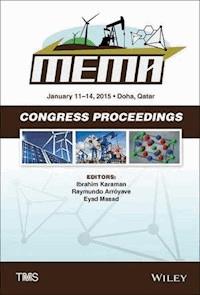
Proceedings of the TMS Middle East E-Book
0,99 €
Mehr erfahren.
- Herausgeber: John Wiley & Sons
- Kategorie: Fachliteratur
- Sprache: Englisch
Mediterranean Materials Congress on Energy and Infrastructure Systems (MEMA 2015)
Sie lesen das E-Book in den Legimi-Apps auf:
Seitenzahl: 823
Veröffentlichungsjahr: 2015
Ähnliche




















Contents
Cover
Title page
Copyright page
Preface
Editors/Organizers
Acknowledgments
MEMA Organizers
Sustainable Infrastructure Materials
Corrosion Challenges for the Oil and Gas Industry in the State of Qatar
Abstract
Introduction
Operation conditions in Qatar
Main material challenges from earlier experiences
Corrosion challenges in Qatar
References
Utilising Fine and Coarse Recycled Aggregates from the Gulf Region in Concrete
Abstract
Introduction
Experimental Programme
Test Methods and Process Methodologies
Experimental results
Conclusions and Further Work
Acknowledgements
References
Finite Element Simulation of the Response of No-Tension Materials
Abstract
Introduction
Concept of no tension model
Hyperelastic model
No-tension model
Validation
Flexible pavement simulation
Sensitivity analysis for no-tension model
Conclusions
References
Investigation and Modeling of the Fatigue Damage in Natural Fiber Composites
Abstract
Introduction
Materials and Methods
Fatigue damage model formulation
Model damage parameters identification procedure
Results and discussion
Conclusion
Reference
Improving Asphalt Mixtures Performance by Mitigating Oxidation Using Anti-Oxidants Additives
Abstract
Introduction
Materials
Testing
Discussion
Conclusions
References
Effect of Warm Mix Asphalt on Aging of Asphalt Binders
Abstract
Introduction
Testing Program
Results and Analysis
Conclusions
Acknowledgement
References
An Innovative Concept for Testing Rutting Susceptibility of Asphalt Mixture
Abstract
Introduction
Objective
Proposed Test Method
Potential Payoff for Practice
Summary
Bibliography
Evaluation of Asphalt Mixes Workability and Compactability Using Laboratory and Accelerated Field Testing
Abstract
Introduction
Background
Materials and Testing Plan
Development of Workability and Compaction Indices
Results and Data Analysis
Laboratory Evaluation of Compaction Indices
Conclusion
References
Effect of Electroless Ni-Co-P and Co-P Coatings on Cavitation Erosion Resistance
Abstract
1. Introduction
2. Experimental procedures
3. Results and discussion
4. Conclusions
5. References
Influence of Joining Time on Microstructure and Mechanical Properties of TLP-Joined IN-738LC to GTD-111
Abstract
Introduction
Experimental Procedure
Results and Discussions
Acknowledgement
Conclusion
Reference
Direct Observation of Effects of Foam Density, Gating Design and Pouring Temperature on Mold Filling Process in Lost Foam Casting of A356 Alloy
Abstract:
1- Introduction
2- Experimental procedure
3. Results and discussion
Conclusions
References
Control of Grain Refinement of A356 Aluminum Alloy by Computer Aided Cooling Curve Analysis
Abstract:
Introduction
Zero curve calculation
Newtonian analysis
Experimental Procedure
Results and Discussions
A. sample 1
B. sample 2
C. sample 3
D. sample4
E. sample5
Conclusion
References
Pulsed Electrodeposition of Ni with Uniform Co-Deposition of Micron Sized Diamond Particles on Copper Substrate
Abstract
1. Introduction
2. Experimental Details
3. Observations and Results –
4. Conclusion & Future ASPECTS
Acknowledgemnt
5. References :-
Materials for Energy Extraction and Storage: Shape Memory Alloys
The Tunable Microstructure and Its Influence on the Giant Magnetocaloric Effect in Magnetic Shape Memory Alloys
Abstract
1. Introduction
2. Refrigerant capacity in magnetic shape memory alloys
3. Experimental procedures
4. The influence of grain size on magnetic field levels
5. The influence of atomic order on magnetic field levels and refrigerant capacity
6. Finding the RC in Ni45Co5Mn36.6In13.4 single crystals
7. Conclusions
8. Acknowledgements
9. References
Studies of Magnetic Properties of Ni-Mn-In-Co Heusler-Type Glass-Coated Microwires
Abstract
Introduction
Experimental details and samples
Results and Discussion
Acknowledgments
References
Optimization of Soft Magnetic Properties in Nanocrystalline Glass-Coated Microwires
Abstract
1.Introduction
2. Experimental details
3 Experimental results and discussion
4. Conclusions
Acknowledgements
References
On the Fracture Response of Shape Memory Alloy Actuators
Abstract
Introduction
Thermomechanical SMA Constitutive Model
Problem Formulation and method of Solution
Results
Conclusions
References
Development of SMA Actuated Morphing Airfoil for Wind Turbine Load Alleviation
Abstract
Introduction
Shape Memory Alloys Actuators
Numerical Tools
Airfoil Geometry and Target Shapes
Morphing Concepts Design Procedure and Simulations
Simulations Addressing Time Response
Conclusions
Acknowledgement
References
Identification of Model Parameter for the Simulation of SMA Structures Using Full Field Measurements
Abstract
Introduction
Material selection and experimental procedure
Thermomechanical model of martensitic transformation for SMAs and model parameters
Parameter identification using Finite Element updating method coupled with an hybrid optimization algorithm
Parameter identification results and validation of the identification procedure
Conclusions
Acknowledgment
References
Comparison of the Work Output Values of Gradually Changing Porosity Samples and the Samples with Single Percent Porosity Level
Abstract
Introduction
Experimental Procedure
Results And Discussion
Conclusion
References
Phenomenological Model for Phase Transformation Characteristics of Textured Shape Memory Alloys
Abstract
Introduction
New transformation criterion and evolution equation for transformation strain
Assessment of the transformation function and evolution rules
Conclusion
Acknowledgements
References
Lightweight and High Performance Materials
Microstructural Design of Mg Alloys for Lightweight Structural Applications
Abstract
Introduction
Experimental Procedures
Results and Discussion
Conclusion
Acknowledgements
References
The Effect of Tool Geometry on Material Mixing During Friction Stir Welding (FSW) of Magnesium AZ31B Welds
Abstract
Introduction
Experimental procedures
Results and discussion
Summary
Acknowledgements
References
Damage Mechanisms at Various Strain Rates and Temperatures in Az31B Magnesium Alloy
Abstract
Introduction
Experimental Procedure
Results and discussion
Conclusion
References
Hybrid Aluminum and Natural Fiber Composite Structure for Crash Safety Improvement
Abstract
Introduction
Honeycomb Specimen Descriptions
Crash Model
Headform Dimensions
Composite Dimensions
FE Crash Test Results
Conclusion
References
Acknowledgements
Mechanical Response and Evolution of Damage of A16061-T6 Under Different Strain Rates and Temperatures
Abstract
Introduction
Experimental setup
Mechanical testing
Microstructural observation of as received material and deformed specimens
Fractographs analyses
Interrupted tests
Conclusion
References
Acknowledgment
Adhesion Improvement Between Polyethylene and Aluminum Using Eco-Friendly Plasma Treatment
Abstract
Introduction
Experimental part
Results and Discussion
Conclusions
Acknowledgement
References
Effect of Re Elements on the Sorption Properties of Nanocrystalline Zr-Co Getters Prepared by Mechanical Alloying
Abstract
Introduction
Experimental procedure
Results and discussion
Conclusions
References
Principles of Improvement the Energy Efficiency in Pyrometallurgy of Copper: Utilization the Secondary Heat Energy of Intermediate Products
Abstract
Introduction
The available waste heat energy of the roasting process of copper-bearing charge
Energy balance of the sulphuric acid plant
Conclusions
Acknowledgement
References
Materials for Energy Conversion and Storage
Numerical Modeling of Cathode Contact Material Densification
Abstract
Introduction
Numerical Model Description
Modeling Results and Discussion
Conclusions
Acknowledgements
References
Perovskites of Type LaBO3 Prepared by the Microwave-Assisted Method for Oxygen Production
Abstract
Introduction
1. Experimental
3. Results and discussion
Conclusions
References
Electrochemical Deposition of High Purity Silicon from Molten Salts
Abstract
Introduction
Experimental
Results and discussion
Conclusions
Acknowledgements
References
Cationic (V, Y)-codoped TiO2 with Enhanced Visible Light Induced Photocatalytic Activity for Photoelectrochemical Applications
Abstract
Introduction
Experiments
Results and discussion
Conclusions
Acknowledgments
References
Numerical Optimization of Lead Free Perovskite Solar Cell
Abstract
Introduction
Methodology
Results and discussion
Conclusion
References
Computational Assessment of the Performance of Lead Halide Perovskite Solar Cells Using Inorganic Layers as Hole Transport Materials
Abstract
Introduction
Methodology
Results and discussion
Conclusion
References
Electrode Materials Based on Phosphates for Lithium Ion Batteries as an Efficient Energy Storage System
Abstract
Introduction
Experimental
Results and Discussion
Conclusion
Acknowledgements
References
Interfacial Stresses and Degradation of Oxide Scale and Substrate Interface at High Temperature
Abstract
Introduction
Results and Discussions
Conclusions
References
Nanomaterials-Based Ultracapacitor for Power Integrated Circuits
Abstract
Introduction
Experiments
Results
Conclusions
Acknowledgements
References
A Multi-Scale Based Model for Composite Materials with Embedded PZT Filaments for Energy Harvesting
Abstract
1. Introduction
2. Methodolgy
3. Experimental Analysis
4. Results and Discussion
5. Conclusion
Bibliography
Methane Production from Carbon Dioxide and Increasing Energy Return of Investment (EROI) in Shale Oil
Abstract
Introduction Historical background of Sabatier methanation
New method for CO2 hydrogenation
Sources of CO2 and Global warming
Energy Return of Investment (EROI) for Shale Oil
Application of new technique of CO2 conversion in Shale oil retorts process: Shale Oil
Conclusion:
References
Storage and Release of Thermal Energy of Phase Change Materials Based on Linear Low Density of Polyethylene. Parafin Wax and Expanded Graphite
Abstract
Introduction
Magnetocaloric effect in Ni-(Co)-Mn-In
References
Computational Materials Design
Calculation of Electronic Structure and Field Induced Magnetic Collapse in Ferroic Materials
Abstract
Introduction
Magnetocaloric effect in Ni-(Co)-Mn-In
References
Strong Stacking Between Organic and Organometallic Molecules as the key for Material Design
Abstract
Introduction
Methodology
Results
Conclusions
Acknowledgements
References
A Biomimetic-Computational Approach to Optimizing the Quantum Efficiency of Photovoltaics
Abstract
Introduction
Preliminary Results
Research Plan
Future Directions
Stability and Mechanical Properties of {AxA′(1−x)}{ByB′(1−y)}O3 Ceramics
Abstract
Introduction
Computational method
Equation of State and Elastic Constants of ABO3 and Alloys
Concluding Remarks
Acknowledgement
References
Tailoring Thermal Conductivity of Ge/Si Core-Shell Nanowires
Abstract
Introduction
Model and Method
Results and Discussions
Conclusion
Acknowledgments
References
Thermal Analysis of Solar Panels
Abstract
Introduction
Thermal Modeling
Results and Discussion
Conclusion
References
Micromechanical Fatigue Visco-Damage Model for Short Glass Fiber Reinforced Polyamide-66
Abstract
Introduction
Multiscale modeling
Results
Conclusion
References
Alloy Design Strategies Through Computational Thermodynamics and Kinetics Approaches
Abstract
Introduction
Design Challenges and the Basic Principles of TRIP Steels
Making the Alloy/Processing – Microstructure – Property Connections
Putting Everything Together: A Computer-based Optimization of Alloy and Heat Treatments for TRIP Steels
Conclusions
Acknowledgements
References
C-Axis Compression of Magnesium Single Crystals: Multi-Scale Dislocation Dynamics Analyses
Abstract
Introduction
Methodology
Simulation Setup
Results and Discussion
Conclusions
References
Multiscale Modeling of Discontinuous Precipitation in U-Nb
Abstract
Introduction
First-Principles Calculations
CALPHAD
Phase-Field Modeling
Conclusion
Acknowledgements
References
Thermo-Mechanical Description of AISI4140 Steel at Elevated Temperatures
Abstract
Introduction:
Experimental Program
Results and Discussions
Concluding Remarks
References
Analysis of Thermo-Mechanical Rigidity of Continuously Cast Steel Slabs
Abstract
Introduction
Model Formulation
Design Description
Simulated Results & Discussion
Conclusions
Acknowledgments
References
Simulation of Solidification, Relaxation and Long-Term Behavior of a Borosilicate Glass
Abstract
Introduction
Multi-Physics Modeling
Results
Conclusion
Acknowledgments
References
A Durability Analysis of Super-Quiet Pavement Structures
Abstract
Introduction
Objective of the Study
Study Parameters
Description of Finite Element Model
Results and Analysis
Conclusions
References
Predictive Modeling for Sustainable Energy Solutions
Abstract
1- Introduction
2- Importance of sustainable energy predictions
3- Weather modeling and energy predictions
4- Variables used for predictive studies
5- Case study and results
6- Conclusion
References
Acknowledgment
Author Index MEMA 2015
Subject Index MEMA 2015
Copyright © 2015 by The Minerals, Metals & Materials Society. All rights reserved.
Published by John Wiley & Sons, Inc., Hoboken, New Jersey. Published simultaneously in Canada.
No part of this publication may be reproduced, stored in a retrieval system, or transmitted in any form or by any means, electronic, mechanical, photocopying, recording, scanning, or otherwise, except as permitted under Section 107 or 108 of the 1976 United States Copyright Act, without either the prior written permission of The Minerals, Metals, & Materials Society, or authorization through payment of the appropriate per-copy fee to the Copyright Clearance Center, Inc., 222 Rosewood Drive, Danvers, MA 01923, (978) 750-8400, fax (978) 750-4470, or on the web at www.copyright.com. Requests to the Publisher for permission should be addressed to the Permissions Department, John Wiley & Sons, Inc., 111 River Street, Hoboken, NJ 07030, (201) 748-6011, fax (201) 748-6008, or online at http://www.wiley.com/go/permission.
Limit of Liability/Disclaimer of Warranty: While the publisher and author have used their best efforts in preparing this book, they make no representations or warranties with respect to the accuracy or completeness of the contents of this book and specifically disclaim any implied warranties of merchantability or fitness for a particular purpose. No warranty may be created or extended by sales representatives or written sales materials. The advice and strategies contained herein may not be suitable for your situation. You should consult with a professional where appropriate. Neither the publisher nor author shall be fiable for any loss of profit or any other commercial damages, including but not limited to special, incidental, consequential, or other damages.
Wiley also publishes books in a variety of electronic formats. Some content that appears in print may not be available in electronic formats. For more information about Wiley products, visit the web site at www.wiley.com. For general information on other Wiley products and services or for technical support, please contact the Wiley Customer Care Department within the United States at (800) 762-2974, outside the United States at (317) 572-3993 or fax (317) 572-4002.
Library of Congress Cataloging-in-Pubfication Data is available.
ISBN 978-1-119-06527-2
PREFACE
This is a collection of manuscripts presented at The Middle East - Mediterranean Materials Congress on Energy and Infrastructure Systems (MEMA 2015), a specialty conference organized by The Minerals, Metals & Materials Society (TMS) and other institutions. The congress was held in Doha, Qatar on January 11-14, 2015.
The intent of this event was to focus on new materials research and development in applications of interest for Qatar and the entire Middle East and Mediterranean region. The main goal was to build synergy among researchers working on different materials applications but with similar objectives of enhancing design, sustainability, and functionality of materials. The congress was a forum for establishing collaboration among academia, research institutions, and industry in the region and the rest of the world, with a goal to help bring sustainability and stability to the region. Attendees represented government organizations, academic institutions, and industry working in various fields of materials for energy extraction, conversion, and storage; sustainability; as well as cross-cutting approaches in computational materials science. The long-term goal of this materials congress in the region is to further develop it into a periodic international materials congress in the Middle East and Mediterranean.
Over 200 authors and attendees from all over the world contributed to this congress in the form of presentations, lively discussions, and manuscripts presented in this volume. The international advisory committee members representing 9 different countries actively participated and promoted the congress.
The specific tracks and topics highlighted during this congress included:
Track 1
: Sustainable Infrastructure Materials. This track included sessions on cementitious materials and composites, and their sustainability, environmental degradation of infrastructure materials, asphaltic materials, and multi-scale characterization and simulations;
Track 2
: Materials for Energy Extraction, Conversion, and Storage. This track included sessions on lightweight and high performance materials, energy storage materials, ferrocaloric and ferroelectric materials, nanomaterials for energy conversion, photovoltaics, and shape memory alloys; and
Track 3
: Computational Materials Design. This track included sessions on alloy and microstructure design, ab-initio materials modeling, computational approaches towards mechanical damage and environmental degradation, and modeling materials across the scales.
The congress consisted of all-conference sessions and parallel sessions that integrated 3 keynote and 14 invited presentations from international experts, 93 contributed presentations, and 62 poster presentations. From the poster session, outstanding posters were selected for awards, which were presented to the authors at the congress banquet.
The 56 papers presented in these proceedings are divided into five sections: (1) Sustainable Infrastructure Materials; (2) Computational Materials Design; (3) Materials for Energy Conversion and Storage; (4) Lightweight and High Performance Materials; and (5) Materials for Energy Extraction and Storage: Shape Memory Alloys. These manuscripts represent a cross section of the presentations and discussions from this congress. It is our hope that the MEMA 2015 congress and these proceedings will provide new knowledge base for enhancing design, sustainability, and functionality of materials that are of interest for the Middle East and Mediterranean region; broaden the collaboration between the region scientists, industry, and the rest of the world; and ultimately help industry design and produce new materials more efficiently and effectively.
The organizers would like to thank all individuals and organizations that supported this congress. Special thanks are given to the Gold Sponsors of the congress: Qatar Petrochemical Company (QAPCO), and Qatar Foundation.
EDITORS/ORGANIZERS
Ibrahim Karaman
Ibrahim Karaman received his Ph.D. from University of Illinois at Urbana-Champaign in 2000. He joined the faculty of the Department of Mechanical Engineering at Texas A&M University in 2000. He was promoted to the rank of Professor in 2011. He has served as the Chair of the Interdisciplinary Graduate Program in Materials Science and Engineering (MSEN) from 2010 to 2013. The MSEN program became a new department in 2013. Dr. Karaman currently serves as the head of the department. His main research interests are processing-microstructure-mechanical/functional property relationships in metallic materials including (1) ultrafine and nanocrystalline materials, and (2) conventional, high temperature, and magnetic shape memory alloys; micro-mechanical constitutive modeling of crystal plasticity; and twinning and martensitic phase transformation. Dr. Karaman has received several national and international awards including the NSF CAREER Award, ONR Young Investigator Award, The Robert Lansing Hardy Award from The Minerals, Metals & Materials Society (TMS), an Honorable Mention for the Early Career Faculty Fellow Award from TMS, and Gary Anderson Early Achievement Award from ASME and AIAA. He is an author or co-author of more than 190 refereed journal articles.
Raymundo Arróyave
Raymundo Arróyave obtained his B.S. degrees in Mechanical and Electrical Engineering from the Instituto Tecnológico y de Estudios Superiores de Monterrey (México) in 1996. He got his M.S. in Materials Science and Engineering in 2000 and his Ph.D. in Materials Science in 2004 from MIT. After a postdoc at Penn State, he joined the Department of Mechanical Engineering at Texas A&M University in 2006. Since August 2012, he has been a faculty member of the newly created Department of Materials Science and Engineering at Texas A&M University. Dr. Arróyave’s area of expertise is in the field of computational materials science, with emphasis in computational thermodynamics and kinetics of materials. He and his group use different techniques across multiple scales to predict and understand the behavior of inorganic materials (metallic alloys and ceramics). The techniques range from ab initio methods, classical molecular dynamics, computational thermodynamics, as well as phase-field simulations. Over the past seven years, Dr. Arróyave and his group have been using these techniques to investigate a wide range of materials, such as high-temperature shape memory alloys, ferromagnetic shape memory alloys, hydrogen storage materials, materials for electric interconnects in microelectronic packaging, novel steel alloys, as well as nuclear fuels for next-generation nuclear power plants. More recently, Dr. Arróyave has been collaborating with colleagues in the fields of microstructural design and design theory to develop inverse methods for the discovery and design of multi-component, multi-phase structural materials. Dr. Arróyave has been co-author of more than 70 publications in peer-reviewed journals, 15 conference proceedings, as well as close to 100 conference papers and 37 invited talks in the United States and abroad. In 2014 he was the recipient of the TMS-EMPMD Distinguished Service Award. Earlier in 2012 he was awarded the TEES Select Young Faculty Fellow Award by the College of Engineering at Texas A&M University. He also received Honorable Mention as an Early Career Faculty Fellow of TMS. In 2010 he was awarded the CAREER Award from NSF. Earlier (2006), he was awarded the Young Leader Professional Development Award from TMS. He has served as the Chair of the TMS Alloy Phases Committee, in which he is currently a member. He is currently the Vice-Chair of the ASM Alloy Phase Diagram Committee and is an active member in the ICME, Physics and Chemistry of Materials as well as other technical and non-technical committees at TMS. He has also chaired and co-chaired more than ten symposia at TMS and MS&T.
Eyad Masad
Eyad Masad is a professor in the Mechanical Engineering Program at Texas A&M at Qatar and the Zachry Department of Civil Engineering at Texas A&M. Dr. Masad’s research focuses on microstructure characterization and constitutive modeling of materials, transport in porous media, granular mechanics, and image analysis techniques. He has active research groups and programs in the United States and in the State of Qatar. He has published more than 350 technical papers and reports. Dr. Masad is a fellow of the American Society of Civil Engineers (ASCE). He is the recipient of the Eisenhower Graduate Research Fellowship (1997) and the Eisenhower Faculty Fellowship in Transportation Engineering (1998) from the Federal Highway Administration. He received several university awards including the Zachry Award for Excellence in Teaching (2004), the ConocoPhillips Faculty Fellow Award for outstanding performance (2005), the Texas Transportation Institute/Trinity New Researcher Award (2006), the Halliburton Professorship Award for Scholarly Excellence in Engineering (2009), and the Dean’s Meritorious Service Award (2010).
ACKNOWLEDGMENTS
The organizers/editors would like to acknowledge the contributions of a number of people without whom the MEMA 2015 Congress, and the proceedings, would not have been possible.
First, we would like to offer many thanks to the TMS staff who worked tirelessly in the organization of the congress and the editing of the proceedings. The local organizing committee and the staff of Texas A&M University Qatar put long hours and tremendous effort to arrange the logistics of the congress and for this we are also tremendously grateful.
Second, we want to thank the international advisory committee for their input in the planning of the congress, the promotion of the congress, and their participation in the congress. This international committee included: Thomas Zacharia, Committee Chair, Qatar Foundation, Qatar; Imad Al-Qadi, University of Illinois at Urbana-Champaign, USA; Yehia Bahei-El-Din, The British University in Egypt; Tahir Cagin, Texas A&M University, USA; M. Enokizono, Oita University, Japan; Zachary Grasley, Texas A&M University, USA; Tayssir Hamieh, Lebanese University, Lebanon; Peter Hewlett, British Board of Agrement and University of Dundee, UK; Nick Kanellopoulos, National Center for Scientific Research “Demokritos”, Greece; Marwan Khraisheh, Qatar Energy and Environment Research Institute, Qatar Foundation, Qatar; Dallas Little, Texas A&M University, USA; A.G. Mamalis, PC-ΝΑΕ, Greece; Tasneem Pervez, Sultan Qaboos University, Oman; Tom Scarpas, Delft University of Technology, The Netherlands; Hussein Zbib, Washington State University, USA.
We would also like to thank the keynote and invited speakers for graciously agreeing to present their work as well as the other presenters for the contributions, ensuring the success of the congress.
Finally, we would like to acknowledge the financial support of all our sponsors, especially the Gold Sponsors of the congress: Qatar Petrochemical Company (QAPCO) and Qatar Foundation, as well as the U.S. National Science Foundation, through the International Institute for Multifunctional Materials for Energy Conversion (IIMEC) at Texas A&M University, Grant No. DMR 08-44082.
MEMA ORGANIZERS
Ibrahim Karaman, Texas A&M UniversityRaymundo Arróyave, Texas A&M UniversityEyad Masad, Texas A&M University at Qatar
ADDITIONAL ORGANIZERS
Raymundo Arróyave, Texas A&M UniversityEyad Masad, Texas A&M University at QatarZoubeida Ounaies, Pennsylvania State UniversityDimitris Lagoudas, Texas A&M UniversityMohammed Khaleel, Qatar Environment and Energy Research Institute (QEERI), Qatar FoundationMariam Al-Maadeed, Qatar UniversityPradeep Sharma, University of Houston
LOCAL ORGANIZATION COMMITTEE AND INDUSTRY LIAISONS
Eyad Masad, Texas A&M University at QatarMariam Al-Maadeed, Qatar UniversityBilal Mansoor, Texas A&M University at QatarGeorges Ayoub, Texas A&M University at QatarAboubakr M. Abdullah, Qatar UniversitySrinath Iyengar, Texas A&M University at QatarSaid Mansour, Qatar Environment and Energy Research Institute (QEERI), Qatar FoundationAbdulaziz Al Mathami, Qatar PetroleumChris Devadas, Hydro Aluminum Technology Centre – QatarMabrouk Ouederni, Qatar Petrochemical Company – QAPCOWakeel Ahmed Khalid Ahmed, Qatar Steel
INTERNATIONAL ADVISORY COMMITTEE
Thomas Zacharia, Qatar Foundation, Committee ChairYehia Bahei-El-Din, The British University in EgyptTahir Cagin,Texas A&M UniversityHussein Zbib, Washington State UniversityImad Al-Qadi, University of Illinois at Urbana-ChampaignTom Scarpas, Delft University of TechnologyZachary Grasley, Virginia Tech UniversityDallas Little, Texas A&M UniversityNick Kanellopoulos, National Center for Scientific Research “Demokritos”Marwan Khraisheh, Qatar Environment and Energy Research Institute (QEERI), Qatar FoundationPeter Hewlett, British Board of Agrement and University of DundeeTayssir Hamieh, Lebanese UniversityA.G. Mamalis, PC-NAEM. Enokizono, Oita UniversityTasneem Pervez, Sultan Qaboos University
Sustainable Infrastructure Materials
CORROSION CHALLENGES FOR THE OIL AND GAS INDUSTRY IN THE STATE OF QATAR
Roy Johnsen
Norwegian University of Science and Technology (NTNU), Richard Birkelands vei 2b, N-7491 Trondheim, Norway
Keywords; Qatar, oil and gas, corrosion, hydrocarbon mixture, aquifer water
Abstract
In Qatar oil and gas has been produced from onshore fields in more than 70 years, while the first offshore field delivered its first crude oil in 1965. Due to the atmospheric conditions in Qatar with periodically high humidity, high chloride content, dust/sand combined with the temperature variations, external corrosion is a big treat to the installations and connecting infrastructure. Internal corrosion in tubing, piping and process systems is also a challenge due to high H2S content in the hydrocarbon mixture and exposure to corrosive aquifer water. To avoid corrosion different type of mitigations like application of coating, chemical treatment and material selection are important elements. This presentation will review the experiences with corrosion challenges for oil & gas installations in Qatar including some examples of corrosion failures that have been seen.
Introduction
The first oil well in the State of Qatar was spudded in October 1938. This was an onshore well – named Dukhan 1 – that produced 5.000 barrels per day in January 1940. The first offshore concessions were granted in 1949. However, due to political reasons the first commercial offshore fields - Idd Al-Shargi and Maydan Mahzam fields - were discovered in 1960. In 1970 the large Bul Hanin field were discovered and came on stream in 1972. In these early years major international oil companies were responsible for the exploration activities in Qatar. However, early 1970-ties, the State of Qatar got its independence from UK and in 1974 they nationalized the oil sector and established Qatar Petroleum (QP). During the coming years Qatar took full control over all oil and gas activities onshore and offshore and the international oil companies were “sent back home” for a period.
In 1991 Qatar intensified their focus on oil and gas exploration and production. This resulted in a boost in oil & gas production from existing and new discovered offshore fields. To assist QP in more efficient exploration and production, international oil companies like ExxonMobil, Occidental, Total, Shell and Maersk Oil were invited to participate in the activities. All these international operating companies have been active during the last years bringing both capital, technology and technical skills to develop and improve the oil and gas exploration and development in the Qatar.
Lesen Sie weiter in der vollständigen Ausgabe!
Lesen Sie weiter in der vollständigen Ausgabe!
Lesen Sie weiter in der vollständigen Ausgabe!
Lesen Sie weiter in der vollständigen Ausgabe!
Lesen Sie weiter in der vollständigen Ausgabe!
Lesen Sie weiter in der vollständigen Ausgabe!
Lesen Sie weiter in der vollständigen Ausgabe!
Lesen Sie weiter in der vollständigen Ausgabe!
Lesen Sie weiter in der vollständigen Ausgabe!
Lesen Sie weiter in der vollständigen Ausgabe!
Lesen Sie weiter in der vollständigen Ausgabe!
Lesen Sie weiter in der vollständigen Ausgabe!
Lesen Sie weiter in der vollständigen Ausgabe!
Lesen Sie weiter in der vollständigen Ausgabe!
Lesen Sie weiter in der vollständigen Ausgabe!
Lesen Sie weiter in der vollständigen Ausgabe!
Lesen Sie weiter in der vollständigen Ausgabe!
Lesen Sie weiter in der vollständigen Ausgabe!
Lesen Sie weiter in der vollständigen Ausgabe!
Lesen Sie weiter in der vollständigen Ausgabe!
Lesen Sie weiter in der vollständigen Ausgabe!
Lesen Sie weiter in der vollständigen Ausgabe!
Lesen Sie weiter in der vollständigen Ausgabe!
Lesen Sie weiter in der vollständigen Ausgabe!
Lesen Sie weiter in der vollständigen Ausgabe!
Lesen Sie weiter in der vollständigen Ausgabe!
Lesen Sie weiter in der vollständigen Ausgabe!
Lesen Sie weiter in der vollständigen Ausgabe!
Lesen Sie weiter in der vollständigen Ausgabe!
Lesen Sie weiter in der vollständigen Ausgabe!
Lesen Sie weiter in der vollständigen Ausgabe!
Lesen Sie weiter in der vollständigen Ausgabe!
Lesen Sie weiter in der vollständigen Ausgabe!
Lesen Sie weiter in der vollständigen Ausgabe!
Lesen Sie weiter in der vollständigen Ausgabe!
Lesen Sie weiter in der vollständigen Ausgabe!
Lesen Sie weiter in der vollständigen Ausgabe!
Lesen Sie weiter in der vollständigen Ausgabe!
Lesen Sie weiter in der vollständigen Ausgabe!
Lesen Sie weiter in der vollständigen Ausgabe!
Lesen Sie weiter in der vollständigen Ausgabe!
Lesen Sie weiter in der vollständigen Ausgabe!
Lesen Sie weiter in der vollständigen Ausgabe!
Lesen Sie weiter in der vollständigen Ausgabe!
Lesen Sie weiter in der vollständigen Ausgabe!
Lesen Sie weiter in der vollständigen Ausgabe!
Lesen Sie weiter in der vollständigen Ausgabe!
Lesen Sie weiter in der vollständigen Ausgabe!
Lesen Sie weiter in der vollständigen Ausgabe!
Lesen Sie weiter in der vollständigen Ausgabe!
Lesen Sie weiter in der vollständigen Ausgabe!
Lesen Sie weiter in der vollständigen Ausgabe!
Lesen Sie weiter in der vollständigen Ausgabe!
Lesen Sie weiter in der vollständigen Ausgabe!
Lesen Sie weiter in der vollständigen Ausgabe!
Lesen Sie weiter in der vollständigen Ausgabe!
Lesen Sie weiter in der vollständigen Ausgabe!
Lesen Sie weiter in der vollständigen Ausgabe!
Lesen Sie weiter in der vollständigen Ausgabe!
Lesen Sie weiter in der vollständigen Ausgabe!
Lesen Sie weiter in der vollständigen Ausgabe!




