


18,49 €
Mehr erfahren.
- Herausgeber: The History Press
- Kategorie: Fachliteratur
- Sprache: Englisch
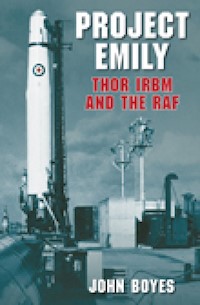
A history of the 4-year period from 1959 to 1963 when RAF bomber command operated 60 Thor Intermediate Range Ballistic Missiles as part of the UK nuclear deterrent force, and how and why it was dismantled. It is well illustrated with aerial photographs of the missile bases alongside photographs, maps and diagrams.
Das E-Book können Sie in Legimi-Apps oder einer beliebigen App lesen, die das folgende Format unterstützen:
Veröffentlichungsjahr: 2008
Ähnliche



















PROJECTEMILY
THOR IRBMAND THE RAF
PROJECTEMILY
THOR IRBMAND THE RAF
JOHN BOYES
To Sylvia
First published in 2008
The History PressThe Mill, Brimscombe PortStroud, Gloucestershire, GL5 2QGwww.thehistorypress.co.uk
Reprinted 2009
This ebook edition first published in 2012
All rights reserved© John Boyes, 2008, 2013
The right of John Boyes, to be identified as the Author of this work has been asserted in accordance with the Copyrights, Designs and Patents Act 1988.
This ebook is copyright material and must not be copied, reproduced, transferred, distributed, leased, licensed or publicly performed or used in any way except as specifically permitted in writing by the publishers, as allowed under the terms and conditions under which it was purchased or as strictly permitted by applicable copyright law. Any unauthorised distribution or use of this text may be a direct infringement of the author’s and publisher’s rights, and those responsible may be liable in law accordingly.
EPUB ISBN 978 0 7524 9377 0
Original typesetting by The History Press
CONTENTS
Foreword
Acknowledgements
Introduction
Glossary of Terms
Missiles
The Birth of Ballistic Missiles
Early Disappointments and Successes
The Thor Agreement – Finding the Bases
Building The Infrastructure
The First Thor Arrives
Training and Squadron Operations
The Cuban Crisis and the End of Project Emily
Appendix 1
Appendix 2
Appendix 3
Appendix 4
Appendix 5
Appendix 6
Appendix 7
Appendix 8
Appendix 9
Bibliography
Foreword
Marshal of the Royal Air ForceSir Michael Beetham GCB CBE DFC AFC
Thor was the first venture by the Royal Air Force into the IRBM sphere of operations. At the time, the late 1950s, Bomber Command was responsible for Britain’s strategic nuclear deterrent, independent but working closely with Strategic Air Command of the United States.
Our deterrent centred around the V-Bomber Force, highly efficient and kept at a high state of readiness. The American deterrent centred on the B-47 and B-52 bombers of Strategic Air Command, but they saw, as Britain did, that Soviet air defences were increasing in capability and that more might be required in the future to keep the Western deterrent fully effective. The Cold War was at its height and the Soviets, using German expertise from the Second World War, were making more major advances in rocketry.
Not to be outdone, the Americans poured enormous resources into the development of an ICBM programme to enable them to be secure, in their eyes, within ‘Fortress America’. At the same time they went ahead with a less ambitious and quicker development of IRBMs for deployment foward in Europe within NATO. These missiles would have the advantage of being nearer to the Soviet Union and thus quicker to react to a threat. Thus was born the Thor Programme. The general public knew little about the plans for Thor deployment. The British Government had enough on their hands dealing with CND and other factions protesting against nuclear weapons and, to aggravate the situation in the public mind, Thor had American nuclear warheads, although the British insisted on maintaining control and a veto over their use. Thus the Government, whilst unable to conceal the deployment within the UK, certainly gave Thor minimum publicity.
Thor was in service with the RAF for five years from the late 1950s. John Boyes has done a great service in writing this book, detailing the protracted negotiations over deployment and control and the many problems of the development programme which, in their usual way, the Americans tackled energetically and successfully. In service with the RAF, Thor made a significant contribution to our strategic nuclear deterrent, nowhere more so than during the Cuban Missile Crisis of October 1962 where it maintained a very high rate of readiness and reliability. Thor fulfilled an important and unique role in RAF history and at a crucial period in the Cold War. The story needed to be told, and this John Boyes has done, covering comprehensively all aspects in great detail.
ACKNOWLEDGEMENTS
There are very many people who deserve recognition for the help they have given me in writing this history of the RAF’s only foray into the world of surface-launched ballistic missiles. Many are credited in the text for their contributions, but there are others who are not quoted yet have nevertheless given me much assistance. They are: Wayne Cocroft (English Heritage), Dr Jack Dunham, Dr Jack Neufeld, Roy Dommett, Dave Wright, Nicholas Hill, Roger Tutt (for photographic assistance), Jim Wilson, former LCOs Doug Browne, Peter Rogers and Peter Vangucci, Dick Parker, Ted Gragg, John Atkison, Col. (Retd) Nick Gaynos, Hal Leonard, Col. (Retd) Orville Doughty, Roger Bradshaw, Col. (Retd) Charlie Simpson (Association of Air Force Missileers), Torri Ingalsbe and Kristopher Levasseur (Public Affairs, RAF Lakenheath), Jeff Goodwin (RAF Hemswell Association), Roy Clarke and Roy Tebbutt (Carpetbaggers Museum at RAF Harrington), Brett Stolle (National Museum of the United States Air Force), Amy Rigg and Jack Fulford at Tempus, and the many helpful staff at The National Archives, The Royal Air Force Museum at Hendon and Cosford and English Heritage at Swindon, Captains Nick Serle and Mark Graham (1KORBR), Brynley Heaven, Linda Ball (Feltwell Golf Club), Clive Brown, Mrs Eileen Dorr, R.P. Treadgold, Vernita Laws and Fran Thomas. My particular thanks go to Jeff Jefford for his help and guidance, and for helping me through the complexities of RAF records and terminology. If I have omitted anyone, please accept my apologies. Responsibility for any errors of fact or interpretation is, of course, entirely mine. I would welcome any comments by email at: [email protected]
John Boyes
West Wickham, September 2009
INTRODUCTION
I first saw a Thor site during an Easter holiday break with my family in 1959. Fascinated by all things aeronautical, my knowledge reinforced by RAF Flying Review (the arrival of which was a keenly anticipated highlight of every month!), I was well aware of what we were driving past. The site was close to the main road and one of the missiles was erect on its launch emplacement. Entreaties to stop to take a photograph with my Kodak Brownie 127, were, no doubt wisely, overruled by my father. However, later on in the day we passed a more distant site and I sneaked a quick photograph which showed little more than a few elements of the site on the far horizon but could nonetheless be identified as a Thor location.
My interest was rekindled in the mid-1990s when my job took me to the areas of the country where Thor had been located. I found some remains, mainly blast walls but a few other remains as well. Of other sites there was nothing left to indicate that at one time ballistic missiles trained on the Soviet Union were stationed there. Most sites are on private land and this should be borne in mind should any ‘site visits’ be planned. But apart from two chapters in Humphrey Wynn’s book on RAF Nuclear Deterrent Forces, there seemed to be little authoritative history published on Thor and its period in RAF service.
Under the unassuming codename, Project Emily, the operation to deploy Thor began in March 1958. It generated a wide range of feelings, both political and military. Even within the operational RAF, knowledge of Thor was often very limited. However, along with the Jupiter IRBMs stationed in Italy and Turkey, these missiles were the first strategic ballistic missiles aimed at targets on the other side of the Iron Curtain. It was, of course, the Jupiters based in Turkey under the codename IBRAHIM II (supposedly because the word contained the letters IRBM) rather than the Thors that secretly defused the Cuban Missile Crisis. In reality, the Jupiters were of little or no military value and the integrity of the command and control of the Turkish missiles was a major concern to the Americans, a concern which reached its height during the crisis. The Soviet Union’s military planners had been significantly upset by the placing of the Jupiters in Turkey, which gave them the unwelcome and unwanted requirement to provide countermeasures for a possible missile attack through their ‘back door’. Was it entirely surprising, therefore, that the Soviets retaliated by placing missiles in Cuba? There was a clear parallel here that the Americans seemed unable or unwilling to accept. Nonetheless, the Thors were on full readiness and were used ‘politically’ by Macmillan as a further way of defusing the slippage towards real conflict. For this fact alone, they need to be remembered.
GLOSSARY OF TERMS
ABMA
Army Ballistic Missile Agency
ACAS
Assistant Chief of the Air Staff
AD
Air Division
ADD
Air Defence Division
AEC
Atomic Energy Commission
AFB
Air Force Base (USAF)
AFBMC
Air Force Ballistic Missile Centre
AFBMD
Air Force Ballistic Missile Division
AFETR
Air Force Eastern Test Range (Patrick AFB)
AFWTR
Air Force Western Test Range (Vandenberg AFB)
ALBM
Air Launched Ballistic Missile
ALERT
CONDITION
Level of UK preparedness for war
AMR
Atlantic Missile Range
AMSO
Air Member for Supply and Organisation
APU
Auxiliary Power Unit
ARDC
Air Research and Development Command
AUW
All Up Weight
CAS
Chief of the Air Staff
CEA
Control Electronic Assembly
CEP
Circular Error Probable
CND
Campaign for Nuclear Disarmament
CTL
Combat Training Launch
DAC
Douglas Aircraft Company
DCAS
Deputy Chief of the Air Staff
DEFCON
Defense Condition (level of US preparedness for war)
EPPO
Electrical Power Production Operator
FDR
Functional Demonstration of Reliability
GSA
Guidance Systems Analyst
GSE
Ground Support Equipment
ICBM
Intercontinental Ballistic Missile
IOC
Initial Operational Configuration
IRBM
Intermediate Range Ballistic Missile
IWST
Integrated Weapons System Training
JAN-BMC
Joint Army Navy Ballistic Missile Committee
LASL
Los Alamos Scientific Laboratory
LCA
Launch Control Area
LCCO
Launch Control Console Operator
LCO
Launch Control Officer
LCT
Launch Control Trailer
LE
Launch Emplacement
LMCO
Launch Monitor Console Operator
LN
Liquid Nitrogen
LOX
Liquid Oxygen
MATS
Military Air Transport Service
MDE
Maintenance Dry Exercise
MOD
Ministry of Defence
MRBM
Medium Range Ballistic Missile
MSAT
Missile System Analyst Technician
MSC
Missile Servicing Chief
MT
Motor Transport
MT
Megaton
NSC
National Security Council
nm
Nautical Miles
OC
Officer Commanding
ORB
Operations Record Book
ORBAT
Order of Battle (the disposition and nature of friendly and enemy forces)
OSD-BMC
Office of the Secretary for Defense Ballistic Missile Committee
POL
Petrol, Oil, Lubricants
PPO
Unofficial abbreviation of EPPO
PTS
Propellant Transfer System
RIM
Receipt, Inspection and Maintenance (Building)
RP-1
Rocket Propellant (Fuel)
RSO
Range Safety Officer
S & I
Surveillance and Inspection (Building)
SAC
Strategic Air Command
SAC MIKE
Strategic Air Command (Missile Division)
SACEUR
Supreme Allied Commander Europe
SAGW
Surface-to-Air Guided Weapon
SAM
Surface-to-Air Missile
SLBM
Submarine Launched Ballistic Missile
sm
Statute Miles
SM
Strategic Missile
SMW
Strategic Missile Wing
SOP
Standard Operating Procedure
SoS(A)
Secretary of State for Air
SPOG
Special Projectile Operations Group
SSA
Special Storage Area
SSQ
Station Sick Quarters
SSM
Surface-to-Surface Missile
STL
Space Technology Laboratory Inc.
TAC
Tactical Air Command
TEW
Thor Electrical Worker
UOC
Ultimate Operational Configuration
USAF
United States Air Force
USAFE
United States Air Force in Europe
VCAS
Vice Chief of the Air Staff
WADC
Wright Air Development Center
WDD
Western Development Division (later BMD)
MISSILES
ATLAS
First US ICBM
BLOODHOUND
UK SAGW operated by RAF Fighter Command to defend the V-Force and the Thor sites
BLUE STREAK
Proposed silo-launched UK MRBM. Cancelled in 1960
JUPITER
IRBM originally developed by the US Army. Very similar to Thor
MINUTEMAN
Third US ICBM (silo-launched, solid fuel)
SKYBOLT
US air-launched ballistic missile. Ordered for the RAF but subsequently cancelled by the US
TITAN
Second US ICBM (silo-launched)
Our task … is to hold our ‘Thor’ missiles in immediate readiness – by day or night – throughout the year. These weapons are the first of a new generation; they take their place beside those which the Royal Air Force has already proved. Their very novelty offers a challenge which our Service gladly accepts. At the same time we should remember the responsibility which has been entrusted to us to operate the latest and most powerful part of the deterrent force. I ask you to do your best.
(The Commanding Officer’s foreword in the ‘Feltwell Information’ booklet issued to RAF personnel stationed at RAF Feltwell.)
CHAPTER ONE
THE BIRTH OF THE BALLISTIC MISSILE
At 7.28a.m. on 8 September 1944, a German Army V-21 missile was launched from the sanctuary of a mobile site in the Ardennes Forest, near to St Vith. Its target was Paris. Despite a successful lift-off, the missile never reached its target, apparently disintegrating on re-entering the atmosphere. This was not an unknown problem, one which was never fully resolved during the war. However, a second missile, launched some three hours later, landed in the Parisian suburb of Maisons-Alfort killing or injuring around thirty people. Without any warning, the age of the ballistic missile had arrived. That evening the first V-2 to reach London landed on Staveley Road in Chiswick.2 Again, there was to be no warning of the missile’s arrival and there were no countermeasures against it, its supersonic arrival speed assured its invulnerability. Even if the mobile launch points could be identified, the launch crews would have already moved onto another launch site by the time any aircraft arrived in retaliation.
The V-2 Programme was masterminded by Army General Walter R. Dornberger with the technical side led by his able protégé, Wernher von Braun. The V-2 was a complex and temperamental weapon. It had taken five years to develop to operational status and was still prone to launch failures. The first two attempts at an operational launch both ended up with the missiles failing to leave the launch pad because insufficient thrust was developed when the rocket motor was ignited. The V-2 carried a relatively meagre 1,650lb warhead and, in simple terms, it did not do well in a basic ‘bangs for bucks’ evaluation, although the effect of the relatively small warhead was magnified by the fact that it arrived on its target at supersonic speed. In a final analysis, the main effect of the weapon proved to be psychological rather than military. The V-2 was unreliable, erratic and it could not be produced in sufficient quantities to provide a sustained bombardment. The original plan to launch the V-2s from secure bunkers in the Pas-de-Calais and the Cherbourg peninsula had fallen prey firstly to the Allied bombing offensive, and secondly to the advancing Allied Armies following D-Day. Hence, the decision was taken to launch from mobile sites in the hope that these would outwit the reconnaissance efforts of the Allied 2nd Tactical Air Force. The decision was completely vindicated as no V-2 launch site was ever discovered with the launch crews or missile in situ. In his testimony to the US Senate on 17 December 1957, von Braun confirmed that ‘not a single V-2 was ever lost at a mobile launching site – and this despite the fact there was a 30-to-1 air superiority by the United States Air Force, along, of course, with the Royal Air Force, in that area’. However, von Braun had not originally been a supporter of mobility. Along with his technical associates he was ‘utterly sceptical that the V-2 was sufficiently advanced for mobile deployment’.3
The V-2 had been developed at the remote research facility at Peenemünde on the Baltic Coast. Peenemünde was shared by the German Army and the Luftwaffe.4 Whilst the Army was developing its V-2 rocket, the Luftwaffe was concentrating on a much more simple pilotless flying bomb, the Fiesler Fi-103, which was to become the V-1. However, on the night of 17–18 August 1943, 597 Lancasters, Stirlings and Halifaxes of RAF Bomber Command attacked the location, their targets being marked for them by sixty-five Pathfinder aircraft. Forty aircraft failed to return but considerable damage was inflicted.5 It was clear that Peenemünde was too vulnerable and so production of the missiles was moved to a near invulnerable underground factory at Nordhausen, deep inside the Harz Mountains in Southern Germany.6 Here a plentiful supply of slave labour was provided from the nearby Dora-Mittelbau concentration camp. Sixty thousand workers brought the missiles to mass production. It is estimated that a third of their number died in the process, victims of the appalling conditions within the underground factory.
The advance of the Allied Armies pushed the launch sites further towards the German border, but it was not until 27 March 1945 that the retreating Germans launched the last of 1,115 V-2s against London, although less than half that number actually fell on the city. Allied commanders had been greatly concerned at the possibility of the missiles being used against the Dutch and Belgian ports, which were so vital to the logistic train of the advancing armies. Although it is widely believed that the majority of V-2s were directed at London, more in fact landed on Antwerp than on the British capital. Very significant resources and matériel which could otherwise have been used directly in prosecuting the war effort had to be diverted to seeking out and attacking whatever evidence of the missiles could be found.
As the Allied Armies advanced from east and west on a ruptured and disintegrating Germany, where only sporadic but still fanatically loyal elements of the SS seemed to hold any control, they sought not only victory but also the victor’s spoils of war. German industrial capability was carefully examined, but the main areas of interest were the aeronautical industries and the rocket research centres. Many post-war aircraft designs in both the West and the Soviet Union used design features which had originated on the drawing boards of Junkers, Heinkel, Messerschmitt, Horten and others. But rockets were, if anything, even more important. The legacy of Peenemünde in both post-war East and West can be found to this day in every significant civilian launch vehicle or ballistic missile.
Combat Command B of the 3rd US Armored Division entered Nordhausen on 11 April 1945 and found to their amazement that the plant was still largely intact. The whole area was to fall into the Soviet sector of influence on 1 June, so time was short. However, when the Soviets occupied the area and entered the underground complex, they discovered, as Colonel Yuri A. Pobedonostsev later admitted, that the Americans had ‘cleaned the place out’.7 The Soviets fared better in Peenemünde, which had fallen into their hands on 6 May 1945 when the 2nd White Russian Army, commanded by General Konstantin Rokossovskii, reached the peninsular. Two hundred rocket scientists were transported to the Soviet Union. Their experience was to be somewhat different to those who sought their future in the West.
Following Hitler’s suicide on 30 April 1945, Dornberger and von Braun, displaying perhaps a certain prescience, had determined to make contact with the American forces in the area. They therefore sent von Braun’s English-speaking brother, Magnus, to find the advancing US 7th Army. He located the US 44th Infantry Division at the small Austrian town of Reutte, which nestled at the foot of the Adolf Hitler Pass, and surrendered to them. Other members of the rocket team willing to cast their lot with the Americans followed soon afterwards. The whole group was taken to Garmisch-Partenkirchen for interrogation. Deprived of their files, many of the statements made appeared to conflict, but gradually a complete picture emerged of the development of the A-4 (V-2) as well as other rockets, notably the A-9/A-10 two-stage intercontinental rocket, designed to be used against New York.8 During his interrogation, von Braun stated that he considered ‘the A-4 rocket developed by us as an intermediate solution conditioned by this war, a solution which still has certain inherent shortcomings and which compares with the future possibilities of the art in about the same way as a bomber plane of the last war compares with a modern bomber’.
The highly secret program to exploit the V-2 knowledge, inaugurated on 19 July 1945, was known as Operation Overcast, later known as Operation Paperclip. It was established under the Chief Military Intelligence Service on an island in Boston Harbor at a camp known as Fort Standish. A certain degree of discretion had to be exercised as the British, who had suffered the effects of the V-2 bombardment which had taken over 2,750 lives and seriously injured a further 6,000, were more disposed to classing the rocket personnel as war criminals rather than valuable war booty. The existence and horrors of the Dora-Mittelbau and Nordhausen concentration camps were conveniently suppressed,9 as was von Braun’s membership of the NSDAP from 1937 and his subsequent commission in the SS.10 However, rocket development was now a vital area of research, particularly since the Soviets had their own interest in the subject through their own captured rockets and engineers. The German scientists were seen as vital to America’s interests in this field but both Dornberger and von Braun were still under interrogation in Great Britain. Von Braun was to travel onwards to the United States, but Dornberger was held until 1947 until the possibility of war crime proceedings was dropped.
Neither Great Britain, the United States, nor the Soviet Union had any serious experience of missile technology, although in the US the rocket scientist Dr Robert H. Goddard had tried unsuccessfully to interest the Army in developing rockets. Whilst a considerable fund of knowledge about A-4 logistics had been assembled, little was known about the actual practical aspects of preparing and launching the rockets in the field. To enhance the overall security of the A-4 programme, full technical manuals for the troops undertaking the actual firing of the rockets had never been prepared. Each soldier knew only his particular part of the operation so that, if captured, little of the overall scenario could be determined. The Allied Air Defence Division (ADD) was under the command of a former Royal Engineer, Major General Alexander Morris Cameron. It was his Personal Aide, Junior Commander Joan C.C. Bernard ATS, who suggested that the captured rocket troops together with some of the A-4s taken from Nordhausen be used to undertake launches of the rocket, so that the complex launch procedures could be fully documented and the technical problems analysed. The British section of the ADD became the Special Projectile Operations Group (SPOG) and, still under Cameron’s command, was given responsibility for the project which was codenamed Operation Backfire. Colonel W.S.J. Carter, Assistant Chief of the ADD, was appointed Colonel, General Staff, SPOG, and was given special responsibility for the project.
The site chosen for the test firings was the Krupps naval artillery range at Altenwalde near to Cuxhaven. Facilities existed there to track projectiles fired out to sea. Some 2,000 Royal Canadian Army sappers constructed a launch site complex with a 300ft-long assembly shed, roads, a concrete launch bunker and a vertical inspection building, which was constructed from Bailey bridge components. Both Dornberger and von Braun were brought to Cuxhaven and, although not taken to the launch site, were nevertheless co-operative along with a specialist German team in advising on aspects of the launch procedures and potential associated hazards.11 A successful launch took place on 4 October 1945.12 Eventually, only eight missiles could be assembled from the components available. The Germans had determined there was little need for a comprehensive inventory of spares for missiles that essentially went straight from factory to launch pad. All eight missiles were, however, launched and in January 1947 a five-volume technical manual and an accompanying film on all aspects of A-4 handling and launching had been completed and lodged with the War Office. It was to be quite some time before the UK was again to launch a missile of any size.
With von Braun now in the United States, an ‘advance guard’ of 11813 German rocket scientists was taken to El Paso in Texas to start work on the US Army’s nascent rocket programme. Their main function was to advise the Army and General Electric (GE), who had been appointed supporting contractor for the programme, about the launch procedures for the rockets. Salvaged components for about 100 A-4s had been stored at Las Cruces, New Mexico, while the open desert of the White Sands Proving Ground had been chosen as the main test area, with the overall headquarters for the programme at Fort Bliss, Texas, designated the Ordnance Research and Development Division, Sub-Office (Rocket). Von Braun now awaited the arrival of the rest of the German team once they had been paid off from Operation Backfire. Although the Americans were entitled to full details of the Backfire reports, their series of A-4 test launches, which started on 16 April 1946 after a static test firing on 14 March, initially at least, merely duplicated what the British programme had already achieved. The Americans, perhaps a little disingenuously, claimed that they had learnt little from the earlier project, stating that the major purpose of their programme was high altitude research.14 The lack of components which had proved to be a limiting factor for Operation Backfire similarly caused problems for the Americans. Their rockets were now many months old and required a significant amount of maintenance. The Germans were soon to discover that the US Army appeared to have only limited funds available and even the most basic equipment seemed to be lacking. They passed the time with further theoretical studies of the rockets’ potential or, by way of interviews, confirmed what they had already achieved and its ongoing significance.
In the same way that the German Army had seen the missile as a natural extension to its artillery capability, the US Army was to use this argument to claim the authority to operate any missile system launched from the land. However, the newly formed US Air Force was to claim that the missile was a derivative of the aircraft and should therefore come under their control. Neither supposition was really completely true, although of course the missile did reflect elements of both arguments. If an atomic warhead could be mated with a missile, the Army also saw this as a way of wresting from the Air Force its monopoly on delivery of atomic weapons, although this capability was, from a technical point of view, still some time away.15 Thus the work of von Braun and his team, whilst partly exploratory, could also have a practical side in extending the Army’s firepower. Increasingly, however, the other services were taking an interest in what the Army was doing and the resulting, if inevitable, inter-service rivalry underscored by the emotive question of ‘roles and missions’ was to delay the development of a properly organised US missile programme for some years to come.16
As well as the V-2s, the US Army had also experimented with JB-2 Loons (LTV-A-1), a US-built copy of the V-1. The US Navy had done likewise and to further its interest in missiles it had obtained two of the A-4s to assess the practicality of launching the missile from a warship. The aircraft carrier USS Midway (CVB 41) was chosen and on 6 September 1947 the missile was launched from the deck.17 Whilst the concept could have had a valid use in extending the stand-off range of naval gunnery, and the Navy did not want to lose out in adopting this new technology, concerns remained about the practical difficulties of handling volatile liquid fuels on a pitching warship, and although the Navy by no means gave up its interest in missiles, it was not until the development of reliable solid fuels that missiles were willingly accepted onboard.
During the Second World War sixteen US Army Air Forces had been deployed to the various theatres of war. The strategic significance of the bombing campaign had led to them becoming increasingly autonomous and in recognition of this Strategic Air Command (SAC) was formed on 21 March 1946 under the command of General George C. Kenney. The role of the air arm in future warfare was further consolidated with the formation of a separated US Air Force on 18 September 1947. The Air Force, however, found itself presented with a dichotomy. On the one hand, it already had, with its bombers, the sole capability to deliver the atom bomb, the most awesome weapon known to man, whilst on the other hand it recognised the significance of the missile and did not intend to let either the Army or the Navy steal a lead in the development of the new technology. In the absence of any coordinated approach between the three services (or ‘three and a half’ if the Marines were included) towards the development of missiles, the assumption was made that the ‘first past the finishing post’ would earn the right to become the custodians of these weapons. Ideally, from an Air Force point of view, airborne capability and missiles should be combined, but the weight of the atom bomb precluded, at least for the time being, the thoughts of using missiles as carriers of these weapons or the even more awesome weapon then being developed – the thermonuclear bomb. In October 1948 the charismatic General Curtis E. LeMay was appointed head of SAC.18 LeMay transformed SAC, which had been forged out of a collection of left-overs from the Second World War, into the world’s most powerful military ‘force in being’, which successfully projected the post-war nuclear threat with its squadrons of Boeing B-47 Stratojets, Convair B-36 Peacemakers and later the supersonic B-58 Hustlers and the awesome Boeing B-52 Stratofortress long-range bombers. Atomic bombs, and there were still not too many of them, were too large to be carried by anything but manned bombers. The implosion weapons were easier to produce than the gun-type but were bigger and heavier. Furthermore, the US Atomic Energy Commission had not proved particularly cooperative in discussions about warheads for ballistic missile use. SAC and its bomber squadrons had unique supremacy – at least for the time being.




