


63,99 €
Mehr erfahren.
- Herausgeber: John Wiley & Sons
- Kategorie: Fachliteratur
- Serie: Wiley Finance Series
- Sprache: Englisch
A unique, international approach to optimal real estate financing
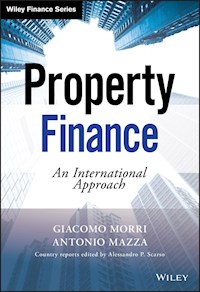
Property Finance is an authoritative guide to both the financial and legal issues surrounding real estate financing. Unique in its exclusive focus on the topic, this book builds from a solid theoretical foundation to provide practical tools and real-world solutions. Beginning with a discussion of the general issues encountered in real estate finance from an international perspective, the authors delve into country-specific information and set out the legal peculiarities of eight important countries (Germany, France, Italy, Spain, China, India, England and Wales) by asking questions of relevance to the leading local law firms specializing in real estate financing. The reader may thus consider in greater depth the problems relating to any given country and compare and contrast the positions under different legal systems.
Examples with numerical calculations and contract excerpts enhance the explanations presented, and are immediately followed by practical case studies that illustrate the mechanisms at work. The companion website features downloadable spreadsheets used in the examples, power point presentations, as well as real estate news and more.
Property financing entails many sources of capital, including both debt and equity resources as well as hybrid forms like preferred equity and mezzanine debt. Knowing how to work with these avenues is important to ensuring financial sustainability in real estate assets. Property Finance covers the most common issues encountered, helping readers prepare for and find a way around possible roadblocks.
- Consider the issues surrounding real estate lending at an international level
- Compare and contrast the positions under different legal systems
- Develop an international perspective on cash flows and financing agreements
- Use powerful tools to structure financing and gauge its effects on property financing
The success of a real estate investment is dependent upon optimal financing, and a mere bird's eye view of the topic does not fully prepare investors for issues ahead: Property Finance provides a knowledge-based approach to real estate investment, detailed information and powerful tools.
Sie lesen das E-Book in den Legimi-Apps auf:
Seitenzahl: 540
Veröffentlichungsjahr: 2014
Ähnliche



















Table of Contents
Title Page
Copyright
Dedication
Foreword
Foreword
Preface
Preface to Part Two
Acknowledgements
List of Figures
Reader's Manual
Part One
Chapter 1: Introduction to Property Financing
1.1 Forms of financing: debt and equity
1.2 A different approach to property financing
1.3 Corporate finance and project finance
1.4 Bank financing
1.5 Fund raising, securitization, and syndication
Chapter 2: Structured Real Estate Financing
2.1 Bank roles
2.2 Bank loan contractual forms
2.3 Loans for development projects
2.4 Parts and stages of a structured loan
Chapter 3: Loan Agreement
3.1 Object and purpose of the loan
3.2 Conditions precedent
3.3 Amount of the loan
3.4 Interest rates
3.5 Interest rate risk hedging
3.6 Loan allocation
3.7 Loan repayment schedule
3.8 Fees
3.9 Frequency of drawdown and procedures
3.10 Events of default
3.11 Property insurance
3.12 Representations and warranties
3.13 Duty to provide information
3.14 Costs, taxes, and ancillary charges
3.15 Contractual covenants
Chapter 4: Loan Repayment, Interest, and Renegotiation
4.1 Bullet payments
4.2 Pre-amortizing (semi-bullet)
4.3 Balloon payment
4.4 Fully amortizing repayment plans
4.5 Other repayment schedules
4.6 Restructuring and renegotiation of real estate loans
Chapter 5: Effects of Financial Leverage on Real Estate Investments
5.1 An illustration of financial leverage
5.2 The effects of an increase in volatility
5.3 The effect of financial leverage on returns
5.4 The effect of financial leverage on risk
5.5 “NO FREE LUNCH”
5.6 The mechanics of financial leverage
5.7 The effect of the spread
5.8 A brief summary of when to use financial leverage
Chapter 6: Structured Real Estate Financing Case Studies
6.1 Structured financing for an income producing property
6.2 Structured financing for a real estate portfolio acquisition
6.3 Financing of a real estate development project
6.4 Financing a shopping centre: credit application
Chapter 7: Hybrid Forms of Financing
7.1 Description
7.2 Procedures for establishing mezzanine finance and cost
7.3 Covenants in a mezzanine financing
7.4 Economic mechanics of hybrid financing
7.5 Waterfall payout agreement
7.6 Intercreditor agreement
Chapter 8: Basel Accords and Effects on Real Estate Financing
8.1 Basel II
8.2 Basel III
8.3 The Basel Accords and real estate financing
8.4 Standardized Approach
8.5 IRB Foundation and Advanced methods
Part Two: Outline of the most relevant legal issues in selected jurisdictions
Chapter 9: China
Chapter 10: England and Wales
Chapter 11: France
Chapter 12: Germany
Chapter 13: India
Chapter 14: Italy
Chapter 15: Spain
Authors
Giacomo Morri
Antonio Mazza
Alessandro P. Scarso
References
Index
End User License Agreement
Pages
xi
xii
xiii
xiv
xv
xvi
xvii
xviii
xix
xx
xxi
xxii
xxiii
xxiv
3
4
5
6
7
8
9
10
11
12
13
14
15
16
17
18
19
20
21
22
23
24
25
26
27
28
29
30
31
32
33
34
35
36
37
38
39
40
41
42
43
44
45
46
47
48
49
50
51
52
53
54
55
56
57
58
59
60
61
63
64
65
66
67
68
69
70
71
72
73
74
75
76
77
78
79
80
81
82
83
84
85
86
87
89
90
91
92
93
94
95
96
97
98
99
100
101
102
103
104
105
106
107
108
109
110
111
112
113
114
115
116
117
118
119
120
121
122
123
124
125
126
127
128
129
130
131
132
133
134
135
136
137
138
139
140
141
142
143
144
145
146
147
148
149
150
151
152
153
154
155
156
157
158
159
160
161
162
163
164
165
166
167
171
172
173
174
175
176
177
178
179
180
181
182
183
184
185
186
187
188
189
190
191
192
193
194
195
196
197
198
199
201
202
203
204
205
206
207
208
209
210
211
212
213
214
215
216
217
218
219
220
221
222
223
224
225
226
227
228
229
230
231
232
233
235
236
237
238
239
241
242
243
244
245
246
247
Guide
Cover
Table of Contents
Foreword
Preface
Part One
Begin Reading
List of Illustrations
Figure 2.1
Figure 3.1
Figure 3.2
Figure 3.3
Figure 3.4
Figure 3.5
Figure 3.6
Figure 3.7
Figure 4.1
Figure 4.2
Figure 4.3
Figure 4.4
Figure 4.5
Figure 4.6
Figure 4.7
Figure 4.8
Figure 4.9
Figure 4.10
Figure 4.11
Figure 4.12
Figure 5.1
Figure 5.2
Figure 5.3
Figure 5.4
Figure 5.5
Figure 5.6
Figure 5.7
Figure 6.1
Figure 6.2
Figure 6.3
Figure 6.4
Figure 6.5
Figure 6.6
Figure 6.7
Figure 6.8
Figure 6.9
Figure 6.10
Figure 6.11
Figure 6.12
Figure 6.13
Figure 6.14
Figure 6.15
Figure 6.16
Figure 6.17
Figure 6.18
Figure 6.19
Figure 6.20
Figure 6.21
Figure 6.22
Figure 6.23
Figure 6.24
Figure 6.25
Figure 6.26
Figure 6.27
Figure 7.1
Figure 7.2
Figure 7.3
Figure 7.4
Figure 7.5
Figure 7.6
Figure 7.7
Figure 7.8
Figure 7.9
Figure 7.10
Figure 7.11
Figure 7.12
Figure 7.13
Figure 7.14
Figure 7.15
Figure 7.16
Figure 7.17
Figure 7.18
Figure 7.19
Figure 7.20
Figure 7.21
Figure 7.22
Figure 7.23
Figure 8.1
Property Finance
An International Approach
GIACOMO MORRIANTONIO MAZZA
with an outline of the most relevantlegal issues in selected jurisdictions
Country reports edited byALESSANDRO P. SCARSO
This edition first published 2015
© 2015 Giacomo Morri & Antonio Mazza
Registered office
John Wiley & Sons Ltd, The Atrium, Southern Gate, Chichester, West Sussex, PO19 8SQ, United Kingdom
For details of our global editorial offices, for customer services and for information about how to apply for permission to reuse the copyright material in this book please see our website at www.wiley.com.
All rights reserved. No part of this publication may be reproduced, stored in a retrieval system, or transmitted, in any form or by any means, electronic, mechanical, photocopying, recording or otherwise, except as permitted by the UK Copyright, Designs and Patents Act 1988, without the prior permission of the publisher.
Wiley publishes in a variety of print and electronic formats and by print-on-demand. Some material included with standard print versions of this book may not be included in e-books or in print-on-demand. If this book refers to media such as a CD or DVD that is not included in the version you purchased, you may download this material at http://booksupport.wiley.com. For more information about Wiley products, visit www.wiley.com.
Designations used by companies to distinguish their products are often claimed as trademarks. All brand names and product names used in this book are trade names, service marks, trademarks or registered trademarks of their respective owners. The publisher is not associated with any product or vendor mentioned in this book.
Limit of Liability/Disclaimer of Warranty: While the publisher and author have used their best efforts in preparing this book, they make no representations or warranties with the respect to the accuracy or completeness of the contents of this book and specifically disclaim any implied warranties of merchantability or fitness for a particular purpose. It is sold on the understanding that the publisher is not engaged in rendering professional services and neither the publisher nor the author shall be liable for damages arising herefrom. If professional advice or other expert assistance is required, the services of a competent professional should be sought.
Cataloging-in-Publication Data for this book is available from the Library of Congress.
A catalogue record for this book is available from the British Library.
ISBN 978-1-118-76440-4 (hardback) ISBN 978-1-118-76438-1 (ebk)
ISBN 978-1-118-76434-3 (ebk) ISBN 978-1-118-76431-2 (obk)
Cover Design: Wiley
Cover images reproduced by permission of Shutterstock.com
To Mum, Dad and my sister Michela Giacomo
To my parents, brothers and sisters
To my wife Marcella and my wonderful children
Martina, Sveva and Lorenzo
Antonio
Foreword
I'm very honoured to be invited by the authors and by Prof. Alessandro P. Scarso to write a foreword for the thoughtful book Property Finance – An International Approach.
As I had the privilege to be the first reader of this book, I believe it to be the most practical and concise guidebook on property finance. Based on the introduction to the fundamentals of property finance, the authors have explored the cutting edge issues of structured real estate financing, loan agreement, bullet payments, effects of financial leverage on real estate investments, structured real estate financing case studies, hybrid forms of financing, the Basel Accords, and effects on real estate financing. This book has a distinctive feature of question and case orientation.
This book has not followed the writing style of the classic textbook. Quite the contrary – the authors present the legal issues first, and then concentrate on providing feasible legal solutions to complete the property financing transactions from various perspectives. Therefore, this book is very appealing to bankers, lawyers, and business people as well as the students of law schools and business schools, who want to gain a clear picture of the legal system on property finance within a short time.
The devil is in the detail. In addition to offering various tailor-made alternatives to meet the different purposes of property financing transactions, this book has also paid appropriate attention to the legal details, which are easily ignored in commercial practice. For instance, the due diligence process, especially legal due diligence, is carefully elaborated on in this book, as most of the failures of property financing transactions could be traced back to the failure of due diligence.
This book is a reader-friendly work in terms of its useful reader's manual and the selection of some of the major jurisdictions on property finance in the seven country reports. These country reports represent not only the developing countries and the developed countries, but also the civil law system and the common law system. The comparative research on property finance in different jurisdictions is extremely important in the era of globalization, as any transaction of property finance could trigger legal effects on the international participants or on the property located in another jurisdiction. This book has successfully pointed out the key differences of property finance systems in different countries. Of course, the authors also encourage readers to identify the commonalities from the various jurisdictions by offering a uniform questionnaire applicable to the seven jurisdictions.
As a Chinese business law scholar, I'm more than pleased to find that Chinese legal rules on property financing have been introduced very accurately. It is true that China has developed a set of sophisticated principles and institutional arrangements on property financing based on its own market conditions and the best international practices. In addition to the statutes such as the Property Right Law of 2007 and Security Law of 1995, the judicial interpretations of the Chinese Supreme Court have also played significant roles in clarifying the ambiguous legal articles.
Of course, it is an open question whether Chinese law recognizes the independent security. In the answer to Question 3 of the country report of China, it is said that “Chinese law so far still does not acknowledge independent security, meaning any type of security, even after establishment, is dependent on the main debt, i.e. the loan contract”. To my knowledge, Chinese courts do recognize the independent security established in the international business transactions, on the ground of the exceptional sentence in Article 5 of the Chinese Security Law, “A guarantee contract is an accessory contract to a principal contract. If the principal contract is invalid, the guarantee contract shall be invalid. Where the guarantee contract stipulates otherwise, such stipulations shall apply.” In 2013, I was invited to offer legal opinions to the Chinese Supreme Court on the possibility of recognizing the independent security in domestic business transactions in the draft of judicial interpretation on independent security. I strongly support the use of independent security in domestic business transactions.
Last but not least, I'm very grateful for the hard work of the prominent authors. When I have to choose a book among hundreds of competing works on the same topic in the bookstores, I usually pay more attention to the reputation and the background of the authors. Giacomo Morri, Antonio Mazza and, as far as the editing of the country reports is concerned, Alessandro P. Scarso completed this book not only on the basis of many years of teaching and research, but also on the basis of their rich experience in the practice of property finance. As a Chinese legal scholar, I personally have benefited greatly from reading it. I'd like to take this opportunity to encourage Chinese and other international readers to share the valuable knowledge presented here.
Beijing, August 2014
Prof. Dr. Junhai LiuDirector, Business Law Center, Law School, Renmin University of China (RUC)Vice Chairman, China Consumers' AssociationVice Chairman & Secretary General, China Consumers' Protection Law SocietyPanelist, CIETAC, BAC, HKIAC, VIAC, ICDR/AAA, WIPO, KCAB, APRAG, KLRCA
Foreword
Real Estate plays a vital role in the economy. The findings of research commissioned by EPRA and INREV which evaluates the role and importance of commercial real estate in the European economy indicate that real estate in all its forms accounts for nearly 20% of economic activity. The commercial property sector alone directly contributed €285 billion to the European economy in 2011, about 2.5% of the total economy and more than both the European automotive industry and telecommunications sector combined. It directly employs over four million people, which is not only more than the car industry and the telecommunications sector, but also greater than banking. Investment in new commercial property buildings and the refurbishment and development of existing buildings on average totals nearly €250 billion each year – representing over 10% of total investment in the European economy and equivalent to the GDP of Denmark. The long-term cash flows generated from property investment provide an important source of diversified income in the portfolios of European savers and pensioners. Property in its various forms represents €715 billion – over 6% – of European pension funds and insurance companies' total investments. Direct ownership is their most common form of property investment but indirect forms of investment – either through non-listed funds or listed property companies and REITs – are becomingly increasingly important.
Relative to its importance, real estate remains under researched whilst at the same time real estate education on an undergraduate as well as a postgraduate level falls behind other sectors with regards to number and quality of educational offerings. It is surprising to note that despite the importance of capital structuring decisions the understanding of market participants remains limited on the way in which the multitude of possible structuring choices of varying equity and debt pieces influences real estate investment risk. The effects of the Global Financial Crisis and the subsequent rapid move from an abundance of lenders – be it in the form of banks, insurance corporations, and other financial intermediaries, willing to provide significant amounts of capital – to a marked unwillingness to continue to provide the previous levels of debt in combination with complete withdrawal of some players from global debt markets, together with increasing requirements of lenders with regards to covenants and margins, have started a painful learning process within the real estate industry across all market participants. As the drying up of the debt market has demonstrated, debt and equity markets are in a very dynamic continuously changing mode and are constantly evolving to meet the requirements of borrowers, lenders, and equity investors.
Antonio Mazza and Giacomo Morri, the authors of this book on property finance, solve the perceived dichotomy between real estate practitioners and academia in an ideal way. Mazza and Morri provide a unique property finance textbook that is based on robust economic and finance principles and comparable to those in the area of managerial finance. The structure of the book fulfils the needs of all actors involved in property finance decision making processes as well as those of students in masters programmes with a specific interest in the field of real estate. The book follows a traditional approach by first differentiating and explaining the basics of general financing decisions as a framework and then quickly relates to real estate financing practices in the leading western economies as well as China and India. What makes this book so valuable and distinctive is the seamless blending of theory and practice. The foundation on theory allows an understanding of the real estate capital markets, its institutions, regulations, and structures and the practical examples, calculations, and reference to case studies position this book in an exceptional way.
I do hope that this book will be picked up by its target readership and thus improve the level of knowledge and professionalism in property finance.
Amsterdam – Brussels, August 2014
Prof. Dr. Matthias ThomasChief Executive Officer, INREV (European Association for Investors in Non-Listed Real Estate Vehicles)
Preface
The Global Financial Crisis (GFC) has confirmed the importance of proper and accurate finance models in the property market. Since then, a period of deep change has commenced, with new structures, characteristics, and perspectives in the property market arising. Moreover, the change also extends to the property market's relationships with other sectors, primarily capital markets and banking. The GFC which has engulfed the world's largest markets has revealed, amongst other things, one common element: players with a global presence will be in a better position to overcome local crises as they can offset cyclical recessions in certain countries against growth periods in others. A global presence enables companies to recoup losses incurred in the developed markets with profits from emerging countries. With this end in view, international investors build up real estate portfolios through the acquisition of properties located around the world in order to allocate the risk among different markets.
The same dynamic is at work in the real estate finance sector. Financial institutions specializing in granting commercial real estate loans have for some time appreciated that the globalization of their reference market represents a major opportunity, as it enables them to finance the property market throughout the world, thereby preventing a real estate crisis or recession in any individual country from causing them to default. This approach is also appreciated by all stakeholders of these financial institutions including shareholders and the holders of covered bonds, which are often used as a source of real estate finance.
The aim of this book is to describe and present factors common to any structured real estate finance irrespective of where it is to take place. These factors may be global or local in reach.
The global factors relate to the technical, economic, legal, and financial variables which must be analysed by operators when engaging in an operation to finance the purchase of property anywhere in the world. These involve economic and financial issues (the substance of the finance), as well as legal considerations (the form of the finance).
Amongst other topics, Part One addresses issues relating to the processing of real estate operations by banks and financial institutions, negotiations relating to structured property finance, the drafting of term sheets and the insertion of covenants, as well as guarantees usually requested by financial institutions. Part One is supplemented by various forms of practical support, such as examples and financial models which illustrate problem areas and set out the principal operational and technical instruments.
Any structured finance operation however is inconceivable without taking into account local factors concerning the investment object – the property – and hence the assessments which local market experts must make in order to establish its value and return. Needless to say, such factors involve, inter alia, civil law and tax and town planning legislation in force in the country in which the property to be financed is located. In particular, in relation to real estate finance, the statutory framework regulating guarantees under loan agreements and the procedural rules governing the terms on the enforcement of personal and real guarantees are of utmost significance.
It is precisely for this reason that Part Two of the book sets out the peculiarities of seven among the most important legal systems by asking questions of relevance to leading domestic lawyers specializing in real estate finance. The reader can thus consider the problems relating to any given jurisdiction in greater depth and compare and contrast the positions under different legal systems.
Such a twin-track approach is extremely practical and detailed on the one hand, whilst adopting a bird's eye view on the other, thereby aiding readers to quickly grasp the key areas of structured financing in the real estate sector, whilst enabling from the outset the most important operational instruments commonly used around the globe to be understood and, above all, put to use.
It is our hope that this book will contribute to a better understanding of the fascinating world of property finance.
San Clemente – Chia, July 2014
Giacomo Morri, Antonio Mazza
Preface to Part Two
The core skills required in the field of property finance – taken in its broad sense to include both the financing and marketing of real estate as well as the securitization of real estate and rental income receivables – are common to all professional operators, irrespective of where a real estate loan is applied for or granted.
The authors of this study have taken this fact as their starting point: from the identification of the borrower to the various stages of due diligence for structured financing; from the specific loan drawdown arrangements to repayment plans; from issues relating to loan syndication to forms of “direct” participation by the lender in the business risk associated with the loan through hybrid financing. In this context, it is instructive that the largest specialist operators often have a significant local presence, as part of their constant and on-going quest for the ideal mix between financial return and risk, which is evidently dependent upon the optimization of investment portfolios and the individual propensity for risk.
Leaving aside for one moment the fact that, from a strictly technical point of view, core skills are identical, it is clear that the formalities associated with structured financing cannot occur in isolation from the legal framework. The relevance of the statutory framework is not strictly limited to the regulation of the contractual instrument of choice. It is indeed indispensable that a close examination of the various ramifications of the legal position, considered overall, be carried out: from issues falling under civil law lato sensu (including the enforceability of guarantees, along with the liability of the guarantor in cases involving the issue of a comfort letter) to various questions under corporate law (including the frequent instances of loans granted to Special Purpose Vehicles [SPVs] within a group context, which are hence subject to inter-group financing arrangements, de facto administration, and prospective liability on the part of the controlling entity); from tax law (needless to say, tax implications cannot be left out of the definition of structured financing) to procedural issues under civil law and the law on bankruptcy, both from the perspective of non-performing loans (a scenario which evidently cannot be neglected within an overall assessment of real estate financing) and with reference to the access to voluntary schemes of arrangement by a borrower or to insolvency proceedings.
From the inter-disciplinary perspective set out above, and in keeping with the supranational dimension chosen, the authors have paired up the “technical” part, which seeks to illustrate core skills relating to real estate financing, with a part summarizing legislative aspects in selected jurisdictions, drawing on the contributions of renowned property finance experts from the individual legal systems considered.
It goes without saying that – due to obvious requirements of brevity, as dictated by the mandate of the study – it would not have been possible to provide an exhaustive illustration of the various complex legal aspects associated with real estate financing operations: also for that reason, an “operational” approach has been preferred which, rather than providing pointless technical explanations, provides operators with an immediate outline of the most significant aspects of the specific regulations applicable to property financing within each legal system considered.
Against this backdrop, irrespective of the structural differences between land law in civilian and common law legal systems, operators will find a straightforward explanation as to why, for example, the instrument of the Grundschuld is preferred in Germany over the traditional mortgage as the principal instrument used for real estate lending. An explanation will be provided for the failure to use letters of responsibility or the reticence in requesting comfort letters in the People's Republic of China, even where the borrower is a SPV controlled by an industrial group. The study will also suggest why Italian lenders tend to shrink from initiatives that encroach further on the management of borrowers in distress (even though – at least as a matter of principle – Italian lenders have voting rights in the borrower's shareholder meeting).
The extension of the scope of the study to legal issues undoubtedly also reflects the broad professional experience built up by the authors in the real estate financing sector. This reflects their awareness that decisions specifically relating to real estate financing cannot fail to adopt an inter-disciplinary perspective. The analysis is complemented by the skilful pairing up of illustrations of fundamental theoretical issues from property finance with their “operational” implications, as is eloquently demonstrated by the examples illustrating individual structured financing operations.
Publication of the study by Giacomo Morri and Antonio Mazza comes in the wake of the end – in Europe as well as the USA – of the long recession sparked off by the US sub-prime mortgage collapse.
As is known, the economic and financial crisis – the most serious peacetime crisis since the Great Depression – was caused to a significant extent by the progressive distancing of increasingly sophisticated real estate financing operations from the theoretical fundamentals of text-book finance.
Against this background, a real estate financing study that strikes a happy medium between theoretical aspects of property financing and the practical implications of instruments underlying real estate financing (and hence of the instruments enabling risk to be measured and allocated correctly) undoubtedly aims to achieve a greater awareness on the part of property finance operators – hailing predominantly from the private sector – of their individual responsibilities. Indeed, an acknowledgement of the central role played by the private sector and of its own responsibilities was, perhaps not by chance, very recently recognized by US President, Barack Obama, as a “rock-solid foundation to make sure the kind of crisis we just went through never happens again”.1
Milan – Frankfurt, August 2014
Alessandro P. Scarso
1
B. Obama, Remarks on Responsible Homeownership, speech given in Phoenix (AZ) on 6 August 2013: “First, private capital should take a bigger role in the mortgage market. […] I believe that while our housing system must have a limited government role, private lending should be the backbone of the housing market […] Second, no more leaving taxpayers on the hook for irresponsibility or bad decisions. We encourage the pursuit of profit – but the era of expecting a bailout after your pursuit of profit puts the whole country at risk is over”.
Acknowledgements
The publication of this book was made possible thanks to the support of Alessandro P. Scarso. Our thanks to Alessandro not only for his valuable operational support, but above all for believing in the project right from the outset. Alessandro's coordination of the country reports described in Part Two enabled an international comparative approach to be pursued. Our sincere thanks also go to all the authors and respective law firms that submitted the country reports in Part Two (in alphabetical order of the respective jurisdiction): Taylor Wessing (Shanghai, Nabarro LLP – London), Patrick Ehret and Sandra Inglese (Schulze & Braun – Paris/Strasbourg), Christoph Keller (PLUTA Rechtsanwalts-GmbH – Munich), Pragati Aneja, Nihit Nagpal, Puneet Dhawan, Mayank Kumar, and Amitabha Sen (Amitabha Sen & Co – New Delhi), Alessandro P. Scarso (Studio Legale PLUTA GmbH – Milan), Joaquim Sarrate (PLUTA Abogados y Administradores Concursales SLP – Barcelona). As a result of their thorough analysis and first-hand experience of real estate finance in their legal systems, they have ensured that the book will be relevant and usable in many countries throughout the world.
Special thanks are also due to Paolo Benedetto (SDA Bocconi and Europrogetti & Finanza), a dynamic academic and real estate professional who has worked alongside the authors for a number of years. Our gratitude to him not only for his contribution to the book, but also for his sterling work as project manager and his on-going and scrupulous review of the entire book, as well as his unfailing and indispensable help throughout all stages of the project.
We are also most grateful to Federico Chiavazza (SDA Bocconi & Avalon Real Estate), Andrea Artegiani (MSc Bocconi University), and Michele Monterosso (ING Commercial Banking) for their support.
Important operational assistance was provided by Thomas Roberts, who translated parts of the book from Italian to English and who supported us during the language review stage.
Last but not least, we owe profound thanks to PLUTA-Rechtsanwalts-GmbH, Studio Legale PLUTA GmbH, and PLUTA Abogados y Administradores concursales SLP for their generous financial support.
Naturally, responsibility for all errors lies solely with the authors.
Giacomo Morri, Antonio Mazza
The authors would like to express their profound gratitude to PLUTA Rechtsanwalts-GmbH, Studio Legale PLUTA GmbH, and PLUTA Abogados y Administradores Concursales SLP (collectively PLUTA) for their advisory and friendly support of the publication.
PLUTA specializes in insolvencies and restructurings of all kinds on a national as well as on an international scale. With more than 300 employees and offices in Germany, Italy, Poland and Spain, PLUTA offers legal and advisory services to companies, institutions, and individuals on debt restructuring arrangements, schemes of arrangement, distressed M&A, banking and finance (including real estate finance, asset and project finance, structured finance products, and syndicated lending) as well as on a broad range of corporate matters. PLUTA constantly ranks in the top tier of German law firms specializing in insolvency administration, as verified by the rankings of INDat, JUVE and the German magazines, Focus, and WirtschaftsWoche.
List of Figures
Figure 2.1 MLV and OMV
Figure 3.1 EURIBOR rates trend
Figure 3.2 EURIRS rates on different maturities on a fixed date
Figure 3.3 Hedging using Caps and Collars
Figure 3.4 Effects of hedging with a Swap
Figure 3.5 Allocated Loan Amount (ALA) table
Figure 3.6 Loan and bank fees
Figure 3.7 Examples of financial covenants
Figure 4.1 Repayment of a loan with bullet payments
Figure 4.2 Pre-amortizing (semi-bullet)
Figure 4.3 Repayment of a loan with balloon payments
Figure 4.4 Partially amortizing constant payment loan
Figure 4.5 Loan repayment procedures: Fixed-instalment repayment plan
Lesen Sie weiter in der vollständigen Ausgabe!
Lesen Sie weiter in der vollständigen Ausgabe!
Lesen Sie weiter in der vollständigen Ausgabe!
Lesen Sie weiter in der vollständigen Ausgabe!
Lesen Sie weiter in der vollständigen Ausgabe!
Lesen Sie weiter in der vollständigen Ausgabe!
Lesen Sie weiter in der vollständigen Ausgabe!
Lesen Sie weiter in der vollständigen Ausgabe!
Lesen Sie weiter in der vollständigen Ausgabe!
Lesen Sie weiter in der vollständigen Ausgabe!
Lesen Sie weiter in der vollständigen Ausgabe!
Lesen Sie weiter in der vollständigen Ausgabe!
Lesen Sie weiter in der vollständigen Ausgabe!
Lesen Sie weiter in der vollständigen Ausgabe!
Lesen Sie weiter in der vollständigen Ausgabe!
Lesen Sie weiter in der vollständigen Ausgabe!
Lesen Sie weiter in der vollständigen Ausgabe!
Lesen Sie weiter in der vollständigen Ausgabe!
Lesen Sie weiter in der vollständigen Ausgabe!
Lesen Sie weiter in der vollständigen Ausgabe!
Lesen Sie weiter in der vollständigen Ausgabe!
Lesen Sie weiter in der vollständigen Ausgabe!




