


19,99 €
Mehr erfahren.
- Herausgeber: John Wiley & Sons
- Kategorie: Fachliteratur
- Sprache: Englisch
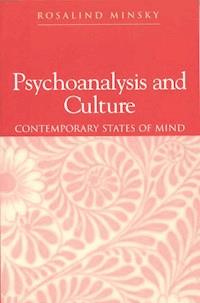
Written in a readable, accessible style, with plenty of up-to-date examples Psychoanalysis and Culture provides a brilliant introduction to key issues in the area of application of psychoanalytic theories to culture. The author argues that we cannot grasp the complexity of contemporary global issues without understanding some of the unconscious processes which underlie them. After introducing some major modern and postmodern psychoanalytic approaches, Minsky offers a broad-ranging critique of Lacan's theory of culture and the unconscious. She explores a range of crucial and topical questions: how should we explain women's historical subordination and what is now often seen as a crisis in male identity? What constitutes 'masculinity' apart from power and control? How important is the father, actually and symbolically in children's development in the context of lone-parent families? Why is contemporary culture often still so violent and destructive? Why is consumer culture so attractive to so many and why is it so difficult to put limits on economic growth in the interests of preventing environmental disaster?
This book will be of great interest to students and scholars in sociology, women's studies, cultural studies, psychology and history as well as psychoanalytic studies. It will also appeal to the general reader interested in the psychology of cultural change.
Sie lesen das E-Book in den Legimi-Apps auf:
Seitenzahl: 516
Veröffentlichungsjahr: 2013
Ähnliche



















Table of Contents
Cover
Dedication
Title page
Copyright page
Epigraph
Preface
Acknowledgements
Abbreviations
Introduction
Modernist and post-modernist approaches
The unconscious, identity and culture
A degree of integration
Psychosomatic experience
An eclectic approach
Encountering psychoanalytic material
Freudian and object-relations theory
Theory and control
Part I: Psychoanalytic Perspectives
1 Freud: sexuality and the unconscious
The unconscious
Sexuality and infantile sexuality
Narcissism
The Oedipal crisis
2 Klein: phantasy and reparation
Loving and hating phantasies
Unconscious mechanisms
Unconscious positions
Defences in the depressive position
The father in Klein’s theory
Envy and gratitude
3 Winnicott: the mother and creativity
The ‘good enough’ mother
Disillusionment
The false self
Transitional phenomena
Playing and reality
4 Lacan: the unconscious as language
The Imaginary and the Symbolic
The father and the place of the father
The phallus: the first sign of difference
Language and the Symbolic
Masquerade and jouissance
Part II: Control or Containment?: Making Sense of Experience
5 Difference: the fluidity of gender
Culture and the father
Bisexuality and the rejection of ‘femininity’
Fluid identities
The victimization of the ‘other’
Fear and dependence
Feminized ‘others’
Cultural change
Gender and biology
Degrees of gender precariousness
Symbolic castration and loss of a ‘feminine’ identity
The need for separation
Heterosexuality
Homosexuality
Lacan: a gendered language and culture
The rejection of experience
6 Womb-envy and women as ‘too much of a good thing’
Change and psychical survival
Womb-envy
Two discoveries of sexual difference
Sight and in-sight
Male and female projections onto the ‘other’
Sexuality and identity
Women as ‘too much of a good thing’
Knowledge as a defence against womb-envy
Intuitive, empathic ways of knowing
Change and the withdrawal of projections
Containing the unthinkable
7 The psychical significance of fathers
Cultural change
The symbolic father
The father as an alternative psychical space
The third position
The baby in the father’s mind
Absent fathers
8 The unconscious roots of violence
Destructiveness and the twentieth century
Freud: sadism and masochism
The victim and the victimizer
Insiders and outsiders
Social fragmentation
Klein: idealization or denigration
Bion: the container/contained relationship
Shame, blame and the grudge
Sibling rivalry
Winnicott: testing the mother’s resilience
Adaptation and compliance
Violence against women
Bollas: the transformative mother
Theft of the self and the violent acting out of inner states
Violent crime and the need for mourning
Cultural responses
Violence and representation
9 Consuming ‘goods’
Oral ‘incorporation’
Narcissism and the ego-ideal
Idealized and denigrated consumer goods
The transformational role of consumer objects
Narcissism and creativity
Culture and the need for containment and boundary
Relative deprivations
Cultural change
10 Fragrant theory and the sweet scent of signifiers
Psychoanalysis in the academic world
The sweet scent of control
The body and intuitive ways of knowing
The seductiveness of Lacan’s theory
An eclectic approach
Anxiety and the rejection of biology and experience
Freud and Lacan
The need to engage with complexity
Bibliography
Index
To Kathleen and Sydney
First published in Great Britain 1998
by Polity Press in association with Blackwell Publishers Ltd.
First published in the United States 1998
by Rutgers University Press, New Brunswick, New Jersey
© Rosalind Minsky 1998
All rights reserved
No part of this book may be reproduced or utilized in any form or by any means, electronic or mechanical, or by any information storage and retrieval system, without written permission from the publisher. Please contact Rutgers University Press, Livingston Campus, Building 4161, P.O. Box 5062, New Brunswick, New Jersey 08903. The only exception to this prohibition is “fair use” as defined by U.S. copyright law.
Library of Congress Cataloging-in-Publication Data and British Library Cataloguing-in-Publication Data are available upon request.
ISBN 0-8135-2585-3 (cloth)
ISBN 0-8135-2586-1 (pbk.)
ISBN 978-0-7456-7784-2 (epdf)
ISBN 978-0-7456-6795-9 (epub)
ISBN 978-0-7456-6794-2 (mobi)
The truth did not come to me suddenly,
It came quietly, circumspectly, snuffling and whimpering,
Looking to be let in many times before.
Paul Scott
Insight into the truth is the flash which, in live
conversation upon serious matters, carries one beyond words.
Iris Murdoch, Metaphysics as a Guide to Morals
There’s a cool web of language winds us in
Retreat from too much joy and too much fear:
Robert Graves, ‘The Cool Web’, Collected Poems
Preface
Despite the regular appearance of ill-informed and often hostile articles about psychoanalysis and psychotherapy, in all sections of the press, based on a surprisingly low level of enquiry, there have been two major areas of developing interest in psychoanalytic ideas. One of these is the increasing number of women entering training institutions in analytical psychotherapy, significantly, perhaps, in a cultural climate where ordinary human need and intuitive, empathic forms of knowledge and containment have often been sacrificed to economic expediency. The other is the continuing interest in psychoanalytic ideas in universities. More and more, sociologists, anthropologists, historians and psychologists are becoming interested in how unconscious as well as conscious processes manifest themselves in their areas of study as well as those involved in literary, cultural, film and women’s studies. These latter were the first to dip their toes in the glinting waters of psychoanalytic knowledge, particularly in relation to our understanding of the complexities of gender.
In contrast to the clinical world of psychotherapy and psychoanalysis, much of the ‘take up’ of psychoanalytic theory in arts and humanities departments in universities has centred on the post-modernist work of Lacan. But intriguing and intellectually seductive as this theory is, it represents only a very small part of the richness and subtlety of psychoanalytic approaches as a whole, including those of object-relations theory or what is sometimes called the British School.
In this book I have tried to suggest some of the flavour and cultural relevance of the intellectual, imaginative and intuitive depth and range which are characteristic of psychoanalytic perspectives generally, none of which, given the complexity with which contemporary culture confronts us, I think we can afford to ignore in our attempts to make some kind of sense of what is ‘going on’.
In spite of the cultural dominance of science and reason, the end of the millennium sees an increasingly fragmented, disordered world which, particularly in the contexts of globalization, the electronics revolution, the environment and poverty, often appears to be already running out of our control. Perhaps, in this context, a desire to feel in control explains our need, sometimes, to ally ourselves too exclusively with perspectives which offer us the greatest sense of mastery of what we may find painful or disturbing even if they leave out crucial and valuable dimensions of our existence. Psychoanalytic insights cannot offer us any precise solutions but they can enable us to see some problems more clearly because they take account of the irrational as well as rational elements that are inherent in them.
All psychoanalytic theories confront us with uncertainty, unpredictability, contradiction and ambiguity and the need to recognize and accept difference. However, I want to suggest that an eclectic use of these theories can allow us to remain in touch with the notion of wisdom, value or the best ways to live well (in the Greek sense), without falling victim to idealization, demonization or totalizing, rigid versions of ‘truth’. An awareness of psychoanalytic knowledge and the emotional resonances and insights it often generates offers the possibility of finding ‘artistic’ ways of understanding culture rather than exclusively scientific or rational ones which leave out so much of what the experience of living feels like. Such ‘artistic’ ways of thinking aspects of culture depend on extending our cultural capacity to appreciate forms of knowledge which, like most forms of art, reflect and value some level of emotional as well as intellectual integration and creativity. This seems more realistic, and potentially more productive, than a defensive resort to denial and control of what makes us feel uncomfortable. In the context of postmodernism, this may include a blanket rejection of any notion of value because of its perceived source in the arbitrariness of language. In this view, values which might spring from our earliest sensory and emotional experiences of infancy and the mode of being which emerges out of them are deemed to be theoretically beyond the pale. At an important level, psychoanalytic approaches suggest that culture does not entirely ‘live’ us. We live ourselves in our different ways partly as a result of what has been available to us as embodied, emotional creatures from the moment we are born.
The tendency for academic fashion to see-saw from one binary position to another, just like fashion in other areas of life, also seems to be a reflection of the emotional need to exclude huge areas of our experience in order to sustain a sense of identity, coherence and security. This book, among other things, emphasizes the possibility of a degree of emotional integration as well as precariousness in our identity. It is this, psychoanalytic theory as a whole suggests, which can enable us to have confidence in some values about how to live and in our ability to make some helpful sense of the complexity and contradictions within ourselves and culture and act on it intuitively and imaginatively as well as rationally.
Acknowledgements
I would like to thank my partner David Pickles for his unstinting support and for his invaluable comments at every stage of this book, Marina Voikhanskaya for her continuing generosity and interest, and Peter Lomas and Gerald Wooster for their encouraging comments on some of my ideas. I would also like to express my gratitude to my students at Anglia Polytechnic University from whose responses to psychoanalytic ideas I have learned so much. I am also grateful to Andrew Winnard, Anthony Giddens, Gill Motley, Julia Harsant and Annabelle Mundy at Polity Press for their help and advice.
The author and publishers gratefully acknowledge permission to use short extracts from the following copyright works as epigraphs:
Sigmund Freud: from The Standard Edition of the Complete Psychological Works of Sigmund Freud, Volume 19, translated and edited by James Strachey, reprinted by permission of Sigmund Freud © copyright The Institute of Psycho-Analysis and The Hogarth Press Ltd; and from the US edition, The Collected Papers, Volume 5 edited by James Strachey, published by Basic Books, Inc. by arrangement with The Hogarth Press Ltd and The Institute of Psycho-Analysis, London, reprinted by permission of Basic Books, a subsidiary of Perseus Books Group, LLC.
Robert Graves: lines from ‘The Cool Web’ from Collected Poems (1997), reprinted by permission of the publisher, Carcanet Press Ltd.
Nick Hornby: from Fever Pitch (1992), reprinted by permission of the publisher, Victor Gollancz Ltd.
Ian McEwan: from The Child in Time (Jonathan Cape, 1987), reprinted by permission of Random House UK Ltd.
Iris Murdoch: from Metaphysics as a Guide to Morals (Chatto & Windus), reprinted by permission of Random House UK Ltd and of Penguin Books, USA.
Susie Orbach: from ‘Revenge Tragedy’ first published in the Guardian, 16.8.97, copyright © The Guardian 1997, reprinted by permission of Guardian Newspapers Ltd.
Paul Scott: quotation reprinted by permission of David Higham Associates.
Abbreviations
The following abbreviations have been used throughout:
SEStandard Edition of the Complete Psychological Works of Sigmund Freud, vols 1–24, 1953–74, London, Hogarth Press and The Institute of Psychoanalysis.PFLPelican Freud Library, 1973 – , Harmondsworth, Penguin.Introduction
Contemporary culture in the Western world confronts us with social, political, technological and economic changes which are often confusing and contradictory and sometimes disturbing and frightening. This seems likely to be related to the sheer scale of change on so many fronts of our existence. These include changes in the relationships between men and women, family breakdown and the increase in lone-parent families, the ending of the Cold War, the decline of European control and the emergence of Asian economic power, globalization, the electronics revolution, the growing divide between rich and poor in the West and between the northern and southern hemispheres, a growth of a sense of social fragmentation rather than cohesiveness (in spite of the connotations of a global village) and environmental damage, such as global warming and a hole in the ozone layer, in a context in which nations, so far, seem helpless in putting limits on unbridled economic growth. In many places both science and economic growth seem to be leading to disorder rather than order and to more, rather than less, global poverty, violence and environmental damage. The world, now divided into a natural and an electronic one, seems to be rapidly spinning out of control. Globalization seems to have replaced imperialism and to be operating outside human beings, national boundaries and material reality. Society, it seems, is fast becoming a mere adjunct to the global economy. As Wolfgang Sachs (1992) argues, the language of control seems to have been replaced by the language of management and monitoring. Our sense of having control, the world at our fingertips, as it is in the famous ‘Armada portrait’ of Queen Elizabeth I and in Michelangelo’s painting The Creation of Adam, is waning fast. Being able to measure the world, or make computerized predictions about it, or look down on it from space, no longer seems to offer us the sense of omnipotent control that it used to. The world seems to be becoming less predictable and old certainties seem to be breaking down. Sachs (1992) offers us the strange contradiction between Bosnia and Rwanda and computer-based globalization.
Psychoanalytic knowledge suggests that we cannot think about the immense complexity and diversity of culture and cultural change adequately if we use only the language of consciousness and rationality. Like our own identities, culture is underpinned by powerful, hidden unconscious as well as conscious processes. Psychoanalytic approaches suggest that history directs and produces outlets for these unconscious processes which take different forms in different historical epochs. Difference is central to this process in the sense of who, at any particular moment, is defined as the scapegoat ‘other’ against which we bolster our own sense of identity (for example, woman, Protestant, Catholic, Jew, Muslim or homosexual). The aim of this book is to explore how unconscious processes may be manifested in culture. Psychoanalytic knowledge does not offer us control. Rather it can offer us some insight into the sources of the irrational dimensions of culture which are not so available within other areas of knowledge. This includes insight into language and representation but it is not confined to them. Although at one level our experience of the world is mediated by thought and language, a recent emphasis primarily on these as the home of the unconscious as well as consciousness has often meant that embodied experience and the psychosomatic emotional dimension of our existence have been ruled out of court. Although the internal structure of Jacques Lacan’s influential psychoanalytic theory justifies this rejection of the value of experience, there are other powerful and compelling psychoanalytic perspectives which inform clinical practice which do not compel us to believe that we are entirely created by our words and that life consists only of events in language. Nor do they assume that we and the knowledge we produce are anything but precarious and imperfect because of the potential subversion of who we are by our unconscious. But they do suggest that there are degrees of precariousness and that some level of emotional integration and way of being deriving from a sphere which pre-dates language is both possible and desirable for a creative, fulfilling life and the ability to learn from experience, something we perhaps call wisdom. In this book I want to suggest that it is time to take another look at identity and culture using a broader spectrum of psychoanalytic ideas.
Lesen Sie weiter in der vollständigen Ausgabe!
Lesen Sie weiter in der vollständigen Ausgabe!
Lesen Sie weiter in der vollständigen Ausgabe!
Lesen Sie weiter in der vollständigen Ausgabe!
Lesen Sie weiter in der vollständigen Ausgabe!
Lesen Sie weiter in der vollständigen Ausgabe!
Lesen Sie weiter in der vollständigen Ausgabe!
Lesen Sie weiter in der vollständigen Ausgabe!
Lesen Sie weiter in der vollständigen Ausgabe!
Lesen Sie weiter in der vollständigen Ausgabe!
Lesen Sie weiter in der vollständigen Ausgabe!
Lesen Sie weiter in der vollständigen Ausgabe!




