


60,99 €
Mehr erfahren.
- Herausgeber: John Wiley & Sons
- Kategorie: Fachliteratur
- Sprache: Englisch
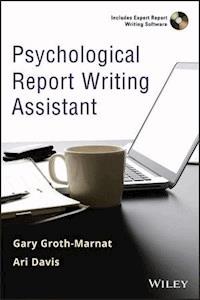
Expert Report Writing Software—provides a step-by-step guide to writing clinically sound and rich psychological reports
The Psychological Report Writing Assistant software is a highly interactive program that guides the report writer through all phases of writing a report that is comprehensive, includes integrated interpretation, uses everyday language, and answers the referral questions. Key features include:
- A composition screen with links to resources to facilitate report writing
- Sample reports with links to guidelines on how to write sections of the report
- A comprehensive menu of treatment recommendations
- Search function to identify problem phrases with suggestions for alternative wording
- Compatible with Microsoft Windows
Blending the best of science with an appreciation for the art of doing clinical work, the accompanying guide:
- Describes six core qualities of an optimal psychological report
- Provides an overview of cognitive, neuropsychological, personality, psychoeducational, and forensic reports
- Offers guidelines for formatting and completing various sections of a report
- Discusses recommendations for treatment and for tailoring the report to the individual
- Includes instructions for navigating the software
Filling the need for an easy-to-use, intuitive tool for organizing and writing relevant psychological reports, Psychological Report Writing Assistant will help you quickly and easily create thorough and complete psychological reports.
Sie lesen das E-Book in den Legimi-Apps auf:
Seitenzahl: 262
Veröffentlichungsjahr: 2013
Ähnliche


















Contents
Preface
Chapter 1: Introduction
Who This Book and Software Are For
Rationale and Philosophy for Report Writing: An Integrative Approach
An Introduction to the Psychological Report Writing Assistant
From Software to the Real World
An Overview of How to Use This Book and Software
Recommended Reading
Chapter 2: Core Qualities of a Good Report: Principles and Strategies
1. Anchoring Referral Questions to the Summary/Recommendations
2. Making the Report Readable
3. Impressions and Interpretations Organized According to Domains
4. Minimal Reference to Tests and Testing
5. Integrated/Readable Expansion of Interpretations That Are Connected to Client’s World
6. Recommendations Sufficiently Broad, Treatment Plan Integrated With Interpretations, Related to Client’s World
Recommended Reading
Chapter 3: Format of the Psychological Report
Identifying Information
Referral Question
Evaluation Procedures
Behavioral Observations/Mental Status
Background Information
Test Results
Impressions and Interpretations (or Simply “Findings” for Forensic Reports)
Using the Integrated Information Manager
Summary
Recommendations
Signature/Title
Appendix
Recommended Reading
Chapter 4: Recommendations
Tailoring Recommendations to the Client
Categories of Recommendations
Recommended Reading
Chapter 5: Types of Psychological Reports
Intellectual/Cognitive Reports
Neuropsychological Reports
Psychoeducational Reports
Personality Reports
Forensic Reports
Vocational/Career Reports
Recommended Reading
Chapter 6: PRWA Overview and Sample Walkthrough
Introduction
Developing a Psychological Report With the PRWA Wizards
Sample Walkthrough: Creating a New Client Record and Developing a Psychological Report
Appendix A: Annotated Psychological Report
Appendix B: Checklist for General Psychological Report
Appendix C: Checklist for Forensic Psychological Report
Appendix D: Selected Resources for Psychological Report Writing
References
About the Author and Software Developer
About the CD-ROM
Author Index
Subject Index
Cover image: © iStockphoto.com/kyoshino
Cover design: Wiley
Copyright © 2014 by John Wiley & Sons, Inc. All rights reserved.
Published by John Wiley & Sons, Inc., Hoboken, New Jersey.
Published simultaneously in Canada.
No part of this publication may be reproduced, stored in a retrieval system, or transmitted in any form or by any means, electronic, mechanical, photocopying, recording, scanning, or otherwise, except as permitted under Section 107 or 108 of the 1976 United States Copyright Act, without either the prior written permission of the Publisher, or authorization through payment of the appropriate per-copy fee to the Copyright Clearance Center, Inc., 222 Rosewood Drive, Danvers, MA 01923, (978) 750-8400, fax (978) 646-8600, or on the web at www.copyright.com. Requests to the Publisher for permission should be addressed to the Permissions Department, John Wiley & Sons, Inc., 111 River Street, Hoboken, NJ 07030, (201) 748-6011, fax (201) 748-6008.
Limit of Liability/Disclaimer of Warranty: While the publisher and author have used their best efforts in preparing this book, they make no representations or warranties with respect to the accuracy or completeness of the contents of this book and specifically disclaim any implied warranties of merchantability or fitness for a particular purpose. No warranty may be created or extended by sales representatives or written sales materials. The advice and strategies contained herein may not be suitable for your situation. You should consult with a professional where appropriate. Neither the publisher nor author shall be liable for any loss of profit or any other commercial damages, including but not limited to special, incidental, consequential, or other damages.
This publication is designed to provide accurate and authoritative information in regard to the subject matter covered. It is sold with the understanding that the publisher is not engaged in rendering professional services. If legal, accounting, medical, psychological or any other expert assistance is required, the services of a competent professional person should be sought.
Designations used by companies to distinguish their products are often claimed as trademarks. In all instances where John Wiley & Sons, Inc. is aware of a claim, the product names appear in initial capital or all capital letters. Readers, however, should contact the appropriate companies for more complete information regarding trademarks and registration.
For general information on our other products and services please contact our Customer Care Department within the United States at (800) 762-2974, outside the United States at (317) 572-3993 or fax (317) 572-4002.
Wiley publishes in a variety of print and electronic formats and by print-on-demand. Some material included with standard print versions of this book may not be included in e-books or in print-on-demand. If this book refers to media such as a CD or DVD that is not included in the version you purchased, you may download this material at http://booksupport.wiley.com. For more information about Wiley products, visit www.wiley.com.
Library of Congress Cataloging-in-Publication Data:
Groth-Marnat, Gary.
Psychological report writing assistant / Gary Groth-Marnat, Ari Davis.
pages cm
Includes bibliographical references and index.
ISBN 978-0-470-88899-5 (paperback)
ISBN 978-1-118-23485-3 (ebk.)
ISBN 978-1-118-22110-5 (ebk.)
1. Clinical psychology—Vocational guidance. 2. Medical assistants—Vocational guidance. 3. Neuropsychological report writing—Study and teaching. 4. Report writing—Study and teaching. I. Davis, Ari. II. Title.
RC467.95.G76 2013
616.89'023—dc23
2013014059
To Robin
Preface
Dear reader: Thank you for purchasing this book and its associated software. We hope that the material is clear and the guidelines, tools, strategies, and resources will make writing psychological reports easy, clear, integrated, focused, relevant—and fast. Most important, we hope it will allow readers to have a deeper understanding of the person being assessed and allow optimal decisions to be made.
Essential to the development of this book and software has been a set of core principles. One of these is the blending of the best of science combined with an appreciation for the art of doing clinical work. Both are interdependent. Science keeps art from becoming filled with bias and folklore. It allows us to be accountable for the conclusions and decisions we make. In contrast, art prevents science from becoming mechanistic and inhuman. It acknowledges the importance of wisdom, empathy, and using test results to understand the struggles and experience of the person. Thus, we hope that readers will find that built into the book and software is a deep appreciation and respect for both the art and science of assessment practice.
Successful efforts in academia seem to follow two possible strategies. One is to take simple information and make it as complex as possible. A second strategy is to take complex information and make it as simple and clear as possible. It is this second principle that we honor and hope we have infused into the book/software. For example, the second chapter of the book describes six core principles that create an optimal report. Each of these is accompanied by guidelines and strategies on how these can be implemented. Similarly, the software has been designed to organically follow the flow of writing a report and, at crucial points, to provide the report writer with guidelines, tools, examples, and resources. We hope that first-time users will easily understand the flow and tools, and that using the software will become even easier over the course of time.
A third principle has been to focus only on information that is most relevant for conducting the task of assessment and report writing. This has resulted in continual questioning of what is truly relevant. We have been cautioned that sometimes, when authors try to say too much, readers can become overwhelmed. The result is that many tools and strategies end up not getting used. Thus, we have focused only on including what we thought were essentials. Report writers themselves should similarly keep this in mind when they write reports. For example, including too many recommendations in a report can sometimes run the risk that none of them will be implemented because readers feel overwhelmed and don’t know where to start.
A final principle has been writing for an unfilled niche. The sister book, Handbook of Psychological Assessment, now in its fifth edition, emerged from an unfilled need in the field. In the late 1970s and earlier, there was no comprehensive educational or professional book that covered the A–Z of how to conduct assessment. The Handbook of Psychological Assessment was designed to meet this need. Similarly, the current book and software were written to allow students/practitioners a source to walk them through the report writing process. This need became apparent during the process of many years of collaborating with students writing reports. It is and was a difficult skill to teach. Indeed, mastering the skills of writing a good, or any, report is often experienced as one of the hardest tasks in the training of professional psychologists. Experienced practitioners similarly struggle with writing reports, especially if they do so on an intermittent basis. Many practitioners who are experienced at report writing do things like collect common phrases or prepare lists of recommendations. They then use these phrases/recommendations to insert into reports at strategic places. These two strategies, as well as many others, were used in the development of the software. Given the clear challenges built into report writing, a book and expert system software seemed like something that would fill the need for a comprehensive tool that would facilitate the report writing process. We felt that not only should the process itself be facilitated, but tools and strategies offered should be based on what research has told us about what is involved in an optimal report. The findings and recommendations of this research have been integrated into both a philosophy of assessment and specific strategies of report writing.
Many people have generously given their time to advising, giving resources, and reviewing portions of this book and software. Professionals and researchers include the following: John Norcross provided his updated list and ratings of self-help books, films, and Internet resources; Larry Beutler consulted and reviewed material for Systematic Treatment Selection/InnerLife; Annie Chung submitted a sample psychoeducational report; Carol Kilgour submitted a sample personality report; Erik Lande provided his list of neuropsychological recommendations; Elisa Gothiel reviewed forensic material and made suggestions on recommendations; Richard Levak reviewed/discussed personality report organization; and both Rodney Lowman and David Donnay provided useful correspondence related to career/vocational reports. Particularly helpful have been my regular meetings with the following practicing psychologists in the Santa Barbara community: Erik Lande, Steve Smith, Jordan Witt, and Rebecca Goodman. They have all been helpful in allowing me to use them to clarify my ideas and compare them with their perspectives on applied assessment. In addition, the following students and professors have provided me with feedback on various portions of the book/software, including beta testing various modules of the software: Michael Mullard, George Ambrose, Aja Mutzel, and Wendy Eichler. In addition, Beta testers have included Anthony Bean, C. Holiday Blanchard, Paul Hamilton, Kristin Thompson, Kerri Bresette, Julia Michael, Jim Earnest, Caitlin Allen, and Card Kilgour.
There have also been a number of crucial publications in the field that provided both inspiration and resources. Although these were extremely useful, we also made careful efforts to alter these resources so that the information ended up being quite different from the original material. These include the following: Braaten’s (2007) The Child Clinician’s Report Writing Handbook; Jongsma and Peterson’s (2006) The Complete Adult Psychotherapy Planner (4th ed.); Lichtenberger, Mather, Kaufman, and Kaufman’s (2004) Essentials of Assessment Report Writing; Rusin and Jongsma’s (2001) The Rehabilitation Psychology Treatment Planner; and Zuckerman’s (2005) Clinician’s Thesaurus (6th ed.).
Chapter 1
Introduction
The goal of psychological assessment is to integrate a variety of sources into a user-friendly, problem-focused, well-integrated psychological report that both describes a person and provides guidance in making optimal decisions. The above goal and associated procedures draw on a wide number of skills and knowledge ranging from technical psychometric knowledge to an ability to understand the lived experience of the persons being evaluated. Given these multiple demands, writing a high-quality psychological report is often a difficult task. This book and software will guide practitioners through the process of organizing and integrating data so as to provide accurate, user-friendly descriptions of persons being evaluated. These resources should not only improve the quality of reports, but should also make report writing more time efficient. It will also serve as a companion to and extension of Groth-Marnat’s Handbook of Psychological Assessment (5th ed.).
Who This Book and Software Are For
This book and software will be most useful for professional psychologists in training, beginning-level professional psychologists, and practicing professionals who write only occasional reports. It may also enable experienced assessment psychologists to write their reports more quickly and ensure that important dimensions of a report have not been overlooked. Specific resources included in this book are a description of the core qualities of optimal reports, report format, guidelines for completing various sections of the report, discussion of treatment recommendations, overview of different types of reports, and strategies for navigating the Psychological Report Writing Assistant (PRWA). Based on this information, a wide number of corresponding resources have been incorporated into the PRWA software. The software is divided into modules for writing the following five most common types of reports: cognitive, neuropsychological, psychoeducational, personality, and forensic (see Chapter 3). It is hoped that report writers will use these resources to easily assemble assessment data into an integrated report. Ideally, writers will find the “voice” of an expert guiding them through each step of the process. The result should be that not only will report writing proceed more quickly, but the quality of reports will be significantly better than for persons not using the PRWA.
Lesen Sie weiter in der vollständigen Ausgabe!
Lesen Sie weiter in der vollständigen Ausgabe!
Lesen Sie weiter in der vollständigen Ausgabe!
Lesen Sie weiter in der vollständigen Ausgabe!
Lesen Sie weiter in der vollständigen Ausgabe!
Lesen Sie weiter in der vollständigen Ausgabe!
Lesen Sie weiter in der vollständigen Ausgabe!
Lesen Sie weiter in der vollständigen Ausgabe!
Lesen Sie weiter in der vollständigen Ausgabe!
Lesen Sie weiter in der vollständigen Ausgabe!
Lesen Sie weiter in der vollständigen Ausgabe!
Lesen Sie weiter in der vollständigen Ausgabe!
Lesen Sie weiter in der vollständigen Ausgabe!
Lesen Sie weiter in der vollständigen Ausgabe!




