


82,99 €
Mehr erfahren.
- Herausgeber: John Wiley & Sons
- Kategorie: Geisteswissenschaft
- Sprache: Englisch
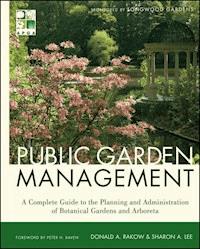
The complete-and-ready reference for establishing, managing, and running a successful and sustainable, profitable public garden As unique museums with living collections of plants, public gardens offer visitors aesthetically beautiful landscapes combined with educational programming and scientific research that promote the value and understanding of plants. In the twenty-first century, public gardens are in the forefront of organizations and institutions committed to promoting the conservation of plants and their habitats, developing sustainable practices that support the environment, and providing green spaces where our increasingly stressed and urbanized citizens can reconnect with the natural world. It is critically important that such institutions have trained, knowledgeable staff members. Because of its comprehensive examination of public gardens, Public Garden Management is the ideal guide for staff members at public gardens, anyone considering a career in public gardens, groups starting a botanical garden or arboretum, and students discovering how these complex institutions work. Public Garden Management is an all-in-one professional reference and textbook that clearly shows how to develop, establish, manage, and maintain a sustainable--both economically and environmentally--public garden. Offering practical coverage of relevant topics, along with useful tools for reinforcing study, this insightful and forward-thinking guide is: * Copublished by the American Public Gardens Association * Written by a panel of leading experts in the field * Filled with dozens of case studies that are real-world illustrations of the principles explored in the text * Illustrated throughout with line drawings, figures, and photographs that assist in conveying critical information Students and professionals will benefit greatly from the management principles outlined in this book, helping them establish and maintain new and existing public gardens that engage, inspire, and connect with their communities.
Sie lesen das E-Book in den Legimi-Apps auf:
Seitenzahl: 1032
Veröffentlichungsjahr: 2011
Ähnliche




















Contents
Acknowledgments
Foreword
Part I: Public Gardens and Their Significance 1
Chapter 1: What Is a Public Garden?
Introduction
Essential Criteria
Types of Public Gardens
Who Creates Public Gardens and Why
Summary
Annotated Resources
Chapter 2: The History and Significance of Public Gardens
Introduction
Humans Are Place Makers
Public versus Private Gardens
Gardens Mirror the Surrounding Society
Public Garden Management and the Legacy of History
The Significance of Public Gardens in the Twenty-first Century
Gardens and the Future of Civilization
Summary
Annotated Resources
Part II: The Emerging Garden
Chapter 3: Critical Issues in Starting a Public Garden
Introduction
Motivations
Allies
Information Needs
Beg and Borrow
Recognize Your Limitations
Potential Obstacles
Managing the New Garden
Conclusion
Annotated Resources
Chapter 4: The Process of Organizing a New Garden
Introduction
Identifying and Organizing a Core Group
Identifying Key Stakeholders
Formalizing the Organization
Development of Vision, Mission, and Goals
Summary
Annotated Resources
Chapter 5: Land Acquisition
Introduction
Financing the Land: Owning vs. Leasing or Renting
Mission, Resources, and Land Size
Other Site Considerations
Environmental Permitting Process
Research and Networking: Critical for Land Planning
Summary
Annotated Resources
Chapter 6: Designing for Plants and People
Introduction
The Garden’s Origins and Its Design
Design Services
Steps in the Design Process
Hiring a Design Team
Summary
Annotated Resources
Part III: Administrative Functions
Chapter 7: Staffing and Personnel Management
Staffing the Start-Up Garden
Staffing the Developing Garden
Public Garden Jobs
Organizational Structure
Personnel Management
Summary
Annotated Resources
Chapter 8: Volunteer Recruitment and Management
Introduction
The Value of Volunteers
Planning a Volunteer Program
Managing the Volunteer Program
Volunteer Recruitment and Placement
The Volunteer Handbook
Volunteer Training
Overseeing and Evaluating the Volunteer Program
Recognizing, Rewarding, and Retaining Volunteers
Summary
Annotated Resources
Chapter 9: Budgeting and Financial Planning
Introduction
Why Budget?
Types of Budgets
The Relationship Between Budgeting and Cash Flow
Tools for Budgeting
The Budget Formulation Process
Budget Oversight and Financial Planning
Summary
Annotated Resources
Chapter 10: Fund-raising and Membership Development
Introduction
Sources of Funding
Fund-raising in a Garden
The Giving Cycle
Fund-raising Programs
Evaluating the Development Program
Summary
Annotated Resources
Chapter 11: Earned Income Opportunities
Introduction
Earned Income Opportunities
Managing Earned Income
Earned Income at Emerging and Established Gardens
Other Earned Income Issues
Summary
Annotated Resources
Chapter 12: Facilities and Infrastructure
Introduction
The Next Step
Building New Structures
Common Botanical Garden Facilities
Summary
Annotated Resources
Chapter 13: Grounds Management and Security
Introduction
Grounds Maintenance Needs
Grounds Management Staff
Total Plant Health Care
Roads, Pathways, and Infrastructure
Water Features
Sustainable Landscape Practices
Public Garden Security
Summary
Annotated Resources
Part IV: Programmatic Functions
Chapter 14: Public Gardens and Their Communities: The Value of Outreach
Introduction
What Are Some of the Ways to Conduct Outreach?
Planning an Outreach Program
Summary
Annotated Resources
Chapter 15: Formal Education for Students, Teachers, and Youth at Public Gardens
Introduction
Rationale
Scope and Character of Formal Education in Public Gardens
Desirable Characteristics of Formal Education Programs
Where to Start: Structure and Operations
Department and Program Development
Ongoing Operations
Summary
Annotated Resources
Chapter 16: Continuing, Professional, and Higher Education
Introduction
Audiences
Adult Continuing Education and Lifelong Learning
Professional Education
Higher Education
Developing New Programs
Evaluate to Ensure Quality Programs
Summary
Annotated Resources
Chapter 17: Interpreting Gardens to Visitors
Introduction
What Is Informal Education?
Characteristics of Effective Interpretation
Developing Informal Education
Range of Interpretive Media
Summary
Annotated Resources
Chapter 18: Evaluation of Garden Programming and Planning
Introduction
What Is Evaluation?
A Brief History of Museum Program Evaluation
Barriers to Conducting Evaluation
Who Does It?
Timing Is Everything
What Can Be Learned from Evaluation?
Data Collection
Special Considerations
Creating an Evaluation Plan
Summary
Annotated Resources
Chapter 19: Public Relations and Marketing Communications
Introduction
Using the Mission to Market the Garden
Marketing Portfolio
Planning for Successful Marketing
Media Relations
Digital Marketing and Social Networking
Crisis Communications
Summary
Annotated Resources
Chapter 20: Collections Management
Introduction
What Are Living Collections?
Collections Policy
Record Systems
Inventories
Plant Names in the Records
Collection/Inventory Maps
Bringing Records to the Web
Celebrating Collection Diversity
Summary
Annotated Resources
Chapter 21: Research at Public Gardens
Introduction
How to Establish a Research Program
Systematics, Floristics, and Herbarium-Associated Research
Conservation-Focused Research
Human/Plant Interactions
Environmental Horticultural Research, Plant Breeding, and Evaluation
Summary
Annotated Resources
Chapter 22: Conservation Practices at Public Gardens
Introduction
Approaches to Plant Conservation
Engaging the Garden in Conservation
Measuring the Success of Conservation Programs
Summary
Annotated Resources
Part V: Long-Term Initiatives
Chapter 23: A Strategic Approach to Leadership and Management
Introduction
The Difference Between Leadership and Management
Tools for Strategic Leadership: From a Shared Vision to a Plan
Tools for Strategic Management: From a Plan to Reality
Summary
Annotated Resources
Chapter 24: Associations and Partnerships
Introduction
Nationally Based Professional Associations
International Associations
Forming Partnerships
Summary
Annotated Resources
Chapter 25: Facility Expansion
Introduction
Why Expand Facilities?
Before the Master Plan
Developing the Master Plan
Budgets
Design Phases
Construction
Summary
Annotated Resources
Chapter 26: The Shape of Gardens to Come
Introduction
Time-Tested, Enduring Features of Early Gardens
Issues Public Gardens Face Today
The Public Garden of the Future
Summary
Appendix A: Factors in the Development and Management of Canadian Public Gardens
Appendix B: The Importance of Plant Exploration Today
Appendix C: Herbaria
Appendix D: Public Garden Archives
Appendix E: The Library in a Public Garden
Appendix F: Horticultural Therapy and Public Gardens
References
Contributors
Index
Copyright © 2011 by Donald A. Rakow and Sharon A. Lee. All rights reserved
Published by John Wiley & Sons, Inc., Hoboken, New Jersey
Published simultaneously in Canada
No part of this publication may be reproduced, stored in a retrieval system, or transmitted in any form or by any means, electronic, mechanical, photocopying, recording, scanning, or otherwise, except as permitted under Section 107 or 108 of the 1976 United States Copyright Act, without either the prior written permission of the Publisher, or authorization through payment of the appropriate per-copy fee to the Copyright Clearance Center, 222 Rosewood Drive, Danvers, MA 01923, (978) 750-8400, fax (978) 646-8600, or on the web at www.copyright.com. Requests to the Publisher for permission should be addressed to the Permissions Department, John Wiley & Sons, Inc., 111 River Street, Hoboken, NJ 07030, (201) 748-6011, fax (201) 748-6008, or online at www.wiley.com/go/permissions.
Limit of Liability/Disclaimer of Warranty: While the publisher and the author have used their best efforts in preparing this book, they make no representations or warranties with respect to the accuracy or completeness of the contents of this book and specifically disclaim any implied warranties of merchantability or fitness for a particular purpose. No warranty may be created or extended by sales representatives or written sales materials. The advice and strategies contained herein may not be suitable for your situation. You should consult with a professional where appropriate. Neither the publisher nor the author shall be liable for any loss of profit or any other commercial damages, including but not limited to special, incidental, consequential, or other damages.
For general information about our other products and services, please contact our Customer Care Department within the United States at (800) 762-2974, outside the United States at (317) 572-3993 or fax (317) 572-4002.
Wiley also publishes its books in a variety of electronic formats. Some content that appears in print may not be available in electronic books. For more information about Wiley products, visit our web site at www.wiley.com.
Library of Congress Cataloging-in-Publication Data:
Public garden management/[compiled by] Donald A. Rakow, Sharon A. Lee.
p. cm.
Includes bibliographical references and index.
ISBN 978-0-470-53213-3 (cloth); ISBN 978-0-470-90457-2 (ebk); ISBN 978-0-470-90458-9 (ebk);
ISBN 978-0-470-90459-6 (ebk); ISBN 978-0-470-95069-2 (ebk); ISBN 978-0-470-95082-1 (ebk)
1. Gardens—Management. 2. Public spaces. 3. Gardening. I. Rakow, Donald Andrew, 1951- II. Lee, Sharon A., 1944-
SB467.8.P83 2011
712'.5068—dc22
2010016949
The authors wish to dedicate this book to their spouses, Sue Rakow and Philip Lebowitz, whose patience, support, and encouragement were absolutely essential throughout the long process of developing this book.
They would further like to dedicate it to all current and future students and practitioners of public horticulture, who have chosen a field that truly does make a difference in the lives of people and the planet on which we live.
Acknowledgments
The authors wish to express their deep appreciation to Longwood Gardens for its generous and unwavering support throughout the process of developing this text. That support is in keeping with Longwood’s well-established leadership in the promotion of professional educational programs. In the 1960s, Longwood recognized the need to have a formalized education program in public garden management and administration and established the Longwood Graduate Program in Public Horticulture in partnership with the University of Delaware. Longwood has continued that leadership by endorsing Public Garden Management, the first textbook on the operations of a public garden, and recognizing the significant impact that such a textbook will have on the continued development of professional courses on the subject.
To the following individuals, we offer our sincere appreciation for their conscientious efforts in reviewing specific chapters:
James M. Affolter, Professor and Director of Research, State Botanical Garden of Georgia
Eleanor Altman, Executive Director, Adkins Arboretum
David P. Barnett, President and CEO, Mount Auburn Cemetery
Jessica Blohm, Interpretive Specialist, New York Botanical Garden
Donald R. Buma, Executive Director, Norfolk Botanical Garden
Marnie Conley, Marketing Department Head, Longwood Gardens Inc.
Richard A. Colbert, Executive Director, Tyler Arboretum
N. Barbara Conolly, Public Garden Leadership Fellow, Department of Horticulture, Cornell University
Michael Dosmann, Curator of Living Collections, Arnold Arboretum of Harvard University
Holly Forbes, Curator, University of California Botanical Garden at Berkely
Charlotte A. Jones-Roe, Associate Director, North Carolina Botanical Garden
Jeremy Jungels, Public Garden Leadership Fellow, Department of Horticulture, Cornell University
Patrick S. Larkin, Executive Director, Rancho Santa Ana Botanic Garden
Carol Line, Executive Director, Fernwood Botanical Garden and Nature Preserve
Erin Marteal, Public Garden Leadership Fellow, Department of Horticulture, Cornell University
Scot Medbury, President, Brooklyn Botanic Garden
Scott Mehaffey, Landscape Architect
Bill Noble, Director of Preservation, The Garden Conservancy
Ken Schutz, Executive Director, Desert Botanical Garden
Adam Schwerner, Director, Department of Natural Resources, Chicago Park District
Holly H. Shimizu, Executive Director, U.S. Botanic Garden
Sonja M. Skelly, Director of Education, Cornell Plantations
Shane Smith, Director, Cheyenne Botanic Gardens
Frederick R. Spicer Jr., Executive Director, Birmingham Botanical Gardens
R. William Thomas, Executive Director, Chanticleer Foundation
Lisa K. Wagner, Education Director, South Carolina Botanical Garden
Ellen Weatherholt, Public Garden Leadership Fellow, Department of Horticulture, Cornell University
Peter White, Director, North Carolina Botanical Garden
To Dorothea J. Coleman, our thanks for her invaluable help in researching and preparing the references.
We are most grateful to the Portico Group, Architects, Landscape Architects, Interpretive Planners, and Exhibit Designers, in Seattle, Washington, for permission to use images of some of their public garden plans, and to the gardens illustrated: Buffalo and Erie County Botanical Gardens; Descanso Gardens; Hughson Botanical Garden; The Burden Center, Louisiana State University AgCenter; Portland Japanese Garden; San Francisco Botanical Garden; and Washington State University Arboretum and Wildlife Conservation Center.
Finally, we would like to acknowledge the assistance of the following in providing information for Appendix A, “Factors in the Development and Management of Canadian Public Gardens”: Chris Graham, former Director of Horticulture at Royal Botanical Gardens; Doug Hevenor, Director of the International Peace Garden; Sharilyn J. Ingram, Assistant Professor, Brock University; Harry Jongerden, Garden Director, VanDusen Botanical Garden; Michel Labrecque, Conservateur, Jardin botanique de Montréal; Alexander Reford, Director, Reford Gardens/Jardins de Métis; and Freek Vrugtman, Curator Emeritus at Royal Botanical Gardens.
Foreword
In our tumultuous modern world, public gardens, with their orderly and diverse collections of plants and extensive educational programs, are ideally positioned to make major contributions not only to the amenity of our lives but also to the ways in which we envision the future. Throughout the United States, there is great interest in establishing new public gardens and building the capacity of existing ones to provide accessible, documented, and educational facilities that serve to attract visitors, but perhaps more importantly, serve as guides to the kind of sustainable, rich, and beautiful world that we would like to build together for the future. Many of us have found that there is no more rewarding profession than that of public horticulture as a way in which individuals can contribute to the enrichment of life and the preservation of the diversity and beauty that it represents. We hope that many who are considering a profession in this area find this book a source of guidance and inspiration.
All life depends on plants. They provide all of our food, directly or indirectly, with just over one hundred kinds of plants responsible for more than 90 percent of the calories we consume. Plants provide most of the medicine used throughout the world, as well as building and other raw materials, and they will be the sources of many more kinds of products that we have yet to discover or recognize. Plants beautify and enrich our lives and give peace to our souls. All of these are reasons why public gardens as showcases for enjoying and learning about plants have become so very important with the passage of years and with the challenges that we face in the modern world.
The global population has tripled within my lifetime to its present level of more than 7 billion people. More than 2 billion more people are expected to be added during the next four decades, an unprecedented number that will pressure a world already drawing some 150 percent of its sustainable capacity, according to GlobalFootprint.org. Consumption levels per person are increasing even more rapidly than population numbers, and so is the proportion of people living in urban centers, which makes the need for public gardens, with their extraordinary ability to connect city dwellers with nature, all the more important. The United States, with the highest consumption rates in the world, is growing much more rapidly than the world as a whole; the 310 million of us now will increase to an estimated 440 million people by midcentury, with almost incalculable pressures on the environment resulting from this growth. We need public gardens and environmental awareness if we are to increase our ability to live as members of a world that can sustain us and everyone else on earth in a stable system.
In addition to direct pressures on habitats, the overharvesting of individual kinds of plants for particular purposes and the rampant spread of invasive alien plants and animals (such as garlic mustard, the emerald ash borer, and sudden oak death) in natural communities threatens their future. Global climate change, which has shifted the USDA established hardiness zones more than 150 miles northward over the past twenty years, is accelerating, and we seem to have limited ability to deal with it. Up to 40 percent of the endemic plants of California are projected to become extinct over the next several decades because of the elimination of their habitats. The Intergovernmental Panel on Climate Change has estimated that 20 to 40 percent of the world’s plants could disappear from nature during the course of this century because of global warming, with its attendant changes in precipitation levels and distribution. This makes the role of public gardens in direct conservation efforts, as well as in education, all the more important.
The many and diverse functions played by public gardens in different settings are laid out especially well in Chapter 1 of this volume, but conservation has sprung to the forefront because of the challenges that our native plants and native communities face in the twenty-first century. The Center for Plant Conservation, a network of botanical gardens and arboreta throughout the United States, works collaboratively for the conservation of our plant species in their native habitats, in public gardens, and in seed banks. Its efforts have never been more important for the future. Beyond the importance of preserving our native plants, we also have a responsibility to contribute to the conservation of all plants. It is estimated that the world’s public gardens hold more than 100,000 of the estimated 350,000 species of plants known worldwide—a rich endowment indeed, even if many of these species are represented by a single individual or too few individuals to constitute a genetically adequate sample. Public gardens, on their own or in cooperation with university departments of horticulture, are also prime sites for the maintenance of traditional cultivars of plants and the development and dissemination of new ones, all topics that are treated well in the pages of this text. The North American Plant Collections Consortium, supported by the American Public Gardens Association, represents a strong effort to coordinate and foster this aspect of our activities.
In view of the many and diverse ways that public gardens enrich our lives and facilitate our ability to envision a more complete and richer future than would be possible without them, it is a special pleasure to introduce this useful and accessible volume to its readers. I do so in the first instance by congratulating its authors, Don Rakow and Sharon Lee, for the fine work they have done drawing together a collection of useful and interesting chapters. With its examination of the functions that different gardens are playing and can play in their individual communities, this book will be of great use to the community of professionals and volunteers who are concerned with the presentation and management of public gardens and with the establishment of new ones. The book offers those of us who are responsible for the management of individual institutions much practical advice and guidance in the many aspects that add up to success in the very important field of endeavor that our public gardens represent.
The gardens in our care have the ability to heal our spirits in a troubled world and to lead us to envision a greater and nobler future for which we otherwise might not find time in the midst of our busy lives and the confused demands of the modern world.
PETER H. RAVEN
President, Missouri Botanical Garden
St. Louis, Missouri
PART I
Public Gardens and Their Significance
CHAPTER 1
What is a Public Garden?
DONALD A. RAKOW
Introduction
If a public garden is any space that has been laid out for public enjoyment, then the history of public gardens can be traced back across both continents and centuries to such luminary garden creators as the Chinese emperor Shen Nung (ca. 2800 BCE), Queen Hatshepsut of the Eighteenth Dynasty of Egypt (ca. 1470 BCE), and the Greek philosopher Aristotle (384–322 BCE).
But in its modern context, a public garden is more than a property that holds a gathering of plants, even when those plants are laid out in an aesthetically pleasing manner. A public garden is both a physical presence that includes plant collections, buildings, and infrastructure and an organization that manages those elements and uses them to further its mission.
To answer the question posed by its title, this chapter will examine the essential criteria for a public garden, offer examples of the different kinds of institutions that meet those criteria, and identify the individuals and organizations that create public gardens and what motivates their efforts.
KEY TERMS
Curation: selecting, organizing, and looking after the objects in a collection.
Systematics: the branch of biology concerned with classification and nomenclature; taxonomy.
Accession: a new item added to a collection in a museum or library.
Accessioning: the act of adding a new item to a collection.
Herbaceous perennial: a plant whose growth dies down annually, but whose roots or other underground parts survive.
Woody plant: any plants with stems and limbs containing lignin; as trees, shrubs, vines.
Ethnobotany: the scientific study of traditional knowledge concerning the medical, religious, and agricultural uses of plants.
Dendrology: the scientific study of trees.
Basic research: research that is driven by a scientist’s curiosity or interest in a scientific question. The main motivation is to expand human knowledge, not to create or invent something.
Applied research: research that is designed to solve practical problems of the modern world, rather than to acquire knowledge for knowledge’s sake.
Mission statement: a concise statement that defines why an organization exists, what are its primary activities, and whom it serves.
Essential Criteria
In its essence, a public garden is a mission-based institution that maintains collections of plants for the purposes of education, research, conservation, and/or public display. It must have a system for maintaining plant records and professional staff. Further, it must be open to the public and provide accommodations for access to all people.
This definition is also useful in identifying what is not a public garden. A park may have beautiful ornamental plants and they may be well cared for by the maintenance staff. Likewise, amusement parks, shopping malls, and even hotels can have lovely and diverse plantings, and community gardens devoted to food production may be public. But such sites do not meet the essential criteria of being public gardens unless there is a mission statement driving their efforts and their plants are actively curated, that is, cared for as objects that are part of the collection of a living museum. Chapter 20 deals in depth with all that is involved with the curation of collections at a public garden.
Mission Statement
Whether it is being applied to a public garden or to a private corporation, a mission statement defines why an organization exists, what its primary activities are, and whom it serves. A public garden’s mission statement might focus on the types of collections it holds, how its collections are to be used, the focus of its programs and/or research, and who its primary audiences are. The mission statement should be the basis for all decisions and planning by the garden.
Plant Collections
Plant collections are fundamentally distinct from purely ornamental displays. Collections can be grouped either taxonomically (i.e., by family association), geographically (plants from one region of the world), functionally (groundcovers), or by plant needs (shade plants or plants for dry soil). One of the greatest challenges for public garden managers is how to merge the method by which collections are organized with the aesthetic goals of the garden.
Lesen Sie weiter in der vollständigen Ausgabe!
Lesen Sie weiter in der vollständigen Ausgabe!
Lesen Sie weiter in der vollständigen Ausgabe!
Lesen Sie weiter in der vollständigen Ausgabe!
Lesen Sie weiter in der vollständigen Ausgabe!
Lesen Sie weiter in der vollständigen Ausgabe!
Lesen Sie weiter in der vollständigen Ausgabe!
Lesen Sie weiter in der vollständigen Ausgabe!
Lesen Sie weiter in der vollständigen Ausgabe!
Lesen Sie weiter in der vollständigen Ausgabe!
Lesen Sie weiter in der vollständigen Ausgabe!
Lesen Sie weiter in der vollständigen Ausgabe!
Lesen Sie weiter in der vollständigen Ausgabe!
Lesen Sie weiter in der vollständigen Ausgabe!
Lesen Sie weiter in der vollständigen Ausgabe!
Lesen Sie weiter in der vollständigen Ausgabe!
Lesen Sie weiter in der vollständigen Ausgabe!
Lesen Sie weiter in der vollständigen Ausgabe!
Lesen Sie weiter in der vollständigen Ausgabe!
Lesen Sie weiter in der vollständigen Ausgabe!
Lesen Sie weiter in der vollständigen Ausgabe!
Lesen Sie weiter in der vollständigen Ausgabe!
Lesen Sie weiter in der vollständigen Ausgabe!
Lesen Sie weiter in der vollständigen Ausgabe!
Lesen Sie weiter in der vollständigen Ausgabe!
Lesen Sie weiter in der vollständigen Ausgabe!
Lesen Sie weiter in der vollständigen Ausgabe!
Lesen Sie weiter in der vollständigen Ausgabe!
Lesen Sie weiter in der vollständigen Ausgabe!
Lesen Sie weiter in der vollständigen Ausgabe!
Lesen Sie weiter in der vollständigen Ausgabe!
Lesen Sie weiter in der vollständigen Ausgabe!
Lesen Sie weiter in der vollständigen Ausgabe!
Lesen Sie weiter in der vollständigen Ausgabe!
Lesen Sie weiter in der vollständigen Ausgabe!
Lesen Sie weiter in der vollständigen Ausgabe!
Lesen Sie weiter in der vollständigen Ausgabe!
Lesen Sie weiter in der vollständigen Ausgabe!




