


10,99 €
Mehr erfahren.
- Herausgeber: Exisle Publishing
- Kategorie: Ratgeber
- Sprache: Englisch
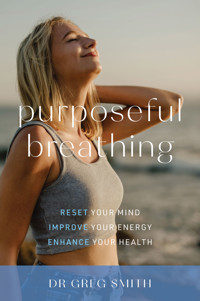
Purposeful Breathing is a practical, user-friendly guide to simple breathing skills that can rapidly reduce states you don’t want (such as stress and anxiety) and increase states you do want (such as feeling stronger or relaxing). It also teaches breathing skills for long term health, informed by new discoveries from psychology and neuroscience.
Das E-Book können Sie in Legimi-Apps oder einer beliebigen App lesen, die das folgende Format unterstützen:
Seitenzahl: 278
Veröffentlichungsjahr: 2020
Ähnliche

















purposefulbreathing
RESET YOUR MINDIMPROVE YOUR ENERGYENHANCE YOUR HEALTH
DR GREG SMITH
For Jane, always beautiful andbrimming with the energy of life.And for Saxon and Levi, endlesssources of inspiration.
CONTENTS
Part 1: Background information
Introduction: The breath as mind–body link
1. Breathing as a master switch
2. Breathing awareness
3. Key mechanisms
4. Problem breathing
Part 2: Getting started
5. Key principles of purposeful breathing
6. Breathing styles and basic techniques
Part 3: Breathing for specific purposes
7. Stop, breathe, refocus
8. Managing and transforming stress
9. Anxiety, trauma and depression
10. Enhancing energy
11. Health and physical goals
12. Happiness, inspiration, creativity
Part 4: Meditation, mindfulness and Eastern traditions
13. Breathing as a means of meditation
14. Breathing with movement
15. Subtle energies
Conclusion: Everyday inspiration
Appendix: The breathing styles
Acknowledgments
References
Endnotes
Index
PART 1
Backgroundinformation
INTRODUCTION:THE BREATH ASMIND–BODY LINK
I remember as a boy being curious about breathing.
I was a keen sportsman and I can particularly recall a time at football training, running hard and straining for breath. When the time came for a break, I approached the coach and asked him what the best way to breathe was. He looked a little puzzled and said something like ‘Just focus on the ball, son.’
To some extent he was right, because different styles of breathing can happen automatically, but when I was painfully struggling for breath I knew there must be more to it.
My interest in breathing has continued over many years.
As a psychologist, I would often notice how people in different emotional states, such as when feeling anxious or depressed, would breathe in quite different ways. Some people would breathe in shallow, rapid patterns. At times people would stop breathing when they were thinking of something upsetting. Often, the most important moments in a therapy session were those moments when a person made an ‘emotional shift’ and they would begin to breathe more deeply or let out a long sigh of release.
I have also practised yoga for many years and breathing is central to the practice. Yoga promotes a depth of breathing that allows deep relaxation. In yoga the breath is taken to reflect a person’s state of mind. Shallow, uneven breathing reflects an agitated mind and slow, deep breathing reflects a calm mind. Yoga also uses the breath to build energy, with pranayama being both a control of the breath and a science of energy expansion. In its practices of meditation, yoga builds an awareness of different states of mind and the breath can be used as a tool to change between these states of mind.
The chapters in this book draw upon my experience as a therapist and yoga teacher to explore the ways the breath can be used as a mind–body link. The book outlines a number of simple practices which can be helpful for a range of purposes in everyday life, from managing stress, promoting health and healing, enhancing performance in different areas, or inviting a sense of inspiration.
How to use this book
The breath forms an incredibly powerful mind–body connection. Even though we all breathe all the time, we don’t usually pay it much attention.
This book is a manual for simple breathing skills that can rapidly reduce states you don’t want (such as stress, anxiety, agitation, depression) and increase states you do want (feeling calmer, stronger, more energized or inspired). These skills are linked with new discoveries from psychology and neuroscience.
For anyone suffering from anxiety, feeling calmer can happen in a breath or two. For anyone wanting to boost performance, the skills in this book will help to get you in ‘the zone’ of peak performance. As well as the rapid skills, the book also teaches breathing skills for longer term health and healing.
As you read through the book, you’ll see various breathing styles, or exercises, scattered throughout the chapters. Some exercises (such as the standing breathing styles on pp. 164–70) can be done in a sequence if preferred, so they appear together. There is also an appendix on p. 186 that lists each breathing style featured in the book.
I have included numerous case studies to show you how I have used different breathing styles to help clients. The case studies are based on real clients but their names and identifying details have changed. Some cases are composites of typical features of many clients.
Breathing skills are a treasure.
Control the breath and you control the mind.
—Buddhist saying
State of breathing reflects state of mind.
—Yoga saying
1
BREATHING ASA MASTER SWITCH
The breath is a remarkably powerful mind–body connection.
Although we all breathe everyday it remains a largely unconscious process. This means our breathing often changes in important ways without us being aware of it. Anxiety, anger, deep calm or steady concentration each have their own patterns of breathing and we move between different styles of breathing every day without usually realizing it. If we can recognize these styles of breathing, we can also consciously change them and this in turn produces a change in our emotional state. We can therefore use changes to a pattern of breathing to change our mood and mental states.
For example, if you are anxious, the breath is often shallow and sharp, and changing your breathing to slow and deep, using the diaphragm, will lower your level of anxiety. This change is not usually so powerful as to make you totally relaxed in a few moments, but it is usually enough to ‘take the edge off’ the anxiety and ‘crank it down a few notches’. For someone suffering anxiety this is usually enough to allow them to think more clearly about the situation and decide upon what additional strategies to use to help.
In my work as a psychologist I have taught simple ‘belly breathing’ or diaphragmatic breathing to literally hundreds of people with severe anxiety, and they learn how to rapidly calm themselves. Severe anxiety can be very debilitating, and if someone was offered a pill that could reduce their anxiety levels by 30 per cent in one or two minutes, there would be a big market for the medication. The same thing, however, can be done with simple breathing, and anxiety is just one application. Breathing skills can be used to change states of mind, concentrate better, enhance performance and much more.
Everyday styles of breathing
The following are typical styles of breathing linked with different moods or emotional states. I notice them for myself, as my own breathing changes with different emotions, but more particularly see them over and again in people who come to see me for assistance in therapy.
Each of these breaths is typical, and the style of breathing may of course change from person to person. They are not recommended styles of breathing, but highlight how breathing changes with mood. If you try each style of breathing you can see how much it might relate to your own breathing patterns as they link with your own emotional changes.
If you would like to try each of these breaths for a few rounds, do it gently. For all of the breathwork in the book, check with your doctor if you have any concerns.
You might like to just read these descriptions, but if you try them, be aware that the effect is often subtle and is also impacted by perhaps feeling a little self-conscious doing something new and different. Sometimes people feel nothing much and then do it more and more, and then all of a sudden go ‘whoa’ as it crosses a threshold of awareness. So go slowly and stop if you feel any discomfort.
Anxious breathing
Generally, people who are anxious tend to breathe high into the top of the chest and hold the breath in. The breath leaks out a little slowly over several seconds, rather than being strongly exhaled, and then there is another breath high in the chest. The in-breath often has a gasping quality to it.
The pattern is: inhale high, hold, hardly exhale at all, inhale high again.
If you do several rounds of this you are likely to find you produce a state of being tense and on edge that would usually physically correlate with anxiety.
Panic breathing
Panic is often accompanied by hyperventilation, whereby people breathe in and out very fast into the upper chest. It is quick and shallow. Generally, when people breathe this way they tend to ‘spin out’. The oxygen and carbon dioxide exchange gets distorted and the old-fashioned remedy of breathing into a paper bag is one method people use to rebalance this.
You probably don’t need to try this breath to imagine it, but if you do try it, do so carefully and stop if you start to feel the sensation of ‘spinning out’ that it can induce.
Chronic hyperventilation
For many people, a mild version of panic breathing can become chronic. They breathe fast and shallow as a normal pattern. This can have a huge impact on their body chemistry and be linked with a range of medical conditions. For these people, learning to breathe slowly and deeply can be life-changing. Read more about chronic hyperventilation in Chapter 4.
Stress breath
Many people, if very stressed or threatened, close down their breathing to a minimal level, with hardly any movement of their chest or belly at all. It can feel almost as if there is some animal response of ‘playing possum’, as if a predator was nearby and the body is attempting to stop all movement, even the movement of the breath. For some people who experience stress, this becomes their predominant breathing pattern.
Blocking emotion
Often when people experience powerful or unpleasant emotions, they hold their breath as if they are bracing themselves. I remember seeing Alien years ago. As the film moved into a particularly suspenseful scene, where it appeared the alien might jump out, I remember the sharp intake of breath from seemingly the entire movie theatre. This would be held silently for a few moments until the suspense was broken, and there were little shrieks and then a ripple of nervous laughter.
People living in chronically stressful situations can develop this kind of breath-holding, which inadvertently keeps them on edge.
Some of the ways we block our breathing can become habitual, and opening beyond them can feel liberating. In therapy, or in other forms of self-development such as yoga, people often find that as they extend the breath it releases some memories from a time when the breath was initially blocked. Done in a controlled way, this can be a helpful release.
Depressed breathing
People who are deeply saddened or depressed can appear to exhale more than they inhale. I often see people breathing out in the manner of a deep sigh, then the breath is held out for some moments before there is a short breath in and another sighing exhale. This breath is usually deeper in the lower chest, in contrast to the anxious breath, which is often high in the chest.
Having longer exhalations than inhalations tends to lower the body’s energy, and holding the breath out tends to lower it even more.
If you would like to try this for a few moments, you will find it tends to produce a state of feeling de-energized and physically flat, as if tired. These traits physically correlate with depression. Of course, you won’t usually want to make yourself depressed, so it may be enough just to read about it.
Although it is an exaggeration, generally people who are anxious don’t breathe out and people who are depressed don’t breathe in.
Enraged breathing
People who are enraged tend to breathe into the front of the chest, pumping the solar plexus area just below the sternum. When I think of this, I often have an image of the New Zealand All Blacks rugby team doing a haka before the start of an international match, both pumping themselves up and projecting a message of intimidation to their foes.
It is easy to picture an enraged person, nostrils flaring and chest pumping, charged with energy and ready to attack. Breathing to this central area in the front of the body seems to link with this sense of being pumped up and ready to fight.
Trying this style of breathing while calmly reading this text might not get you enraged but you are likely to feel something of the ‘pumped up’ feeling and the sense that this may be directed at some outward object. This is in contrast to the ‘spinning out’ of fast, high panic breathing, and also contrasts with strong, fast breathing to the belly, which charges the body but also allows a more controlled, centred feeling.
Habitual breathing
For the most part breathing goes on unconsciously, unless we stop and deliberately control it. But breathing patterns are continually changing in line with our interactions. If we are shocked we tend to gasp, if we are sad we often sigh; our breathing rate speeds up or slows down depending on our level of excitation or calm. There is a range of ways in which these bodily responses link with our experience of the world.
Breathing patterns may reflect long-term embodied patterns of responding, as well as immediate responses. If you suffer from chronic anxiety you may have a pattern of breathing into the upper chest and holding your breath, or you might overbreathe in a low-level, ongoing hyperventilation. Such patterns can become habitual, rather than just lasting for a few anxious moments.
Attention to the breath has long been important in Eastern traditions such as yoga. Smooth, slow breathing is more inducive and reflective of a state of calmness, as opposed to sharp or fast breathing. When inhalations are longer than the exhalations energy levels rise, and vice versa.
Stress is a significant factor. After being stressed, our bodies can reset in ways that have damaging long-term effects. Some people can become hyper-vigilant and ‘on alert’ most of the time, with breathing patterns interlinking with their mental and emotional states. Over time, people may suffer from the results of stress in a range of physical ways.
All of us will have habitual patterns of breathing which influence mood for better or for worse, but the good news is that changing styles of breathing can have a profound influence on mood and health.
Breathing as therapy
When people become ‘stuck’ in psychological difficulties, such as depression, anxiety or chronic post-traumatic stress, they are usually also stuck in habitual and limited breathing patterns. The case studies below show how I’ve worked with some clients to help them move from habitual breathing patterns to more helpful breathing styles.
Nick
Nick came to see me for help with his anxiety. He described being anxious a lot of the time, especially in social situations. He had Asperger’s syndrome, which meant that he had difficulty reading other people’s social cues, and this in turn fed his social anxiety. As we talked about this background I noticed his breathing was quite strained.
I asked if he would like ways to calm himself and he was keen to learn some of these techniques. I gave some information about breathing and mood. I asked where he would place his level of anxiety at that moment on a scale of 0 to 10, where 0 was totally relaxed and 10 was extreme anxiety. He said about an 8.
When I asked him to take a deep breath, he breathed in what looked like a gulping action and lifted his shoulders high, breathing into the very top of his chest.
I taught him diaphragmatic breathing, which he did for several breaths. I asked again how he felt and he said he was now a 3 on the scale. He said he felt ‘lightheaded in a good way’ and ‘blissful’. He had never focused on styles of breathing before and the whole thing was a revelation to him. The process, from beginning to talk about breathing to teaching it and practising, only took a few minutes. Nick was very clear that this was a skill he would practise every day.
Vicki
Vicki came into my office beaming. She was clearly excited and said she wanted to shout in celebration when she had gotten into the carpark. Then she told me that she had driven from her home to my office.
About twelve months earlier, Vicki had been in a horrific car accident. While physically only suffering bruising, the accident had a deep psychological impact. She became terrified of travelling in cars as a passenger and could not drive at all. She saw a psychologist, who told her she would never drive again. The accident came after a time of other problems in her life and she became quite withdrawn, ceased working and was spending long periods at home.
Eventually Vicki was referred to me for help with her post-traumatic responses to being in a car. She could manage to go on short trips with her husband driving, but would jump and shout if any car pulled close to them. She avoided other car travel, and would feel sick when she occasionally caught a bus.
When she first came to my office, Vicki was clearly extremely tense. As with many people I see who have post-traumatic stress, her breathing was very high and constrained; shallow to just the top of the chest. I spent time trying to help her breathe more deeply, using the diaphragm and breathing as if into the belly. Initially this was impossible for Vicki. It was as if her diaphragm, her solar plexus, and the area just under her ribs had been frozen. We talked about this, as if her body had become stuck in that moment of shock and fear.
Slowly and gently we worked to help her breathe more deeply and she would practise at home. By the third session she was able to breathe deeply again, and as she did this she was able to begin, bit by bit, to relax. Over time I asked Vicki to sit in her car while it was parked in her driveway, to help her get used to once again being in the car and feeling more in control, using the breathing when needed to calm herself. A few weeks later she drove herself to the appointment.
More than this, other emotions that had been blocked when Vicki was frozen in fear, could now surface. She began expressing more excitement, joy, happiness, indignation and sadness as she again responded more freely to what was happening in her daily life and what had happened over the last couple of years. Vicki still faced many challenges, but freeing up her breathing had been a key to unlocking potentials for further recovery.
Jenny
Jenny came to see me describing problems with controlling her emotions. She had ongoing sadness, and would often break down in tears. Her doctor had prescribed an antidepressant, which she had been taking for the last five months.
Her problems with sadness and depression had begun two years earlier when her relationship of seven years ended. The relationship had been deteriorating but it was her boyfriend who broke it off. She said she was upset and just put up with her sadness for several months, but when it continued for more than a year she felt it wasn’t right, and eventually after about eighteen months saw her doctor.
She felt the medication had helped a little but sought psychological assistance to get over the sadness and to have control over her tearfulness. On broader discussion, Jenny said she felt often disappointed that at 29 she had not achieved much in life. She worked part-time as a retail assistant, but was now also in her second year of university studies.
In the session we identified longer and shorter-term goals. Her immediate goal was to feel ‘lighter’ as she felt so heavy most of the time. We discussed breathing as one immediate option for helping to feel lighter.
In looking at her breath it seemed very constricted — it was hard to see anything happen, any movement of chest or belly. When asked to take a deep breath, she breathed quite high in her chest, as most adults do. We then progressed to teach belly breathing, both slow and in a stronger muscular fashion.
I described the hara point (below and behind the navel; see p. 104) and how to breathe to this point.
After that we progressed to full breathing, beginning in the belly and progressing up to the middle and upper chest and then out from upper, middle and lower. After doing some rounds of this we then tried to direct the full breath more to the back of the body, and did several rounds of this breathing.
After this, I asked how Jenny felt. She said enthusiastically ‘Much lighter’, and smiled, clearly happy with the difference.
Jenny seemed keen to practise the breathing techniques and said she would practise for 20 minutes a day. I told her 20 minutes was great, but even a few minutes a few times a day would be very good.
I went through how to use the different breaths: slow diaphragmatic breathing to calm anxiety; muscular, strong, breathing if feeling fragile and wanting to feel strong; slow, full, back breath for a calm and more meditative state; a full, strong, medium-paced back breath for energy and focus; full frontal breathing only if she felt she wanted to release some emotion.
Jenny said that when doing the breathing she became aware of what felt like a blockage releasing in her solar plexus area — she said ‘here’ and placed her hand in the centre of her upper abdomen just below the rib cage. She said she felt like she hadn’t previously been breathing below that point, and as if something had been stuck there. I discussed with her that often people going through times of difficult emotion will block and hold tension there.
As she felt calmer and stronger, Jenny was much better placed to talk though other issues, including working through unresolved grief following her break-up.
A very restricted range of breath limits your emotional responses. This emotional restriction may be helpful in the short term — such as staying alert to threat or not wanting to break down and sob in public — and may be initially conscious or unconscious. But in the longer term it can become ‘stuck’ and very unhelpful. Changing the breathing can open up more emotional freedom.
Changing modes
In the play The Bourgeois Gentleman by Molière, Monsieur Jourdain asks his philosophy teacher to help him compose a love letter. The teacher asks if he should write it in poetry or prose. Monsieur Jourdain does not want poetry and has to ask what prose is. When told that prose is what he speaks all the time, he is delighted to discover he is a master of such a skill. All the while, he has been an expert in prose without even realizing it!
Like Monsieur Jourdain, all of us are masters of many skills which go unrecognized in day-to-day life. One of these skills is the way we ‘change modes’.
While people sometimes talk about being in ‘work mode’ or ‘party mode’, we change ‘modes’ throughout the day, without usually being aware of them. Stress, depression, creative states, ‘survival mode’ and the ‘zone’ of peak performance might all be seen as particular modes.
Often we get stuck in a particular mode without realizing it. Staying too long in any one mode is a sure way to induce stress, frustration and a vague sense of being a robot.
In any mode, ways of thinking, acting, feeling and relating are interlinked. For example, if someone is depressed, they tend to feel depressed, think depressing thoughts, notice all the negative things around them (but not the positive things) and often avoid other people. If someone is in the ‘zone’ of peak performance, they tend to be fully absorbed in the task, active, energized and calmly focused.
While such modes happen every day, the idea of modes is radical. It goes against many deep-rooted convictions in Western thought, such as those which hold the mind to be separate from the body and reason to be separate from emotion. Although the ‘mind/body split’ has become an outdated concept in recent medical advances, it is still a dichotomy that remains pervasive in both healthcare and broader Western culture, and acts to obscure the ways that thinking involves a body which is actively responding, feeling and perceiving. Thoughts, emotions and perceptions are not separate objects in everyday life but occur as intertwined aspects of living in the world.
Each mode offers different types of awareness and different ways of knowing and acting. They reflect the way that mind, body, emotion and language are intertwined as aspects of the one living process.
The breath is also linked to these modes. Different modes are linked to different breathing patterns. Changing breathing patterns can allow us to enter different modes. In particular, if you are stuck in a mode you don’t like, simple controlled breathing allows a way to step out of it and refocus.
On subtle levels we shift modes dozens of times each day. Stress, anger, depression, play and inspiration might all be seen as particular states of mind, with different physical and emotional orientations.
A clear example is the particular mode related to the ‘fight or flight’ response, a natural response that occurs in humans and animals when faced with danger. This is useful in an evolutionary sense, as the release of adrenaline and other physical changes help in either running away faster or fighting better. The brain also goes into something of a short circuit, so that we can notice and respond to danger well, but are not very creative or clear-thinking. This mode and all its associated changes are a great help if you are about to be hit by a truck, but not so helpful if you are about to give a talk to your work colleagues.
Some modes might be highly desirable. Others, like stress, can be harmful if we get stuck in it for too long. Even someone who is perpetually cheerful can become grating on their companions if cheerful is the only mode they have, and they can be limited in their response to serious issues. The important point here is to notice the ways we move in and out of different modes. Once we recognize these modes we can recognize unhelpful ones and consciously choose to change them. Sometimes it may be changing the degree — you might not be able to stop being depressed just by choosing it, but you can have more power in being able to lessen its severity and more choice in how to respond to it. The more awareness you have of these modes, the more choice you have over moving between them.
There are many techniques to help change our mind–body states. Breathing skills are especially easy and effective. Breathing can be used as the ‘reset’ switch to change modes.
Sometimes our pattern of breathing is part of a particular mode, and at times it can also trigger particular reactions.
Max
Max had a phobia about public speaking. While a very confident young man in most areas of his life, speaking in front of group triggered a sense of panic. It had begun in high school after a bad experience presenting to a class and was severe enough that when he went to university he chose subjects based in part on whether the assessment involved group presentations — if a subject involved speaking in front of a group, he chose another subject. He worked on it over time, practising reading aloud and engaging in self-development courses, but the problem persisted.
When he described this to me in detail, it became clear it was not really associated with negative thinking but felt like a physical reaction. I had him give a practice presentation to me, reading aloud from a text. As he did this, I noticed he would read quite long sections of text then take in a sharp intake of breath. When he read shorter sections of text (and was not out of breath) he still took in this sharp intake. The breathing pattern itself was the key trigger of his anxiety — the sharp intake kicked off the fight or flight response (the sympathetic nervous system). Such a breathing pattern was unconscious, but once he practised consciously changing it, allowing himself to pause and take a slow controlled inhale, he overcame the phobia. He went on to enjoy giving presentations, and now regularly does public speaking.
2
BREATHINGAWARENESS
The first step in purposeful breathing is to become more aware of the breath and which parts of the body are involved with different styles of breathing. A simple way to do this is just to take a few breaths with full awareness. Read the section below as a guide, then close your eyes and just let your breathing happen naturally without directing it.
CONSCIOUS BREATHING
Notice which parts of your body move as you breathe in and as you breathe out. Does your upper chest move more or your lower chest? How much does your belly move? How much do your back ribs move? Do the sides of your chest move? Are you breathing through your nose or mouth? If through your nose, is the air flowing more through one nostril than the other? Which parts of the nostril are most touched by the air — is the air drawn more over the lower or upper edges of the nostrils? Notice any other sensations as you breathe.
Rest for a moment and then count your breaths — how many breaths are there in 30 seconds (multiply by two for breaths per minute)?
Then take a fuller breath, deliberately breathing more deeply for a few rounds and notice what happens then, asking all the same questions as above.
Then notice your posture, and how this might affect the breath. If you notice you are leaning forward or back, slumping or leaning in any way, exaggerate that a tiny bit and notice how that feels. Don’t judge anything as right or wrong, just notice.
Another way to build awareness is to place one hand on your chest, over your heart, and one hand on your belly, at about the navel. Notice which hand moves more with the inhalation and which hand moves more with the exhalation.
These awareness exercises are good to return to occasionally. You can notice changes in the breath if you are in different emotional states or after you have practised some of the breaths listed in later chapters.
The anatomy of breathing
When you are learning different styles of breathing it is usually best just to try and see how it feels. Thinking about what is working anatomically can feel too technical and be a distraction in the early stages. Once you have tried some different breathing styles, however, some knowledge of the anatomy involved is invaluable.
While breathing is so simple that we do it without thinking, the anatomy of breathing is very complex, and some aspects of the physiology are still not fully understood.
Nonetheless, for breathing awareness there are several key points. The air is taken in through the nose or mouth, then goes through the throat and through branching passages until it reaches the alveoli (the tiny air sacks in which the air and blood exchange oxygen, carbon dioxide and waste gases). The lungs are a bit pear shaped — there is more of the lungs and more of the alveoli in the lower part. This means breathing deeply rather than high in the chest is a more effective breath.
While the musculature involved in breathing is complex, it can be simplified to three key components: the diaphragm, the muscles of the middle chest (especially the intercostal muscles between the ribs) and the complex collection of muscles around the shoulders linked with the upper chest. This links with three types of breathing: lower, middle and upper.
But the most important muscle involved in breathing is the diaphragm.
The diaphragm
The diaphragm is a dome shaped sheet of muscle that runs across the body under the lungs, roughly level with the bottom of the ribcage. Breathing as if into the belly utilizes the diaphragm, drawing it out and down. You can learn to control the diaphragm directly, using it and strengthening it like any muscle.
Most adults, when asked to take a deep breath, usually breathe quite high in the chest. It is as if we are aware the lungs are in the chest so it seems logical to push the chest out and up in order to take a full breath. By contrast, if you look at young children (two or three year olds) when they are relaxed and lying down, it is their belly that moves with the breath.




