


25,99 €
Mehr erfahren.
- Herausgeber: John Wiley & Sons
- Kategorie: Wissenschaft und neue Technologien
- Serie: RGS-IBG Book Series
- Sprache: Englisch
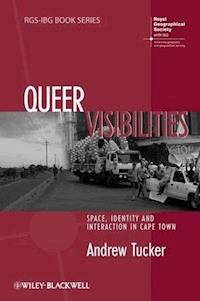
Combining current theory and original fieldwork, Queer Visibilities explores the gap between liberal South African law and the reality for groups of queer men living in Cape Town.
- Explores the interface between queer sexuality, race, and urban space to show links between groups of queer men
- Focuses on three main 'population groups' in Cape Town—white, coloured, and black Africans
- Discusses how HIV remains a key issue for queer men in South Africa
- Utilizes new research data—the first comprehensive cross-community study of queer identities in South Africa
Sie lesen das E-Book in den Legimi-Apps auf:
Seitenzahl: 536
Veröffentlichungsjahr: 2011
Ähnliche



















Contents
Figures and Tables
Series Editors’ Preface
Acknowledgements
Chapter One Queer Visibilities in Cape Town
Introduction
A Question of Visibility
Questioning the Sites and Categories of Study
Questioning ‘the Closet’
Recasting what is ‘Queerly Visible’
The Construction of ‘Race’ in South African Urban Space
Queer Visibilities in Cape Town
Some Notes on Methods
Notes on Form
Part I Visibilities
Chapter Two Legacies and Visibilities among White Queer Men
Introduction
The Intertwining of Racial and Sexuality-Based Discrimination
A Developing Culture and the Dying Days of Apartheid
The West as Destination: Visibility on the Cape
Cracks in the Façade
Locating the Visibility of White Queer Men
Conclusion
Chapter Three Coloured Visibilities and the Raced Nature of Heteronormative Space
Introduction
The Creation and Destruction of a Coloured Community
‘The Vices of Both Parents and the Virtues of Neither’
Moffies!
Respectability and the Ambivalence of Coloured Identity
A Legacy Continued: Gender and the Construction of Coloured Queer Communities
‘It’s actually quite scary... this effeminate dude that flaunts his fake-ass tits’
Queer Visibility in the City Bowl and on the Cape Flats
Conclusion
Chapter Four How to be a Queer Xhosa Man in the Cape Town Townships
Introduction
The Black ‘Threat’ and the European ‘Contamination’
The Possibility of Qualified Acceptance
Ivys and Pantsulas on the Cape
Creating Competing Visibilities
The Delineation of Visibilities
Homophobia and the Creation of Social Nodes
Conclusion
Part II Interactions
Chapter Five Social Invisibilities
Introduction
Breaking Down the Fortifications
The Power of the Rand and the Weakness of Solidarity
Gender Identity as Exclusion
Ignorance as Exclusion
Conclusion
Chapter Six Political Invisibilities (and Visibilities)
Offering the Services of Triangle Project
Being Proud of Cape Town Pride
Same-sex Marriage: being Married to a Constitution
Conclusion
Chapter Seven The Costs of Invisibility
Introduction
HIV and the Cost of Invisibility
Queer Visibilities, Queer Diversities and HIV
Rainbow Homophobia, Rainbow Lives
Concluding the Case for Queer Visibility
Notes
Bibliography
Index
RGS-IBG Book Series
Published
Queer Visibilities: Space, Identity and Interaction in Cape Town
Andrew Tucker
Arsenic Pollution: A Global Synthesis
Peter Ravenscroft, Hugh Brammer and Keith Richards
Resistance, Space and Political Identities: The Making ofCounter-Global Networks
David Featherstone
Mental Health and Social Space: Towards InclusionaryGeographies?
Hester Parr
Climate and Society in Colonial Mexico: A Study in Vulnerability
Georgina H. Endfield
Geochemical Sediments and Landscapes
Edited by David J. Nash and Sue J. McLaren
Driving Spaces: A Cultural-Historical Geography of England’s M1Motorway
Peter Merriman
Badlands of the Republic: Space, Politics and Urban Policy
Mustafa Dikeç
Geomorphology of Upland Peat: Erosion, Form and LandscapeChange
Martin Evans and Jeff Warburton
Spaces of Colonialism: Delhi’s Urban Governmentalities
Stephen Legg
People/States/Territories
Rhys Jones
Publics and the City
Kurt Iveson
After the Three Italies: Wealth, Inequality and Industrial Change
Mick Dunford and Lidia Greco
Putting Workfare in Place
Peter Sunley, Ron Martin and Corinne Nativel
Domicile and Diaspora
Alison Blunt
Geographies and Moralities
Edited by Roger Lee and David M. Smith
Military Geographies
Rachel Woodward
A New Deal for Transport?
Edited by Iain Docherty and Jon Shaw
Geographies of British Modernity
Edited by David Gilbert, David Matless and Brian Short
Lost Geographies of Power
John Allen
Globalizing South China
Carolyn L. Cartier
Geomorphological Processes and Landscape Change: Britain in the Last 1000 Years
Edited by David L. Higgitt and E. Mark Lee
Forthcoming
Aerial Geographies: Mobilities, Subjects, Spaces
Peter Adey
Politicizing Consumption: Making the Global Self in an UnequalWorld
Clive Barnett, Nick Clarke, Paul Cloke and Alice Malpass
Living Through Decline: Surviving in the Places of thePost-Industrial Economy
Huw Beynon and Ray Hudson
Swept-Up Lives? Re-envisaging‘the Homeless City’
Paul Cloke, Sarah Johnsen and Jon May
Millionaire Migrants: Trans-Pacific Life Lines
David Ley
Complex Locations: Women’s geographical work in the UK1850–1970
Avril Maddrell
In the Nature of Landscape: Cultural Geography on the NorfolkBroads
David Matless
Transnational Learning: Knowledge, Development and theNorth-South Divide
Colin McFarlane
Value Chain Struggles: Institutions and Governance in thePlantation Districts of South India
Jeffrey Neilson and Bill Pritchard
Domesticating Neo-Liberalism: Social Exclusion and Spaces ofEconomic Practice in Post Socialism
Adrian Smith, Alison Stenning, Alena Rochovská and Dariusz S´wiątek
State, Science and the Skies: Governmentalities of the BritishAtmosphere
Mark Whitehead
This edition first published 2009
© 2009 Andrew Tucker
Blackwell Publishing was acquired by John Wiley & Sons in February 2007. Blackwell’s publishing program has been merged with Wiley’s global Scientific, Technical, and Medical business to form Wiley-Blackwell.
Registered Office
John Wiley & Sons Ltd, The Atrium, Southern Gate, Chichester, West Sussex, PO19 8SQ, United Kingdom
Editorial Offices
350 Main Street, Malden, MA 02148-5020, USA
9600 Garsington Road, Oxford, OX4 2DQ, UK
The Atrium, Southern Gate, Chichester, West Sussex, PO19 8SQ, UK
For details of our global editorial offices, for customer services, and for information about how to apply for permission to reuse the copyright material in this book please see our website at www.wiley.com/wiley-blackwell.
The right of Andrew Tucker to be identified as the author of this work has been asserted in accordance with the Copyright, Designs and Patents Act 1988.
All rights reserved. No part of this publication may be reproduced, stored in a retrieval system, or transmitted, in any form or by any means, electronic, mechanical, photocopying, recording or otherwise, except as permitted by the UK Copyright, Designs and Patents Act 1988, without the prior permission of the publisher.
Wiley also publishes its books in a variety of electronic formats. Some content that appears in print may not be available in electronic books.
Designations used by companies to distinguish their products are often claimed as trademarks. All brand names and product names used in this book are trade names, service marks, trademarks or registered trademarks of their respective owners. The publisher is not associated with any product or vendor mentioned in this book. This publication is designed to provide accurate and authoritative information in regard to the subject matter covered. It is sold on the understanding that the publisher is not engaged in rendering professional services. If professional advice or other expert assistance is required, the services of a competent professional should be sought.
Although every effort has been made to trace the copyright holders of the images reproduced in this book, if any have been inadvertently overlooked the publisher will be pleased to make the necessary arrangement at the first opportunity.
The publisher has no responsibility for the persistence or accuracy of URLs for external or third-party internet websites referred to in this book, and does not guarantee that any content on such websites is, or will remain, accurate or appropriate.
Library of Congress Cataloging-in-Publication Data
Tucker, Andrew, 1980–
Queer visibilities: space, identity, and interaction in Cape Town/Andrew Tucker.
p. cm.—(RGS-IBG book series)
Includes bibliographical references and index.
ISBN 978-1-4051-8303-1 (hardcover: alk. paper)—ISBN 978-1-4051-8302-4 (pbk.: alk. paper) 1. Gay men—South Africa—Cape Town—Social conditions. 2. Sexual orientation—South Africa—Cape Town. 3. Sex discrimination—South Africa—Cape Town. 4. Gay men—Identity. 5. Cape Town (South Africa)—Social conditions. I. Title.
HQ76.2.S6T83 2009
306.76′6209687355—dc22
2008024001
A catalogue record for this book is available from the British Library.
Set in 10 on 12pt Plantin by SNP Best-set Typesetter Ltd., Hong Kong Printed in Malaysia by Vivar Printing Sdn Bhd
1 2009
Figures and Tables
Figures
2.1The location of the De Waterkant gay village in the centre of Cape Town2.2A view up Dixon Street in the gay village2.3The location of various leisure and consumer venues in the gay village2.4The location of suburban areas in relation to the CBD/City Bowl and Atlantic Seaboard3.1Zonnebloem today, close to the heart of the city3.2District Six prior to forced removals (in grey) and today3.3Kewpie, a coloured queer hairdresser © copyright GALA3.4Coloured cross-dressing ‘moffies’ circa0 1960 © copyright GALA3.5Some of the locations to which coloured groups from District Six were moved3.6A coloured cross-dressing queer man today3.7Front covers of Detail newspaper4.1The location of the Transkei and Ciskei in relation to Cape Town4.2The location of some of the major townships in Cape Town today4.3Informal shacks in Cape Town5.1Monthly income amongst the employed aged 15–65 by population groups in South Africa6.1Triangle Project offices located in Mowbray in Cape Town6.2A view into the gated party at the end of the 2004 Johannesburg PrideUnless otherwise stated all photographs taken by and © the author.
Tables
3.1Size of racially defined population groups in South Africa, 20013.2Size of racially defined population groups in Cape Town, 2001Series Editors’ Preface
The RGS-IBG Book Series only publishes work of the highest international standing. Its emphasis is on distinctive new developments in human and physical geography, although it is also open to contributions from cognate disciplines whose interests overlap with those of geographers. The Series places strong emphasis on theoretically-informed and empirically-strong texts. Reflecting the vibrant and diverse theoretical and empirical agendas that characterize the contemporary discipline, contributions are expected to inform, challenge and stimulate the reader. Overall, the RGS-IBG Book Series seeks to promote scholarly publications that leave an intellectual mark and change the way readers think about particular issues, methods or theories.
For details on how to submit a proposal please visit: www.rgsbookseries.com
Kevin Ward
University of Manchester, UK
Joanna Bullard
Loughborough University, UK
RGS-IBG Book Series Editors
Acknowledgements
This book was made possible with the assistance of the Economic & Social Research Council of the UK.
I say with absolute certainty that had it not been for the continual support of my PhD supervisor, Gerry Kearns, this book would not have come about. It is with equal certainty that I say Gerry is one of the most kind, thoughtful and intelligent people I have ever met. My time at Cambridge has been immeasurably enriched by knowing Gerry and being able to explore and think about the world with him in ways that I had never thought possible. It is therefore with great thanks that I dedicate this book to him. Cheers, mate.
In South Africa I could not have survived without the help of so many individuals. I would especially like to thank Marina Griebenow for always being there to pick me up and dust me off whenever life in the city became a bit too hectic. As a continual source of kindness and information about the Mother City she helped set me on the course that concluded with this book. Cape Town is a better place with her living in it.
I would also like to give a big thank you to the staff of Triangle Project, the Gay and Lesbian Archives of South Africa (GALA) and all the other organisations I met and got to know. Thanks therefore go to Dawn Betteridge, Anthony Manion, Toni Sylvester, Mabhuti Mkangeli, Funeka Soldaat and Vista Kalipa. In particular, I’d like to acknowledge and thank Glenn de Swardt for showing me not only the breadth and depth of the city of Cape Town, but also how to cope with its extremes. Over the years that I have known him, Glenn has worked tirelessly to achieve a better world for all queer individuals in the city. It is perhaps an indicator of both his humility and effort that today so many queer men and women in the city do not even know how he has helped them. South Africa is a country that, despite its problems, has achieved so much good for so many in such a short period of time. To continue astounding the world, it will need more individuals like Glenn.
A special word of thanks also needs to be extended to Paul Wise for battling through countless hours of tape and transcribing the most muffled comments into comprehensible prose. Thanks also need to be extended to Leon Kruger (for all those chats, coffees and nights out) and to Sharad Chari, Ismail Jazbhay, Vasu Reddy, Graeme Reid, Teresa Dirsuweit, Peter van der Walt; David Stoch, Nathan Romburgh, Alex Hivoltze-Jimenez and Jean Mearing for their friendship and assistance. And lastly on that note, a big thank you to David Stockwell, my consiglieri on the Cape (and then later in London). As a sounding board and as a friend, David made the whole process of researching and then writing just that much more enjoyable.
In Cambridge a big shout-out also needs to go to Jane Robinson, Jane Hampshire and Robert Carter for helping me source so much information. Further thanks to Philip Stickler for applying his prodigious skills to help create the maps in this book. Thanks also to Simon Reid-Henry, Steve Legg, Karen Till, Richard Smith, Phil Howell, Jim Duncan, Liz Watson, David Nally, Steve Trudgill, Stu Basten, Hannah Weston, Tom Welsh, Andrew Rudd, Marco Wan, Andrew Ferguson, David Beckingham, Fran Moore, Rory Gallagher and Jacob Levy for their friendship through thick and thin.
In a similar yet also unique vein, a big thank you to Fran Sainsbury for always bringing with her a moment of calm, fun and friendship. From ‘spiders making gravy’ to the RCSA to life as adults you’ve stayed a person I know I’ll always love and respect.
A big thank you also to Kevin Ward, editor at the RGS-IBG Book Series, for his encouragement and support. At Wiley-Blackwell a huge debt of gratitude needs to be paid to Jacqueline Scott and Hannah Morrell for their highly professional help in guiding my book through the process towards publication. And a further shout-out to Kit Scorah for applying her truly excellent and tireless copy-editing skills to this book.
Thank you also to Jon Binnie and Jennifer Robinson for their constructive comments on earlier drafts of this work.
A special thank you also to Mum and Dad and my sister, Ronnie. To each of you in different and yet equally important ways I say how grateful I am, knowing that you have always been there for me along the way. And I state with the deepest love how proud I am to be related to you.
And lastly, to Richard Nkulikiyinka for keeping me sane and filled with happiness.
Chapter One
Queer Visibilities in Cape Town
Introduction
At the end of 2006 South Africa joined a very small, yet very special club. Indeed, this club was so special that, since its creation at the beginning of the new millennium, it had lead to incessant discussion among many other nations. While very few other countries seemed particularly enthusiastic about joining its membership, several spent a remarkably large amount of time explaining why those who had joined were mistaken in doing so. Commentators in nations stretching from the Middle East to Eastern Europe to Africa all appeared to believe that membership must never be sanctioned and, if possible, should be actively legislated against.1 The President of the United States even went so far as to suggest subscribing to the club’s ideas might imperil the ‘most fundamental institution of civilisation’.2 This was therefore, in some ways, not only a special, but also apparently a rather dangerous club.
South Africa had decided to grant same-sex couples the right to marry. It joined the Netherlands, Belgium, Spain and Canada. The legalisation of same-sex marriage has helped position South Africa as the most progressive country on the entire continent. Nationally, same-sex marriage has been held up as one of the strongest examples of the country’s move away from an intolerant past – a past now more associated with the opponents of same-sex marriage than with the current South African government. Some might fairly argue that such achievements have been well worth the hyperbole from ‘less progressive’ countries.
And indeed, the achievement of South Africa in this regard should not be underestimated. In just one and a half decades the country has gone from persecuting and arresting individuals with same-sex desire, to allowing them to adopt children and marry. No other country has so radically changed its position towards queer individuals or the world’s perception of itself in such a short period of time.
Yet while such achievements have indeed been admirable, the legal rights attained do not necessarily equate to daily improvements in the lives of many queer South Africans. While, de jure, queer citizens in South Africa now have the ability to marry, de facto, many still cannot. And while cities such as Cape Town are able to boast about their liberal and accepting stance towards queer individuals, the reality on the ground for many, even in Cape Town, may be considerably different. This book explores this gap between liberal law and the more dangerous reality for groups of queer men in Cape Town.
To understand this gap requires first an acknowledgement of the diversity of queer experiences in the country and, as this book will show, the diversity across urban space in one particular city. As researchers in other locations have shown, the variety of community experiences that make up queer existence across the globe is truly staggering (Cruz-Malavé and Manalansan 2002; Hayes 2000; Jackson and Sullivan 1999; Parker 1999; Patton and Sánchez-Eppler 2000; Reid-Pharr 2002). An attempt to understand any local queer community therefore requires a detailed exploration of the many issues that have affected, and continue to affect, it. Yet in a country such as South Africa, queer experiences are further complicated by the extraordinary way in which communities have historically been spatially regulated by the state. The use of ‘race’ as the basis of a system of discrimination has left the country with deep social, economic and political scars. Queer communities today have therefore also remained strongly influenced by the way colonial and later apartheid mechanisms compartmentalised, regulated and manipulated groups.
Lesen Sie weiter in der vollständigen Ausgabe!
Lesen Sie weiter in der vollständigen Ausgabe!
Lesen Sie weiter in der vollständigen Ausgabe!
Lesen Sie weiter in der vollständigen Ausgabe!
Lesen Sie weiter in der vollständigen Ausgabe!
Lesen Sie weiter in der vollständigen Ausgabe!
Lesen Sie weiter in der vollständigen Ausgabe!
Lesen Sie weiter in der vollständigen Ausgabe!
Lesen Sie weiter in der vollständigen Ausgabe!
Lesen Sie weiter in der vollständigen Ausgabe!
Lesen Sie weiter in der vollständigen Ausgabe!




