


Erhalten Sie Zugang zu diesem und mehr als 300000 Büchern ab EUR 5,99 monatlich.
- Herausgeber: Sallux Publishing
- Kategorie: Geisteswissenschaft
- Sprache: Englisch
The EU two-state policy concerning the Palestinian-Israeli conflict is failing, despite a half-century of strenuous EU efforts expending tens of billions of euros to implement it. The reality of policy failure is discomforting but must be acknowledged.Failure should provoke reflection: reasons need to be understood to avoid repeated mistakes and to construct a more successful policy for the future. The reasons for failure of the EU Two State Policy are serious but surprisingly obvious. At the base of the EU two-state policy lie 3 false assumptions of wishful thinking: the Palestinian-Israeli conflict is territorial and not existential; East Jerusalem and the West Bank legally belong to the Palestinians; and the establishment of a democratic Palestinian state at peace beside Israel is realistic and feasible.This report challenges these assumptions and makes recommendations for a new approach to enabling Palestinian autonomy, Israeli security and regional stability.Palestinian rights to self-determination must be respected, but they may not be allowed to conflict with the fair and non-discriminatory application of international law, nor be allowed to undermine Israeli sovereignty or regional stability. Peace will never be achieved through agendas aimed at destruction.The EU should focus on ensuring rejection of extremism and mutual acceptance; the fair and equal application of international law to all actors in the region; and strengthening institutions of government based on the rule of law. The authors of this report seek to stimulate vigorous debate on the EU approach to the Palestinian-Israeli conflict and a better way forward for Europes engagement in the Middle East.
Sie lesen das E-Book in den Legimi-Apps auf:
Seitenzahl: 543
Veröffentlichungsjahr: 2023
Das E-Book (TTS) können Sie hören im Abo „Legimi Premium” in Legimi-Apps auf:
Ähnliche



















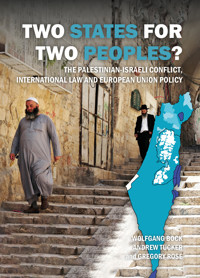
Two States for two Peoples?
The
Palestinian-Israeli Conflict, International Law and European Union Policy
Report
Wolfgang Bock
Andrew Tucker
Gregory Rose
COLOPHON
Two States for two Peoples?
Wolfgang Bock, Andrew Tucker and Gregory Rose
2nd (revised) edition
© 2023 The Hague Initiative for International Cooperation All rights reserved. No part of this publication may be reproduced, stored in a retrieval system, or transmitted, in any form or by any means, electronic, mechanical, photocopying, recording or otherwise, without the prior permission of The Hague Initiative for International Cooperation.
Cover design and lay-out: Reproserve
Cover images: Shutterstock.com
ISBN 978-94-92697-36-3
Disclaimer
Since 2011, the activities of Sallux have been financially supported by the European Parliament. The liability for any communication or publication by Sallux, in any form and any medium, rests with Sallux. The European Parliament is not responsible for any use that may be made of the information contained therein.
About
Professor Wolfgang Bock studied Law and Political Science at the Universities of Geneva, Giessen and Frankfurt/Main. Since 1979 he worked as judge at the Frankfurt/Main Regional Court in civil and criminal matters as well as at the Wiesbaden Administrative Court, inter alia, in matters of asylum. During his time as research consultant at the Interdisciplinary Research Institute of the Protestant Churches (FEST Heidelberg), he obtained his doctorate at the Faculty of Law of the Johann Wolfgang von Goethe University Frankfurt/Main in 1993. Within the scope of different research projects he dealt in depth with Legal cultures in predominantly Islamic societies and the human rights and legal issues concerning an Islamic religious education. In 2004, he obtained the postdoctoral degree in Public Law (Habilitation) at the Faculty of Law of the Heinrich Heine University Düsseldorf and worked since 2004 as lecturer at the Centre for Near and Middle Eastern Studies at the University of Marburg and as associate professor at the Justus Liebig University Giessen. After his secondment in 2011/2012 to the Hessian State Office for the Protection of the Constitution in Wiesbaden (special fields: Islamist extremism and Islamist terrorism), he worked from 2012 till his retirement in September 2017 as Counsellor for Constitutional and International Law at the Federal Academy for Security Policy, covering the Near and Middle East, and Islam. He writes and teaches on Constitutional Law und Security Law, on Islam, Islamic Cultures and Islamism, and on Policies and Legal Cultures in the MENA region.
Andrew Tucker is a graduate of the Universities of Melbourne (BA, LLB) and Oxford (BCL). He has over 20 years of experience as an attorney in Australia, UK and Netherlands, advising governments and corporations mainly in the energy, transport and telecoms sectors. Previous positions include in-house counsel to the Australian Competition and Consumer Commission (ACCC). He has been Research Fellow at the T.M.C. Asser Institute for European Law, International Law and International Commercial Arbitration, in The Hague, Netherlands, and Senior Fellow in the Faculty of Law, University of Melbourne. In 2017 he co-founded The Hague Initiative for International Cooperation (thinc.) – a non-profit think tank educating and advising politicians, policy-makers and others on the fair and non-discriminatory application of international law in relation to the Israel Palestinian conflict and the Middle East generally.
Gregory Rose is a Professor of Law at the Australian National Centre for Ocean Resources and Security (ANCORS) at the University of Wollongong, Australia. His expertise is in international law and his areas of research include international law relating to marine environmental governance and transnational environmental crime. He teaches international fisheries, environmental and criminal law, law of the sea, and administrative law. He is an Associate Editor of the Yearbook of International Environmental Law, a Member of the Boards of Editors of the Review of European Comparative and International Environmental Law and of Environmental Policy and Law. He has served as Chair of the Academic Senate at the University, as Discipline Leader and Deputy Dean for the School of Law and as Chair of the University’s Thesis Examination Committee. Outside the academy, Greg was Head of the Environmental Law Unit in the Legal Office of the Australian Department of Foreign Affairs and Trade, where he represented Australia at international meetings and advised on international environmental law.
Preface
The EU two-state policy concerning the Palestinian-Israeli conflict in the Middle East is failing, despite a half-century of strenuous EU efforts expending tens of billions of euros to implement it. The discomforting reality of policy failure must be acknowledged.
Failure should provoke reflection: reasons need to be understood to avoid repeated mistakes and to construct a more successful policy for the future. The reasons for failure of the EU two-state policy are serious but as surprisingly obvious as an elephant in the room.
The elephant is wishful thinking. It is so familiar that we no longer notice that the room is otherwise unoccupied. Wishful thinking forms three central false assumptions at the base of the EU two-state policy: (1) the Palestinian-Israeli conflict is territorial and not existential; (2) the West Bank legally belongs to Palestinians for their State; and (3) the establishment of a Palestinian state at peace beside Israel is realistic and feasible.
This report examines these three assumptions as manifest in (1) EU declarations, (2) legal justifications and (3) interventions on the ground. The report addresses each of these in Parts I, II and III respectively, with its main focus in Part II, on the international law justifications. The report finds that EU legal justifications for its Palestine policy were deployed to cover for a Middle East policy actually driven by dire energy security needs, which are described in Part I of the report. The legal justifications are tenuous and characterized by double standards. As the imperatives of EU energy security gradually changed over the past half-century, the enduring legal justifications now do a bureaucratic disservice, ossifying EU political policy and hindering EU responsiveness to new circumstances. Part III of the report examines how EU interventions aimed at building a Palestinian state misunderstand the reality on the ground. Designed to assuage Arab Gulf oil producers’ demands of a half-century ago but no longer current today, the EU’s current interventions instead feed hostilities and undermine progress to peace.
We conclude the report with recommendations for a new approach to the Palestinian-Israeli conflict that moves forward from the EU current two-state policy. Feasible and realistic solutions are possible that enable Palestinian autonomy, Israeli security and regional stability.
This report is a preliminary study of highly complex issues. By researching and articulating assumptions underlying the EU two-state policy, The Hague Initiative for International Cooperation (thinc.) seeks to stimulate debate on the EU approach to the Palestinian-Israeli conflict and on a better way forward for Europe’s engagement in the Middle East.
This study has been made possible by grants received from Sallux and the European Christian Political Movement (ECPM), as well as private donors, to whom we express our appreciation.
The principal authors are Prof. Wolfgang Bock and Andrew Tucker. Andrew was lead author for chapters 1-9 and Wolfgang for chapters 10-13. Prof. Gregory Rose undertook reconceptualization, structural editing, Chapters 1 and 15 and additional insertions and redrafting of the report. Chapter 14 (New Perspectives in the Middle East), is authored by Dan Diker and Khaled Abu Toameh, and was originally published by the Jerusalem Center for Public Affairs on 12 November 2020 under the title “Arab Normalization and Palestinian Radicalization: The Tug of War over the Middle East Peace Process” and is republished here with the approval of both the authors and publisher.
We wish to acknowledge the work of our colleague Pieter Hoogendoorn who made substantive contributions during the many discussions we had, reviewed and proofed all chapters and assisted masterfully in the management of this project. Invaluable research assistance was provided by Anna Rosa Schlechter. The findings concerning the decision-making in Netherlands, France, Germany and UK in the years 1967-1980, as summarized in chapter 3, are based on research carried out by Prof. Fred Grünfeld and Dr. Matthijs de Blois (Netherlands), Dr. Dov Jacobs and Jennifer Naouri (France), Anna Rosa Schlechter (Germany), and Jonathan Turner and Daniella Dekel (UK). We acknowledge their valuable research, the full results of which will be included in a further larger publication on this topic, to be published in 2023. Thanks also go to Prof. Avi Bell, who reviewed and commented on early drafts of the chapters that now appear in Part II.
We thank Johannes de Jong for his support for this project, and many inspiring and challenging discussions about the role of international law in developing democracy and defending freedoms in the Middle East.
Of course, we take full responsibility for any shortcomings.
This report is based on research carried out until 25 January 2023.
Wolfgang Bock, Gregory Rose and Andrew Tucker
Frankfurt am Main / The Hague
14 March 2023
Executive Summary
Introduction
1) Since 1967, Europe has gradually adopted and implemented a ‘two-state policy’ towards the Palestinian-Israeli conflict. This policy envisages partition of the land west of the Jordan through the establishment, by means of negotiations, of an independent, democratic, contiguous, sovereign and viable Palestinian state with East Jerusalem as its capital and within what is referred to as the ‘1967 lines’.
2) This policy has failed, in the sense that an ‘‘independent, democratic, contiguous, sovereign and viable state of Palestine’’ has not been established. Notwithstanding progress made under the Oslo Accords towards fulfilling Palestinian self-determination, the Palestinian entity represented by the Palestinian Authority is not independent, democratic, contiguous, sovereign or viable. A Palestinian state does not exist, and for many years, there have been no negotiations.
3) Over recent years support for a two-state solution has waned. Indeed some experts conclude that the idea that two states could be established to ‘end the conflict’ is a ‘delusional aspiration’ based on a liberal Western notion of peace that ignores the historical, cultural and legal realities on the ground.
4) At the core of the Palestinian-Israeli conflict is an existential dispute concerning the right of the Jewish people to nationhood and sovereignty within their traditional homeland. Israel and the Jewish people assert their right to exist as a Jewish sovereign state entitled to territorial integrity, political inviolability and secure borders – even if that means no Palestinian state is created. The tragic reality is that all factions of the Arab Palestinian political leadership have consistently rejected such a right and have promoted the use of force to prevent the establishment of a Jewish state (prior to 1948), and to destroy Israel (after May 1948). Failure to resolve this existential conflict is preventing resolution of the dispute as a whole.
5) Israel’s position in the Middle East has changed dramatically since 1967. Israel is no longer isolated; rather, Israel plays a central role in the region. Israel has entered peace treaties with Egypt and Jordan, and the recent Abraham Accords (normalization agreements) are evidence of Israel’s close economic, cultural, and political ties with several countries in the Middle East and Northern Africa.
6) EU-Israel relations also now show signs of a process of revitalization. At the time of finalization of this report in October 2022, the first meeting in a decade of the EU-Israel Association Council was held (it was suspended in 2012). In June 2022, a significant EU memorandum of understanding was signed with Israel and Egypt to allow the EU to import Israeli natural gas to secure European energy supplies. In light of the adoption of the Abraham Accords in the Middle East and Northern Africa (MENA), EU Commissioner on Neighbourhood and Enlargement, Oliver Varhelyi, stated to the EU Parliament in September 2022: ‘‘Europe should not only start understanding the new regional language since the Abraham Accords, but it should also learn to speak this language, and seize the new opportunities for business, people, trade and travel’’.
7) Since the Oslo Accords in the 1990s, many attempts have been made to negotiate two states by means of a final status agreement. All have failed, shedding doubt on the viability of a two-state model for resolution of this conflict.
8) Further, as the recent proceedings before the Pre-Trial Chamber of the International Criminal Court in the ‘Situation in the State of Palestine’ have demonstrated, the legal status of the Palestinian claim to statehood in the ‘occupied Palestinian territories’ is highly contested. This casts doubt on the EU’s assumptions underlying its two-state policy that the PLO has a right to statehood within the ‘1967 lines’.
9) For these and other reasons, there is in both Israeli and Palestinian circles increasing consideration of alternatives. These include the creation of one ‘unitary’ state between the Mediterranean and the Jordan River, to replace the current State of Israel and administered territories. Such a state could be either bi-national, ‘Jewish’, ‘Palestinian’, or nationless. Other alternatives discussed include a federation, a confederation, and a Jewish state containing a territory on which Palestinians would have ‘less-than-state’ autonomy.
10) The time is thus right to review and revise the assumptions underlying the EU two-state policy on the Palestinian-Israeli conflict. Two States for Two Peoples? offers a thought-starter on the way international law may play a role in the process of seeking ways forward to refresh the EU approach to the Palestinian-Israeli conflict that has stagnated over the past 40-plus years.
Purpose and Scope
11) This report looks at the two-state policy from the perspective of international law because the EU asserts that the two-state policy is the only possible policy, and that it is required by international law. The purpose of this study is to examine how and why the EU seeks to rely so heavily on international law, whether the positions it adopts are justified, and whether international law allows scope for consideration of alternative approaches to the resolution of the conflict.
12) It should be emphasized that our goal is not to advocate any particular solution based on legal grounds. Rather, our working assumption is that international law usually does not prescribe specific solutions to complex political problems. Furthermore, if the EU approach is based on incorrect or biased legal analysis this should be identified and acknowledged, as that approach is unnecessarily locking the EU into a policy that has so far failed to produce peace. No political solution will succeed in bringing peace between Israel and the Palestinians in the long term unless grounded in the genuine will of both peoples.
13) This report focuses on the territories between the Jordan River (west of the river) and the 1949 Israel-Jordan armistice line, known as the Green Line (east of the line) – variously called the (Jordanian) West Bank, Occupied Palestinian Territories (OPT), and (Jewish) Judea and Samaria. Each of these terms is loaded with historical and political meaning. Nevertheless, in this report, those territories, including East Jerusalem, are referred to as the West Bank although acknowledging it as a convenient common foible. We do not include the Gaza Strip or Golan Heights in this report, because each is under different legal circumstances: the Golan Heights are not claimed by Palestinians and the Gaza Strip is under autonomous Palestinian rule.
Methodology
14) The EU two-state policy is premised upon three assumptions:
a) that the Palestinian-Israeli conflict is territorial;
b) that the West Bank belongs to the Palestinians, who have a right to statehood there; and
c) that a peaceful and secure Palestinian state in the West Bank is feasible.
15) These three assumptions are, in turn, reflected in the three levels at which the EU two-state policy manifests in practice:
a) the assumption that the conflict can be resolved by means of territorial compromise is reflected in the formal declarations of the two-state policy;
b) the assumption that the West Bank belongs to the Palestinians is reflected in the EU’s ‘parameters’ asserting international law justification of its policy; and
c) the assumption that a peaceful and secure Palestinian state is feasible is reflected in the EU’s massive financial support and interventions on the ground in the West Bank to create a Palestinian state.
16) Accordingly, this report examines and analyzes the EU two-state policy, drawing on historical, legal and political sciences.
a) The historical research examines the development of the EU two-state policy to obtain insights as to the role played by international law in its origins, development and purpose (Part I).
b) The legal research describes the juridical basis of the EU two-state policy and analyzes the legal positions adopted by the EU to justify the policy, within the framework of international law (Part II).
c) The political research analyzes the fundamental question of Palestinian statehood within the concept and patterns of statehood and the changing political landscape of the Middle East (Part III and Chapter 11).
PART I HISTORY
Existential nature of the Palestinian-Israeli conflict
17) The EU two-state policy is premised on Israel’s right to exist as a Jewish nation, as envisaged by the Mandate for Palestine. However, this is disputed by many members of the Arab League, the Organization for Islamic Cooperation and Palestinians, as well as by some legal academics who argue that the Jewish State of Israel has no right to sovereignty or control of even the territory west of the Green Line to the Mediterranean coast.1 Instead, the Palestinian people is asserted to be entitled to, or to already have, a state there that is occupied. In other words, Jewish national existence (in whatever form) is seen as an imposition on land that is exclusively Arab.
18) Prior to 1948, the Arab Palestinian leadership rejected the Mandate for Palestine and every proposal for a two-state solution. It rejected the 1937 Peel Plan, the 1939 McDonald White Paper and the 1947 UN Partition Plan – in each case because it rejected the existence of a Jewish nation in any part of Palestine. Quite simply, the Palestinians could have had an Arab state in Palestine on multiple occasions prior to 1948.
19) Instead, having rejected Arab Palestinian statehood prior to 15th May 1948, the Palestinian leaders supported the Arab State wars of 1948, 1967 and 1973 that were intended to eradicate the State of Israel. Notwithstanding the ensuing peace treaties with Egypt (1979) and Jordan (1994), they have continued to reject Jewish sovereignty. Today, the main parties to active armed conflict with Israel are Arab non-state actors. They include Hezbollah in Lebanon and Hamas in Gaza (both backed heavily by Iran), and the Palestine Liberation Organization (PLO) in the West Bank. Palestinians are central actors in armed conflict with Israel within the West Bank, with organizational headquarters in towns, including Jenin and Hebron. The main fighting organizations are nationalist or Islamist factions, including the Popular Front for the Liberation of Palestine, and Fatah (both part of the PLO), and Hamas and Palestinian Islamic Jihad. These non-state actors are financially and diplomatically supported by many states in the Middle East, Europe and worldwide.
20) Palestinians in the West Bank are represented politically (although not democratically) by the Palestinian Authority (PA), which is controlled by the PLO, and is engaged in conflict with Israel at many levels – political, legal, and paramilitary. The PA/PLO policy is not to ‘normalize’ relations with Israel, because it refuses to recognize Israel as a state, and to engage in normal diplomatic cooperation with it. This attitude of rejection was the main reason that the various US-facilitated attempts to negotiate a final status agreement since the Oslo Accords (2000/2001, 2008 and 2014) failed.
21) Moreover, the PLO/PA participates actively with UN member states in initiatives through United Nations institutions, such as the UN Human Rights Council, to delegitimize the Jewish State of Israel. They include condemnations and prosecutions of Israel as guilty of human rights violations and war crimes, and as being racist and apartheid in essence.
22) In addition, Palestinian organizations leverage global civil society support to boycott, to divest from and to sanction Israel. The Boycott, Divestment and Sanctions (BDS) delegitimization campaign expresses its aim to ‘liberate’ not only the West Bank but all of Israel within the Green Line to the Mediterranean coast from Israeli governance.
23) The Palestinian-Israeli dispute thus is not territorial; rather, it is ‘existential’, in the sense that the Palestinian political leadership rejects – politically, legally and by force of arms – the right of the Jewish State of Israel to exist. Palestinian organizations (including the PLO) claim that the Jewish State of Israel is illegitimate, that Palestine (including Israeli land west of the Green Line to the Mediterranean coast) must be ‘liberated’, and that they are legally entitled to use force to achieve these claims. Israel, for its part, insists on its right to exist within secure borders. Such an existential conflict cannot be resolved via territorial compromise.
Foundations and development of the European two-state policy
24) The EU two-state policy is, however, based on territorial compromise: partition of Palestine into two contiguous states.
25) The foundations of the EU two-state policy were established by the members of the European Economic Community (EEC) in the period 1967-1980, culminating in the Venice Declaration (1980).
26) There were several driving political and economic factors behind the creation of the EU two-state policy. One was the post-war unification in Europe leading to the European nations’ increasing concept of themselves as a “community bound by law”, and their consequent desire to seek political influence as a bloc of nations (competing with the US and Soviet Union) by advancing European values in conflict resolution globally.
27) Another driver was the urgent economic need in the 1970s to develop a positive relationship with the Arab oil-producing states. In 1967 Europe was dependent upon the Middle East for 80% of its oil consumption, comprising 48% of its power supply. In late 1973, following the military failure of Egypt and Syria to vanquish Israel in their Soviet-coordinated attack (the Yom Kippur War), the Organization of Petroleum Exporting Countries (OPEC) escalated economic warfare against Israel. OPEC embargoed or curtailed supply of oil to Europe, increased prices, and discriminated in imposing these penalties between European countries according to its perceptions of the strength of their pro-Arab policies. OPEC countries in the Arab Gulf explicitly demanded support for the Palestinian cause as a condition for restoring oil supplies to Europe. Consequently, the Euro-Arab Dialogue commenced urgently in December 1973.
28) Further, during the 1970s the attitude of the European states towards the conflict was influenced by the changing dynamics within the UN, where many new member states, under pressure from the Soviet Union, were increasingly hostile to Western values.
29) On 13th June 1980, the then-nine EEC states issued the Venice Declaration. It was formulated in the context of understandings reached through the Euro-Arab Dialogue. The Declaration culminated a process that has charted the course of the EU two-state policy since. Of its 11 points, four refer to principles of international law. These are set out in the Documents section of this report.
30) Decision-making processes in the EEC, Netherlands, Germany, France, and UK in the period 1967-1980 show that the main considerations leading up to the Venice Declaration were political and economic, not legal. While reference was made to legal principles, especially the prohibition on acquisition of territory by war, in fact, very little attention was paid to legal analysis.
31) After 1980, based in part upon Europe’s perceived obligation to export its own concept of ‘just peace’, the EEC/EU ‘hardened’ its policy by imposing concrete ‘parameters’ on the parties.
PART II LAW
32) From 1980 onwards, the European countries increasingly justified their parameters by resorting to legal arguments. However, these legal arguments were developed primarily to advance the Europeans’ political and economic interests and concepts of justice.
West Bank: Israel to remain or leave?
33) Since 1967, apart from models rejecting Israel’s existence, two main political/legal models have been developed by international actors and legal academics, in order to shape their answers to the question of Israel’s rights to sovereignty or to remain in control of the West Bank. The two models that are relevant for the discussion of the EU two-state policy are:
1) ‘West Bank remain’: in this model, Israel is a state under international law that is legally entitled to hold control of the territories captured in a defensive war in June 1967 until a peace agreement between all the relevant parties is reached. The Palestinian people have a right to self-determination, but this must be balanced with Israel’s legitimate territorial claims. Israel is not currently obliged to relinquish all territories taken in 1967 prior to a peace agreement. This model is backed by Israel, the United States and some other states.
2) ‘West Bank leave’: this model posits that Israel is not entitled to keep control of East Jerusalem and the West Bank territories, which belong to the Palestinians, who are legally entitled to a state of their own there.
34) The EU two-state policy is based on the West Bank leave model. For over four decades, the EU’s policy claims that, while negotiations are required, the Palestinians have a right to statehood in the territory of Mandate Palestine outside the 1949 Armistice Lines (subject perhaps to minor adjustments or land swaps, as agreed), that Israel has no valid sovereignty claims to those territories, and that Israel must ‘end the occupation’ and enable the establishment of the Palestinian state.
35) The language of international law has provided Europe with a ‘shield function’ by giving an apparently objective reason for siding with the Arabs rather than with Israel. In effect, the EU interprets and applies international legal principles in order to justify a political position – namely its West Bank leave model, which requires Israel to surrender control of the West Bank and East Jerusalem, in the belief that partition of the land through establishment of an exclusively ArabPalestinian state will solve the conflict.
36) A clear distinction needs to be made between international law and policy, however. The rule of law requires strict legal reasoning, whereby law is to be interpreted and applied in an objective, transparent and non-discriminatory manner. International law should not be manipulated as rhetoric to urge a country to submit to another’s preferred political outcome. Interpreting and applying international legal principles to Israel and the Palestinians in a way that is not applied to other states and peoples, in order to satisfy pre-conceived political ideas of ‘justice’, is an unacceptable use of the international legal system. Israel should be treated in the same way as other comparable states and the Palestinians in the same way as other comparable peoples.
37) Naturally, positing political parameters in legal terms has not advanced flexibility in negotiations about the issues upon which the parties differ, and which have been identified by the parties as the subjects of a possible ‘permanent status’ agreement. These issues include East Jerusalem, refugees, settlements, security arrangements, borders, relations with neighbors, and other issues of common interest.
38) Rigidly fixed but contentious ‘legal’ parameters impede negotiations otherwise based on historical and current factual realities. They ‘harden’ Palestinian positions and prevent compromise because the PLO thinks its claims are backed by law and EU political strength. For example, while Israel has repeatedly indicated willingness to negotiate withdrawal from almost all the disputed territories, the Palestinians have rejected or ignored every offer of less than 100% of their claims. While Israel claims that East Jerusalem belongs to its sovereign territory, Israel nevertheless voluntarily ceded to Jordanian control of the Temple Mount waqf and was willing to negotiate possibilities of a shared control of parts of East Jerusalem, but Palestinians demanded full sovereignty over East Jerusalem and even continue to dispute Israeli sovereignty over West Jerusalem and, as a matter of principle, its sovereignty in any part of former Mandate territory.
39) Concerning the West Bank, including East Jerusalem, the EU two-state policy declares three interlocked legal parameters, alleged to be on the basis of international law:
a) The West Bank territories are not part of the sovereign territory of the State of Israel;
b) The West Bank territories belong to the Palestinian Arab population of the West Bank who has a right to statehood there; and
c) Since June 1967, under the laws of armed conflict, Israel is an occupying power in the West Bank and is obliged to end its occupation and its illegal settlements there.
40) Our analysis shows that international law, when interpreted and applied objectively, does not justify the assertion of these three legal parameters. The application of international law to the Palestinian-Israeli conflict depends principally on the interpretation of rights and obligations flowing from treaties, including the Oslo Accords, and customary international law relating to the creation of states, acquisition of territorial sovereignty, self-determination, and humanitarian conduct.
41) International legal norms usually do not produce specific and unequivocal legal solutions to complex and long-standing conflicts with political, religious and cultural roots, and that is the case here. In the complex and unique circumstances of the Palestinian-Israeli conflict, the EU’s rigid legal parameters arguably conflict with the fair and objective application of international law to the complex matrix of key issues in dispute between the parties.
Legal Parameter (a) – East Jerusalem and West Bank territories are not part of Israel
42) First, the EU asserts that the West Bank is not part of the sovereign territory of Israel, an assertion that Israel contests. In fact, the sovereign status of the West Bank is controversial and disputed. The opinions of legal experts are divided, and there has never been any binding or definitive judicial decision on the matter.
43) The League of Nations established a binding legal system to enable the peoples of the former Turkish-Ottoman territories to achieve independence. This included a system of Mandates. The Mandate for Palestine was part of an overall settlement of claims, in which the Arab peoples achieved independence in the vast majority of these territories. The Mandate for Palestine recognized the historical justice of enabling the Jewish people – one of the most significant people groups in the region – to achieve independence in the form of a national home in the territory that was known as Palestine. The Mandate specifically required the civil and religious rights of non-Jewish communities in Palestine to be protected.
44) In 1920, Transjordan was carved out of Palestine to become a state exclusively for the Arab population of Palestine. Transjordan became the Hashemite Kingdom of Jordan in 1946.
45) The State of Israel was established on 14th May 1948, upon the termination of the Mandate for Palestine. The State of Israel was established as a Jewish State, but it was not exclusively for the Jewish people. It was a state for all the inhabitants of Palestine irrespective of race, religion or sex, who (as expressed in the Declaration of Independence) were assured equal rights, freedom and protection under law. As such, it was the fulfilment of the objectives of article 22 of the Covenant of the League of Nations and of the Mandate for Palestine.
46) In this context, it is strongly arguable that, upon Israel’s establishment in May 1948, according to the principle of uti possidetisjuris (the rule that normally determines the status of territories emerging from mandates, trusts etc), the boundaries of the Mandate for Palestine became the de jure (i.e., formal legal) borders of the State of Israel.
47) However, Israel was not in fact able to possess all of the Mandate territory, as the newly established State of Israel was attacked in May 1948 and forced to defend itself against five Arab states. The conflict came to a halt with the agreement of Armistice Lines in 1949. The 1949 Armistice Lines explicitly specified that they were not borders and they were never accepted as such by Israel and the other parties. As a result of that war, Egypt (Gaza) and Jordan (East Jerusalem and West Bank) illegally obtained control over substantial territory previously under the League of Nations Mandate. Neither Egypt nor Jordan obtained any territorial sovereignty over these territories.
48) In June 1967, following a successful defense against coordinated armed attacks by Egypt, Jordan and Syria, Israeli armed forces came into possession of all the West Bank, including East Jerusalem. Having acted in self-defense, Israel was entitled to retain control over these territories.
49) But Israel was more than a legitimate occupant. Its territorial entitlements (based on the Mandate) remained intact. In June 1967 Israel had better legal title than any other claimant, including Jordan and the Palestinian people.
50) Eventually, in 1994, a border between Israel and Jordan was determined in a peace treaty, Jordan having already relinquished all sovereignty claims to East Jerusalem and the West Bank in 1988.
51) Since June 1967, Israel has applied Israeli law and jurisdiction to East Jerusalem. Based on international law and the legal rights flowing from the Mandate for Palestine, protected by Article 80 of the UN Charter, Israel was justified in its assertion of sovereignty over East Jerusalem and of proclamation of the reunified city as the capital of the state. East Jerusalem thus has become part of the sovereign territory of the State of Israel. UN resolutions condemning Israel’s actions do not alter Jerusalem’s legal status.
52) In the wider West Bank, however, in 1967 Israel chose to implement a military administration, rather than extend its law and jurisdiction in a manner amounting to full assertion of sovereignty. Nevertheless, governments of Israel have since proclaimed long-standing Jewish territorial claims to the West Bank, sovereignty over which (in Israel’s view) is ‘in abeyance’ until an agreement is reached. Israel’s claims of sovereign title to the West Bank are juridically better supported than any other claimant (including the Palestinian people). So far, Israeli public discussion of unilateral ‘annexation’ has not led to any formal action. Nevertheless, ongoing failure in peace negotiations with Palestinians may result eventually in Israeli assertion of its sovereignty.
53) The Oslo Accords between Israel and the PLO (1993-1995) created the Palestinian Authority and granted it extensive powers and jurisdiction in Area A of the West Bank (in both civil and security matters) and in Area B (civil matters only). In Area C the PA has no authority and Israel continued to exercise military jurisdiction (in both civil and security matters) as it had since 1967. However, the Oslo Accords did not alter the fundamental, underlying legal status of sovereignty claims or rights in the West Bank.
54) So far, Israeli governments have sought political solutions based upon mutual agreement. These solutions are preferred by Israeli governments, as compared to unilateral steps, so as to bring an end to hostilities in the perennial Palestinian-Israeli conflict, to enable the Palestinian people to exercise their right to autonomy, avoid the difficulties of Israeli jurisdiction over substantial Palestinian populations, and also to bring normalization of relations between their populations. However, decades of seeking such solutions has passed without progress.
55) The assertion that Israel is a ‘mere’ foreign occupying power, inferring that the occupying power cannot have any sovereignty rights, is unfounded and contrary to fundamental international law. The law of occupation (assuming it is applicable – which we doubt) does not prevent or prohibit an occupying power from asserting pre-existing sovereignty claims with respect to the territory captured in the course of a conflict. Although it is not entitled to use the mere fact of military control as the basis for annexing territory, it is not prevented from asserting pre-existing sovereignty.
56) The political stalemate has created a unique legal status, sui generis, in the West Bank. No existing state has both de facto and de jure jurisdiction over the West Bank. Israel has, thus far, elected not to exercise its sovereignty claims. The Palestinian people, not being a state, have a right to autonomy, but not a right to sovereignty.
57) In conclusion, the EU legal parameter rigidly asserting that West Bank territories and East Jerusalem are not part of the sovereign territory of the State of Israel, and that they belong to the Palestinian people, runs counter to important principles of international law. It is inconsistent with the League of Nations Mandate, the principle of uti possidetis juris, the right to retain territory legally taken in self-defense, and the recognition 0f the best legal title to land.
Legal Parameter (b) – Palestinians have a right to statehood in the whole of the West Bank
58) Second, the EU asserts that the Palestinian people have a right to statehood in the West Bank and East Jerusalem. Since the 1967 Six Day War, the Palestinian people have claimed a right to self-determination. According to international law, a right of self-determination encompasses a people’s right to negotiate a form of autonomy. That form of autonomy is subject to the outcome of peaceful negotiations. Self-determination, however, does not (except in limited decolonization circumstances – which do not apply here) give an automatic right to statehood or secession.
59) Israel is obliged to respect the Palestinian claim to autonomy, and to enter into and maintain good faith negotiations.
60) However, the Palestinian claim to statehood must also be seen in light of the repeated rejection of statehood by Palestinian Arab leaders prior to 1948, including the 1947 UN Partition Plan, plus the fact that they actively participated in the illegal aggression against Israel in 1948 and 1967, as well as continued violence since 1967. It would be an inversion of the prohibition of aggression under international law to require Israel to approve a territorial benefit from illegal acts of aggression against it.
61) The 1949 Armistice Lines may not be used as assumed or de facto borders. Those lines were the result of an illegal act of aggression by Arab states against Israel (in which the Palestinian leadership was complicit), and neither Arab states nor Israel have ever accepted those lines as borders.
62) Israel’s legitimate political claims to secure borders arguably include borders that will give it strategic depth, such as military control over eastern slopes of the Judea and Samaria ridge and the Jordan Valley, to the east of an area of Palestinian autonomy.
63) The Oslo Accords created a new legal situation in the West Bank. These accords do not conflict with the customary law rights of the Palestinian people to self-determination; rather, they are an expression of that right, having been reached by means of good faith negotiations between Israel and the PLO (representing the Palestinian people).
64) Although the Palestinian Authority has declared a self-styled ‘State of Palestine’, at the present time, this entity is not a state under international law. The reason is that it lacks the qualifying characteristics required of a state by international law. In particular, it lacks internal institutions and structures enabling the full and independent exercise of governmental authority over the territory it claims, as well as the external capacity to enter into foreign relations.
65) The PLO’s efforts to obtain international recognition of Palestinian statehood, without Israel’s agreement, is also in fundamental breach of the Oslo Accords.
66) Recognition of the PLO as ‘The State of Palestine’ has been endorsed by many of the 194 UN members, including some EU members. United Nations voting on matters concerning Israel is dominated by the largest UN sectoral voting bloc, the Organization for Islamic Cooperation, which has 56 members that strongly influence voting through its members in both the African (54 countries) and Asian (63 countries) regional voting blocs, thus largely determining UN vote outcomes on matters of its sectoral interest.The UN political recognition of the ‘State of Palestine’is compounded by ‘non-member observer state status’ within the UN General Assembly since 2012. This has also enabled the ‘State of Palestine’ to accede to many UN multilateral treaties.
67) However, the PLO’s status is unaffected by political declarations of recognition in UN fora. Not being a state under international law, the Palestinian people do not have sovereignty over the West Bank, nor a prevailing legal ‘title’ or automatic right to statehood.
68) The Oslo Accords offered a common agreed way toward a peaceful solution. The PLO and the Palestinian Authority have neglected their obligations of peaceful behavior and continued their armed fight for the destruction of Israel, thereby violating these accords. Despite its commitment made in 1993, the PLO has never revised its Charter to remove provisions stipulating armed struggle as the only way to liberate Palestine. Following the Oslo Accords, the PLO instigated the Second Intifada resulting in 1600 Israelis murdered and 9000 wounded. In multilateral fora and proceedings before international tribunals, the PA makes claims to territorial sovereignty, not limited to the West Bank, in contravention of the accords.
69) Given the evidence that the Palestinian quest for statehood is merely a strategic step within a broader political struggle to destroy Israel, and the ample history of Palestinian popular violence against Jews, it is remarkable that the EU maintains unconditional support for Palestinian statehood claims. Additional factors, such as the Jewish history of the territories, the disputed nature of territorial title, and official Israeli objections to EU interventions, make the EU’s legal position more tenuous.
70) The EU’s legal and political treatment of Palestinian self-determination and statehood claims contrast starkly with its treatment of self-determination claims in other comparable cases, such as those of Abkhazia and Western Sahara, each of which involve a dispute over territory between an internationally recognized states (Georgia and Morocco, respectively) and a people claiming a right to self-determination (Abkhaz and Sahrawis, respectively). Yet, the EU does not consider that the Abkhaz and Sahrawis have rights to sovereignty or statehood, whereas the Palestinians are regarded as having such rights.
71) The EU’s legal parameter asserting that the Palestinian people have a right to sovereignty and statehood in the whole of the West Bank (including East Jerusalem) therefore conflicts with fundamental principles of international law, including the international principles of peaceful negotiation of self-determination, criteria of statehood, the territorial rights and political inviolability of states, and the treaty obligations that the EU endorsed under the Oslo Accords.
Legal Parameter (c) - Israel’s West Bank occupation must be ended
72) Third, the EU asserts that Israel must end the occupation of East Jerusalem and the West Bank that began in 1967. Jordan had previously been in possession of those territories as the result of its illegal use of force against Israel in 1948-9 and had subsequently annexed East Jerusalem and the West Bank.
73) In 1967, Israel legitimately obtained control over the West Bank and East Jerusalem, when acting defensively against Jordanian aggression during the Six Day War. There is no doubt that Israel became legally entitled under the laws of armed conflict to control of those territories, pending peace agreements with Jordan. As stated, Israel also had valid and superior claims of territorial sovereignty over these territories. In 1988, Jordan renounced itsclaim to the West Bank and East Jerusalem. In 1994, Israel committed to negotiate an agreement on the legal status of the West Bank. The question arises whether Israel became, and remains, subject to the law of belligerent occupation, and if so what are the consequences. In light of the unique background of these territories, this is a highly contested and complicated issue.
74) The law of occupation is part of international humanitarian law (the law of international armed conflict). The content of the law of occupation is essentially to be found in the Hague Regulations (1907) as well as the Fourth Geneva Convention (1949) and its Additional Protocol 1. These treaties provide rules governing situations where, in the course of an armed conflict, a state gains control over, and subsequently exercises public power in, a territory not previously under its control. The law of occupation has two primary goals: (a) protecting sovereignty over territory, and (b) protecting the occupants of the territory.
75) The law of occupation is triggered by a state taking control of territory, as reflected in Article 42 of the Hague Regulations:
“Territory is considered occupied when it is actually placed under the authority of the hostile army. The occupation extends only to the territory where such authority has been established and can be exercised.”
76) Article 43 of the Hague Regulations expresses the gist of the law of occupation:
“The authority of the legitimate power having in fact passed into the hands of the occupant, the latter shall take all the measures in his power to restore and ensure, as far as possible, public order and civil life, while respecting, unless absolutely prevented, the laws in force in the country.”
77) The main aspects of the law of occupation can be summarized as follows:
a) Occupation is not, per se, illegal – the occupying power may remain in occupation until a peace treaty is reached with the ousted sovereign.
b) However, the occupying power is obliged to establish a military administration in the occupied territory, that is distinct (separate) from the government of the occupying state;
c) The occupying power is a kind of trustee; it must respect and maintain the political and other institutions that exist in the territory for the duration of the occupation; and
d) Occupation is intended to be temporary, pending final dispute settlement.
78) The law of occupation does not apply to East Jerusalem. As East Jerusalem has become part of the sovereign territory of Israel, the law of occupation cannot apply on the sovereign territory of the alleged occupying power. Nor is there need for an international legal regime protecting the interests of the population, because all residents of Jerusalem are entitled to become Israeli citizens.
79) It is unlikely that the international law of occupation in war was intended to apply to the unique circumstances of the West Bank as a matter of formal law. The reasons include: (a) the fact that there is no formally recognized state claiming sovereignty over this territory, (b) Israel’s strong right to claim legal title over this territory prior to its belligerent occupation by Jordan, and (c) the unique sui generis situation of the de facto controlling (Israeli) state seeking to negotiate peaceful terms and conditions for handover of autonomy for over half a century despite the other (Palestinian) party’s intransigence.
80) Since June 1967, Israel has taken the position that it is not bound de jure (legally) by the Fourth Geneva Convention (GCIV), but it has undertaken to observe the Convention’s ‘humanitarian provisions’. Israel’s argument is that, under the second paragraph of Article 2, the Convention applies only to “occupation of the territory of a High Contracting Party”; as Israel never recognized that the West Bank was territory of Jordan, it considered that the formal recognition of the applicability of the Convention might therefore have implied a recognition of the sovereign title of the former administration.
81) This position has been widely criticized because the application of GCIV to the West Bank is also covered by the first paragraph of Article 2, which applies more generally. In other words, it is argued, GCIV is primarily a humanitarian instrument intended to protect the rights and interests of the local population and does not depend on showing that another state has sovereignty over the territory.
82) However, Israel’s view would seem to be the correct one: where the ousted state never was the legitimate sovereign, those rules of belligerent occupation directed to safeguarding that sovereign’s reversionary rights cannot have application, and only that part of the law of occupation applies which is intended to safeguard the humanitarian rights of the population. Thus, commonly repeated assertions that ‘‘Israel is a mere foreign occupying power’’ fail to take account of the fact that Israel has best legal title and is the reversioner.
83) Pending a peace agreement with Jordan and for the benefit of the civilian population, Israel established a military government in the West Bank that accepted that it was subject to restrictions and limitations that have been imposed by customary international law and international conventions codifying customary international law which are binding on Israel even if she has not formally adhered to them. Although Israel did not recognize the Jordanian annexation of the West Bank, it respected the latter’s existing laws in order to maintain public order, subject to any proclamations or orders issued by the military commander. This basic principle has been applied ever since. Military orders have been issued and published, and a military administration established under the authority of the military commander. Military courts and tribunals were established.
84) Further, the Israeli Supreme Court, in its capacity as the High Court of Justice, has accepted jurisdiction (competence) to review the measures of the military administration in the territories in light of the Hague Regulations as customary international law, and in light of Israeli administrative law. This is unique – in no other occupation have occupation measures been examined by independent national courts of the occupying power. In practice, however, the Court has been criticized for giving too much weight to the military administration’s security interests, or conversely for treating them too lightly.
85) Nevertheless, Israel complies with the humanitarian provisions of the law of occupation, and residents of the West Bank also have access to the Israeli Supreme Court, which guarantees that the State of Israel complies with customary international law.
86) While the law of occupation assumes an occupation will be short-lived, it does not limit the duration of the occupation or require the occupant to restore the territory to the sovereign before a peace treaty is signed. Until peace is achieved, the occupant is obliged to negotiate for peace in good faith. Meanwhile, imposing conditions on or obstructing negotiations for the purpose of retaining territorial control, may conflict with international law. In all cases, of course, regard must be given to the whole circumstances, including the corresponding conduct of the other party to the negotiations.
Settlements
87) Even assuming the Fourth Geneva Convention is formally applicable to Israel’s presence in the West Bank (which we doubt), the blanket statement that ‘‘settlements are illegal’’ is false. The claim is based primarily on the prohibition on forcible transfer or deportation of the occupying power’s civilian population into the occupied territory (article 49(6) Fourth Geneva Convention). Paragraph (6) must be interpreted in the context of the whole of article 49. All of the preceding paragraphs of article 49 are explicitly stated only to apply to forced transfers of population. The convention was designed to cover the forcible transfer, deportation or resettlement of large numbers of people. In order for state encouragement of population transfers into the occupied territory to qualify as illegal, there must be some ‘atrocious purpose’.
88) Applying this provision in the context of the West Bank must take account of the unique historical circumstances prior to June 1967. During the British Mandate (1922-1948) the majority of Jerusalem’s population was Jewish living in the east and west of an undivided city. A small number of Jews lived in the West Bank – primarily in Hebron (until the massacre of 1929), Etziyon bloc villages, Bet Ha’arava, Neve Yaakov and Kalia. The 1937 Peel Commission recommended that “at present, and for many years to come, the Mandatory Power should not attempt to facilitate the close settlement of the Jews in the hill districts generally”. This recommendation conflicted with the requirement under the Mandate for Palestine to allow Jews ‘close settlement’ and was implemented when the British Mandatory authorities decided, in 1939, to prohibit any purchase by Jews of land in the West Bank. Consequently, the High Commissioner issued orders that Jews would be forbidden from purchasing land in the hills of the West Bank. Between 1948 and 1967, Jordan ethnically cleansed the Old City of Jerusalem and the West Bank of Jews and destroyed all Jewish cemeteries and places of worship. Thus, when Israel took control of the West Bank including East Jerusalem in 1967, the reason there were no Jews there was because external powers (Great Britain and Jordan) had illegitimately evicted them or prevented them from living there.
89) In the West Bank not including East Jerusalem, there are today almost a half million Jewish Israelis. Jewish habitations range in character from farming communities and frontier villages to urban suburbs and neighborhoods. The largest are the cities of Modi’in, Illit, Ma’ale Adumim, Beitar Illit and Ariel, having populations ranging between 18,000 and 55,500. Their infrastructure includes not only industrial constructions and domestic homes and public buildings, but also roads, water, electricity, sewage and sanitation necessary to support these communities.
90) All Israeli civilians who have moved into these areas since 1967 have done so voluntarily. While some may have received government assistance, none have been ‘induced ’, ‘coerced ’ or ‘forced’ to do so by the Israeli government. The claim that all Israeli settlements amount to illegal transfers of population, and the suggestion that Israel is under an obligation to remove them, is a gross distortion of both the letter and the spirit of Article 49(6). As Professor Julius Stone stated: “[I]rony would thus be pushed to the absurdity of claiming that Article 49(6), designed to prevent repetition of Nazi-type genocidal policies of rendering Nazi metropolitan territories judenrein, has now come to mean that Judea and Samaria (the West Bank) must be made judenrein and must be so maintained, if necessary by the use of force by the government of Israel against its own inhabitants”.
91) Even assuming Article 49(6) applies, we would concur with the nuanced approach that “[w]hen settlers act entirely in their own initiative, when they do not arrogate for themselves land belonging to others or expropriated from its rightful owners, and when they do not benefit from any overt or covert government inducement neither the letter nor the spirit of Article 49 (sixth paragraph) comes into play”.
92) Further, enabling such movement does not, in and of itself, conflict with the Oslo Accords, nor does it constitute an obstacle to Palestinian autonomy or the negotiation of a permanent status agreement.
93) The claim is often made that settlements constitute ‘creeping annexation’. This cannot be true of the smaller Israeli communities, as Israel has consistently shown its willingness to give up the territory on which they are established as part of a permanent status agreement. The situation is less clear, however, with respect to larger cities, in respect of which Israel is likely to assert sovereignty in the context of a final agreement.
94) Thus, the EU legal parameter demanding an end to Israeli control of the West Bank and asserting that Israeli population movements and settlement building into Area C of the West Bank are illegal under international law is incorrect. It misconstrues the international law of occupation in war by misinterpreting it so as to conform with EU foreign policy.
PART III EU EFFORTS TO FOSTER INSTITUTIONS FOR STATEHOOD
95) EU interventions on the ground in the West Bank to foster Palestinian self-determination assume that the establishment of a peaceful and secure Palestinian state there is a feasible project. The EU assumes that Palestinians long for a democratic, freedom-based state along Western lines, and no doubt some do. The veracity of that generalization needs to be reviewed in light of the regional patterns of statehood, the political culture and structures in Palestinian society, and the continuing failure in Palestinian state-building despite extraordinary global funds expended and efforts exerted over many decades.
Statehood in the Middle East based on force and struggle for mastership
96) Statehood in the MENA region is regularly based on (a) tribal cultures - individuals enjoying protection of their rights through the power of groups and families; (b) the reign of force - lacking the rule of law in legal culture, the strongest group becomes the most powerful and governs the political institutions; and (c) conservative religious ideologies. This kind of statehood neither guarantees an equal status of citizenship for everybody, nor is it based on separation of state and religion, nor does it protect the rule of law, equal basic rights and freedoms for everybody.
97) Except for Israel, no state in the Middle East has developed a legal culture based on the rule of law, equal rights of all citizens, and the political responsibility of governments.
98) The dynamics and forces structuring the Middle East political system may be best recognized by looking at the divisions of the Middle East along four large political camps: (1) Iran and its allies (in Lebanon, Syria, Iraq, Yemen and Gaza); (2) Turkey (sometimes) and Qatar (permanently) in alliance with the Muslim Brotherhood (variously organized in most states in the Middle East); (3) Islamic State, Al Qaida and other Sunni Jihadist groups; and (4) Israel, Egypt, Jordan, Saudi Arabia and the Gulf states (except Qatar), Morocco and Tunisia.
99) The first three groups are based on extremist ideologies of mostly religious cultural, or totalitarian origin, where political ideas aim at supremacy, often connected with corrupt or criminal economic activities. These states and groups have a far-reaching negative impact on prospects for peace, as they fight the states of the fourth group and try to destroy every Western political influence. Not only do they reinforce Palestinian rejection of Israel, but they pose ongoing threats of destabilization and takeover by radical armed fighting groups of several other countries in the region.
100) In many states of the MENA region struggles for power between state institutions and extreme Muslim groups lead to elliptical foci of powers. Thus, groups propagating basic freedoms, rule of law, liberal values and democracy are caught between two mill stones.
101) In such political cultures democratic elections may be doubted as they can become a one-way street in the quest for power, allowing the victor to take everything.
102) Statehood per se should not be evaluated as positive simply because it achieves stability and seems to legitimize order. Rather, it is necessary to assess whether the internal structures of statehood in the long run are likely to promote or produce equal freedom and security for their citizens. Fundamental conditions of democracy need to be developed: a legal community self-organized by means of equal rights for everybody.
103) It should be noted that, throughout the Middle East, there are changes in economic and cultural conditions and orientations, related inter alia to a growing number of well-educated young people, changing perspectives on religion, changing relations between the sexes, the introduction of communications via the internet, and communication through arts. Also, there have been some fragile developments in the establishment of self-governing territories based on respect for ethnic and religious identity, such as the Autonomous Administration of North-East Syria and the autonomous province in Northern Iraq.
104)




