


11,51 €
Mehr erfahren.
- Herausgeber: Fernhurst Books Limited
- Kategorie: Geisteswissenschaft
- Sprache: Englisch
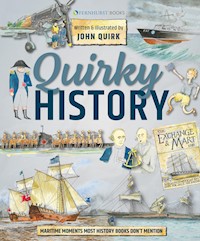
John Quirk loves history, drawing and boats and these three elements come together in this attractive and entertaining book. He has sought out obscure episodes or familiar events from the past and written engagingly about them, illustrated with his excellent colour cartoons. Where possible he relates the historical happenings and maritime moments to the present day, be it when tracing the history of the screw, misinformation (fake news) during the Second World War, plague ships in the fourteenth century, or Russia's ill-fated war with Japan in 1904. The events covered range from Henry V's invasion of France in 1415, consisting mainly of chartered French ships and paid for partially by Dick Whittington, to episodes in the Second World War, like the Somali Camel Corps capturing a German U-boat. Other historic figures involved include Horatio Nelson, Napoleon, Rudolf Diesel and Lawrence of Arabia. The 25 stories and over 100 cartoons are a treasure-trove of compelling, salt-infused, tales told with imagination and humour, with an eye on the present day, which will be enjoyed by anyone with an interest in maritime history (or even just history).
Das E-Book können Sie in Legimi-Apps oder einer beliebigen App lesen, die das folgende Format unterstützen:
Veröffentlichungsjahr: 2022
Ähnliche




















To Jo-anne, my wife and life support system, and every one of my wonderful family.
And yes, that includes you, Mimi.*
*See Chapter 15 for how she got her name.
CONTENTS
Introduction
1. Camel Corps Captures U-Boat
2. Henry V’s Channel Cruise
3. The Taming Of The Screw
4. Boats That Fly
5. I’m Sorry, I Haven’t The Foggiest
6. The Great Lynmouth Lifeboat Rescue
7. The Man Who ‘Hid’ The Suez Canal
8. Warning Shots
9. The Birth Of The US Navy
10. Lawrence To The Rescue
11. The Sea Devil
12. Plague Ships
13. Dr Ted from Berkeley
14. The Greatest Killer In Nelson’s Navy
15.Mimi & Toutou Go Forth
16. Off To D-Day In A Four Poster
17. Those Magnificent Merlins
18. The Navy Goes To Lake Turkana
19. James Bond & The Armada
20. Scuppered At Scarpa
21. The First Yacht Race
22. Whatever Happened To Diesel?
23. Napoleon’s Australia
24. The End Result
25. Russian Roulette
INTRODUCTION
I had the good fortune to go to school in a smoke-blackened relic of the Victorian era in a grubby end of Birmingham. Despite the surroundings, many of the teachers were exceptional. The History, English and Art teachers, in particular, gave me an enthusiasm for these subjects which continue to this day. So you can definitely blame them for this book.
History was not a string of dates but delivered as an ongoing drama of events shaped by the personalities of those involved. It was as if we were being told about an adventure film that the masters had just seen. And it was delivered with wit and humour which made it more memorable and entertaining.
As a ten-year-old I dreamt of playing Stewart Granger
The Art master, who left to be the secretary of the British Amateur Racing Drivers Club, drove a string of exciting open sports cars and me into pursuing a career in architecture. I have been eternally grateful for this as it allowed me to draw for a living while travelling the world on interesting and challenging projects. It didn’t feel like work. Most importantly, that was how I met my wife when she was a client.
As a ten-year-old, I was captivated to see how dashing Stewart Granger looked in the 1950 King Solomon’s Mines and vowed that one day I would go to east Africa and play at being him. 14 years later, I left my job as a draftsman in a Birmingham rubber factory, got myself out there and, amazingly, wound up building game lodges in the bush. From there I was asked to join an international hotel group based in New York City and for eight years travelled the world for them before discovering Australia and moving here.
There are critical dimensions in game lodge design; for example, the grabbing distance of an elephant on hind legs and a stupid tourist with a bun is 7.1 metres
All the time, there was this passion for messing about in boats starting with my father’s motor cruisers on the River Severn, then out to sea and exploring the south coast and Channel Islands. I built and restored boats in the UK, Kenya and New York and enjoyed a 25-foot sloop on Long Island Sound. The waters and the weather around Sydney are made for boats and the passion continues. We now live in an active fishing village with just over 200 souls. The beach is at the bottom of the garden.
I hope you enjoy reading this as much as I have in putting it together.
Quirky
Patonga Creek
New South Wales, Australia
CAMEL CORPS CAPTURES U-BOAT
The U-boat is still there on the Somalian beach
This chapter title sounds like an extract from the Goon Show’s Major Bloodnok’s war diaries. “So there I was, laundering my white flag in a wadi when my faithful bearer approached with the news that I was out of clean jodhpurs and there was a U-boat over the next sand dune...”
“And there I was laundering my white flag…”
Except that it is true.
Maybe not the bit about the jodhpurs but astonishingly in 1944 a German U-boat was captured by the Somali Camel Corps. I had heard rumours of this over 60 years ago, but it was thought to be in World War One and it was surrendering to the Turks. I am indebted to Kenya historian Tom Lawrence in the excellent Old Africa Magazine who told the story in amazing detail
In 1944, U-852 was dispatched from the Fatherland to head to the Indian Ocean and harass shipping up the east African coast. She had an amazing range of 12,750 nautical miles – about halfway around the world. That voyage would have been about 10,000 nautical miles and, at the time, the Germans were a bit light on filling stations east of Suez, so they probably counted on being refuelled by the Japanese or sticking up an Allied tanker. Kapitänleutnant Heinz-Wilhelm Eck was ordered to proceed in utmost secrecy en route.
In the South Atlantic, they came across the Greek freighter SS Pellus and Eck just couldn’t help himself. He waited until dark on 13 March 1944 and sent two torpedoes into the ship. She broke in half and was gone in three minutes. He took two surviving seamen aboard for interrogation and then tossed them back onto their raft.
Eck was concerned about the amount of floating debris which, he thought, would indicate his impulsive action and show signs of U-boat activity. He ordered the debris to be destroyed by grenades and gunfire.
It never seemed to enter his Teutonic mind that 35 crew members were clinging to the wreckage. Only three survived to be picked up after an astonishing 35 days adrift by a neutral Portuguese merchant ship and taken to Angola to tell their story.
On 1 April, just off South Africa, Eck came across the British merchant ship Dahomian with 5,000 tons of general war cargo and 17 precious aircraft. She was torpedoed and sunk ten miles off Cape Point. Two engineers were killed but the other 49 crew were saved by two South African Navy minesweepers.
There was a dramatic increase in air surveillance after the first U-boat attack in south and eastern African waters. Eck’s radio signals were being picked up in Mombasa, Diego Garcia, Addu Atoll and the Seychelles. He managed to evade all the aerial searches until he was off the Somali Coast on 2 May, when he sent a long chatty message. His signals were picked up and six planes of 621 Squadron were scrambled.
A Wellington bomber from northern Somalia was experiencing low cloud and flew low and suddenly found a submarine surfacing in front of them. The radio operator notified all Allied bases from Aden to Mombasa and of course, when in pursuit of a sub, the Somali Camel Corps. He gave the position and the Wellington dived down to take on the U-boat head on. They raked the conning tower with gunfire and returned to drop two depth charges as the sub was diving.
Gotcha! There was an oil slick which would today earn an apoplectic outcry from environmentalists and U-852 began to resurface. It fired furiously at the Wellington and other aircraft that arrived from Aden to drop a total of 47 depth charges and unload 7,000 rounds of ammunition.
“Come out and fight! We know you’re in there…”
U-852 was sinking; to save the crew, Eck beached the sub but failed to blow her up just as the cavalry arrived. The Somali Camel Corps came lolloping over the sand dunes to capture the 59 crew. Eck destroyed the Enigma machine and codes, which was not as critical as it seemed at the time: Bletchley Park was looking over his shoulder at every keystroke. But he didn’t destroy the logbook or his own diary which was a fatal mistake.
British Intelligence tied U-852 to the sinking of SS Pellus and the killing of survivors. Eck, the ship’s doctor and Senior Officer Hoffman were executed for murder. Several other crewmen received terms from seven years to life. Eck claimed he was just tidying up the ocean from all that debris and was not following Admiral Doenitz’s Laconia Order* which would actually have spared him the death penalty. This instructed U-boats not to pick up survivors of sunken ships. Really? After the Royal Navy picked him up having sunk his UN-68 in World War One? There’s gratitude for you.
Even the Royal Navy failed to destroy the wreck of U-852 and sections of it can still be seen just south of Ras Hafun. I am sure when the Covid travel restrictions are over, tourists will be flocking back to Somalia and to those magnificent golden beaches I enjoyed years ago and will be able to check it out...
Tourists will be flocking back to those magnificent golden beaches
*MS Laconia was torpedoed off west Africa in 1942 by U-boats which stopped to rescue survivors and called for Allied shipping to help. US Captain Robert C Richardson lll ordered aircraft to destroy the subs. 1,619 survivors died. I met one of the survivors on a ship as we crossed the exact location who gave a harrowing account of the events. The US declined to undertake any investigation.
HENRY V’S CHANNEL CRUISE
How early in advance do you plan your summer cruise?
11 August marks the anniversary of Henry V’s departure to invade France and to reclaim lands he was convinced should be under English rule. Check Shakespeare for details – he pinched the facts from Hollingshead, a diligent and accurate historian. Henry V was flat broke and had seven ships in his Navy when he decided to go to war. All this was planned, executed and paid for within three months. Quirky is awed by the pre-planning and logistics. You might be too.
Henry goes into the bareboat charter business.“OK, that’s 2d a ton for three months, plus crew. Does the skipper’s quarters come with an en suite?”
Don’t you just love trivia quizzes?
I particularly enjoy the ones where the quiz master has pulled obscure facts from the internet that he did not know before, then lords it over the contestants as if he knew them all along and thinks he is the President of MENSA when we can’t produce the answers up from our memory banks…
It is so much fun when they get it wrong. Like:
“No, the correct title of that painting is not Whistler’s Mother but an Arrangement in Grey And Black Number One. And you have the apostrophe in the wrong place.”
“Sorry Elton, ‘Hakuna matata’ does not mean ‘No worries’ in Swahili. A ‘matata’ is a civil uprising or riot. ‘Worry’ is ‘wasiwasi’.”
Then there is the Tie Breaker. When teams tying for first place have to guess an obscure number and whoever is closest wins. Our quiz master memorised the 1,665 steps up the Eiffel Tower and was so smug that we were 11 steps out. I felt compelled to act.
With an encouraging arm over his shoulder, I said: “You had some interesting questions earlier about Shakespeare’s Henry V and the 100 Years’ War. Yes, it was really 116, wasn’t it? How many arrows did Henry take with him to Agincourt?”
“Er… 15,000…?”
“Slightly more. He took 8,982 archers with him. That’s not quite two each.”
“100,000?”
“Really? That would last the full army less than a minute. Even grounded with dysentery, the reduced English and Welsh archers fired a thousand arrows a second into the French.”
Researchers, through the records of the day, reckon Henry packed between one and two million arrows in his luggage.
To supplement the ones that the English fletchers were churning out at six a day for three farthings each, Henry charged import duties not in cash, but in arrows and bow staves: ten Spanish or Italian yew staves for every ton of imports. Strangely, Mediterranean yew was preferred for making the English long bow.
England had prepared generations of bowmen by forbidding all sport except archery on Sundays. Any man who earnt more than two pounds a year was required to own a bow. If you could not fire ten arrows a minute and hit a target 100 yards away, you were considered a wimp and unfit for military service. The bow pull was 75 kilos. Get one of your gym-junky mates to demonstrate this: lift 75 kilos half a metre, twelve times a minute, with two fingers around a bit of string. The longbow could wound at 250 yards and kill at 100. Even through armour.
The arrow’s metal barbs (or ‘bodkins’ against armour) were secured only with beeswax so the shaft could only be withdrawn without the head and the competition could not fire them back. They were shipped in circular leather collars of 24 to protect the flights. For a million arrows, that’s over 40,000 batches.
Traditional arrowhead
Bodkin for piercing armour – the square section head is wider than the shaft
Henry realised that his official Navy of seven ships would need a bit of help to get men and equipment across the Channel. He negotiated with the owners of merchant ships over 20 tons to charter their vessels at a rate of two shillings per ton per quarter. This was a bareboat charter; the crew was extra at 3d a day for seamen and 7d for masters. Some of the largest, stoutest ships were in the Bordeaux wine trade, many were French owned, but they still joined Henry’s fleet. Even the faster defensive convoy protection vessels he used were French. That’s like Churchill calling up Admiral Donitz just before D-Day and asking if he could borrow a couple of E-boats…
To invade France, Dick Whittington helped Henry charter over 700 ships; guess what – most of them were French
All he had to do now was to pay for it. He raised 130,000 pounds in 1415 money by hocking the family (crown) jewels and selling shares in the expedition which was basically a real estate and ransom venture. Among the investors in Henry V Inc. was the Lord Mayor of London, Dick Whittington. He was a very shrewd businessman and he and the City of London received a very good return. Yes, the same character in kids’ stories and pantomimes really existed and actually became Mayor four times, not just the three in the story...
In his brilliant Azincourt Bernard Cornwell puts the invasion fleet at 1,500 but forensic accountants, digging through the records reckon there were 743 ships carrying 2,265 men at arms, 8,982 archers, the ships’ crews of 2,566… and 18,000 horses (and no doubt a few jars of horseradish…), plus stores and weapons for all of the above.
That’s food for 13,813 active blokes plus horse fodder. They crossed the Channel in just two days and made a more accurate landfall than we did 550 years later with a diesel engine, an ex-RAF compass and a School Cert in maths. These were fat, barrel-bilged ships, normally with a single square sail, loaded right down to their podgy gunwales and with the windward performance of a haystack. They arrived at Honfleur at the mouth of the Seine to find it barricaded by a boom of tree trunks. Henry was first ashore for legal reasons, advised by his lawyers. Something about him ‘taking possession’. Cargos and contestants were discharged in three days. They reassembled their knocked-down IKEA-type wagons, loaded up and headed off to lay siege to Honfleur for five weeks... chewing up supplies, arrows and men.
Those who distrust French plumbing will not be surprised that Henry lost over a third of his troops to dysentery. He was now outnumbered 5:1 by the French and he offered to negotiate a surrender to spare his men the pain of battle. But they could not agree on the fine print, so he offered to settle the outcome with single-handed combat with the French King or Dauphin. Both wimped out. Henry was one tough cookie; at the Battle of Shrewsbury when he was sixteen, he copped an arrow through the cheek and fought on. He later endured the two weeks of agony it took to extract the arrowhead (see next chapter).
So on Friday, 25 October 1415, following some brilliant pre-battle planning, Henry did not quote Shakespeare. According to eyewitness accounts, the 28-year-old King just waved his sword and cried “C’mon lads, let’s go.”
Henry V’s Channel cruise compared with ours in 1963
THE TAMING OF THE SCREW
(You wouldn’t believe how many titles we went through to get to this one: ‘A brief history of…’, ‘One good…’, etc.)
Following the mention of the successful removal of an arrowhead from Henry V’s skull when the King’s life depended on a threaded rod, Quirky was led into the history of this amazing invention and early precision metal working. Those of us who whinge about the cost of 316 stainless steel or bronze screws take note… we are lucky they are so cheap.
Henry V was an innovative ruler, not just because of the Kim Jong-un haircuts – he was the first English King to speak English; it was French up till then.
Henry V caught an arrow in the face at the Battle of Shrewsbury in 1403. The 16-year-old fought on with his team to win and the shaft was extracted after the battle, but the surgeons bodged their efforts to remove the arrowhead.
Today, 16 years old seems quite young to win a battle with an arrow sticking out of your face
He was trundled 65 miles (ouch!) to Kenilworth where Dr John Bradmore was summoned. He was renowned as a skilled surgeon and metal worker, often making his own tools for the job. His enthusiasm for metal working got him into trouble and he was sprung from jail for this op having been banged up for forging coins...




