


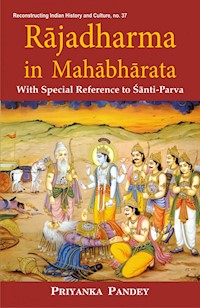
12,49 €
Mehr erfahren.
- Herausgeber: D.K. Printworld
- Kategorie: Religion und Spiritualität
- Serie: Reconstructing Indian History and Culture
- Sprache: Englisch
About The Book
The idea of politics hardly finds an expression elsewhere as clearly as in Mahābhārata. This work thus investigates the political thought explicit in Śānti-Parva and emphasizes that Mahābhārata is a text in the study of politics, apart from the perception of it being a great epic and a text of high literary value. Whatever be the notion of politics we contemplate upon, it finds an articulation in Mahābhārata. As the Greek tradition of thinking is the base of Western politics, Śānti-Parva of Mahābhārata represents the Indian notion of political thinking, though there remain many similarities and dissimilarities between the two systems.
This volume navigates one to how to read Mahābhārata as a political text; the idea of political thoughts, the constituting principles of politics and the political institutions in Śānti-Parva; and the relevance of these political thoughts in modern time. Topics such as daṇḍanīti, origin of state, the seven elements of state, functions of state, types of state, kinship, judiciary and administration are discussed in detail, among many other issues of political importance.
The book collects, analyses and examines the internal evidences from Śānti-Parva and also from other parvans of Mahābhārata to reach a decisive conclusion, making the work a composite result of textual analysis, related literature and subjective contemplation. It clearly shows that the idea of politics is not separated from the idea of ethics. Rather they are intertwined.
About the Author
Dr Priyanka Pandey is an upcoming Sanskrit scholar with a penchant for serious researches on Indian classics. She got her PhD for the thesis, “Perspectives of Rājadharma in Mahābhārata: A Critical Analysis” from Jawaharlal Nehru University, New Delhi. This book Rājadharma in Mahābhārata with Special Reference to Śānti-Parva is an offshoot of her research project.
Dr Pandey has presented articles in many national and international seminars and has ten articles published in journals/books of repute to her credit.
Das E-Book können Sie in Legimi-Apps oder einer beliebigen App lesen, die das folgende Format unterstützen:
Seitenzahl: 411
Veröffentlichungsjahr: 2019
Ähnliche














Rājadharma in Mahābhārata
Reconstructing Indian History and Culture, no. 37
Rājadharma in Mahābhārata
With Special Reference to Śānti-Parva
Priyanka Pandey
Cataloging in Publication Data — DK
[Courtesy: D.K. Agencies (P) Ltd. <[email protected]>]
Pandey, Priyanka, 1986-
Rājadharma in Mahābhārata : in particular reference
to Śānti-parva / Priyanka Pandey.
p. cm. (Reconstructing Indian history and
culture; no. 37)
Includes bibliographical references (p. ).
ISBN 13: 9788124610084
1. Mahābhārata. Śāntiparva – Criticism, interpretation, etc.
2. Hinduism and politics – India. 3. State, The, in literature.
I. Title. II. Series: Reconstructing Indian history and
culture; no. 37.
DDC 294.5923046 23
ISBN 13: 978-81-246-1008-4
First published in India in 2019
© Priyanka Pandey
All rights reserved. No part of this publication may be reproduced or transmitted, except brief quotations, in any form or by any means, electronic or mechanical, including photocopying, recording, or any information storage or retrieval system, without prior written permission of the copyright holder, indicated above, and the publishers.
Printed and published by:
D.K. Printworld (P) Ltd.
Regd. Office: “Vedaśrī”, F-395, Sudarshan Park
(Metro Station: ESI Hospital)
New Delhi - 110015
Phones: (011) 2545 3975; 2546 6019
e-mail: [email protected]
Website: www.dkprintworld.com
To
my dear
Father and Mother
नारायणं नमस्कृत्य नरं चैव नरोत्तमम् |
देवीं सरस्वतीं व्यासं ततो जयमुदीरयेत् ||
nārāyaṇaṁ namask¦tya naraṁ caiva narottamaṁ |
devīṁ sarasvatīṁ vyāsaṁ tato jayamudīrayeta|| —Mbh, Ādi-Parva I.1
Preface
What is here is found elsewhere.
What is not here is nowhere else. — Mahābhārata I.62.53
MAHĀBHĀRATA is a huge monument of Sanskrit literature. It is generally considered as a literary text and is one of the two great epics of India. It is the encyclopaedia of ancient India as it deals with different subjects in different contexts. It was enlarged at different periods by persons of different regions, time and mentalities. It occupies an important place in Indian tradition. Its importance lies in the fact that it has summarized the views of Indian political thinkers and further, its writers have discussed numerous political problems in detail and supplies various problems regarding the relation between man and state. Many scholars have tried to study the political ideas contained in Mahābhārata, many books have come to light dealing with the same subject. The idea of politics hardly finds an expression elsewhere as clearly as in Mahābhārata. The present work, in this regard is a modest attempt in the same direction. The purpose of the present work is to investigate the political thought in Śānti-Parva of Mahābhārata. The focus is to carve out the idea of the politics in the text. As we know in recent debates on the idea of the politics there are several positions like modernist and postmodernist.
One suggests that “political” defines the activities related to the statecraft, whereas the other proposes to take over personal as political. The main intention here is to make an intervention in the contemporary debate from the point of view of Sanskrit knowledge tradition. There are scholars in the West who have recently started exploring the political dimension of this knowledge system, however, their inability to comprehend the larger canvas of Sanskrit knowledge system fails them in such an endeavour. This book anchors itself in longer context of Indian philosophy and tries to read the political context of the text, which is considered merely as a religion or a literary text.
The aim of this work is show that Mahābhārata, apart from being an epic, is also a text in the study of politics. Whatever notion of politics we take, there is a possibility to find good amount of resources in Mahābhārata to articulate an Indian notion in this field. By comparing the notion of politics in the West, taking mainly the Greek tradition of thinking represented by Aristotle, and the Indian tradition represented by Śānti-Parva of Mahābhārata, I would like to argue that there are many similarities and dissimilarities between the two. Our central aim is to show that the idea of politics is not separated from the idea of ethics. The point perhaps will become clear if we explore the way these institutions are conceptualized. Therefore it is highly essential to study the notion of politics in Mahābhārata in the present context. The major focus areas of this work are:
1. Read Mahābhārata as a political text
2. Idea of political thoughts in Śānti-Parva
3. Constituting principles of politics in Śānti-Parva
4. Political institutions in Śānti-Parva
5. Relevance of these political thoughts in modern time.
The work has adopted the following methods in its course of delineation:
1. It has tried to interpret the original Sanskrit text, Śānti-Parva in relation to its political thinking.
2. Beside this, other writings on Indian political thoughts are also taken into account, via books, journals, articles, etc.
3. This work is focused on both the primary and secondary writings on Mahābhārata, by enquiring the basic political principles in Śānti-Parva.
4. It produces a comparative and critical study of the political thoughts in Mahābhārata with the modern politics, finding its place in the history of political thought.
Sources
For the present work, the following sources have been utilized.
1. Mahābhārata (Critical Edition), ed. V.S. Sukthankar, Poona, Bhandarakar Oriental Research Institute, 1933-66.
(The complete edition of Mahābhārata (18 parvas, 89,000 verses in the constituent text and elaborate critical apparatus; 19 volumes; no. of pages: 13,000 + demi quarto size) was released on 22 September 1966. This edition was prepared with painstaking efforts of scholars for about five decades consulting 1,259 manuscripts.)
2. Mahābhārata (6 volumes in Hindi and Sanskrit), ed. Pandit Ramanarayana Dutt Shastri Pandey, Gita Press, Gorakhpur, 1980.
Other secondary sources consist of Bhāratabhāva-Dīpīkā, Nīlakaṇṭha’s commentary on the epic, different translations of, and general works on Mahābhārata. Some other books like Rāmāyaṇa, Manu-Sm¦ti, Kāmandakīya Nītisāra and Śukra-Nītisāra have also been taken into account. Many books on political science have also been referred. And the writings of Indian and Western scholars have also been consulted. At some places archaeological, numismatic and epigraphic evidences have been used.
Beside the utilization of the secondary sources, attempt has been made to go through the reviews both of the occidentalists as well as of the orientalists. A glance at the reviews of the books has helped in two ways. One, it has given information about the limitations as pointed out by the reviewers in the scholarly works, and two, it also has made the researcher balanced in thought and meditation on the discussed problems. Hence the chapter-wise analysis of the topic has been made. The extant research is undertaken from the political point of view. The evidences of the epic have been collected as possible aid to research. They have also been used tentatively as historical material.
The topics, namely, daṇḍanīti, origin of state, the seven elements of state, functions of state, types of state, kingship, judiciary, administration, etc. have been discussed. The internal evidences from Śānti-Parva and also from other parvas of the epic have been collected, analysed and examined. The decisive conclusion made through introspection is tested on the objective data provided by the analytical chart. Thus, the work is the composite result of textual analysis, related literature and subjective contemplation.
Contents
Preface
List of Tables and Figures
Map of Bharātavarṣa in the Mahābhārata period
Abbreviations
Transliteration Key
Acknowledgements
1. Mahābhārata : An Introduction
Authorship of Mahābhārata
Date of Mahābhārata
Contents in Mahābhārata
Commentators on Mahābhārata
Devabodha
Vaiśampāyana
Vimalabodha
Sarvajñanārāyaṇa
Caturbhuja Miśra
Ānandapūrṇa Vidyāsāgara
Arjuna Miśra
Nārāyaṇa
Vādirāja
Nīlakaṇṭha
Important Sanskrit Recensions and
Editions of Mahābhārata
Mahābhārata in Other Indian Languages
Earlier Works on Mahābhārata
Śānti-Parva of Mahābhārata
Contents in Śānti-Parva
2. Politics in Western Tradition
Theoretical Aspect
Foundations Of State
The Theory of Divine Origin of the State
Force Theory
The Social Contract Theory
Patriarchal and Matriarchal Theories
Evolutionary Theory
Stages in Development of the State
Practical Aspect: Political Institutions
The State
Population
Territory
Government
Sovereignty
Theories of State Function
Idea of Liberalism
Political Ideas in Śānti-Parva
The Background
Daṇḍanīti
Nītiśāstra
Arthaśāstra
Rājyaśāstra
Rājanīti
Rājadharma
3. Political Ideas in Śānti-Parva
Origin of Politics
Subject Matter of Daṇdanīti
Importance of Daṇdanīti
State
Theory of The Origin Of State
Ends And Functions Of State
Constituents of The State
Svāmī (King)
Amātya (Minister)
Kośa (Treasury)
Janapada (Territory)
Durga (Fort)
Allies (Friends)
Daṇḍa (Military)
4. Interstate Relationsand Forms of Government
Interstate Relations
Concept of Maṇḍala in Śānti-Parva
Classification of States and Six Expedients of Foreign Policy
Sandhi (Treaty and Alliance)
Vigraha (war)
Yātrā or Yāna
Āsana
Samśraya
Dvaidhībhāva or The Dual Course of Action
The Fourfold Foreign Policy
Diplomatic Agents
Ambassadors
Spies
Types and Forms of Government
Classification of Government In Mahābhārata
Monarchical States
Anarchical States
Gaṇarājya
Aristotle’s Classification of Government
Conclusion
5. Judiciary and Ethical Concepts
Judiciary
Justice According to Plato and Aristotle
Judiciary in Mahābhārata
Orgainzations of Judiciary
Code Conduct of Judges
Legal Procedure
Daṇḍa (Punishment) in Theory and Practice
Ethical Concepts
Ethics in Śānti-Parva
Varying Interpretationof “Dharma”
Sources of Dharma
Forms of Dharma
Sādhāraṇa-Dharma (Universal Moral Code)
Viśiṣṭa-Dharma
Varṇa-Dharma
Āśrama-Dharma
6. Conclusion
Bibliography
Index
List of Tables and Figures
Tables
1.1 18 Parvas of Mahābhārata
1.2 List of Commentators and Commentaries
1.3 Important Information about Major Editions of Mahābhārata
2.1 Theoretical and Practical Politics
Figures
2.1Branches of political science
3.1 Seven constituents of the state
3.2 Types of durgas
4.1 Types of state in Mahābhārata
4.2 Forms of government according to Aristotle
Map of Bharātavarṣa in the Mahābhārata period
Abbreviations
ABORI — Annals of Bhandarkar Oriental Research Institute
AitBrā— Aitareya Brāhmaṇa
BhāgavataP — Bhāgavata Purāṇa
B¦Up — B¦hdāraṇyaka Upaniṣad
BrSaṁ — B¦hat Saṁhitā
Gītā — Bhagavadgītā
IHQ — Indian Historical Quarterly
JAOS — Journal of the American Oriental Society
JRAS — Journal of the Royal Asiatic Society
NK — Nītisāra of Kāmandaka
KA — Kauṭilya Arthaśāstra
Manu — Manu-Sm¦ti
Mbh — Mahābhārata
Nś— Nītisāra of Śukra
ŚP— Śānti Parva
YS — Yājñavalkya-Sm¦ti
Transliteration Key
A = a
AÉ = ā
C = i
D = ī
E = u
F = ū
G = ¦
H = §
I = ḷ
L = e
Lå = ai
AÉå = o
AÉæ = au
Mçü = k
ZÉç = kh
aÉç = g
bÉç = gh
Xèû = ṅ
cÉç = c
Nèû = ch
eÉç = j
fÉç = jh
gÉç = ñ
Oèû = ṭ
Pèû = ṭh
Qèû = ḍ
Rèû = ḍh
hÉç = ṇ
iÉç = t
jÉç = th
Sè = d
kÉç = dh
lÉç = n
mÉç = p
Tçü = ph
oÉç = b
pÉç = bh
qÉç = m
rÉç = y
Uç = r
sÉç = l
uÉç = v
vÉç = ś
wÉç = ṣ
xÉç = s
Wèû = h
¤Éç = kṣ
§Éç = tr
¥Éç = jñ
Å = ’
-ं (Anusvāra) = ṁ
È (visarga)ḥ
Acknowledgements
My efforts to accomplish this book would not have been possible, without the love, affection, help, guidance and encouragement of a number of people and institutions. Their altruistic contributions deserve to be recalled.
First and foremostly, I am grateful to my esteemed supervisor Dr Santosh Kumar Shukla, Associate Professor of Special Centre for Sanskrit Studies (SCSS), JNU, and to my respected co-supervisor Dr Manindra Nath Thakur, Associate Professor of CPS, JNU, for their perspective guidance, inspiration, encouragement, feedback and cooperation despite their busy schedule. Their gracious propositions have propelled me to academically explore whole new things. I am highly indebted to them.
I express my sincere gratitude and thanks to our Chairperson, Prof. Girish Nath Jha and other faculty members, namely, Dr Hari Ram Mishra, Dr Ram Nath Jha, Dr Rajnish Mishra, Dr Sudhir Kumar and to Dr Shashiprabha Kumar, SCSS, JNU, New Delhi for encouraging and allowing this work to come into fruition. I am thankful to the staff members of Jawaharlal Nehru University Library, University of Delhi Library and University of Allahabad Library for their timely assistance in finding out the right materials. I also express my sincere thanks to all the office staff of my centre and those who directly or indirectly helped me in completing this work.
I will be indebted forever to the unconditional and immutable love of my parents father Shri Pramod Chandra Pandey and mother Smt. Malti Pandey. I am delighted by recalling the adorable moral back-up that I have received from my elder sister Vandana and elder brothers Bhupendra, Rajan and Pankaj. I am deeply indebted to my sister Monika and brother Rahul for their prayers, affection and immense support. Also it is hard to forget the lovely and unbreakable talks of Aditya and Gaargi. I owe my sincere gratitude to my mamaji, Shri Jaideva Mishra and to my jijaji Vashistha Narayana Shukla for their constant love and encouragement for completing this work.
I am very appreciative of unmatched help provided by my friends, classmates and seniors. They have been with me in each and every bit of my sufferings.
I also convey my gratitude and thanks to all the persons and institutions, those who have overtly or covertly propelled me miles towards this academic horizon. Without their cooperation this book could not have come out in its final form.
1
Mahābhārata : An Introduction
majjet trayī daṇḍanītau hatāyāṁ
sarve dharmāḥ prakṣayeyurvibuddhāḥ |
sarve dharmāścāśramāṇāṁ hatāḥ syuḥ
kṣātre tyakte rājadharme purāṇe ||
sarve tyāgā rājadharmeṣu dr̥ṣṭāḥ
sarvā dīkṣā rājadharmeṣu coktāḥ |
sarvā vidyā rājadharmeṣu yuktāḥ
sarve lokā rājadharme praviṣṭāḥ || — Śānti-Parva LXIII.28.29
In the history of literature, world literature in general and Sanskrit literature in particular, Mahābhārata occupies a central place. Perhaps after Rāmāyaṇa this great epic has deeply influenced the minds of scholars and researchers as well as of common people. So many of the scholars considered it as Itihāsa1 (itihās purṇābhyāṁ vedaṁsamupbr̥hayet), Purāṇa,2Ākhyāna,3 Saṁhitā,4Kāvya5 and the sources and basis of all the legends. It is the fifth Veda, namely, the Kārṣṇa Veda,6 i.e. the Veda of Kr̥ṣṇa Dvaipāyana Vyāsa, being Kr̥ṣṇa Dvaipāyana Vyāsa its author. It is mentioned in the Svargārohaṇa-Parva that Vyāsa completed this work after working hard for three years:
tribhirvarṣairidaṁ pūrṇaṁ kr̥ṣṇadvaipāyanaḥ prabhuḥ|
akhilaṁ bhārtaṁ cedaṁ cakāra bhagavān muniḥ|| —Svargārohaṇa-ParvaV.48
Mahābhārata is considered as the essence for all the Vedas. By itself it is equal to, nay, even greater than the remaining Vedas.7 Hence one should study the Vedas with its help:
itihāsapurāṇābhyāṁ vedaṁ samupabr̥ṁhayet ||
bibhetyalpaśrutād vedo māmayaṁ prahariṣyati | — Ibid. I.267-68
Besides these it is known as Dharmaśāstra, Arthaśāstra and Kāmaśāstra.8 There is much truth in Vyāsa’s challenge that:
dharme cārthe ca kāme ca mokṣe ca bharatarṣabha |
yadihāsti tadanyatra yannehāsti na tat kvacit ||— Ibid. I.62.53
That which occurs here about dharma, artha, kāma and mokṣa (four ends of human life), occurs elsewhere and that which does not occur here, occurs nowhere else.
It is really an encyclopaedia of Indian intellectual tradition in which social, moral, ethical, economical and political conditions are described extensively. It removes ignorance the way sun removes darkness.9 By its name, it is self-explanatory. In Svargārohaṇa-Parva, it has been stated that the significance of Mahābhārata lies in its greatness and weightiness. In Ādi-Parva, the meaning of the two compound words (mahā-bhārata) finds mention in more clear terms. Being a voluminous (mahat) work and heavy (bhāravat) to lift and carry, the great epic came to be called Mahābhārata. It contains a detail of life and death of Kuru vaṁśa, hence it is identified with Mahābhārata. As stated:
mahattvād bhāravattvācca mahābhāratamucyate |
niruktamasya yo veda sarvapāpaiḥ pramucyate || — Ādi-Parva I.274
It is the longest poem known to the literary history with 100,000 verses (ślokas). So far as the prefix mahā is concerned, it is justified to add that Mahābhārata is larger than Iliad and Odyssey both in size and contents. Even the Vedas have a diminishing utility in comparison and contrast with Mahābhārata. The internal evidences of Mahābhārata refer to the utility of its study. Second, one should study the Vedas with its help. It is further stated that when one’s knowledge of the Vedas is superfluous and useless, one delves into Mahābhārata. There is one more ground which adds a feather to its significance. It is open for both scholars and laymen. It will not be out of place to discuss its importance so far as its readers, reciters and listeners are concerned. Its study is fruitful for everyone irrespective of one’s profession and caste (varṇa). It has been stated in Ādi-Parva that one gets emancipation and is free from all his committed sins, provided he reads the epic in the early morning.
Even a listener is bestowedwith an equal merit if he listens to it. It holds great importance for warriors. One undoubtedly emerges victorious in the battlefield if one reads and listens to it. There is another significance of the epic as it has been interpreted in a different sense by the scholars. In the northern and southern recensions of the epic, it has been emphasized that its reading help to attain victory (jaya). R.C. Jain (1979) is desperately busy to prove that jaya was the nucleus of Mahābhārata. For the support of his statement, he has taken many references from R̥gveda and the Brāhmaṇas.
It has been dwelling on that if the king wants to emerge victorious in the war, he must read the great epic. The advantage of its reading and listening is equal to the merit of Rājasūya and Aśvamedha Yajñas. As stated in Ādi-Parva LXII.21:
mahīṁ vijayate rājā śatrūṁścāpi parājayet |
idaṁ puṁsavanaṁ śreṣṭhamidaṁ svastyayanaṁ mahat ||
It is capable of liberating one from great sins, and of helping one in the attainment of long life, glory and heaven.10 The merits of this “deathless poem” have been well recognized by many modern scholars also. To Winternitz (1927/1953), it is “in a poetic sense, not one poetic production at all, but rather a whole literature”.11A.A. Macdonell (1928) calls it an “encyclopaedia of moral teaching”.12R.C. Dutt (1944: 332) describes it as “an encyclopaedia of the life and knowledge of ancient India” and says “no single work except the Bible has such an influence in affording moral instructions in Christian lands as Mahābhārata and Rāmāyaṇa in India” (ibid.: 33). According to C. Rajagopalachari (1951) it is a “Veritable ocean, containing countless pearls and gems. It is, with Rāmāyaṇa, a living fountain of ethics and culture of our motherland.”13P.C. Roy (1890) describes it as “pre-eminently the encyclopaedia of the heroic age of the Hindus…”.14
The epic has several messages and the more one delves into it, the deeper one grasps its meaning. It is considered as the book of education not less significant than that of Plato’s Republic which supplies information in connection with the education of the philosopher kings and communism of wives. So far as the impact of Mahābhārata is concerned; the poet Bāṇa was influenced by it.15 It also has inspired the dramatists in the past. Ludwig, a Vedic scholar, was of the view that special attention should be paid to study the disjointed pieces of Mahābhārata (Sukthankar 1975: 29).
Similarly, Ācārya Śaṅkara and Kumārila, the celebrated Indian philosophers, as well as Jñānaeśvar and Rāmadāsa, the famous Indian saints, were influenced by its message.16Amartya Sen (2006: 3) has also written about it:
With about one hundred thousand verses, long prose passages, or about 1.8 million words in total, the Mahābhārata is roughly seven times the length of Iliad and Odyssey combined or about the four times the length of Rāmāyaṇa.
W.J. Johnson (1998) has compared the importance of Mahābhārata to the world civilization to that of Bible, works of Homer and Quran. Though the phalaśruti (merit of regarding the people) has been questioned it is not an original part of Mahābhārata. But both the southern and northern recensions of Mahābhārata refer to its usefulness.
In Indian tradition Mahābhārata is considered as the great source of the best ideals (Sukthankar 1975: 30). In the vast parameters of the original narratives of Bharata-Vaṁśī heroes, the preachers of the Dharmārtha and Ākhyāyanas were included in this text. Because of these Ākhyānas, teachings and description on dharma and Nīti-Śāstric views, Mahābhārata is literally, historically and religiously considered a great and important text of Hindus. According to C.V. Vaidya (vs 1917: 26), Mahābhārata is not only a text of history and religion, but it is the best epic. In the starting of the text Veda Vyāsa himself called it poetry17 and also there is an indication in Mahābhārata that this poetry will be upajīvya for all the major poets.
sarveṣāṁ kavimukhyānāmupjīvyo bhaviṣyati || — Ādi-Parva I.92
Mahābhārata is a great source of motivation for many epics and dramas of the Sanskrit language and also for the Kāvyas of Hindi poets (Sinha 1985: 20). It is the source of motivation for Sanskrit, Hindi and many other Indian languages texts.
Beside these, Mahābhārata is also valuable from the political point of view. In Mahābhārata abundant materials are available on politics. In Śānti-Parva, a large part named “Rājadharma” is on politics. And many other parvas like Ādi, Sabhā, Āraṇyaka and Udyoga also have given valuable information on political ideas.
Many writers, who have written on “Ancient Indian Monarchy” or on the political field, have taken a great amount of valuable materials from Mahābhārata. D.R. Bhandarkar, N.C. Vandyopadhyaya, Beni Prasad, R.P. Giri, V.R.R. Dikshitar, T.V. Mahalingam, N.N. Law, P.C. Basu, A.K. Sen, R.C. Majumdar, R.K. Mukherjee, K.P. Jayaswal, J.J. Anjaria and H.N. Sinha are some of the great scholars, who have given their mature contribution to this field. The text Government in Ancient India of A.S. Altekar is quite well known. In these texts, the evidences are mainly taken from Śānti-Parva and one or two verses have also been taken from other parvas. U.N. Ghoshal in his A History of Indian Political Ideas has discussed about “Rājadharama”, featured in Śānti-Parva, in four chapters, which is not available in such a form in any other text of political theory. Shyamlal’s text, Bhīṣma kā Rājadharma is based on the Rājadharma section of Mahābhārata.18 Due to the availability of abundant materials on politics, Mahābhārata is selected as the fundamental text for the present work.
Authorship of Mahābhārata
jayati parāśarasūnuḥ satyavatīhr̥dayanandano vyāsaḥ |
vyāsasyakamalagalitaṁ vāṅmayamamr̥taṁ jagat pibati ||— Harivaṁśa-Parva II.3
Traditionally, the authorship of Mahābhārata is attributed to Vyāsa. It is mentioned in Ādi-Parva that Kr̥ṣṇa Dvaipāyana Vyāsa was its author. And on the basis of Kr̥ṣṇa, which forms a part of its supposed author, it is called the Kārṣṇa Veda,19 the Veda of Kr̥ṣṇa Dvaipāyana Vyāsa. As said in Ādi-Parva I.10:
samīpe pārthivendrasya samyaka parikṣitasya ca |
kr̥ṣṇadvaipāyanaproktāḥ supuṇyā vividhāḥ kathāḥ||
Its critical survey reveals that it is not the composition by a single person, and was not composed within the period of three years but a large number of composers have contributed their shares to rise Mahābhārata from Bhārata. Mahābhārata has undergone many redactions. On the basis of internal evidence, we know with a certain degree of certainty, about its three composers, viz. Vyāsa, Vaiśampāyana and Sauti. The first began it with salutation to Nara, Nārāyaṇa and Sarasvatī, the second with “Sarpaśāstra”, i.e. the beginning of the Āstika-Parva and third with the Aṁśāvataraṇa-Parva, whence starts the actual narrative of the Bhārata race.20
The epic itself informs that it was composed after the great battle by Vyāsa to spread the fame of the great Pāṇḍavas and other kṣatriyas in the world, and was known as Jaya Kāvya; it is corroborated by the fact that Mahābhārata calls itself the Itihāsa — jaya nāmotihāsoayaṁ,21 as it narrates the events of the victory of the Pāṇḍavas over the Kauravas.22 It is thus apparent that originally the present Mahābhārata was a war epic consisting of the heroic songs related to the great battle. This epic was known as Bhārata as it was composed on the theme of battle between Kauravas and Pāṇḍavas by Vyāsa and it consisted of only 24,000 ślokas.
caturviṁśatiśāhastrīṁ cakre bhāratasaṁhitāṁ |
upākhyānairvinā tāvad bhārataṁ procyate budhaiḥ || — Ādi-Parva I.102
Finally, with the deliberate accession of considerable doses of fresh matter from time to time, aiming the work to be an encyclopaedia of Indian culture with all its components, it assumed the form of the compendium of all the existing knowledge called Mahābhārata with about 1,00,000 verses and was appropriately given the descriptive title Śata-Śāhasrī Saṁhitā.23 This conjuncture is supported by Āśvalāyana Gr̥hyasūtra III.4.4 referring to Bhārata and Mahābhārata both:
sumantujaiminīvaiśampāyanapailasūtrabhāṣyabhārata-dharmācāryā jānanti ||
Mahābhārata also calls itself by three names, viz. Jaya, Bhārata and Mahābhārata.24
Date of Mahābhārata
Dating of Mahābhārata, which has given rise to a heated controversy among the scholars, can be seen from the two standpoints: (1) the date of Kurukṣetra war, and (2) the date of the composition of Mahābhārata. And the latter issue is related with the question of its authorship. Since “there was no author of the great epic” (Hopkins 1901: 58), as we have already stated, no particular and exact date can be assigned to it, in its present form. Before reaching at the probable date of the composition of the epic, it is desirable to know the different views of the scholars for disagreement or concordance.
According to P.L. Vaidya (1937, vol. II: 56), the great epic in its present form is the outcome of a long and continuous literary activity. N. Jagannatha Rao (1931/1976) thinks that the war of Kurukṣetra was fought in 3139 BCE.25 On the basis of the astronomy K.V. Abhayankar (1944) places the Great War in c. 3000 BCE.26 The same view has been given by C.V. Vaidya (1907: 5)27 and P.V. Kane (1965, vol. III: 896 and 923). 3102 BCE is the year from which Kaliyuga believed to be set in and according to Ādi-Parva, the war of Kurukṣetra was fought in the end of Dvāpara Age and it was the beginning of the Kaliyuga.
antare caiva samprāpte kalidvāparayorabhūta |
samantapañcake yuddhaṁ kurupāṇḍavasenayoḥ ||— Ādi-Parva II.13
The traditional date for the Kali Age was first time given by the celebrated astronomer Āryabhaṭa (born 473 CE) and in Aihoḷe inscription (dated 634 CE) of the Cāḷukyan emperor Pulkeśin II of Bādāmī (Bījāpur district, Karnataka). However, there also exist some other almost equally early traditions dating this event a few centuries subsequent to the start of the Kali Age. According to a very persistent tradition, it occurred in 2449 (current) or 2448 (expired) BCE. This notion is first referred to by Varāhamihira (mid-sixth century CE) who in his Br̥hatSaṁhitā gives the interval between the period of Mahābhārata hero Yudhiṣṭhira for his commencement of the Śaka era as 2526 years.28
The famous Kashmiri poet and historian Kalhaṇa (twelfth century CE) in his Rājataraṅgiṇī has quoted the statement of Varāhamihira and given the idea that the Bhārata war took place at the end of the Dvāpara Age and also assists that Kuru and Pāṇḍavas flourished when 653 years of the Kali Age had elapsed:
śatesu ṣaṭsu śārdeṣu tryadhikeṣu ca bhūtale |
kalergateṣu varṣāṇāmanubhvan kurupāṇḍavāḥ || — Rājataraṅgiṇī I.51
Some modern Indian astronomers have tried to show that even some astronomical references in Mahābhārata itself lend support to this date. What is interesting in the present context is the fact that this tradition is also sought to be buttressed by some scholars on the basis of a certain assertion met with in the copper-plate characters of the Prāgjyotiṣa monarch Bhāskarvarman (600-50 CE).29 It is averred in his Nīdhānpura plates that Vajradatta, son of Bhagadatta who played an important role in the Bhārata war, was followed by his descendants who ruled for 3,000 years after which Puṣyavarman became a king.30P.C. Sengupta (1937) assigns 2449 BCE to the event (war).31 Basing his investigation on the astronomical data J.S. Karindikar (1943: 749) suggests that 1931 BCE is the date of Kurukṣetra war*. According to K.P. Jayaswal (1967) it took place in 1424 BCE.32R.C. Datta (1910: 169, 323) assigns the thirteenth or fourteenth century BCE to the event. N.K. Siddhanta (1929: 33-42) tries to solve the problem in three ways.
On the basis of the gap between the birth of the Parīkṣita and the coronation of Mahāpadmananda, the founder of the Nanda dynasty, which was 1,050 and 1,015 years according to Matsya Purāṇa 272.36 and Viṣṇu PurāṇaIV.24.32 respectively, he regards 1472 and 1437 BCE as the date of birth of Parīkṣita, who was born immediately after the war of Kurukṣetra. By using the genealogical list, which is given in the Purāṇas, he places the war in the eleventh century BCE. To K.G. Sankara (1930-31) war took place in 1183 BCE,33 whereas K.L. Daftari favours 1197 BCE as its date.34 The same differences of opinion are there about the composition of the epic. Regarding the period which the epic covers, A. Macdonell(1928: 241) and R.C. Majumdar35 think that Mahābhārata in its present shape, existed in about 350 CE. According to George Bühler the epic took place during 300–500 CE.36 In the words of E.W. Hopkins (1913: 397ff):
As a whole poem dates from about the second century BCE extending to the second century CE or with the margin allowed by some scholars, its period extends from 400 BCEto CE400, this representing the centuries during which the whole poem was developed into its present shape.
After making a comparative study of the geography of the Buddhist Mahāvagga with that of Mahābhārata, S. Levi concludes that the latter received its final redactions in the first three or four centuries CE.37
According toS. Paramavitana,
This Epic may not have existed in its present form in the time of Aśoka but it is not impossible that the kernel of the epic is as old as, or older than, third century BCE. At any rate, the story of Pāṇḍavas and Kauravas must have been current in India in Aśoka’s age or even earlier.38
So from the above account it is clear that the date of the “dateless”39Mahābhārata is obscure and concealed in mystery.
In Baudhāyana Gr̥hyasūtra there is a clear description of “Viṣṇusahasranāma” and one verse of Bhagavadgītā IX.2640 is quoted there as an evidence and it is known to all that Gītā is the part of Mahābhārata. Time period of Āśvalāyana and Baudhāyana was around fourth century BCE(Macdonell 1928: 287). It appears that the composition of Mahābhārata took place in 200 or 600 BCE, from the composition of these two Saṁhitās (Āśvalāyana and Baudhāyana). Based on these two quotes it can be said that Mahābhārata must have been composed before the spread of Buddhism (450-400). Time period of Āśvalāyana is considered around 400 BCE, and before Āśvalāyana Gr̥hyasūtra there was no description of Mahābhārata in any available literature.
So from the above references it becomes clear that Mahābhārata was composed about fifth century BCE. Some German scholars have estimated that the present form of the epic must have got composed between ninth and tenth centuries BCE, but the great German scholar Winternitz did not agree with this because it has been proved from the evidences of literary inscriptions and description that the time period of Mahābhārata was about fifth century BCE. According to Winternitz, Mahābhārata covers a period ranging from fourth century BCE to fourth century CE.41 Hence from the above reviews it becomes clear that it was composed not earlier than 400 BCE. Therefore, it is estimated that its composition may be occurred between fourth and fifth centuries BCE.
Contents in Mahābhārata
According to the nineteen voluminous parts of BORI’s critical edition, the great epic Mahābhārata is divided into eighteen major sections known as parvas (books), namely, Ādi, Sabhā, Vana, Virāṭa, Udyoga, Bhīṣma, Droṇa, Karṇa, Śalya, Sauptika, Strī, Śānti, Anuśāsana, Āśvamedhika, Āśramavāsika, Mausala, Mahāprasthānika and Svargārohaṇa. Each parva is subdivided into chapters made up of verses composed in various metres, usually in śloka form, but also in triṣṭubhs and other less common metres as well as occasional prose passages. It contains an appendix (Khila-Parva) called Harivaṁśa which has 16,375 verses. All these eighteen parvas and one additional Harivaṁśa contain 100 sub-parvas. These parvas have been named after some important incidents of the main narrative of the epic, which is related with the Kuru dynasty and may be summarized as follows:
1. Ādi-Parva:Mahābhārata begins with Ādi-Parva. Here the word ādiḥ means the beginning or the first. Its 225 chapters first present the cycle myths leading up to King Janamejaya’s snake sacrifice at which Mahābhārata is first spoken by Vaiśampāyana, a disciple of Vyāsa. After this, it proceeds to tell the origin of the Pāṇḍava brothers and their cousins the Kauravas, the marriage of the Pāṇḍavas to Draupadī and the roots of the conflict between them, which is the main theme of the central narrative.
2.Sabhā-Parva: Sabhā-Parva has 72 chapters and takes the narrative further by telling how the kingdom was divided between the two branches of the family and how the great Rājasūya sacrifice was performed by Yudhiṣṭhira and the Pāṇḍavas. It tells of the envy of Duryodhana and the Kauravas and finally of the gambling match at which Yudhiṣṭhira loses everything to the Kauravas, Draupadī is insulted and the Pāṇḍavas are exiled to the forest.
3.Vana-Parva: Vana-Parva (229 chapters) describes Pāṇḍavas’ life in different forests. It contains discourses of Dhaumya, Mārkaṇḍeya, Lomaśa and Ariṣṭisena to Yudhiṣṭhira, and many discussions on the moral virtues. Two famous episodes, the Nalopākhyāna and the Rāmopākhyāna, occur in this parva.
4.Virāṭa-Parva: Virāṭa-Parva (67 chapters) describes how the Pāṇḍavas pass their final year of exile (ajñātavāsa) living incognito at the court of King Virāṭa. Here the drama is not punctuated by didactic passages as in the vane.
5.Udyoga-Parva: From the Udyoga-Parva (197 chapters) we come to know after the expiry of the thirteen years of banishment, Yudhiṣṭhira once more claimed the kingdom, but Duryodhana refused to give even an inch thereof to him. All attempts at negotiations proved futile and ultimately war was declared. Both the parties, that of the Kauravas and that of the Pāṇḍavas, began making preparation for the war.
6.Bhīṣma Parva: The Bhīṣma-Parva (117 chapters) describes the initial drawing up of the armies at Kurukṣetra and contains Bhagavadgītā, in which Kr̥ṣna convinces Arjuna that it is right for him to wage war. The battle is then described up to the point at which Arjuna shoots down Bhīṣma, the Kaurava’s general.
7.Droṇa-Parva: The Droṇa-Parva (173 chapters) is the seventh parva among the eighteen parvas of Mahābhārata. This parva starts with the defeat of Bhīṣma in the battle of Kurukṣetra and with the taking over of the command of the entire Kuru army by Droṇācārya. A major part of this episode deals with the narration of the battle. In this parva there is a description of about most of the great warriors and their end while fighting in the battle of Kurukṣetra war.
8.Karṇa-Parva: The Karṇa-Parva (69 chapters) concentrates specifically on the conflict between Arjuna and Karṇa. This parva starts with the birth of Karṇa and it ends with the death of Karṇa in the great battle of Kurukṣetra in the hands of Arjuna.
9.Śalya-Parva: Śalya-Parva (64 chapters) is the ninth parva of the great epic. This parva describes the taking over of the charge of the commanding the Kuru army by Śalya, the king of Madra, after the death of Karṇa. And this parva also tells of the final stages of the battle in which Yudhiṣṭhira kills his uncle, Śalya, and Bhīma puts an end to Duryodhana in a single combat. This parva describes the last date of the battle at Kurukṣetra.
10. Sauptika-Parva: The Sauptika-Parva (18 chapters) describes the massacre in the Pāṇḍava camp by three survivors from the Kaurava side.
11.Strī-Parva: Strī-parva (27 chapters) has been devoted to the vilāpa (lament) of the ladies, who lost their near and dear once in the war of Kurukṣetra. This is followed by a description of the performance of the funeral rites, viz. dāha and śrāddha of the deceased warriors.
12.Śānti-Parva: Śānti-parva (353 chapters) is the twelfth parva among the eighteen parvas of Mahābhārata. This parva comprises a sixth part of the total extent of Mahābhārata and this parva opens with the victorious Yudhiṣṭhira lamenting over the suffering he has caused and wishing to abandon the kingdom he has won to take up the life of an ascetic. There follows a great discussion on the proper duty of the king, before everybody returns to the battlefield where the fallen Bhīṣma gives more detailed instructions on this subject.
13.Anuśāsana-Parva: TheAnuśāsana-Parva (154 chapters) consist of the final instruction or the anuśāsana from Bhīṣma to Yudhiṣṭhira. This episode is a long interval in the great epic of Mahbhārata and it explains in detail the instructions given by Bhīṣma while he was in deathbed of arrows in the battlefield. This parva is considered to be a very large treasure-trove of the Brāhmaṇic lore which is later added to the epic of Mahābhārata.
14.Āśvamedhika-Parva: The Āśvamedhika-Parva (96 chapters) then narrates how the Pāṇḍavas executed a horse sacrifice to atone for the sins incurred by killing others in the battle. Much of the parva, however, consists of teachings from Kr̥ṣṇa to Arjuna.
15.Āśramavāsika-Parva: Āśramavāsika-Parva (47 chapters) deals with Dhr̥tarāṣṭra’s departure to the forest as a hermit.
16.Mausala-Parva: Mausala-Parva (9 chapters) gives an account of the destruction of the Yādavas with the mūsala (pestle) in accordance with the curse of Vālmīki.
17.Mahāprasthānika-Parva: The Mahāprasthānika-Parva (3 chap-ters) describes the death of the Pāṇḍavas and of Draupadī after they have given up their kingdom and journeyed to the Himalayas.
18.Svargārohaṇa-Parva: As indicated by its name Svargārohaṇa, the eighteen and the last parva with 5 chapters, describes the attainment of svarga (heaven) by the leading characters of the great epic.
Table 1.1: Parvas of Mahābhārata
Parva
Sub-parvas
Adhyāyas
Ślokas
Ādi-Parva
19
225
7,197
Sabhā-Parva
9
72
2,390
Vana-Parva
16
299
10,338
Virāṭa-Parva
4
67
1,824
Udyoga-Parva
11
197
6,063
Bhīṣma-Parva
5
117
5,406
Droṇa-Parva
8
173
8,192
Karṇa-Parva
1
69
3,871
Śalya-Parva
4
64
3,315
Parva
Sub-parvas
Adhyāyas
Ślokas
Sauptika-Parva
3
18
772
Strī-Parva
5
27
730
Śānti-Parva
3
353
12,902
Anuśāsana-Parva
2
154
6,439
Āśvamedhika-Parva
2
96
2,743
Āśramavāsika-Parva
3
47
1,062
Mausala-Parva
1
9
273
Parva
Sub-parvas
Adhyāyas
Ślokas
Mahāprasthānika-Parva
1
3
106
Svargārohaṇa-Parva
1
5
194
Total in 18 parvas
98
1,995
73,817
Harivaṁśa (Khila-Parva)
2
–
16,375
Total (including Khila-Parva)
100
1,995
90,192
Source: Mahābhārata (according to BORI’s critical edition).
The division of eighteen parvas is given in Table 1.1.
Commentators on Mahābhārata
Mahābhārata has a long tradition of commentators under which great scholars, religious and wise (adhyātmavettā) hermits are counted. According to Sukthankar the name of the famous commentators of Mahābhārata are as follows: Anantabhaṭa, Arjuna Miśra, Ānanda, Devabodha, Nārāyaṇa, Nīlakaṇṭha,Caturbhuja Miśra, Jagadīśa, Rāmānuja, Lakṣmaṇa, Varad, Vādirāja, Vidyāsāgara, Vimalabodha, Śaṅkarācārya, Śrīnivāsa, Sarvajñanārāyaṇa and Sr̥ṣṭidhara. In addition to these commentators there are many other commentators also, such as, Gadānanda (has written commentary named Bhāratajñānadīpikā) which is available in the Vāṅgya Sāhitya Pariṣada, in handwritten form. Jagaddhar, Janārdana Muni and Vidyānidhibhaṭṭa (Ānandapūrṇa has given the indication of these four commentators in his commentary named Bhārata-Ṭīkā), Vaiśampāyana, Śāṇḍilya, Māghava, Ratnagarbha, Kavindra, Utkalakavi and Gadānanda.
The instruction of first one (Vaiśampāyana) is given by Vimala-bodha and the description of the last two (Śāṇḍilya and Māghava) is given by Arjuna Miśra in his commentaries. Virodhārthabhañjinī Vyākhyā of Rāmakr̥ṣṇa and Viṣamapāda-Vivaraṇa of Ajñātanāma are also published on Virāṭa-Parva. Some commentaries on Vādirāja’s Lakṣābharaṇa have been published on Virāṭa and Udyoga-Parva. Gujarati Printing Press has made a special contribution in the simulation of Mahābhārata by publishing Virāṭa-Parva (with eight commentaries) in 1950 and Udyoga-Parva (with five commentaries) in 1920.42
In addition to these, Bhāratavyākhyā of Kavīndra is also available. The name of the Vādirāja’s commentary is Lakṣaślokālaṁkāra. Śrīdharācārya has also written his commentary on Mokṣadharma of Mahābhārata. Thus we have information on thirty-six commentators of Mahābhārata. Description of some famous commentators is as follows.
DEVABODHA
He is one of the most ancient commentators of Mahābhārata. The name of his commentary is Jñānadīpikā. He is mentioned by later commentators with honour and respect. He is also called Devaswāmi. His commentary is accepted as a standard commentary. His text will not have original verses of Mahābhārata but contains chapter numbers, verse numbers, etc. He has given the meaning with very difficult expressions. He precedes Vimalabodha, Sarvajñanārāyaṇa and Vādirāja. Arjuna Miśra bases his commentary43 on Jñānadīpikā. Devabodha commented on Ādi, Sabhā, Udyoga, Virāṭa and Bhīṣma-Parva. Time period of Devabodha should be just before 1766 CE.
VAIŚAMPĀYANA
Vimalabodha in his Viṣam Ślokī (known as Mahābhārata-Vyākhya) has mentioned the name of Vaiśampāyana.
vaiśampāyana ṭīkādidevasvāmimatāni ca |
vīkṣya vyākhyā viracitā durghaṭārthaprakāśinī||
VIMALABODHA
The name of his commentary isDurghaṭārtha-Prakāśinī, also known as Viṣamaślokī. He commented on all the eighteen parvas of Mahābhārata. His time is considered as around 1802 CE. Gujarati Printing Press published his works on Virāṭa and Udyoga-Parva.
SARVAJÑANĀRĀYAṆA
The name of hiscommentary is Bhāratārtha-Prakāśikā. He was expected to have lived between the period 1110–1300 CE. According to P.V. Kane, Arjuna Miśra quotes him in his work.
CATURBHUJA MIŚRA
His commentary Bhārata-Upāya-Prakāśa is on Virāṭa-Parva. In his commentary he presented Medinī Koṣa as an evidence. Time of the MedinīKoṣa is considered between CE 1200 and 1275. Ānanda-pūrṇa Vidyāsāgara has mentioned Caturbhuja Miśra in his commentary named Vidyāsāgarī. So from this, the time of the Caturbhuja can be made out as the end of the thirteenth century.
ĀNANDAPŪRṆA VIDYĀSĀGARA
The nameof hisfamouscommentary is Vidyāsāgarī. In the history of Advaita Vedānta he is famous as a great writer. His commentary on Mahābhārata is so vast and erudite, in which we find ancient commentators’ name in a large number. His commentaries are available on the five parvas, namely, Ādi, Sabhā, Bhīṣma, Śānti and Anuśāsana-Parva. His time has been considered as the fourteenth century CE.
ARJUNA MIŚRA
He is also a great commentator on Mahābhārata. The name of his commentary is Bhāratārtha-Dīpikā. He commented on the whole text of Mahābhārata. According to Kane, he belonged to 1620 CE.
NĀRĀYAṆA
His commentary is Nigūḍhārtha-Pāda-Bodhinī. His time is considerd to be the closing period of the fourteenth century.
VĀDIRĀJA
Lakṣābharaṇa or Lakṣālaṁkāra is his famous commentary on Mahābhārata. He was a south Indian “Naiyāyika” (Indian logician), of Mādhava following lived during 1525-75 CE. This text neither follows the southern manuscript nor the northern. Gujarati Printing Press has published his works on Virāṭa and Udyoga-Parva.
NĪLAKAṆṬHA
Nīlakaṇṭha Caturdhara, the best known commentator on Mahābhārata, lived in Banāras in the second half of the seventeenth century. His commentary Bhāratabhāvadīpa is the only one that is widely used in Sanskrit studies today.44 This is available on the whole eighteen parvas of Mahābhārata. He quotes Devabodha, Vimalabodha, Arjuna Miśra and Sarvajñanārāyaṇa. He wrote commentary for Śivatāṇḍava in 1680 and commentary on Gaṇeśa Gītā in 1693. The time period of the different handwritten form of Bhāratabhāvadīpa was 1687-95; so from this, one can estimate the time period of Nīlakaṇṭha as CE 1650–1700.45
Table 1.2 Lists the commentators of Mahābhārata and their commentaries.46
Important Sanskrit Recensions and
Editions of Mahābhārata
1. The Calcutta edition, Asiatic Society; the Editio Princeps, in Nāgarī character (quarto); 4 volumes, 1834-39.
2. The Bombay edition, 1863.
3. The Madras edition, re-edited with ṭīkā by Nīlakaṇṭha Govinda, 1890.
4. The Southern Recension, 18 volumes, critically edited by P.P.S. Shastri, and published by Ramaswamy Sastrulu & Sons, Madras, 1932.
Table 1.2: List of Commentators of Mahābhārata with Their Commentaries
Commentators
Time Period
Commentary
Parva
Devabodha
1766 CE
Jñādīpikā
Sabhā,Bhīṣma,
Udyoga and Virāṭa
Vimalabodha
1050 CE
Durghaṭārtha-Prakāśinī
18 parvas
Nārāyaṇasarvajña
Sometime between 1110–1300 CE
Bhāratārtha-Prakāśikā
Virāṭa and Udyoga
Caturbhuja Miśra
1300 CE
Bhārata-Upāya-Prakāśa
Virāṭa
Ānandapūrṇa
1350 CE
Vidyāsāgarī
Ādi, Bhīṣma and Śānti
Commentators
Time Period
Commentary
Parva
Arjuna Miśra
1534 CE
Bhārtārtha-Dīpikā
Virāṭa, Sabhā, and Anuśāsana
Nārāyaṇa
After fourteenth century
Nigūḍhārtha-Pāda-Bodhinī
Ādi, Sabhā, Bhīṣma, Śānti and Anuśāsana
Vādirāja
1525-75 CE
Lakṣābharaṇa or Lakṣālaṁkāra
Virāṭa, Udyoga and Śānti
Nīlakaṇṭha Caturdhara
1650–1700 CE
Bhāratabhāvadīpa
18 parvas
Mādhavācārya
1197–1276 CE
Mahābhārata Tātparya Nirṇaya
—
5. The Poona Recension (popularly called the “Bhandarkar edition”) 1933-66, the most authoritative, a painstaking labour of scholarly love; the first critical edition, completed in 1966.
6. Complete Mahābhārata, with Hindi translation, Gita Press, Gorakhpur, 8 volumes.
Table 1.3 details the major editions of Mahābhārata.
Mahābhārata in Other Indian Languages
Forcenturies together Mahābhāratahas been popular not only in India but also in several parts of the world. From the fifth century BCE, saints, scholars, poets and dramatists have quoted copiously from it. In the second century BCE a Greek envoy referred to precepts called from this epic. In the second century BCE the whole poem was recited in temples in Cambodia. It has attracted the notice of the international community, because of its largest volume, with 100,000 stanzas, which is totally full of inordinate depth. So many works have been done based on Mahābhārata. It is a treasure house of the Indian culture, both secular and sacred. This epic provided the material and ideas for the numerous works on Sanskrit literature. Its translation became the foundation for many of the Indian languages to generate once again a vast body of narrative poems and other poems in these languages.47 Based on the original text of Mahābhārata many versions of it have been written in different Indian languages, the description of which is as follows:
Table 1.3: Important Information about Major Editions of Mahābhārata*
Edition
No. of Vols
No. of Verses
Year of Publishing
Bhandarkar edn (Poona edn) ed. V.S. Sukthankar
19
89,000
1933-66
Complete Mahābhārata (with Hindi tr.), Gita Press, Gorakhpur
6
1,00,217
1980
Edition
No. of Vols
No. of Vols
Year of Publishing
The Calcutta edn, Asiatic Society
4
—
1834-39
The Southern edn, ed. P.P.S. Shastri
18
100,217 more or less than this
1932
*Note: The number of ślokas is not confirmed, but information on them is given as it may be possible from literary sources.
1. Assamese:Mahābhārata, translated into Assamese by Mahindra Bora, Guwahati: Students Stores, 1988.
2.Bengali: Basu, Rajasekhara, Mahābhārata, Calcutta: M.C. Sarkar & Sons, 1955.
3. Gujarati:ŚrīMahābhārata, tr. Shankaradutt Shastri, Parvati Shankara; ed. Bhikshu Akhanadananda, 3rd edn, Ahmedabad.
4. Kannada:H.N. Rangaswami, Śrīmadmahābhārata, tr. and ed. Rangaswami et al., Bangalore: Bharata Darshan Prakashan.
5.Malayalam:Bhāṣābhāratam, tr. Kodungallur Kunjikkuttan Thampuran, Irinjalakuda: T.N. Namputiri, 1952-56, 7 vols.
6.Manipuri:Mahābhāratam, tr. Kallachand Shastri, Imphal: Manipuri Mahābhārata Committee, 1956-63.
7.Marathi:Srimanmahābhāratache Marathi suras Bhāṣāntara, tr. Narhar Raghunath Pathak, Bombay: Surekha Prakashan, 1967, 10 vols.
8. Oriya:Mahābhārata, tr. Gobinda Chandra Mahapatra, Bhubaneswar: Oriya Sahitya Academy.
9.Punjabi:Mahābhārata, ed. Swami Shabdanandaji, Amritsar: Bhai Jawaher Kripal Singh.
10.Konkani:Kelekar Ravindra, Mahābhārata




