


27,99 €
Mehr erfahren.
- Herausgeber: John Wiley & Sons
- Kategorie: Fachliteratur
- Serie: Rapid
- Sprache: Englisch
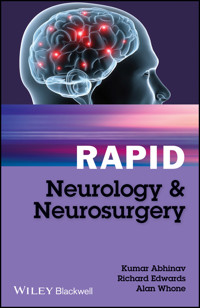
RAPID Neurology & Neurosurgery
The Rapids are a series of two-colour reference and revision pocket books that cover key facts in a simple and memorable way. Each book covers the common conditions or drugs that students and junior doctors encounter on the wards, in clinics, and in their exams. The core relevant facts are provided to ensure these books are perfect concise ‘rapid refreshers’. To see all titles in the series, go to: www.wiley.com/go/rapids
Rapid Neurology and Neurosurgery is a must for all medical students and junior doctors-it is a quick and easy on-the-ward or clinical reference and the perfect revision tool for those approaching finals, undergraduate neurology and neurosurgery examinations and the Membership of Royal College of Surgeons (MRCS) examinations.
It provides a concise, structured approach to neurology and neurosurgery learning, covering key fact in a simple and memorable way:
PART I (The Basics) features the basic principles and facts essential for a good understanding of neurology and neurosurgery and includes sections on relevant neuroanatomy, neurological history and examination, and investigation including neurophysiology and neuroradiology. MRI and CT scans are included throughout the text.
PART II (Complaints: Face-to-Face with the patient) features OSCE-style and viva-voce examination preparation and has chapters on presenting complaints, with relevant and selected questions to ask for establishing the differential diagnoses (presented in a table) with basic investigations and management.
PART III (Conditions: Applying the basics) presents important clinical conditions with sections on definition, epidemiology, aetiology, associations/risk factors, pathology, history, examination, investigations, management, complications, prognosis and a list of differential diagnoses with general clinical information and distinguishing information to exclude the alternative diagnoses.
Each chapter includes key points to remember and highlights key facts.
Rapid Neurology and Neurosurgery contains only the essential, core, and relevant facts in a concise, pocket-sized, ‘rapid’ refresher-providing a thorough foundation of neurology and neurosurgery knowledge that will allow you to excel in the examinations.
All content reviewed by students for students
Wiley-Blackwell Medical Education books are designed exactly for their intended audience. All of books are developed in collaboration with students. This means that our books are always published with you, the student, in mind. If you would like to be one of our student reviewers, go to www.reviewmedicalbooks.com to find out more. To receive automatic updates on Wiley-Blackwell books and journals, join our email list. Sign up today at www.wiley.com/email
Sie lesen das E-Book in den Legimi-Apps auf:
Seitenzahl: 291
Veröffentlichungsjahr: 2012
Ähnliche



















Contents
Cover
Title Page
Copyright
List of Abbreviations
Preface
Acknowledgements
Part I: The Basics
Chapter 1: About this Book and How to Use it
Chapter 2: Basic Neuroanatomy
Cortical Anatomy
Brainstem and Cranial Nerves (CN)
Cerebellum
Vascular Anatomy (Cranial)
Spinal Cord
Peripheral Nervous System
Chapter 3: Neurological History, Examination, Signs and Localisation
‘Where’
‘What’
‘Why’
The Neurological History
Neurological Examination
Chapter 4: Neurological Investigations
Neurophysiology
Neuroradiology
Lumbar Puncture and CSF Analysis
Part II: Complaints: Face-to-Face with the Patient
Chapter 5: Headache
Useful Selected Questions to Ask/Facts to Establish?
Other Points to Consider
Differential Diagnoses (see Chapter 12)
Chapter 6: Blackouts
Useful Selected Questions to Ask/Facts to Establish (Syncope Versus Seizures)
Differential Diagnoses (Table 6.1)
Chapter 7: Visual Disturbances
Loss of Vision
Diplopia (Double Vision)
Chapter 8: Dizziness and Vertigo
Useful Selected Questions to Ask/Facts to Establish?
Differential Diagnoses (Table 8.1)
Chapter 9: Weak Legs
Useful Selected Questions to Ask/Facts to Establish?
Differential Diagnoses (Table 9.1)
Chapter 10: Numbness and Sensory Disturbance
Useful Selected Questions to Ask/Facts to Establish?
Differential Diagnoses (Table 10.1)
Chapter 11: Gait Assessment and Disturbance
Useful Selected Questions to Ask/Facts to Establish (During Gait Assessment)
Differential Diagnoses
Basic Management
Part III: Conditions: Applying the Basics
Chapter 12: Headache
Migraine
Tension-type Headache
Cluster headache
Brief Notes on Other Conditions Causing Headache
Chapter 13: Transient Ischaemic Attacks (TIAs)
Chapter 14: Stroke I: Thromboembolic Stroke and Syndromes
Clinical Syndromes
Stroke Units
Thrombolysis
Aspirin
Note on Rehabilitation
Chapter 15: Stroke II: Intracerebral Haemorrhage
Chapter 16: Stroke III: Subarachnoid haemorrhage
Chapter 17: Epilepsy
Chapter 18: Multiple Sclerosis
Chapter 19: Parkinson's Disease and Other Related Syndromes
Chapter 20: Other Movement Disorders
Tremor
Chorea
Dystonia
Chapter 21: Central Nervous System Infections: Meningitis
Note on CSF Shunt Infections
Chapter 22: Central Nervous System Infections: Cerebral Abscess
Chapter 23: Radiculopathy and Disc Herniation
Note on Red Flag Signs for Imaging
Chapter 24: Peripheral Neuropathies' Syndromes
Guillain–Barré syndrome
Note on Chronic Inflammatory Demyelinating Polyneuropathy (CIDP)
Chapter 25: Common Peripheral Nerve Lesions: Mononeuropathies
Chapter 26: Motor Neurone Disease (MND)
Chapter 27: Myasthenia Gravis and Lambert–Eaton Myasthenic Syndrome
Chapter 28: Diseases of the Muscle
The Treatable Inflammatory Mmyopathies
Chapter 29: Alzheimer's Disease and Other Dementia Syndromes
Chapter 30: Raised Intracranial Pressure and Herniation Syndromes
Notes on Differential Diagnoses (see also Chapter 31 on Coma)
Chapter 31: Coma and Brainstem Death
Criteria for Diagnosis of Brainstem Death
Chapter 32: Head Injury: General Approach and Management
Note on Differential Diagnoses
Chapter 33: Head Injury: Subdural Haematoma, Skull Fractures and Contusions
Other Conditions of Note (Table 33.1)
Chapter 34: Head Injury: Extradural Haematoma
Chapter 35: Spinal Injuries and Spinal Cord Syndromes
Notes on Common Cervical Spine Fractures
Chapter 36: CNS Neoplasia
Chapter 37: Hydrocephalus
Appendices
Appendix 1: Management of Status Epilepticus (SE)*
Appendix 2: Glasgow Coma Scale (GCS)
Appendix 3: Primary Neuroepithelial Tumours of the Central Nervous System
Appendix 4: Other Tumours Affecting the Central Nervous System
Index
This edition first published 2012 © 2012 by John Wiley & Sons, Ltd
Wiley-Blackwell is an imprint of John Wiley & Sons, formed by the merger of Wiley's global Scientific, Technical and Medical business with Blackwell Publishing.
Registered office: John Wiley & Sons, Ltd, The Atrium, Southern Gate, Chichester, West Sussex, PO19 8SQ, UK
Editorial offices: 9600 Garsington Road, Oxford, OX4 2DQ, UK
The Atrium, Southern Gate, Chichester, West Sussex, PO19 8SQ, UK
111 River Street, Hoboken, NJ 07030-5774, USA
For details of our global editorial offices, for customer services and for information about how to apply for permission to reuse the copyright material in this book please see our website at www.wiley.com/wiley-blackwell.
The right of the author to be identified as the author of this work has been asserted in accordance with the UK Copyright, Designs and Patents Act 1988.
All rights reserved. No part of this publication may be reproduced, stored in a retrieval system, or transmitted, in any form or by any means, electronic, mechanical, photocopying, recording or otherwise, except as permitted by the UK Copyright, Designs and Patents Act 1988, without the prior permission of the publisher.
Designations used by companies to distinguish their products are often claimed as trademarks. All brand names and product names used in this book are trade names, service marks, trademarks or registered trademarks of their respective owners. The publisher is not associated with any product or vendor mentioned in this book. This publication is designed to provide accurate and authoritative information in regard to the subject matter covered. It is sold on the understanding that the publisher is not engaged in rendering professional services. If professional advice or other expert assistance is required, the services of a competent professional should be sought.
Library of Congress Cataloging-in-Publication Data
Abhinav, Kumar.
Rapid neurology and neurosurgery / Kumar Abhinav, Richard Edwards, Alan Whone.
p. ; cm. – (Rapid series)
Includes bibliographical references and index.
ISBN 978-0-470-65443-9 (pbk. :alk. paper)
I. Edwards, Richard (Richard John) II. Whone, Alan. III. Title. IV. Series: Rapid series.
[DNLM: 1. Nervous System Diseases–Handbooks. 2. Neurosurgical Procedures–Handbooks.
3. Trauma, Nervous System–Handbooks. WL 39]
616.80076–dc23
2012009836
A catalogue record for this book is available from the British Library.
Wiley also publishes its books in a variety of electronic formats. Some content that appears in print may not be available in electronic books.
Cover image: iStock © Sebastian Kaulitzki
Cover design by Fortiori Design
List of Abbreviations
ABCAirways and breathing and circulationADAlzheimer's diseaseADEMAcute disseminated encephalomyelitisADHDAttention deficit hyperactivity disorderAEDAntiepileptic drugAFAtrial fibrillationALSAmyotrophic lateral sclerosisAPPAmyloid precursor proteinASDHAcute subdural haematomaAVMsArteriovenous malformationsBNFBritish National FormularyBPVBenign positional vertigoCAACerebral amyloid angiopathyCADASILCerebral autosomal dominant arteriopathy with subcortical infarcts and leukoencephalopathyCBFCerebral blood flowCESCauda equina syndromeCIDPChronic inflammatory demyelinating polyneuropathyCMAPCompound muscle action potentialCNCranial nerveCNSCentral nervous systemCPPCerebral perfusion pressureCSDHChronic subdural haematomaCTComputed tomographyCTACT angiographyCTSCarpal tunnel syndromeCVRCerebral vascular resistanceDAIDiffuse axonal injuryDBSDeep brain stimulationDINDDelayed ischaemic neurological deficitDVLADriver and Vehicle Licensing AgencyDVTDeep venous thrombosisEEGElectroencephalogramEMGElectromyographyEMQExtended matching questionsETEssential tremorETVEndoscopic third ventriculostomyEVDExternal ventricular drainFTDFrontotemporal dementiaFVCForced vital capacityGCAGiant cell arteritisGBMGlioblastoma multiformeGBSGuillian–Barré syndromeGCSGlasgow Coma ScaleGTCGeneralised tonic–clonicHACEHigh altitude cerebral oedemaICHIntracerebral haemorrhageICPIntracranial pressureIIHIdiopathic intracranial hypertensionINOInternuclear opthalmoplegiaIVIGIntravenous immunoglobulinLACSLacunar strokeLEMSLambert–Eaton myasthenic syndromeLBDLewy body dementiaLMNLower motor neuroneLOCLoss of consciousnessLPLumbar punctureLPLumboperitonealMAPMean arterial pressureMCIMild cognitive impairmentMCQMultiple choice questionsMDTMultidisciplinary teamMGMyasthenia gravisMNDMotor neurone diseaseMRAMR angiographyMRCMedical Research CouncilMRIMagnetic Resonance ImagingMSMultiple sclerosisMUPsMotor unit potentialsNAHINon-accidental head injuryNCSNerve conduction studiesNMJNeuromuscular junctionNPHNormal pressure hydrocephalusOCSPOxford Community Stroke ProjectOSCEObjective Structured Clinical ExaminationsPACSPartial anterior circulation strokePBPProgressive bulbar palsyPCCProthrombin complex concentratePDParkinson's diseasePEPulmonary embolismPEGPercutaneous endoscopic gastrostomyPFOPatent foramen ovalePLSPrimary lateral sclerosisPMAProgressive muscular atrophyPNSPeripheral nervous systemPOCSPosterior circulation strokePPMSPrimary progressive multiple sclerosisPRESPosterior reversible encephalopathy syndromePTAPosttraumatic amnesiaRAPDRelative afferent pupillary defectRASReticular activating systemREZRoot entry zoneRRMSRelapsing/remitting multiple sclerosisRTARoad traffic accidentsSACDSubacute combined degeneration of the cordSAHSubarachnoid haemorrhageSCISpinal cord injurySCMSternocleidomastoidSEStatus epilepticusSEMSpinal extradural metastasesSPMSSecondary progressive multiple sclerosisTACSTotal anterior circulation strokeTBITraumatic brain injuryTIAsTransient ischaemic attacksTNTrigeminal neuralgiaUMNUpper motor neuroneVAVentriculoatrialVPVentriculoperitonealPreface
My late grandfather, a university professor, used to talk about the so-called ‘ideal’ students, who read extensively on a topic prior to attending the relevant lecture, made their own ‘notes’ in their own ‘words’ in a summarised fashion, which they subsequently memorised in the lead up to the exams. This inspirational philosophy with respect to teaching and the ‘ideal’ learning method can be difficult to adhere to as a modern medical student, where the ever-increasing breadth of the curriculum makes it difficult to both identify the pertinent information and then assimilate it in preparation for the exams.
Our objective was to put together a book in a condensed format, which gave the necessary basic information for building a solid foundation in neurology and neurosurgery required by medical students and junior doctors, and then followed it up with sections on presenting complaints and all the key clinical conditions. This book aims to simplify information in specialties traditionally considered ‘difficult’, to which medical students have variable and usually limited exposure, and to facilitate focused exam preparation. We really hope differential diagnoses tables, a consistent feature across this book, are helpful particularly for OSCE and EMQ sections of the exam and are used to refresh knowledge from other cross-referenced chapters during revision.
We sincerely hope this easy-to-use and concise book with ample practical information is useful for exams and as a reference guide on the wards and clinics for medical students, junior doctors and other health professionals in neurology and neurosurgery.
Kumar Abhinav
Richard Edwards
Alan Whone
Acknowledgements
We are indebted to all those who provided helpful advice at different stages of the production of the book. We are also grateful to the medical students and junior doctors who provided invaluable advice regarding improving the contents of the book. Specifically, we would like to acknowledge the following at Frenchay Hospital, Bristol: Mr Kristian Aquilina, Consultant Neurosurgeon for authoring the chapters on meningitis and cerebral abscess; Dr Philip Clatworthy, Specialist registrar in Neurology and Stroke Medicine, for his contribution towards the chapters on transient ischaemic attacks and thromboembolic stroke and syndromes, and Mr Devindra Ramnarine, Senior registrar in Neurosurgery, for his feedback regarding the chapter on radiculopathy and disc herniation. We would further like to thank all our colleagues at the Wiley-Blackwell: in particular, Martin Davies for his support through the initial stages of the book proposal and Laura Murphy for her guidance through the preparation of the manuscript. Finally, we are immensely thankful to our partners and families for their encouragement and patience through the preparation of the book and particularly to Melanie Yoogalingam for her help and support throughout this endeavour.
Part I
The Basics
Chapter 1
About this Book and How to Use it
The principal purpose of this book is to act as a quick revision tool for medical students approaching finals or other undergraduate neurology/neurosurgery exams. Although the book is intended as a quick revision tool, using it diligently and devoting time to understanding the basic concepts outlined herein will allow you to neurologically flourish rather than simply pass exams. The book is designed for both the newer type of written exams, including multiple choice questions (MCQ) as well as the extended matching questions (EMQ), and traditional exams requiring long and short answers. This book is also designed to prepare you for the Objective Structured Clinical Examinations (OSCE); in particular, Part II is geared towards this purpose.
The book is divided into three parts. Part I gives you the necessary basic principles and facts essential for building a foundation in clinical neurology/neurosurgery at an undergraduate level. Only clinically relevant neuroanatomy is presented along with an introduction to the topics of neurological history, examination and investigations. In particular, we have tried to simplify neuroradiological concepts and presented the rationale for using different imaging modalities.
Part II is very much geared towards the OSCE and the viva voce exams in finals. This section consists of chapters dealing with various presenting complaints. Lists of focussed and discriminating questions for determining the important differential diagnoses are included in these chapters along with tables listing the relevant disease entities in order of incidence. Please note, however, that you will also be expected to ask other relevant questions not listed in the chapters while taking a detailed history, including past medical history, drug history and social history. Additional important clinical information for each presenting complaint is included. The tables of potential differential diagnoses are supplemented by information on basic investigations and management. Again, in an exam setting you will have to be guided by the clinical information and suggest a list of focussed and relevant investigations! This part of the book can also act as a worthy quick reference on wards and in clinics.
Part III presents the important clinical neurological and neurosurgical conditions with focussed pertinent clinical information. Neurological topics are presented first followed by neurosurgical topics with the exception of the chapter on subarachnoid haemorrhage, which is included under ‘stroke’. Part III like other parts is interspersed with sentences beginning with ‘Remember . . .’ and designed to highlight key facts from the chapter. At the end of each chapter there is a list of common differential diagnoses (up to a maximum of four–five) for the particular condition described. General clinical details are provided, including, where applicable, information that can be used to distinguish between or exclude the alternative conditions. This should be of particular help for the EMQ section of the exam and will also prove useful in the OSCE when presenting a list of potential differential diagnoses.
Some of the chapters in the book may not strictly follow the format as laid out above and will generally be due to the nature of the topic and thereby the limitations of presenting it in a specific format.
We hope that the format; organisation and simple language employed will facilitate quick and effective revision and will help you perform well in all sorts of undergraduate examinations. Moreover, we trust this book will permit a better understanding of the basic concepts underpinning neurology and neurosurgery and thus provide a firm basis upon which to build your clinical neurological/neurosurgical expertise as you journey through your medical career.
Good Luck!
Chapter 2
Basic Neuroanatomy
The following section aims to present only the very relevant anatomical information.
Cortical Anatomy
Figure 2.1 demonstrates the following relevant key areas on the cortical surface:
Figure 2.1 Lateral surface of cerebral hemisphere demonstrating cortical surface anatomy.
Lesen Sie weiter in der vollständigen Ausgabe!
Lesen Sie weiter in der vollständigen Ausgabe!
Lesen Sie weiter in der vollständigen Ausgabe!
Lesen Sie weiter in der vollständigen Ausgabe!
Lesen Sie weiter in der vollständigen Ausgabe!
Lesen Sie weiter in der vollständigen Ausgabe!
Lesen Sie weiter in der vollständigen Ausgabe!
Lesen Sie weiter in der vollständigen Ausgabe!
Lesen Sie weiter in der vollständigen Ausgabe!
Lesen Sie weiter in der vollständigen Ausgabe!
Lesen Sie weiter in der vollständigen Ausgabe!
Lesen Sie weiter in der vollständigen Ausgabe!
Lesen Sie weiter in der vollständigen Ausgabe!
Lesen Sie weiter in der vollständigen Ausgabe!
Lesen Sie weiter in der vollständigen Ausgabe!
Lesen Sie weiter in der vollständigen Ausgabe!
Lesen Sie weiter in der vollständigen Ausgabe!
Lesen Sie weiter in der vollständigen Ausgabe!
Lesen Sie weiter in der vollständigen Ausgabe!
Lesen Sie weiter in der vollständigen Ausgabe!
Lesen Sie weiter in der vollständigen Ausgabe!
Lesen Sie weiter in der vollständigen Ausgabe!
Lesen Sie weiter in der vollständigen Ausgabe!
Lesen Sie weiter in der vollständigen Ausgabe!
Lesen Sie weiter in der vollständigen Ausgabe!
Lesen Sie weiter in der vollständigen Ausgabe!
Lesen Sie weiter in der vollständigen Ausgabe!
Lesen Sie weiter in der vollständigen Ausgabe!
Lesen Sie weiter in der vollständigen Ausgabe!
Lesen Sie weiter in der vollständigen Ausgabe!
Lesen Sie weiter in der vollständigen Ausgabe!
Lesen Sie weiter in der vollständigen Ausgabe!
Lesen Sie weiter in der vollständigen Ausgabe!
Lesen Sie weiter in der vollständigen Ausgabe!
Lesen Sie weiter in der vollständigen Ausgabe!
Lesen Sie weiter in der vollständigen Ausgabe!
Lesen Sie weiter in der vollständigen Ausgabe!
Lesen Sie weiter in der vollständigen Ausgabe!
Lesen Sie weiter in der vollständigen Ausgabe!
Lesen Sie weiter in der vollständigen Ausgabe!
Lesen Sie weiter in der vollständigen Ausgabe!
Lesen Sie weiter in der vollständigen Ausgabe!
Lesen Sie weiter in der vollständigen Ausgabe!




