


24,99 €
Mehr erfahren.
- Herausgeber: John Wiley & Sons
- Kategorie: Fachliteratur
- Serie: Rapid
- Sprache: Englisch
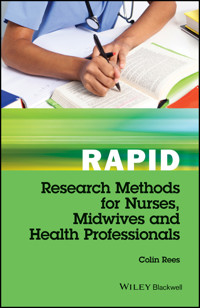
Rapid Research Methods for Nurses, Midwives and Health Professionals is designed to help you find and understand the meaning of key research terminology and, more importantly, develop your knowledge of some of the essential ideas and concepts they describe. This A-Z dictionary of terms is a collection of over 200 entries with a definition of each word put in context with additional tips on its use in assignment work. Alphabetically arranged in an accessible, reader-friendly format, this book:
- Answers a clear demand for a practical, fast and concise introduction to the key ideas, concepts and methods in nursing and healthcare research
- Provides students with fast and accessible information designed for revision and writing research-based assignments
- Demystifies a field of study that students often find daunting
Sie lesen das E-Book in den Legimi-Apps auf:
Seitenzahl: 218
Veröffentlichungsjahr: 2015
Ähnliche



















Table of Contents
Dedication
Title Page
Copyright
Introduction
Aim
The structure
Using this book
A
Abstract
Accidental sampling (See: Convenience sampling, sampling methods)
Action research
Aim (also called objective or purpose)
Analysis of Variance (ANOVA)
Analysis of Covariance (ANCOVA)
Anonymity
Audit
Audit trail
B
Back chaining
Bar graph
Before and after designs (pretest–posttest designs)
Beneficence
Bias
Blinding
Bracketing
C
Case–control study
Causal relationship
Cell
Chi-square test (
χ
2
)
Clinical trial (See: Randomised controlled trial)
Closed (close-ended, fixed choice) questions
Cluster sample
Coding
Cohort study
Concept definition
Confidentiality
Confirmability
Confounding variable
Contingency table (See: Table)
Control group
Convenience sample (also called an accidental or opportunity sample)
Correlation
Covert observation
Credibility
Cross-over design
Cross-sectional study
Critique (critique frameworks)
D
Data
Database
Data saturation
Demographic data
Dependent variable
Descriptive statistics
Double-blind study
E
Ethics
Ethics committee
Ethnographic research
Exclusion criteria
Experimental design
Ex post facto studies
F
Face validity
Fieldwork diary
Fieldwork
Findings
Fittingness (also called transferability)
Focus group
Forward chaining
Frequency distribution
G
Generalisability
Grey literature
Grounded theory
H
Hawthorne effect
Hermeneutics
Heterogeneity and homogeneity
Hierarchy of evidence
Histogram
Homogeneity (See: Heterogeneity and homogeneity)
Hypothesis
I
Inclusion and exclusion criteria
Inferential statistics
Independent variable
Informed consent
Interval data (See: Levels of measurement)
Interviews
Inverse relationship (also called a negative relationship)
J
Judgemental sample (See: Purposive sample)
Justice
K
Key informant
Key words
L
Levels of measurement
Likert scale
Literature review (also called Review of the literature)
M
Manipulation
Masking (See: Blinding)
Measures of central tendency
Mean (See: Measures of central tendency)
Measures of dispersion
Meta-analysis
Mode (See: Measures of central tendency)
Median (See: Measures of central tendency)
N
Naturalistic research (See: Qualitative research design)
Non-maleficence
Nominal data (See: Levels of measurement)
Non-probability sampling methods
Normal distribution
Null hypothesis (See: Hypothesis testing)
O
Observation
Observational designs
Open questions
Operational definition
Opportunity sample (See: Convenience sample)
Outliers
Ordinal data (See: Levels of measurement)
P
p
Values
Paradigm
Phenomenology
PICO (See: Key words)
Pilot study
Population
Power analysis
Pretest–posttest designs (See: Before and after designs)
Principles of research
Probability sampling methods (See: Sampling methods, non-probability sampling)
Prospective and retrospective study designs
Q
Qualitative research designs (also called Naturalistic research)
Quantitative research designs
Quasi-experimental research
Questionnaires
Quota sampling (See: Sampling methods)
R
Randomisation (also called random allocation)
Randomised controlled trials (RCTs) (See: Experimental design)
Range (See: Descriptive statistics)
Ratio data (See: Levels of measurement)
Reflexivity (See: Fieldwork diary)
Reliability
Research
Research design
Research method
Response rate (See: Questionnaires)
Retrospective study (See: Prospective study, case–control study, ex post facto study)
Review of the literature (See: Literature review)
Rigour
S
Sample (See: Sampling methods)
Sampling methods (also called sampling plan or sampling strategy)
Sampling frame (See: Sampling methods, cluster sample)
Self-report (See: Interviews)
Snowball sample (See: Sampling methods, qualitative research)
Social desirability (See: Interviews)
Statistical analysis (See: Descriptive statistics, inferential statistics)
Survey
Systematic reviews of the literature (See: Literature review)
T
Table
Thick data (See: Credibility and fieldwork)
Transferability (See: Fittingness)
Triangulation (See: Confirmability and qualitative research designs)
Trustworthiness (See: Credibility)
Type I, Type II, Type III errors
U
Unstructured interviews
Unstructured observations
V
Validity
Variable
End User License Agreement
Pages
xi
xii
1
2
3
4
5
6
7
8
9
10
11
12
13
14
15
16
17
18
19
20
21
22
23
24
25
26
27
28
29
30
31
32
33
34
35
36
37
38
39
40
41
42
43
44
45
46
47
48
49
50
51
52
53
54
55
56
57
58
59
60
61
62
63
64
65
66
67
68
69
70
71
72
73
74
75
76
77
78
79
80
81
82
83
84
85
86
87
88
89
90
91
92
93
94
95
96
97
98
99
100
101
102
103
104
105
106
107
108
109
110
111
112
113
114
115
116
117
118
119
120
121
122
123
124
125
126
Guide
Table of Contents
Introduction
Begin Reading
List of Illustrations
B
Figure 1 Bar chart showing number of staff in each category of employment in four clinical areas.
H
Figure 2 Number of hours of exercise per week by those who exercise weekly (
n
= 239).
L
Figure 3 Hierarchy of levels of measurement.
List of Tables
P
Table 1 Interpretation of ‘
p
values’ for experimental and correlation studies.
Q
Table 2 Comparisons between quantitative and qualitative research.
R
Table 3 Frequently used research methods within paradigms
T
Table 4 Those taking more than 30 minutes exercise a week by gender (
n
= 782).
Table 5 Common problems leading to Type I and Type II errors and possible corrective actions
‘For my wife Brenda, with thanks for her help and support’
Rapid Research Methods for Nurses, Midwives and Health Professionals
Colin Rees
Lecturer (retired) School of Health Care Sciences Cardiff University Cardiff, UK
Lesen Sie weiter in der vollständigen Ausgabe!
Lesen Sie weiter in der vollständigen Ausgabe!
Lesen Sie weiter in der vollständigen Ausgabe!
Lesen Sie weiter in der vollständigen Ausgabe!
Lesen Sie weiter in der vollständigen Ausgabe!
Lesen Sie weiter in der vollständigen Ausgabe!
Lesen Sie weiter in der vollständigen Ausgabe!
Lesen Sie weiter in der vollständigen Ausgabe!
Lesen Sie weiter in der vollständigen Ausgabe!
Lesen Sie weiter in der vollständigen Ausgabe!
Lesen Sie weiter in der vollständigen Ausgabe!
Lesen Sie weiter in der vollständigen Ausgabe!
Lesen Sie weiter in der vollständigen Ausgabe!
Lesen Sie weiter in der vollständigen Ausgabe!
Lesen Sie weiter in der vollständigen Ausgabe!
Lesen Sie weiter in der vollständigen Ausgabe!
Lesen Sie weiter in der vollständigen Ausgabe!
Lesen Sie weiter in der vollständigen Ausgabe!
Lesen Sie weiter in der vollständigen Ausgabe!
Lesen Sie weiter in der vollständigen Ausgabe!
Lesen Sie weiter in der vollständigen Ausgabe!
Lesen Sie weiter in der vollständigen Ausgabe!
Lesen Sie weiter in der vollständigen Ausgabe!
Lesen Sie weiter in der vollständigen Ausgabe!
Lesen Sie weiter in der vollständigen Ausgabe!




