


30,99 €
Mehr erfahren.
- Herausgeber: John Wiley & Sons
- Kategorie: Geisteswissenschaft
- Sprache: Englisch
Reading Sixteenth-Century Poetry combines close readings of individual poems with a critical consideration of the historical context in which they were written. Informative and original, this book has been carefully designed to enable readers to understand, enjoy, and be inspired by sixteenth-century poetry. * Close reading of a wide variety of sixteenth-century poems, canonical and non-canonical, by men and by women, from print and manuscript culture, across the major literary modes and genres * Poems read within their historical context, with reference to five major cultural revolutions: Renaissance humanism, the Reformation, the modern nation-state, companionate marriage, and the scientific revolution * Offers in-depth discussion of Skelton, Wyatt, Surrey, Isabella Whitney, Gascoigne, Philip Sidney, Spenser, Marlowe, Mary Sidney Herbert, Donne, and Shakespeare * Presents a separate study of all five of Shakespeare's major poems - Venus and Adonis, The Rape of Lucrece, 'The Phoenix and Turtle,' the Sonnets, and A Lover's Complaint- in the context of his dramatic career * Discusses major works of literary criticism by Plato, Aristotle, Horace, Longinus, Philip Sidney, George Puttenham, Percy Bysshe Shelley, Seamus Heaney, Adrienne Rich, and Helen Vendler
Sie lesen das E-Book in den Legimi-Apps auf:
Seitenzahl: 629
Veröffentlichungsjahr: 2011
Ähnliche




















Contents
IntroductionThe Pleasures and Uses of Sixteenth-Century Poetry
Part I 1500–1558. Reading Early Tudor Poetry: Henrician, Edwardian, Marian
1 VoiceThe Poetic Style of Character: Plain and Eloquent Speaking
2 PerceptionThe Crisis of the Reformation, or, What the Poet Sees: Self, Beloved, God
3 WorldThe Poet’s Ecology of Place: Sky, Sea, Soil
4 FormThe Idea of a Poem: Elegy, Pastoral, Sonnet, Satire, Epic
5 CareerThe Role of the Poet in Society: Skelton, Wyatt, and Surrey
Part II 1558–1600. Reading Elizabethan Poetry
6 VoiceThe Poetic Style of Character: From Plain Eloquence to the Metaphysical Sublime
7 PerceptionWhat the Poet Sees, and the Advent of Modern Personage: Desire, Idolatry, Transport, Partnership
8 WorldThe Poet’s Ecology of Place: Cosmos, Colony, Country
9 FormFictions of Poetic Kind: Pastoral, Sonnet, Epic, Minor Epic, Hymn
10 CareerThe Role of the Poet in Society: Whitney, Spenser, and Marlowe
Part III A Special Case
11 Shakespeare: Voice, Perception, World, Form, Career
ConclusionRetrospective Poetry: Donne and the End of Sixteenth-Century Poetry
Bibliography
Index
Reading Sixteenth-Century Poetry
Reading Poetry
The books in this series include close readings of well-known and less familiar poems, many of which can be found in the Blackwell Annotated Anthologies. Each volume provides students and interested faculty with the opportunity to discover and explore the poetry of a given period, through the eyes of an expert scholar in the field.
The series is motivated by an increasing reluctance to study poetry amongst undergraduate students, born out of feelings of alienation from the genre, and even intimidation. By enlisting the pedagogical expertise of the most esteemed critics in the field, the volumes in the Reading Poetry series aim to make poetry accessible to a diversity of readers.
Published:
Reading Eighteenth-Century PoetryPatricia Meyer Spacks, University of VirginiaReading Modernist PoetryMichael Whitworth, Oxford UniversityReading Sixteenth-Century PoetryPatrick Cheney, Penn State UniversityForthcoming:
Reading Seventeenth-Century PoetryMichael Schoenfeldt, University of MichiganReading Romantic PoetryFiona Stafford, Oxford UniversityReading Victorian PoetryRichard Cronin, Glasgow UniversityThis edition first published 2011© 2011 Patrick Cheney
Blackwell Publishing was acquired by John Wiley & Sons in February 2007. Blackwell’s publishing program has been merged with Wiley’s global Scientific, Technical, and Medical business to form Wiley-Blackwell.
Registered OfficeJohn Wiley & Sons Ltd, The Atrium, Southern Gate, Chichester, West Sussex, PO19 8SQ,United Kingdom
Editorial Offices350 Main Street, Malden, MA 02148–5020, USA9600 Garsington Road, Oxford, OX4 2DQ, UKAtrium, Southern Gate, Chichester, West Sussex, PO19 8SQ, UK
For details of our global editorial offices, for customer services, and for information about how to apply for permission to reuse the copyright material in this book please see our website at www.wiley.com/wiley-blackwell
The right Patrick Cheney to be identified as the author of this work has been asserted in accordance with the UK Copyright, Designs and Patents Act 1988.
All rights reserved. No part of this publication may be reproduced, stored in a retrieval system, or transmitted, in any form or by any means, electronic, mechanical, photocopying, recording or otherwise, except as permitted by the UK Copyright, Designs and Patents Act 1988, without the prior permission of the publisher.
Wiley also publishes its books in a variety of electronic formats. Some content that appears in print may not be available in electronic books.
Designations used by companies to distinguish their products are often claimed as trademarks. All brand names and product names used in this book are trade names, service marks, trademarks or registered trademarks of their respective owners. The publisher is not associated with any product or vendor mentioned in this book. This publication is designed to provide accurate and authoritative information in regard to the subject matter covered. It is sold on the understanding that the publisher is not engaged in rendering professional services. If professional advice or other expert assistance is required, the services of a competent professional should be sought.
Library of Congress Cataloging-in-Publication Data
Cheney, Patrick, 1949–
Reading sixteenth-century poetry / Patrick Cheney.
p. cm. – (Blackwell reading poetry)
Includes bibliographical references and index.
ISBN 978-1-4051-6954-7 (alk. paper)
1. English poetry–16th century–History and criticism. 2. English poetry–Appreciation. 3. England–Intellectual life–16th century. I. Title.
PR521.C47 2011
821′.309–dc22
2010043495
A catalogue record for this book is available from the British Library.
This book is published in the following electronic formats: ePDFs 9781444396546; Wiley Online Library 9781444396560; ePub 9781444396553
For Elizabeth Fowler and Richard A. McCabehumane readers of sixteenth-century poetry
Introduction
The Pleasures and Uses of Sixteenth-Century Poetry
Sixteenth-century English poetry is a treasured artifact of world art. 1564 saw the birth of William Shakespeare, author of such world-class masterpieces as the Sonnets and Hamlet, both originally written in the 1590s. The sixteenth century is also the era of the madcap “Skeltonics” invented by John Skelton, the first self-crowned “poet laureate” in modern English; the revolutionary “Petrarchan” poetry of Sir Thomas Wyatt and Henry Howard, earl of Surrey; the breakout national poetry of Edmund Spenser and Sir Philip Sidney; the domestic and civic poetry of the first woman in English thought to have a literary career, Isabella Whitney; and the spiritually haunting love poems of Sir Walter Ralegh, Christopher Marlowe, and John Donne, each of whom registers a voice that sounds distinctly modern: “For God’s sake, hold your tongue and let me love,” exclaims Donne to open “The Canonization.” Yet students encountering this poetry for the first time confront a genuine historical problem: poetry of the sixteenth century may constitute the gold standard for poetry in English, yet over 400 years of cultural change make the famed poetry of Shakespeare and his contemporaries not simply difficult but also alien.
This volume in the Wiley-Blackwell series Reading Poetry aims to help students become better readers of sixteenth-century poetry. Since most students possess some familiarity with the problem this entails – perhaps through knowledge of the enigmatic beauty of Shakespeare’s Sonnets – the book concentrates on a strategy for responding to the problem. In doing so, it argues that sixteenth-century poetry is exceptional in the experience it offers readers today: both profound joy and unexpected utility in the process of identity formation.
In particular, the strategy offered aims to fuse two methods of analysis often kept separate in literary criticism: close reading of individual poems as artifacts of value, and historical reading of “background” or contextual material as the crucible out of which poems are produced. The fusion of the two methods proceeds from a central assumption: we can read sixteenth-century poems most fully through the lens of their historical making. For instance, we can read Donne’s “The Canonization” the way it was read for much of the twentieth century: as a “well-wrought urn” (to borrow a slogan from the poem’s fourth stanza), a closed artifact independent of context, unified by its innate form. By such a “formalist” method, we would understand the poem to be about the mystical way in which two lovers jump the gap between self and other to become a timeless “one,” and perhaps even about the making of the poem as an artifact. Yet we can augment this reading by knowing something about Neoplatonic love in the late Elizabethan era, about the religious and political crises of the decade, and even about Donne’s own literary ambitions. We can go further and say that we need to read the poem in this way because the terms of the poem compel us to do so: from its religious title; to its reference to “the King’s real or his stampèd face” (7); to its contemporary Neoplatonic notion of “two, being one” (24); and to its formal literary diction about “verse” specific to the era: “sonnets,” “hymns,” “legend[s]” (30–5). As we shall see in the conclusion to this book, the poem ends up “canonizing” not just the lovers whom Donne fictionalizes but also, more specially, his own revolutionary poetry in the context of his time.
Equally to the point, Donne’s methodology operates by two mutually reinforcing principles, ones that join with meter to make poetry poetry: figuration and allusiveness. By “figuration,” I mean a type of language that is symbolic, not literal – a word, phrase, line, or passage representative of something, as when Donne says to his mistress in “The Canonization,” “We’re tapers, too, and at our own cost die” (21). This single line contains two figurations and a pun: “We’re tapers” is a metaphor that equates the lovers with candles; “cost” is a metonym that uses an economic principle of expense to denote the loss the lovers accrue through sexual union; and “die” is a pun that clarifies the nature of the loss, since the word is Elizabethan slang for sexual climax, a reference to the belief that orgasm shortens life. Metonymy and metaphor are two of the four elemental tropes of poetry, the other two being irony, which says one thing and means another (as when Donne’s narrator develops the logic of canonization for his lovers as for saints, without Donne himself expecting the reader to accept the substance of his equation); and synecdoche, which uses a part to signify a whole (as when Donne’s opening line uses “tongue” as the part that represents the mouth with which the imagined friend chides the narrator). In brief, Donne communicates figuratively to his mistress that they will consume their lives by having intercourse.
By “allusiveness,” I mean language that alludes primarily to another author or work of literature, as when Donne uses his figuration of the spiritual union of male and female to allude to the most authoritative Neoplatonic poetry in English, written by Edmund Spenser. Hence, in the penultimate stanza of “The Canonization,” Donne mentions a series of “verse” forms as avenues by which he and his mistress can “live by love” (28) – that is, become eternal: “legend” (30), “sonnets” (32), and “hymns” (35). A case could be made here (we shall make it in the conclusion) that Donne alludes to three major eternizing forms in the Spenser canon: Spenser’s “Legend of Holiness” in Book 1 of The Faerie Queene; his Petrarchan sonnet sequence, Amoretti; and his Fowre Hymnes. By alluding to Spenser, we might conclude, Donne offers his poetry as a rival to that of England’s national poet.
In this way, figurative poetry like Donne’s is almost always allusive poetry. It does not simply represent; it alludes; and what it often alludes to formally is the history of poetry itself. To read sixteenth-century poetry is to acquire information about a lot of things (e.g., politics, religion, and sex), but also to learn how the poets themselves understand their art historically. By remembering this simple formula, we discover a view of what the century’s poetry is, how it works, for whom, and toward what ends.
The fusion of historical analysis with close reading registers a shift from much recent criticism: from an emphasis on the “discourse of power” surrounding the “subject” to a focus on the “intertext” of the “author,” that is, from focusing on the self fashioned by political institutions to focusing on relations between the poet’s poems and those of previous and contemporary authors. While the word “intertextuality” was coined in the late 1960s as a poststructuralist principle for privileging the “text” over the “author” – to support a movement of interpretation known as “the death of the author” – the term has migrated to mean many things, including simply the way texts written by authors interrelate with one another. By featuring a shift from reading for the subject of power to reading for the intertext of the author, we may see how a poet contributes to the formation of identity, because in our reading method we attend to the author’s role in the making of the subject.
The link between identity and poetry has an ancient origin. Greek and Roman writers imagined poetry as the first language of the human. They believed that poetry gives voice to a primal urge – our deepest desires, our most important forms of consciousness – a process that helps us determine what makes men and women human, distinct from stones, plants, and animals. Consequently, they told the story of the first poet, Orpheus, who used his harp to tame wild beasts and move inanimate objects like trees: the poet is the primeval civilizing leader of society. In the nineteenth century, the Romantic poet Percy Bysshe Shelley ends his Defence of Poetry on this topic: “Poets are the unacknowledged legislators of the World” (Reiman and Powers 508). Throughout the history of poetry, poets make a case for that acknowledgment. The reason they need to is that the West’s most authoritative philosopher, Plato, presents his icon of wisdom, Socrates, banishing the founding poets of the Western canon, Homer and Hesiod, from his ideal Republic, because they violate reason, falsify reality, blaspheme against the gods, and altogether corrupt the minds of the youth. For Plato, the magic of poetry breaks down the reason-based laws of society (Republic, Book 10).
Between Plato and Shelley, major writers offer “defences of poetry”; a short list includes Aristotle in the Poetics, Horace in the Art of Poetry, Boccaccio in the Genealogy of the Gods, Julius Caesar Scaliger in the Poetics, and, during the Elizabethan era, the first formal treatises in English: most famously, Sir Philip Sidney’s Defence of Poesy (circa 1582) and George Puttenham’s Art of English Poesy (1589). Aristotle clearly rejects the judgment of his teacher, Plato, but he never formally states what we are left to infer: that poetry is vital to the state because it brings health to the individual. More interested in the “formative elements” of poetry (1449a8), Aristotle mentions its effect, which he calls “proper pleasure” (1459a20), and which he imagines as having the function of “catharsis,” whether purging or refining the unruly “emotions” of “pity and fear” (1449b24–30). Only in passing does Aristotle mention poetry’s “moral purpose” (1454a18).
Consequently, the most important spokesman for the civic-building power of poetry for sixteenth-century England is Horace – which might explain why Queen Elizabeth began a verse translation: here we see a sovereign trying to institute the Horatian model. For a full translation, we can turn to Ben Jonson, who emerges late in the queen’s reign to become a major author of the early seventeenth century under her successor, James I: “Poets would either profit, or delight, / Or mixing sweet, and fit, teach life the right” (Art of Poetry 477–8). For Horace, the poet “can apply / Sweet mixed with sour, to his reader, so / As doctrine, and delight together go” (514–16). Jonson retains Horace’s conjunction between delight and instruction, but in another Defence of Poetry, from 1579, Thomas Lodge expresses the widely held causal connection succinctly: poets use “pleasure to draw men to wisedome” (G.G. Smith 1: 66). For his part, Jonson’s Horace goes on to cite Orpheus as a model for the ideal role of the poet in society:
Orpheus, a priest, and speaker for the gods, First frighted men, that wildly lived, at odds, From slaughters, and foul life; and for the same Was tigers said, and lions fierce, to tame.
(479–82)
As a poet-priest, Orpheus speaks the divine language of the gods, which means in part that the gods speak in verse, and poets imitate them. As such, poets are figures of “wisdom” who put their knowledge to work on behalf of society: they “separate” the “sacred” from the “profane,” the “public” from the “private,” to “abate / Wild ranging lusts; prescribe the marriage good; / Build towns, and carve the laws in leaves of wood” (486–90). Clearly, Horace, like Jonson and many writers of the sixteenth century, lend to the poet a high cultural calling.
The present book will try to tell a story about this calling made historically important by Skelton, Wyatt, Surrey, Sidney, Spenser, Donne, and others. Today, we might benefit from hearing a story about the sixteenth-century poet as world legislator (or civic leader) because it can give us access to humane voices that readers for 400 years have valued when finding the human coming under threat, or the human in need of being made. We might even say that we need this poetry, because the pleasure and meaning it provides help us contend with the often fraught and fractured existence we lead: “When in disgrace with Fortune and men’s eyes,” writes Shakespeare in Sonnet 29, “Haply I think on thee” (1–10). The sixteenth century is not just any century in the history of the English language: evolving from Middle English, it forms the birth moment of modern poetry, and, as we are seeing, the birth moment of the modern human. In reading sixteenth-century poetry, we witness the making of the human, men and women in the process of becoming active agents of civility. Not just the modern subject but also the modern subject made by the modern poem: this is the promised end of sixteenth-century poetry.
Promised, yet not always delivered. For we can take the civilizing function of poetry too far. Thus, other parts in the story of Orpheus exhibit genuine sadness and horror: when he loses his wife Eurydice as he retrieves her out of Hades, or when intoxicated Maenads dismember him and throw his severed head in the Hebrus River, the tongue shockingly continuing to sing. Here we need to confront just what the word “primal” means, for the story of Orpheus suggests that there is something superrational – pre-civil? – about the art of poetry, something intoxicating, even violent, not simply of the human but also of the gods. In addition, then, to what we might call the Horatian-Sidneian model of the poet as civic builder, we discover a second model, which is not as often discussed. I’m going to call this darker, divine aspect the model of the sublime poet, in keeping with the first treatise on the concept, On Sublimity, written during the first century AD by the Greek scholar known as Longinus. According to Longinus, the reading of sublime poetry heightens rather than regulates our emotions, producing either terror or rapture, and leaving the human in the exalted condition of the gods: “sublimity raises us towards the spiritual greatness of god” (36.1: 178). Importantly, Longinus agrees that poetic figuration often alludes to other works of literature, but his master stroke is to see figurative allusion as a site for the sublime: “another road to sublimity … is … imitation and emulation of great writers of the past” (13.2: 158); “metaphors conduce to sublimity” (32.6: 174). Yet the goal is not civility but “astonishment” (15.2: 159). Hence, Longinus never says that the poet of the sublime civilizes a “democracy”; instead, he says simply that a democracy houses the sublime poet (44.2–3: 185–6), who exists solely in a state of “wonder” (1.4: 143). The Horatian civic-building project of the conventional “Orphic poet” explodes, for the sublime “tears everything up like a whirlwind” (1.4: 144).
In reading poetry during the sixteenth century, when Longinus was first published and translated into Latin, we will need to keep in mind the model of poetry as a civic-building art and the model of poetry as spiritual transport. Yet in the lexicon of the period, the two are not created equal. Indeed, the Longinian model almost never gets articulated, let alone authorized, even though we can find vestiges of it where we might least expect it – in Sidney’s Horatian defence, for instance. On the one hand, Sidney calls poetry “the companion of camps,” because it proves instrumental to the soldier (Vickers 373); but on the other, he can claim what looks like a Longinian effect for the poet, who “doth … strike, pierce, … [and] possess the sight of the soul” (Vickers 351). Because the Horatian-Sidneian model is the official registrar of sixteenth-century poetics, we shall emphasize it throughout, letting the Longinian model emerge as it will.
During the past hundred years, poets and scholars have continued the discussion about “poetics” advanced by writers from Aristotle and Horace to Sidney and Shelley. According to Seamus Heaney, in his 1995 The Redress of Poetry, “Professors of poetry, apologists for it, practitioners of it, from Sir Philip Sidney to Wallace Stevens, all sooner or later are tempted to show how poetry’s existence as a form of art relates to our existence as citizens of society – how it is ‘of present use’” (Cook 568). Heaney goes on to suggest that the “operation” of poetry
does not intervene in the actual but by offering consciousness a chance to recognize its predicaments, foreknow its capacities and rehearse its comebacks in all kinds of venturesome ways, it does constitute a beneficent event, for poet and audience alike. It offers a response to reality which has a liberating and verifying effect upon the individual spirit, and yet I can see how such a function would be deemed insufficient by a political activist. (Cook 568–9)
Heaney’s comment embeds, separates, and updates the terms of the Horatian and the Longinian models of poetry. Throughout the twentieth and twenty-first centuries, poets and critics have been lining up on one side or the other. Adrienne Rich, for instance, sees poetry as “a dialogue between art and politics,” and thus she herself writes poetry to “bring together the political world ‘out there,’” exhibiting a profound “fusion” of “political struggle and spiritual continuum” (Cook 507–13). In contrast, Helen Vendler sees poetry as “a mirror” of her own “feelings”: “Everything said in a poem was a metaphor for something in my inner life” – what she calls “the voice of the soul” (Cook 576). In Renaissance studies, Stephen Greenblatt writes famously that “Shakespeare’s plays are centrally, repeatedly concerned with the production and containment of subversion and disorder,” creating a profound “meditat[ion] … on the consolidation of state power” (Shakespearean Negotiations 40), while Harold Bloom disagrees vociferously:
The work of great poetry is to aid us to become free artists of our selves. Even if Shakespeare cannot make me into Falstaff or Hamlet, all great poetry asks us to be possessed by it. To possess it by memory is a start, and to augment our consciousness is the goal. The art of reading poetry is an authentic training in the augmentation of consciousness, perhaps the most authentic of healthy modes. (“Art of Reading Poetry” 29)
In this well-advertised opposition, we can find vestiges of poetry as a mode of sublimity and poetry as a mode of civility.
Heaney’s comment also allows us to discern the way in which poetic theorists from Greenblatt and Bloom back to Horace and Plato appear to work from a single conceptual template, expressive of a particular (often idiosyncratic) relation among the following set of concepts: (1) imagination, (2) world, (3) word, (4) object, and (5) effect. Expressed as a coherent process, a comprehensive “poetics” might witness the poet using imagination to construct and reconstruct the world out of words, to produce the material object of the poem, for an emotional, intellectual, and activist effect on the reader.
In this book, I work from the foundation of such a poetics. In particular, I propose to concentrate on the pleasures that readers today can experience when they realize the utility of poetry in their lives: a utility that can be therapeutic, because it changes the way we think and feel; activating, because it changes the way we behave; or simply transportive, because it elevates us into ecstasy. In all these ways, poetry is instrumental. Readers are here invited to approach sixteenth-century poetry much as some approach music: for what it can do for us – for our feelings and thoughts, our beliefs, and sometimes our actions. Sixteenth-century poetry is not static or passive but dynamic and active; its formal qualities intrinsically create (as if by Orphic magic) the vital energy needed for performing one of life’s most pressing challenges: to convert our inner life into a meaningful form, whether of personal contentment, inner vitality, or social engagement. Rather than being simply objects for study and dissection, poems are by nature artifacts of pleasure – even when they are structurally disjointed and topically sad – and as such they constitute mini-reservoirs of meaning that readers can translate into conduits for identity, pleasure, and action.
I do not mean to suggest that the instrumental process of reading poetry for identity formation, transport, or civic engagement is either sure or simple. It is neither. Poetry offers a guide (rarely a single guide), not a doctrine; a form of inspiration, not a rigid model. Intensely personal, sixteenth-century poetry can help us grow as citizens, expanding consciousness, challenging intellection, and impassioning feeling. It does not always help us become the same sort of citizen. The subversive poetry of Christopher Marlowe differs radically from the ethical poetry of Isabella Whitney. Yet we also need to recognize that sometimes poetry might help us grow as private individuals. In both cases, nonetheless, readers might recurrently ask themselves as they read, How is a given poem fashioning me? What kind of identity is it forming for (and in) me? No two people will answer in the same way, nor will one person often answer in a consistent way.
The general project of this book, then, is to suggest that the first form of an “educated imagination” in modern English (to borrow Northrop Frye’s phrase) proceeds by “reading sixteenth-century poetry” closely and historically, and that this process can have both a private, a divine, and a civic function. Since, as we have seen, the sixteenth century had its own vocabulary and principles for articulating this project, the proposed strategy makes a segue for discussing both the differences and the similarities between “then” and “now.” Readers can expect to encounter a sense of both historical continuity and historical difference, accruing awareness about just how alien the poetry of Shakespeare and his contemporaries can be, but also how familiar. Reading sixteenth-century poetry closely within its own historical context and reading it in the context of lived experience today are not separate endeavors but part of a larger process that can make the past integral to the present and to the future.
I hasten to add that no prescribed method can fully “make us better readers” of sixteenth-century poetry. Reading will always be idiosyncratic, personal, and even mysterious: more an art than a science. Throughout, nonetheless, we will pursue a practical way to read sixteenth-century poetry carefully and contextually. This method, we might further add, can be transportable in a different sense: of use to readers when they read other poems, other poets, and other eras.
What, then, does the proposed strategy for reading sixteenth-century poetry look like? Structurally, it begins by dividing the sixteenth century into two eras: “early Tudor” (1500–1558), which covers the reigns of Henry VII (1485–1509), Henry VIII (1509–1547), Edward VI (1547–1553), and Mary I (1553–1558); and “Elizabethan” (1558–1600), which follows the reign of Elizabeth I (1558–1603). The sixteenth century is indeed the century of the Tudors. When 1499 turns into 1500, Henry VII is king; when 1599 turns into 1600, his granddaughter, Elizabeth, is queen. While recent historians tend to study “the long sixteenth century,” which begins with the coronation of Henry VII in 1485 and ends with the death of Elizabeth in 1603, I take the phrase “sixteenth century” literally, although occasionally I stray across boundaries at either end. While the 1590s may be the most remarkable decade in English literary history, the opening decades of the century are notable in their own right, and deserve to be understood as continuous with the creative distinction that comes afterward. Whereas most literary histories of the English Renaissance either neglect the early Tudor era or underscore its separateness from the age of Elizabeth, we shall here see how Skelton, Wyatt, and Surrey at the beginning prepare the way for Spenser, Sidney, and Shakespeare at the end. Hopefully, readers will discover the opportunity such a century-long spectrum provides.
Next, to track the twofold structure of the Tudor century into early Tudor and Elizabethan eras, the strategy identifies five major inventions of sixteenth-century English poetry as historically important – inventions that I derive from the author-centered “poetics” identified earlier: voice, perception, world, form, and career. Briefly, I mean to suggest that sixteenth-century poets are important for inventing distinctive poetic voices in their fictions, revolutionary gendered perceptions of the (sexual) other, fascinating imagined worlds, unique literary forms or genres, and finally literary careers in English. By including chapters on each of the five inventions under both the early Tudor and the Elizabethan eras, we can track the development of voices, perceptions, worlds, forms, and careers throughout the century. Readers can then use this pentad of inventions as engines or crucibles for interpretation, meaning, and perhaps social action. Through the course of the book, readers can learn to find these inventions in the poems we read and to produce informed reactions to them.
Voice, perception, world, form, and career are not the only inventions of sixteenth-century poets. I have chosen these five because they seem to me the most important ones; they allow us to view afresh what is distinctive about the century. Yet the order in which I discuss the pentad is in part arbitrary; while writing the book, I changed the order several times, and throughout I’ve been conscious that readers may wish to read the chapters in a different order. Nonetheless, by examining the five inventions as a structure, I suggest that we can traverse the significant topics of modern scholarship and criticism. In this way, the book aims to be both structurally eclectic and conceptually unified.
Since I am concerned to read sixteenth-century poetry closely by reading it historically, I try to witness how the pentad of poetic inventions emerges in response to the major cultural revolutions of this tumultuous era. In particular, I foreground five revolutions, as each charts a change in identity formation: (1) Renaissance humanism; (2) the Reformation; (3) the modern nation-state; (4) companionate marriage; and (5) the scientific revolution. First, Renaissance humanism is an educational movement deriving from fourteenth- and fifteenth-century Italy, located especially in the poet and scholar Petrarch, that led to a “rebirth” (“renaissance”) of classical texts, learning, and finally secular beliefs and values. In sixteenth-century England, this movement greatly facilitated the expansion of grammar schools and the technological spread of print, helping to bring about a massive shift: from private contemplation of God to public service on behalf of the nation.
Second, the Reformation is a religious revolution begun in 1517 by the German theologian Martin Luther, and advanced by his French heir, John Calvin, who rejected “justification by works” in favor of “justification by faith” – that is, the rejection of salvation by human will (such as prayer) in favor of salvation by faith in God alone (exercised through individual conscience acting in accord with Scripture). This distinction radically relocates the source of identity from an exterior authority to an interior one, with the Word of God replacing the pope as the mediator of the individual’s relation with the deity. When Henry VIII broke with the Church of Rome in 1534, he legislated belief, requiring citizens to declare their allegiance to the king as head of both the Church and the Crown – a policy his daughter Elizabeth would soften when she wrote to Sir Francis Bacon, “I would not open windows into men’s souls” (quoted in King, “Religious Writing” 104): she would not require citizens to declare openly their inward beliefs, only their outward duty to her. While Elizabeth’s policy largely worked, it opened a rift between inner and outer that is one of the hallmarks of the Elizabethan era.
Third, the modern nation-state is a political centralizing of governmental power in the monarch, the people, and the Parliament (the three primary constituents of the English Constitution), instead of in a feudal array of baronial courts scattered around the country. The Tudors are famous for inventing the modern nation-state, but, taken as a whole, the century constitutes a remarkable contest between two forms of government: that of the monarch, organized around the authority of kings, with its values of duty and obedience; and that of Parliament and the people – popular sovereignty – with its values of consent and freedom. Hence, when Henry VIII based his reign on sacral monarchy, he provoked a series of critiques along “republican” lines, that is to say, along anti-monarchical lines, in opposition to kingship; and one effect during the Elizabethan era was to develop medieval notions of a “mixed government” into what Patrick Collinson famously terms a “monarchical republic”: a country governed centrally by a monarch but governed locally by the people, with Parliament acting as a mediator.
Fourth, companionate marriage is a family innovation, also with deep roots in medieval culture (Chaucer, for instance), emphasizing partnership between husband and wife, as newly supported by Protestant belief in the freedom of conscience and the rights of the godly person, including priests, to marry. For the upper classes, the dominant institution during the sixteenth century was arranged marriage, in which the father arranged for his son or daughter to marry someone he or she did not necessarily love, in order to gain wealth, prestige, or power for the family (as in Romeo and Juliet). Protestantism helped foster resistance to this “patriarchal” model, and much of the literature of the period – from Spenser’s Faerie Queene to Shakespeare’s As You Like It – witnesses support for the budding institution of romantic love.
Fifth, the scientific revolution here includes three “discoveries” not always discussed together: the 1543 Copernican discovery of a heliocentric as opposed to a geocentric universe, which decentered human identity and opened the possibility of a mechanistic cosmos; the 1492 Columbian discovery of the New World or Americas, leading to the sixteenth-century voyages of Sir Francis Drake and others, which expanded the globe beyond the original Christian consciousness set out in the Book of Genesis; and the nearly century-long discovery of a new land in Britain itself, measured through such earth-shifting events as the intensifying “enclosure” of pastureland, the Henrician dissolution of the Catholic monasteries, and, in 1579, Christopher Saxton’s inaugural surveying of Britain, all of which ended up relocating national identity away from the monarch and toward the land and its people.
Quite literally, the universe of the sixteenth century altered – beneath, around, and above. Poets wrote their poems amid this era of immense cultural change. Whether we understand the change to be “revolution” or “evolution” remains a matter of debate. Yet it does not seem unreasonable to imagine historical process during the sixteenth century as evolving so far as to become revolutionary. We’re then left to assign value to the change. During much of the twentieth century, literary historians found the Renaissance to be a triumphalist time of liberation, but revisionist work in the early twenty-first century argues to the contrary: “the institutional simplifications and centralizations of the sixteenth century provoked correlative simplifications and narrowings in literature. … If literary history and criticism [are] … ancillary to the complex history of freedoms, then this is a narrative of diminishing liberties” (Simpson 1). Such a view is sobering, and demands that we recognize pre-sixteenth-century English culture as having its own greatness, including in the art of poetry, but it cannot account for the emergence of world-class poetry by Spenser, Shakespeare, Marlowe, or Donne. The key point is that we’re still trying to discover a way to talk about this momentous era.
At issue has even been whether we should speak of “the Renaissance” or “the early modern period.” Neither designation is native to the sixteenth century. The term “Renaissance” was invented in the late nineteenth century to talk about the “rebirth” of classical culture, while “early modern” was used in the late twentieth century to talk about a precursor to modernity. Both views have their own accuracy, and many scholars today use both terms, because this special time in history does indeed look back to classical culture and ahead to modern culture. Such a practice will be adopted here.
We can also measure change in ways especially relevant to poetry. In 1500, London’s population was around 35,000, 50 new words per year were standard for entering the national vocabulary, and only 35 books came off the printing press. By 1600, the population had reached around 200,000, 350 new words per year was the norm, and 268 books saw print. In this environment, the institution of modern English poetry was born. Our purpose will be not simply to narrate the historical record but also to let it emerge as the evidence of the poems warrants. For instance, Renaissance humanism will inform the chapters on the more “literary” concepts of voice, form, and career; the Reformation and companionate marriage will be important in the chapters on perception; the modern nation-state will enter into the chapters on perception and on the world; and the scientific revolution will assume prominence especially in chapters on the world.
To reinforce a holistic approach to reading sixteenth-century poetry, the book adds a third part, a special case study of the period’s most illustrious author. William Shakespeare constitutes a special case here because so often he is viewed as the consummate “man of the theatre” – when, historically speaking, he participates in a new sixteenth-century institution that will resonate through the centuries: indebted most directly to the practice of his colleague and rival Christopher Marlowe, but in fact tracing to Skelton, George Gascoigne, and Thomas Watson, Shakespeare combines poems and plays within a single literary career. In addition to such masterpieces in drama as King Lear, Shakespeare produces some of the most extraordinary freestanding poems in English, such as The Rape of Lucrece. In this final chapter, readers will have the opportunity to bring the pentad of inventions from the first two parts to bear on a single author.
A conclusion, titled “Retrospective Poetry,” will recognize the emergence of a new type of poem, such as John Marston’s “Satire VI” or Spenser’s Colin Clouts Come Home Againe, which looks back on sixteenth-century poetry, in order to suggest its legacy for readers today: the sixteenth- century is the first to invent not just the institution of modern English poetry but also a self-conscious national community of poets. Here, we shall feature Donne, and in particular the poem with which we began, “The Canonization,” to anticipate the way that the late Elizabethan era gives birth to a type of poetry in the seventeenth century, known as “metaphysical” poetry.
In accord with guidelines set by Wiley-Blackwell, Reading Sixteenth-Century Poetry functions primarily as a companion text to be used in college and university classrooms with the corresponding volume in the Blackwell Annotated Anthologies series, Sixteenth-Century Poetry: An Annotated Anthology (which modernizes the spelling, punctuation, and typography of all poems, even Spenser’s Faerie Queene). With over 500 pages of poetry written in England between 1500 and 1600, this anthology collects a good deal of the best poems of the sixteenth century, by a wide array of men and (just a few) women, along an extensive grid of cultural topics. Yet no single anthology can excerpt all excellent poetry from the sixteenth century. Most notably, Sixteenth-Century Poetry does not include poetry by Shakespeare, and it leaves Ben Jonson and Thomas Campion for the next anthology in the series, Seventeenth-Century Poetry. I abide by the latter decision; but I choose to end my book with Shakespeare, since no book on sixteenth-century poetry can ignore its most famous figure.
Moreover, the Blackwell Anthology privileges lyric or Petrarchan poetry, as well as offering splendid coverage for the Ovidian minor epic, but it gives short shrift to pastoral eclogues, to “divine” (or devotional) poetry, and to epic, as well as to poetry by women. It also devotes only 79 pages to early Tudor poetry, allotting 437 pages for the Elizabethans. Since I have divided my book evenly between these two eras, I have relied on other anthologies and editions (see below). For each era, readers can expect to encounter individual poets in more than one chapter. For the early Tudor era, I’ve organized each chapter around the three major poets – Skelton, Wyatt, and Surrey – on the grounds that they require the most attention, and will be taught most frequently, but I have nestled in as many other poets as space allows. For the Elizabethan era, I’ve been less systematic – there are too many major poets! – but readers will find Spenser in each chapter, while others, like Whitney, Marlowe, and Donne, will recur. Because space is limited, I’ve recurrently been compelled to select a single poem to stand for many others. (Readers may find consolation in knowing that the original draft of this book was twice as long as the finished product.) I especially regret not being able to carry out my original proposal to devote more attention to Edwardian and Marian poets, The Mirror for Magistrates, and such poets as Thomas Churchyard, Edward Dyer, and the earl of Oxford.
As the case of Shakespeare intimates, one innovation of the volume will be to break the logjam in current criticism, scholarship, and pedagogy that separates “poetry” from “drama” and from “prose.” While necessarily concentrating on poets and poems, I will also consider the poetry that makes up and gets represented in plays (e.g., A Midsummer Night’s Dream) and, to a lesser extent, in prose fiction (e.g., Sir Thomas More’s Utopia). In this way, students will come to see poetry, not as a form apart, but rather as an integral part of English Renaissance literary culture.
A second term in my book title warrants glossing: “reading.” I interpret my charge to address “reading” as a methodology to mean (in large part) interpretation. Effectively, all reading is a form of interpretation; the process starts automatically. We can sit down and read sixteenth-century poetry purely for “entertainment” or “escape.” And I imagine that some members of my audience might pick up my book because of such a “generalist” interest. For the most part, however, I address readers who are taking a college or university course on sixteenth-century English literature, for which almost certainly “reading” will lead to a form of “writing.” Although my book cannot be a practical guide in the art of critical writing, it does concentrate on formulating critical arguments about its subject matter.
The final term in my book title is “poetry.” There are as many definitions of this term as there are people who use it, but The Oxford English Dictionary offers a definition relevant here: “The art or work of a poet” (definition 2) – specifying, “Composition in verse or some comparable patterned arrangement of language in which the expression of feelings and ideas is given intensity by the use of distinctive style and rhythm; the art of such a composition,” adding, “Traditionally associated with explicit formal departure from the patterns of ordinary speech or prose, e.g., in the use of elevated diction, figurative language, and syntactical reordering” (definition 2a). There is a lot to unpack here, from the initial definition identifying poetry as simply a “work” written by a “poet,” to the emphasis on a particular form of style self-conscious about its usage, to pattern and figuration, and to the intensity of “feelings and ideas.” A final goal of this book, however, will be a bit different: to place sixteenth-century poems within the broader field of reading sixteenth-century “poetry,” not simply to study individual poems. In the end, we might come to see the sixteenth century as an Age of Poetry, the inaugural era of modern English poetry, the modern English poet, and finally the modern English poetic career.
A bibliography appears at the back of the book, divided into five units. The first lists the primary editions of English Renaissance works cited in the book. The second lists primary editions of works outside the English Renaissance. The third identifies works that are quoted or cited in the text. The fourth offers an annotated outline of general critical studies of the sixteenth century. And the fifth offers a chapter-by-chapter list of critical works relied on in the discussion or recommended for further reading. (For the particular system relied on for quotation and citation, please see the headnote to the bibliography.)
Throughout, poems will be modernized when the editions from which they come are modernized; but sometimes readers can expect to encounter poems in early modern spelling. This dual technique will allow readers to experience both types of printing practice. For the early modern texts, I have silently modernized i to j and u to v, as well as other obsolete typographical conventions, such as the italicizing of names and places.
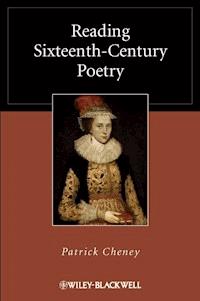
In writing this book, I remain grateful to colleagues and friends who have contributed conversation and correspondence: Elizabeth Jane Bellamy, Colin Burrow, Dympna Callaghan, Danielle Clarke, Robert R. Edwards, Lukas Erne, Ewan Fernie, Roland Greene, Jane Griffiths, Emily Grosholz, Andrew Hadfield, Margaret P. Hannay, Philip Hardie, Laura Knoppers, Charles Martindale, David Lee Miller, Marcy North, Michael Schoenfeldt, Bart van Es, Gordon Teskey, John Watkins, and Greg Walker. I have benefited from help by my research assistants, Katharine Cleland, Paul Zajac, and Lesley Owens; and my undergraduate interns, Stéfan Orzech, Rosa Frank, and Peter Vertacnik. Katharine, Paul, Stéfan, and Rosa did a heroic job of checking quotations and citations, and I’m grateful for their stellar work. Paul also expertly prepared the index. I’m grateful to Katharine for working with Dr. Julianna Bark, an art historian and literary scholar at the University of Geneva, to identify a cover image for the book; Julianna’s suggestion of the Margaret Laton portrait is most appreciated. Elizabeth Fowler and Garrett A. Sullivan Jr. both generously read the manuscript, expertly suggesting many corrections and changes; they saved me from a lot of error, and I’m lucky to benefit from their care and learning. As always, I’m grateful to my English Department head, Robin Schulze, and my Comparative Literature Department head, Caroline D. Eckhardt, as well as dean of the College of Liberal Arts, Susan Welch, for granting me a sabbatical leave, during which I did much of the research and writing. The Huntington Library in San Marino, California, provided a space on two occasions for certain parts of the research. Finally, I wish to thank Emma Bennett, commissioning editor at Wiley-Blackwell, and her assistants, Isobel Bainton and Ben Thatcher; and the copy-editor for the book, Cheryl Adam.
The book is dedicated to two colleagues who have been close friends for many years. I have known Elizabeth Fowler since 1995, when we co-organized an international Spenser conference at Yale University. Since 1999, we have worked together as general editors on The Oxford Edition of the Collected Works of Edmund Spenser. In addition to reading the complete manuscript, she served as a constant guide in the thinking and writing phase of the project. Through Elizabeth, I first met Richard McCabe at the Yale Spenser conference, and we have been in constant touch ever since. In 2001, Richard served as host to me and my family at Merton College, Oxford, where I held a visiting research fellowship through his good offices. Recurrently, we’ve contributed essays to each other’s edited collections. Both Richard and Elizabeth have been important sources of inspiration for my work for over 15 years, but they’ve also been international leaders in bringing together scholars from the United States, the United Kingdom, and other countries. I can’t thank them enough for their professional leadership and their personal warmth of character.
Part I
1500–1558Reading Early Tudor PoetryHenrician, Edwardian, Marian
1
VOICE
The Poetic Style of CharacterPlain and Eloquent Speaking
There were … two styles available – the plain and the ornate.
Thom Gunn, “Introduction,” Fulke Greville 18
The structure of all poetry is the movement that an active individuality makes in expressing itself. Poetic rhythm … is the chart of a temperament.
Mina Loy, “Modern Poetry,” Cook 132
[P]oetry itself begins in those situations where the voice has to be raised.… The voice has to be raised.
James Fenton, An Introduction to English Poetry 7–8
Poetic voice is a miracle of creation, subject to analysis yet rarely to explanation. Consider, for instance, one of the most moving short poems in the English language, perhaps written in the opening years of the sixteenth century:
Lesen Sie weiter in der vollständigen Ausgabe!
Lesen Sie weiter in der vollständigen Ausgabe!
Lesen Sie weiter in der vollständigen Ausgabe!
Lesen Sie weiter in der vollständigen Ausgabe!
Lesen Sie weiter in der vollständigen Ausgabe!
Lesen Sie weiter in der vollständigen Ausgabe!
Lesen Sie weiter in der vollständigen Ausgabe!
Lesen Sie weiter in der vollständigen Ausgabe!
Lesen Sie weiter in der vollständigen Ausgabe!
Lesen Sie weiter in der vollständigen Ausgabe!
Lesen Sie weiter in der vollständigen Ausgabe!
Lesen Sie weiter in der vollständigen Ausgabe!
Lesen Sie weiter in der vollständigen Ausgabe!
Lesen Sie weiter in der vollständigen Ausgabe!
Lesen Sie weiter in der vollständigen Ausgabe!




