


11,99 €
Mehr erfahren.
- Herausgeber: John Wiley & Sons
- Kategorie: Fachliteratur
- Sprache: Englisch
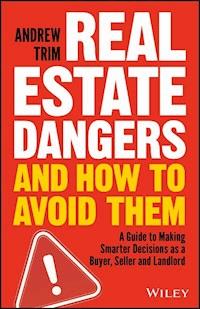
Essential information for anyone with property Real Estate Dangers and How to Avoid Them is a must-read guide for anyone thinking of buying or selling property, or becoming a landlord. Whether you're looking for your dream home, to sell a property, or to invest, flip or rent out an existing investment, this book is packed with the insider information you need to avoid getting ripped off. By shining a light on the flawed and unnecessary aspects of the real estate industry, this book will help you make smarter decisions based on knowledge rather than "advice," saving you time, money and headache. Stories of those who have seen the dangers highlight the ways in which this outdated system takes advantage of first-timers and experienced investors alike--and expert guidance shows you how to steer clear of the traps and pitfalls lurking around every transaction. Nearly everyone will have their hands in real estate at some point, and the real estate industry can be intimidating--after all, you rarely make financial transactions this large. But the truth is that the industry can be quite simple and can go quite smoothly, if you eliminate the distractions and focus on making smart decisions. This book shows you the real truth about the industry, helping you: * Avoid the traps that rip off buyers and sellers * Make smart decisions, minimise financial risk and let the system work for you * Identify unnecessary add-ons and bogus charges * Learn the tricks of the trade so you can save your money * Become a smarter landlord and attract quality tenants. With clear, no-nonsense advice for buyers, sellers, landlords, and flippers, Real Estate Dangers and How to Avoid Them arms you with the knowledge you need to succeed in the property business.
Sie lesen das E-Book in den Legimi-Apps auf:
Seitenzahl: 272
Veröffentlichungsjahr: 2018
Ähnliche



















This book will serve as a great reference to anybody within the real estate market. As a typical real estate owner who neither buys nor sells very often, I believe this very impressive book will no doubt help a great deal of people like me. Very comprehensive in nature, yet not cumbersome with industry jargon. A terrific read from start to finish.
— John Scattergood, real estate consumer
Andrew Trim is a real estate expert, a successful business owner and a property investor. Andrew’s book, Real EstateDangers and How to Avoid Them, will undoubtedly save property sellers, buyers and investors hundreds of thousands of dollars collectively. Andrew not only points out real estate’s greatest dangers, but he also offers advice on how to avoid falling victim to those dangers. This is one book you’ll be glad you read!
— Gary Pittard, CEO, Pittard, and author of Why Winners Win
Andrew Trim has written this insightful book to share his extensive knowledge of proven strategies to avoid real estate’s most common dangers. In my 25 years as a property manager, I have not seen many written resources for the landlord. The section on property management gives readers practical knowledge with proven strategies on how to protect their investment property. This book is an excellent resource for property sellers and investors alike.
— Tracey Lake, property manager for 25 years
REAL ESTATE DANGERS AND HOW TO AVOID THEM
A Guide to Making Smarter Decisions as a Buyer, Seller and Landlord
ANDREW TRIM
First published in 2018 by John Wiley & Sons Australia, Ltd 42 McDougall St, Milton Qld 4064 Office also in Melbourne
© John Wiley & Sons Australia, Ltd 2018
The moral rights of the author have been asserted
All rights reserved. Except as permitted under the Australian Copyright Act 1968 (for example, a fair dealing for the purposes of study, research, criticism or review), no part of this book may be reproduced, stored in a retrieval system, communicated or transmitted in any form or by any means without prior written permission. All inquiries should be made to the publisher at the address above.
Cover design by Wiley
Cover image © milmirko/iStockphoto
Disclaimer
The material in this publication is of the nature of general comment only, and does not represent professional advice. It is not intended to provide specific guidance for particular circumstances and it should not be relied on as the basis for any decision to take action or not take action on any matter which it covers. Readers should obtain professional advice where appropriate, before making any such decision. To the maximum extent permitted by law, the author and publisher disclaim all responsibility and liability to any person, arising directly or indirectly from any person taking or not taking action based on the information in this publication.
For my girls — Bev, Holly, Chloe and Alexandra. Thanks.
CONTENTS
ABOUT ANDREW TRIM
ACKNOWLEDGEMENTS
INTRODUCTION
The real estate industry
Remuneration matters
The franchise dilemma
Notes
PART I BECOMING A SMART SELLER
CHAPTER 1 THE IMPORTANCE OF PRICING
The digital footprint
The multiple agent digital footprint
Dangers in establishing a market price
Waiting for the market to improve
Know why you want to sell
CHAPTER 2 THE TWO LIES
The endowment effect
Listing potential sellers
The improbable lie
The lie of omission
The agent’s responsibility
CHAPTER 3 CHOOSING AN AGENT
How agents get listings
Hiring the wrong agent
Identifying the right agent
Team versus individual
Current trends
Multiple agents
Dismissal guarantees
CHAPTER 4 THE METHOD OF SALE
The problem
Selling strategies
Flawed strategies
The final deception — pricing and online marketing
The Smart Sale Strategy
Unusual properties
Notes
CHAPTER 5 SMART MARKETING DECISIONS
The cost of advertising
The quality of marketing
Note
CHAPTER 6 PRESENTATION AND RENOVATION
First impressions count
Staging
The danger of over-capitalising
Flipping
Inspection methods
CHAPTER 7 NEGOTIATION
Knowledge is power
How to negotiate the best price
Selling before buying — keeping the power
Renegotiating after inspection
Short of full disclosure
Final negotiating tips
PART II BECOMING A SMART BUYER
CHAPTER 8 PURCHASING DANGERS
What to be aware of
CHAPTER 9 NEGOTIATING THE RIGHT PRICE
Weak negotiation tactics
Smart negotiation tactics
CHAPTER 10 THE PURCHASING PROCESS
First home buyers
Mortgage insurance
Buying at auction
Buying off the plan
Buyer’s agents
Vendor finance
PART III BECOMING A SMART LANDLORD
CHAPTER 11 THE SMART INVESTMENT PURCHASE
Know your purpose for investing in property
Growth and return
Buying on trend
Rental guarantees
Buying off the plan
Government schemes
Investment clubs and gurus
CHAPTER 12 BEING A LANDLORD
Early repairs
Insurance
Smoke alarms
Finding a tenant
Furnished or unfurnished?
Pets
Keeping a good tenant
Start right
Managing properties
Management structures
Choosing an agent
What to expect
CHAPTER 13 SELLING AN INVESTMENT PROPERTY
A voluntary sale
A forced sale
Which agent?
CONCLUSION
REFERENCES
INDEX
Wiley End User License Agreement
Guide
Cover
Table of Contents
Introduction
Pages
i
v
vi
vii
xi
xiii
xiv
xv
xvi
xvii
xviii
xix
xx
xxi
xxii
xxiii
xxiv
1
3
4
5
6
7
8
9
10
11
12
13
14
15
16
17
18
19
20
21
22
23
24
25
26
27
28
29
31
32
33
34
35
36
37
38
39
40
41
42
43
44
45
46
47
48
49
50
51
52
53
54
55
56
57
58
59
60
61
62
63
64
65
66
67
68
69
70
71
72
73
74
75
76
77
78
79
80
81
82
83
84
85
87
88
89
90
91
92
93
94
95
96
97
98
99
100
101
102
103
104
105
106
107
108
109
110
111
112
113
114
115
116
117
118
119
120
121
122
123
124
125
126
127
129
131
132
133
134
135
136
137
138
139
140
141
142
143
144
145
146
147
148
149
150
151
152
153
154
155
156
157
159
161
162
163
164
165
166
167
168
169
170
171
172
173
174
175
176
177
178
179
180
181
182
183
184
185
186
187
188
189
190
191
192
193
195
196
197
198
199
201
203
204
205
206
207
208
209
210
211
212
213
214
215
216
ABOUT ANDREW TRIM
Andrew Trim began his real estate career in 1992 after competing at the Barcelona Olympics in the sport of kayaking. Although his Olympic career continued through the Atlanta and Sydney games, where he medalled in both, he continued to take an interest and be involved in property.
Combining his athletic training with study and real estate coaching, Andrew continued to grow his expertise in residential property.
Andrew purchased his first real estate business, Johnson Real Estate, soon after the Sydney games. It was a small team of five people, including one who remains as one of his business partners today. In 2007, Andrew led his business to win ‘Office of the Year’ at the Australasian Real Estate Awards.
Since then, Andrew’s company, now called The Johnson Real Estate Group, has thrived and grown to incorporate multiple sales offices and an exceptional property management business that operates across south-east Queensland. In a business known for its high turnover of staff, it is a credit to Andrew’s leadership that many of his staff have been with him for more than 10 years.
Andrew is currently the managing director of The Johnson Real Estate Group. With his passion for high performance and ethical business practices, he is a key speaker at many sales, management and leadership conferences.
ACKNOWLEDGEMENTS
Writing a book is an onerous task and the inspiration and support come from many places.
Firstly, thanks to my original real estate mentors, Gerald Crowe, Michael Johnston, Kerry Rowley, Neil Jenman and Gary Pittard — without all of you, my life would be very different.
To my leadership team and their partners: nothing happens without your support and energy. Jeff and Peta, Chris and Janelle, Peter and Vi, Tracey and Tony, Adam and Jess: thanks for your faith and belief in what we are endeavouring to achieve. Along with Lisa and Kean I look forward to changing the real estate world with you all.
Some great real estate leaders across Australia have inspired me over the years: Frank Pike, Chris Martin, Andrew Pennisi, Michael Meakin, Paul Kounnas, Adam McMahon, Cate Killiner, Paul Wrigley, Barry McEntee, Michael Kies, Todd Pearce, Sue Pearce, Peter Dunn, Leo Gurney, Ben Price and all the other wonderful real estate people I have learned from over the years. Peter O’Malley, your deep thinking regarding our industry has inspired me for years — thank you.
The two coaches who impacted my life more than most — Jim Murdoch and John Sumegi — and Dan Collins, my brother in so much more than sport: thanks for the lessons on discipline and belief, the losses and the victories.
To my three editors, Gail Tagarro, Sandra Balonyi and Gihan Perera, thank you for your efforts and professionalism. To my secretary, Helen — thanks.
Mum and Dad, you always had a home full of love, as well as books. My love of books started with yours.
Lastly to Bev, thanks for all those years where there was never a complaint as we worked to build this wonderful life of ours.
INTRODUCTION
Real estate, like many other industries, experienced a digital revolution with the advent of internet advertising. The way buyers researched, enquired and bought property changed rapidly within a couple of years, as did the way landlords searched for tenants.
What haven’t changed are the fundamentals of a real estate agent’s job. Agents are still responsible for representing their clients — property sellers and investment property owners — and maximising their returns with minimal risk. This is a responsibility that many in the industry take seriously.
Unfortunately, not everyone involved in the real estate industry sees it this way. Plenty of agents and many of the associated businesses that hang off real estate’s success see it as an opportunity to make easy money through unnecessary add-on charges and costs. It seems that everybody wants a piece of the real estate pie.
There is also a lamentable lack of investment in staff training and education by real estate agent agency owners, especially considering the value of the asset agents are responsible for selling or managing.
This book attempts to explain why selling, purchasing and managing residential real estate is so fraught with danger, and answers some key questions about the industry — for example:
What are the flawed systems and procedures that have survived the digital revolution?
What are the hidden dangers the internet has created?
Why is there such a lack of investment in training and education within the industry?
The book also provides advice and some simple, effective strategies to avoid real estate’s inherent dangers. Examples of real-life scenarios are used to highlight the dangers exposed in the book; however, names have been changed to ensure the privacy of individuals.
Real Estate Dangers and How to Avoid Them has been written for the typical Australian residential property owner and investor whose home is their castle and whose investment property is their retirement. Having had the courage to invest in real estate, they deserve to receive every last cent from that investment.
The real estate industry
Australian real estate agents have an approval rating slightly above that of used-car salespeople and slightly below that of politicians. As an industry, real estate is regarded as untrustworthy and dishonest.
What makes this so hard to believe is that most people know, are related to, or know someone who knows an agent. When asked, they say these agents are genuine, honest and reputable.
So why the disparity between the genuine, honest individuals and the industry as a whole?
The disparity lies in the fundamental processes and systems of real estate — in the industry’s DNA, if you like.
Two main factors affect the real estate industry’s integrity and reputation:
how salespeople are remunerated
the methods and strategies used by real estate agencies to sell and manage property.
A real estate business competes for two key clients: the property seller and the property investor.
For sellers, the choice of salesperson, their associated agency and its adopted methods of business are the keys to their real estate experience.
For investors, property managers hold the key to a successful experience. While holding similar accreditation to a sales agent and being regarded as part of the real estate industry, they stand apart. Property managers face vastly different challenges and judgements from those of the sales industry and will be discussed extensively in Part III ‘Becoming a smart landlord’.
Remuneration matters
Unfair remuneration of salespeople is an ongoing issue in the real estate industry. The low base pay and associated commission structures make real estate different from all other sales professions.
SMART TIP
In real estate, the income of salespeople is directly correlated with their results.
In most industries and careers, workers are paid for hours attended and work completed. But in real estate, the income of salespeople is directly correlated with their results.
There are fair and reasonable ways of doing this — it’s how salespeople in other professions are mostly remunerated. But in real estate, most salespeople are paid on commission only — or a close variation — because principals of residential sales offices have no desire to pay salespeople before the sale is made.
EXAMPLE
Channy recently applied to join a major franchise. She was offered $650 a week, payable in advance. However, Channy would have to repay this from the commission she received from sales. This is a debit and credit system: the longer she goes without making a sale, the more debt she accumulates.
Various forms of limiting pay have crept into the industry. A recent example involves paying an hourly rate and then capping the number of hours worked per week. This helps principals limit outgoing wages, while knowing very well the employee will work extra hours without pay to try and make the required sales.
Commission only — that is, zero pay until a property is sold and settled — is generally reserved for the more experienced agents. Some agencies employ salespeople on a subcontract model, paying very high percentages of commission while the salespeople pay all their own expenses.
Regardless of the specific structure, if the base salary is not enough for survival (or worse, is repayable), the salespeople face the same issue: the longer they go without making a sale, the more the bills add up. No income doesn’t mean no living expenses! Mortgages must be honoured, school fees paid, families fed and a myriad other expenses met.
After entering the real estate industry, new salespeople must wait a minimum of three months — and, more likely, six to nine months — before they start to see regular income through sales results. And to achieve results in this time frame, they also need good training and education, and that’s rarer than you would imagine. Six to nine months is a long time to live on a minimal income.
So how do real estate salespeople react in these circumstances? They begin to make unethical choices and compromise their integrity in order to survive.
Professional real estate salespeople should have only one consideration when selling a house: ‘What is best for my client?’ The client — generally the property seller — is the person paying for the service (buyer’s agents, who are paid separately, are addressed in chapter 10).
SMART TIP
Often the agent’s aim is to minimise the risk to themselves, not their client.
Real estate agents have a responsibility towards their clients, and that should never be forgotten or compromised. They are being trusted with, and are responsible for, selling what is often the owner’s largest asset. It is the agent’s responsibility to work in the best interests of their client, selling the property for the highest possible price in the current market, with as little financial risk as possible and within the owner’s time frame.
Often, however, the agent’s aim is to minimise the risk to themselves, not their client. Money is getting tight and the bills are adding up, so what does the salesperson with little or no income do?
Like many who end up in this unenviable position, they begin making decisions based on their personal situation. The client is no longer the number one priority: survival is. In Maslow’s hierarchy of needs, survival will always come first. It’s human nature in its most primal form.
If a portion of the real estate industry is a dog-eat-dog environment, it becomes a fight for survival. Often, it’s the hard-nosed individuals who survive, and the fair-minded people (who put their clients’ needs first) who get chewed up and decide to leave.
This explains the exodus of good people from the real estate industry after a short stint. They don’t like the person they need to become to make it in the traditional, commission-based models.
Is it any wonder that, according to the REIQ, the real estate industry loses around 90 per cent of its new salespeople within 12 months?1
If the traditional real estate pay structure creates such a volatile workforce, why do agencies continue to use it? Any human-resource expert will tell you that workforce stability is a prerequisite for a successful business.
The industry persists with this clearly flawed model of pay because a vicious cycle has been created — a cycle that starts with the 90 per cent. Nine out of 10 people who start today in real estate will not be in the industry this time next year. There are very few, if any, careers matching this churn rate.
Real estate business owners rely completely on their salespeople to generate cash flow for their sales business. When new salespeople have a 90 per cent chance of failing over their first 12 months, owners believe they can’t pay them reasonable salaries and survive.
As a result, the commission-based model of pay for real estate salespeople survives in its various guises. The theory is, ‘If I only pay you when you generate a commission, you are costing my business nothing’. It’s important to note, even with the raised minimum wage from the 2018 Fair Work review, the debit/credit system of pay remains untouched.
Many people entertain the thought of selling houses as a profession. They watch the TV shows, have dealings with agents and think, ‘I can do better than this’. Friends and family tell them they would be great — so they decide to give it a go.
However, even with newly-legislated increases in the minimum wage, the first thing they discover is how much effort is required for the low base salary. ‘Forget the salary’, they are told. ‘Good money can be made through commission.’
Deciding to continue, they complete their licensing commitments. Although this is more difficult in some states than others, becoming qualified to sell houses is a relatively simple process. You complete a basic course on legislation and learn some rudimentary skills, and then — shazam! Like magic, you are supposed to be a fully fledged real estate salesperson, ready to enter the heady world of selling houses.
SMART TIP
There are many new salespeople within the industry … working incredibly hard and getting little or no support.
New recruits quickly realise there isn’t much ongoing training or support. Often, their first day involves getting a desk, a phone and best wishes. They may have corporate sales programs thrown in if they’re lucky, but that’s about it.
Left to fend for themselves, they struggle to make headway in a tough, competitive industry.
Why isn’t there more support?
The business owner, aware of the 90 per cent dropout rate, doesn’t want to invest any resources until the new salesperson has proven themselves. Money, time and energy spent on training, guiding and mentoring are wasted (so they think). After all, if they won’t be there next year, why bother?
Consequently, there are many new salespeople within the industry with little to no training, remunerated on a commission-based model (or a close variation), working incredibly hard and getting little or no support.
EXAMPLE
Channy, who works for a major franchise, is a classic example. After six months in the industry, she was moved into a commission-only model. She doorknocked for new clients every day for the next six months and earned a total of $3000. That’s $500 a month.
Earning a little more than $100 a week, her options for survival were limited. She could embrace the ‘get business at any cost’ culture or leave the industry, joining the other 90 per cent of now-disillusioned starters.
Over a long period, this has become one of the systemic problems within the real estate industry. New, unskilled and untrained people are paid very little and must compete in an industry over-supplied with agents.
Over time, systems and methods have developed within the real estate industry to help unskilled and untrained agents survive. Two classic examples (which are discussed in chapter 2) are the lies agents tell sellers — or facts they omit to tell sellers — about the likely sales price they will achieve.
There are countless good people in real estate working within defective and dysfunctional systems. Once they become aware of these flaws and deficiencies, many of them leave.
That’s why, according to a 2017 Roy Morgan poll,2 for the past 15 years the real estate industry has sat unchanged at a 9 per cent approval rate. In other words, fewer than one in 10 Australians think real estate agents are honest and ethical.
Nevertheless, some real estate businesses trading in Australia offer their salespeople genuine salaries (not held against future commission) with bonus structures. These businesses believe in their people. They invest in great training and provide daily support and mentoring. They are often independent agencies — but not always, with many individual businesses from within major franchises adopting this strategy.
Quality, stable teams are a hallmark of a good real estate company.
The franchise dilemma
Most real estate principals are owners of a small business with low margins. They are no different from the thousands of other small business owners driving the Australian economy. Although they may trade under a large, recognised franchise name, the franchisors don’t pay the bills. In fact, they add a layer of costs that can significantly cut into the business profits.
Many of these owners must pay a percentage of their gross turnover to a franchise, regardless of their profit margin, even if the business trades at a loss. Business owners are even encouraged to take out insurance to ensure the franchisor is paid. This is a terrific model for the franchisor, but pretty tough on the small business owner!
It makes sense that any organisation will maximise its revenue wherever possible. If a franchise is paid on the turnover of its clients, its methods and systems will be designed to increase revenue, not necessarily profits.
In the industry, this leads to two things: increased marketing costs (borne by the seller) to raise the profile of the franchised business, and methods of sale that promote a sale at any price.
In Australia, thousands of dollars in equity vanish every day through unnecessary and expensive advertising, poor pricing tactics, even poorer agent negotiation skills and the wrong method of sale.
There are many trustworthy and honest people throughout the real estate industry who mean well but continue to use these methods. It’s how they’ve been trained and it’s what they expect. Unfortunately, for the real estate consumer it’s also what they have come to know and expect from agents.
But there is an alternative. It’s all about making smart decisions.
In part I we will discuss how to make smart selling decisions, including pricing; choosing an agent and a method of sale; marketing; and negotiation. Part II will make you aware of purchasing processes and dangers; and in part III we look at the potential pitfalls associated with being a landlord, including buying and selling an investment property.
Notes
1
REIQ (Real Estate Institute of Queensland) licence course, 30 August, 2016.
2
Roy Morgan Poll, 8 February, 2017.
PART IBECOMING A SMART SELLER
CHAPTER 1THE IMPORTANCE OF PRICING
There are four steps to selling a property:
choosing a real estate agentsetting the pricemarketingpresenting the property.Ideally, all four are in place and combine for a positive result.
However, getting the right pieces in the right places is not always easy. It is here where the danger of significant financial loss for the property seller looms larger than in any other part of a real estate transaction.
If the four steps don’t all fall into line seamlessly, will three out of four lead to a good result?
Sometimes.
With a good agent, marketing and the right price, even a property that has been trashed will most likely sell.
SMART TIP
There are real dangers in overpricing a property.
But the right price is critical. If the price is wrong, you won’t get the sale — even if the other three pieces are a perfect fit. An overpriced property — even if it is advertised on the front page of every major daily newspaper, or placed at the top of every page on every real estate website in the country — won’t sell. There are real dangers in overpricing a property.
The digital footprint
Before the internet, properties were mainly promoted via newspaper advertisements, flyers, signs and agents’ windows. These locations had a remarkable and often overlooked advantage over modern forms of advertising: they left no easily traceable marketing or sales history.
There is an old saying: ‘Nothing is as useless as yesterday’s newspaper’. In the newspaper age, a property owner could dip their toe in to test the waters. If they didn’t like the result, they would take the property off the market or reduce the price. With no digital footprint, there was very little long-term harm to the property value. The marketplace quickly forgot.
Now, the rules have changed: the internet records everything and forgets nothing.
Properties advertised in Australia appear on several real estate marketing websites, including the two majors, which advertise almost all properties for sale in Australia: realestate.com.au and domain.com.au.
CoreLogic is the largest supplier of property information in Australia. Major online advertising portal realestate.com.au routinely shares all advertising and known property information with this major data collection company. All property information from these two sites is stored in perpetuity, and is easily accessible.
Before the internet, the only indication a property had been on the market for an extended period was a faded card in a real estate window or a crooked, worn sign in the front yard. Once these were removed, the attempt to sell faded quickly from the marketplace’s collective memory.
That’s no longer the case. The internet creates a digital footprint: a visible record of a property’s advertising and pricing history.
SMART TIP
The internet records everything and forgets nothing.
A digital footprint intensifies the danger posed by an extended marketing period. If a property is launched on the main real estate websites at an inflated price and doesn’t sell, this can cause significant damage to the property’s recorded history — and thus the eventual selling price.
The market price is now partially driven by the digital footprint, and any attempt to beat the market is risky. In the past, it was sometimes possible to ‘jag’ a buyer at a high price. But this is a dangerous strategy in the digital age, and it can easily backfire and drive down the final selling price by creating an adverse digital footprint.
Many websites provide easy options for buyers to explore information that was previously hidden. On realestate.com.au, one click shows the number of page visits, giving a buyer an early idea of a property’s time on the market and desirability. The CoreLogic homepage for agents is one click away from showing all listings that have been advertised for more than 60 days. Agents use this to find owners who may be fed up with their current agent and are ready for a new start at a new price.
This is a powerful resource for the agent, and many property sellers don’t realise their every move is being tracked — and those moves are easily accessible to buyers.
The majors are not the only websites offering buyers property information. Countless others offer buyers the chance to find a bargain: oldlistings.com.au, for example, has a complete digital footprint on properties marketed in Australia — for example, a unit for sale in Essendon, Victoria, had nine different marketing campaigns over a 10-month period, with every detail recorded, including its various prices. This is valuable information for a buyer considering buying this property.
Buyers have a wealth of knowledge available at the click of a mouse — and, in negotiation, knowledge is power.
This knowledge helps buyers answer questions such as:
Has it sold in the past?
For how much?
Did it get passed in at auction?
Why hasn’t it sold?
Why have so many people looked but not bought it?
Why did it get withdrawn from sale?
Having answers to these questions increases a buyer’s negotiating position.
As Peter O’Malley says in his book Real Estate Uncovered, ‘All this public information is forming a “pseudo credit rating” for your property’.
Agents encourage owners to increase their digital marketing spend on property websites by pointing out that a premium advertisement — costing thousands — will, compared to a stan-dard advertisement, increase the number of views (for a full explanation see chapter 5).
But increased views don’t necessarily mean a better price. As a rule, the more a property is viewed, but not purchased, the more the price drops.
Why is this?
To genuine buyers, an ever-increasing number of views indicates a longer time on the market. Time on the market leads to questions that lead to certain perceptions:
Why hasn’t this sold yet?
Plenty of people have looked at it. I wonder what’s wrong?
Is it the price or is it the house?
The perception of an unwanted property comes from exposure — excessive views are one of the most direct and visible forms of exposure. To a property’s price, it is akin to sunburn: the greater the exposure the greater the pain. When selling property, the pain comes in the form of a lower selling price.
SMART TIP
The greater the exposure the greater the pain. When selling property, the pain comes in the form of a lower selling price.
Real estate consumer advocate Neil Jenman used to describe properties that stayed on the market for a long time as




